Leo Kottke and Mike Gordon brought their acoustic duo tour to Troy Savings Bank Music Hall on Wednesday December 15. The venue has been a sought after performance destination by various artists since the 20th century. The original padded wooden seats help absorb a layer of sound. Listeners in even the deepest seats hear the effect of the entire room. Leo & Mikes acoustic bass and guitars resonated just right into acoustic ear candy at the performance on the Hudson.
Photo by Dave Decrescente
The visual and historic appeal of the Hall must not be overlooked in any discussion of its acoustic character. The ear and the eye are inseparable in the concert-going experience in Troy. The room with equivalent acoustics could not sound as good without also being visually vibrant.
Mike Gordon took note of the Hall’s history on his Instagram by saying
Classical performers consider this room to have the best acoustics in the country. I can’t believe I get to share a chair with Leo Kottke to play in it tonight. Heavenly.
Mike Gordon
Photo by Dave Decrescente
There is even a black and white shot of Leo on the Halls walls from 1996 along side all the other great performers to grace the stage. Leo took lead on alot of the numbers through out the evening. Mike had the best seat in the house next to Kottke as he listened with audience to his various tales coming off the band stand. Mike did jump in front for a cover of Hank Williams Jr “Old Habits”.
I hope you don’t mind how lost I am. I’m just having a real good time up here.
Leo told the crowd of American modernist composer Charles Ives and his struggles to get his work out. Overtime he hired Burlesque dancers to enhance attention on his Concord Sinata 2. After becoming acknowledged for his work someone told Ives over time… “I can tell it’s good music but it doesn’t sound very good” Ive’s reply:
Whats sound got to do with music?
Charles Ives
Troy Savings Bank Music Hall
Leo also read a passage of Sunday Morning by Wallace Stevens to the Troy Music Hall crowd.
All Pleasures and all Pains, remembering the bough of summer and the winter branch. These are the measures destined for her soul
Wallace Stevens
Photo by Dave Decrescente
The duo covered a lot of material from their 2020 Album Noon. They also brought the crowd back to their first album collaboration Clone by performing “From Pizza Towers To Defeat” In true Leo fashion the duo sat through the encore so that “we could all leave the room at the same time” They finished with “Invisible” off their Sixty Six Steps album.
The duo truly gave a history lesson on the shores of the Hudson. They split the bill down the middle in Troy for an evening of composition, and improvisation. The live performance that unfolds in front of you is credited it to the moment that we all can share in before leaving the room at the same time. The tour concludes in Plattsburgh’s Strand Theater on Sunday December 18 2021. The venue is 2.5 miles from where Mike performed at the Cilfford Ball in 1996.
Leo Kottke & Mike Gordon, Troy Savings Bank Music Hall, December 15 2021:
Set List: Rings, Living in the Country, Tiny Island, Old Habits, The Last Steam Engine Train, Airproofing, Ojo, You are My Flower, Twice, Flat Top, From Pizza Towers to Defeat, Invisible
Originally from Hauppauge, Melanie Chirignan is a flautist known for her musicality and versatility of repertoire. Her eclectic tastes have led Melanie to collaborate with many different performers and ensembles.
Melanie earned her Bachelor’s in Music Performance and Music Education graduating magna cum laude from SUNY Fredonia and her Master’s degree in Flute Performance at the Hartt School. She has taught general music, chorus, and orchestra, and has taught every level from elementary school to conservatory level students. Melanie has taught workshops on the “Origins of South American Folk Music” through Hartford Performs, with Alturas Duo. An adjunct faculty at the College of Saint Rose, she is also a member of Quintocracy, who are artists in residence at Troy Savings Bank Music Hall.
RRX: Many people take classical instrument lessons when they grow up, few pursue it, and you have. And not only have you beat the odds, you’re pretty much one of the people boosting the odds for others. How do you think you were able to beat the odds and wind up with a classical career?
MC: Wow, thank you for the huge compliment. Well, everyone that sticks with music at all has some talent, so that’s not it. I treat it like a job because it is, and I persevered and practiced a lot for many, many years. Also, I really love chamber music. Concerts are the highlight of the month, so I make sure to keep scheduling things. When I find a piece I want to play, I find the players, and create an event. I keep finding pieces I must play, and so it goes on.
RRX: You are a flautist, which for the uninitiated, means you play the flute. You also play piccolo and alto flute. I think many people, including our readers, might be hard-pressed to tell the difference between these based on sound alone. How would you describe the differences in these three instruments?
MC: The piccolo is smaller and requires much more precision than the flute. It’s like it has a smaller bullseye, and the tiniest lip movement or change in air speed will be heard. It is an octave higher and can really sing out over an entire orchestra. It’s small but mighty. The alto flute is much bigger than the flute. It has a more hollow, mellow sound than the flute. Many people like the alto flute best because they find the more diffuse tone pleasant. I like the flute best because of the bigger dynamic range (it can play louder and softer than alto flute) and I like its richness, how it has more harmonics in the sound.
RRX: You’ve played in so many places, including, but certainly not limited to the Smithsonian Museum of Natural History, Albany Pro Musica, Glens Falls Symphony Orchestra, Troy Savings Bank Music Hall, and Proctors. If all the places you’ve played were in a lifeboat, it would sink. Describe one that has a special meaning to you.
MC: The Troy Savings Bank Music Hall is so acoustically perfect; it is literally awe-inspiring. The sensation is that the hall supports your sound and helps you play your best. This is why the hall has such an internationally known reputation. For me, I’m so thrilled to have a residency there with my wind quintet Quintocracy, and Jon Elbaum and the staff are so great to work with-those things help make it stand out as outstanding to me too.
RRX: We are used to covering the more rock ‘n’ roll side of things. And we do so because it’s not just a music, it’s a story. Insane tours, bar fights, Egos left and right. But classical is different. It seems closed off, hermetically sealed from drama. Is it? Are there adventures that go beyond the movements? Is the community just organized differently?
MC: I think for me, I try to take life’s drama and use it to play as musically as possible. I remember after my first heartbreak, my teacher told me to use those feelings to play, and we came back to Debussy’s Syrinx. Unlike pop music, classical musicians strive to never play the same phrase exactly the same. We come up with variations constantly, and so I think being attuned to the nuances that are your human emotions helps your musical expression. That being said, there is of course drama. Look at Mozart in the Jungle! Luckily, I got to be an extra in, and never experienced anything like that. Although we as classical musicians may look like we have it all together, my duo partner once forgot his pants-well his concert pants, he had jeans on.
RRX: The flute and the piccolo are woodwinds. Their drivers are breath. And unlike singing, which is basically simple to do but impossible to master, some feel that woodwinds are just impossible to do. And you’re performing for an hour or more sometimes, which makes it harder. Is there a breathing technique that makes it easier?
MC: You’re correct that the flute is a tough instrument for air usage. It wastes the most air out of all the winds because there isn’t a mouthpiece to blow into that is sealed. Air gets blown across and there is wasted air, unlike the clarinet, oboe, bassoon, or any brass instrument. However, you learn to be efficient with your embouchure (the shape of your mouth), and with your air. I think if you’re used to practicing for a couple of hours a day, then you just get used to the breathing, you’re trained for it and have that endurance built up. I think practicing yoga has helped me with body awareness and breathing. Since I’m small, I make sure my cardio game is strong, which also helps my flute playing. I remember my undergrad teacher telling me she started running a few months before having to play the Neilson concerto to build up her lung capacity.
RRX: You teach as an adjunct professor at Saint Rose, and privately. And you teach all levels, from elementary school to conservatory level students. When I hear “conservatory” I think, are there named levels of learning? What does a conservatory student learn that’s different from a student just below that level? Is it just gradual?
MC: A conservatory is different from a liberal arts education in that you’re only learning music. My extraordinary high school flute teacher, Michelle LaPorte, convinced me that I should go for a liberal arts education so that I would be a more well-rounded person. The idea is that being well-rounded would be reflected in your artistry as a more engaged, fulfilled listening experience. I think she was right, but I did go to a conservatory for my master’s degree to fine-tune my playing.
RRX: This is where you answer the question I didn’t ask. Longest breath? Pied piper’s type of flute? Educate, enlighten, emote – the floor is yours.
MC: We keep hearing that classical music is dying, but it’s not. It’s just being re-birthed in different, more creative ways. Groupmuse for instance, is an organization that facilitates people to have BYOB chamber music house concerts. It has launched and is thriving in many cities as well as internationally. Also, I think with more awareness, women composers and black composers that weren’t previously published or brought into the classical canon are beginning to. I think there’s some great changes ahead.
For more info on Melanie Chirignan and to subscribe to her mailing list, visit MelanieChirignan.org
For the first time in 16 years, guitarist Leo Kottke and bassist Mike Gordon will tour together, in an eagerly awaited series of dates in December.
Acoustic guitar legend Leo Kottke and Phish bassist Mike Gordon first linked up in 2002 for Clone, and followed by 2005’s Sixty Six Steps. The upcoming tour will celebrate last year’s release of the first new Kottke/Gordon album in 15 years, Noon, hailed by Rolling Stone as “full of lilting grooves that go on wild musical tangents.”
Read past interviews with Mike Gordon from 2013 and 2016.
The pair also today premiered a 4-song mini set, including performances of the Kottke song “Sheets” and “How Many People Are You,” which has found a spot in the rotation both with Phish and Mike Gordon Band. Both tracks are found on Noon, with Phish drummer Jon Fishman appearing on “How Many People Are You.” The set is rounded out with the Kottke classic “Rings,” and “Disco” from the duo’s 2002 release, Clone.
Leo Kottke and Mike Gordon December 2021 Tour Dates
December 8 – Munhall, PA – Carnegie of Homestead Music Hall December 9 – Washington, DC – Sixth & I December 10 – Tarrytown, NY – Tarrytown Music Hall December 12 – Beverly, MA – The Cabot December 13 – Lebanon, NH – Lebanon Opera House * December 15 – Troy, NY – Troy Savings Bank Music Hall December 16 – Norwalk, CT – Wall Street Theater December 17 – York, PA – Appell Center for the Performing Arts December 19 – Plattsburgh, NY – Strand Center for the Arts
All Dates go on sale Friday, October 8 at 10 am ET, except for Lebanon Opera House, which goes on sale at 12pm on Friday. More info can be found here.
Albany Pro Musica has announced their 2021-2022 season featuring new compositions, educational programming, and more.
The Albany Pro Musica are a preeminent choral ensemble based in New York’s Capital Region. They are known for their distinctive artistic style and of a wide range of musical genres. They are critically acclaimed for their performances of intimate a cappella pieces and large-scale choral works alike. They are led by Opalka Family Artistic Director Dr. José Daniel Flores-Caraballo. They reside at the Troy Savings Bank Music Hall.
Albany Pro Musica will be returning to the concert hall in 2021 after having a fully virtual 40th anniversary season last year due to the COVID-19 pandemic. This season will feature Broadway to Brahms with a little something for everyone. This season will feature the high level of artistry and creativity that is known from them. This season will feature new compositions, educational programming, and more.
Support for our 2021-2022 season comes from their marquee season underwriters: Isabel Bader, Al De Salvo and Rachael Thompson Biggs, in memory of Susan Thompson, Ellen Jabbur and Chet and Karen Opalk.
The season will start off with Cabaret Uncorked! on September 25, 2021 at 5PM at the Altamont Vineyard and Winery. The event will feature members of Albany Pro Musica, The John Sauer Trio, José Daniel Flores-Caraballo, and the Opalka Family Artistic Director.
On October 24, 2021 they will host their Let’s Talk About Love event at 3PM at the Troy Savings Bank Music Hall. The event will host Albany Pro Musica Concert Chorus, José Daniel Flores-Caraballo, and Opalka Family Artistic Director.
On December 19, 2021 at 3PM the The Many Moods of Christmas event will take place at the Troy Savings Bank Music Hall. The event will feature the Albany Pro Musica Concert Chorus and Orchestra Pro Musica, José Daniel Flores-Caraballo, and the Opalka Family Artistic Director.
On March 6, 2022 at 3PM the Rachmaninoff’s All Night Vigil event will take place at the Troy Savings Bank Music Hall. The event will feature Albany Pro Musica Concert Chorus, José Daniel Flores-Caraballo, Opalka Family Artistic Director, Elizabeth Eschen as mezzo-soprano, David Vanderwal as tenor, Elizabeth as Pitcairnand violin.
On May 8, 2022 at 3PM the Brahms’s Human Requiem event will take place at the Troy Savings Bank Music Hall. The event will feature Albany Pro Musica Masterworks Chorus and Orchestra Pro Musica, José Daniel Flores-Caraballo, Opalka Family Artistic Director, Laquita Mitchell as soprano, Michael Chioldi as baritone, and Marcos Daniel Flores-Caraballo on piano.
On August 8, 2022 at 3PM the Broadway Pro Musica! It will take place at the Park Playhouse in Washington Park. The event will feature Albany Pro Musica Concert Chorus and the Pro Musica Pops, José Daniel Flores-Caraballo, and Opalka Family Artistic Director.
The Troy Savings Bank Music Hall Corp. requires proof of vaccination for entry to all events at the Music Hall or any ancillary location. Those individuals unable to be fully vaccinated, including children under 12, must have proof of a negative Covid PCR test (taken within 48 hours of performance). TMH staff will check for proof of vaccination and negative Covid PCR tests at the doors as a condition of entry. Additionally, masking is required inside the venue for the duration of your visit. Patrons and employees will be required to wear masks, except while actively eating or drinking.
For more information on Albany Pro Musica 2021-2022 season visit their website.
The Summer Square Concert Series takes place in the Music Hall Courtyard every Friday and Saturday night in July and August, starting at 6 pm, and is free and open to the public with no tickets required. All performances are weather dependent, there is no alternate rain location.
The Troy Savings Bank Music Hall, a National Historic Landmark located at 30 Second Street, has been in perpetual use since its opening in 1875. World renowned for its near perfect acoustics, it has hosted performances by legions of world-renowned artists, from legends like Dizzy Gillespie, Ella Fitzgerald, Isaac Stern, Sergei Rachmaninoff, and Vladimir Horowitz, to the best on today’s contemporary music scene, including Joshua Bell, Andrew Bird, Steve Martin, Lyle Lovett, John Prine, and many others.
The Summer Square Concert Series will kick off Friday, July 9 with local Troy musician Jacob Shipley, an Alt/Folk artist whose influences run the gamut from Talking Heads to Phoebe Bridgers, Damien Rice to Lucius, and Halley’s Comet to the Decemberists.
On Saturday, July 10, Carol Daggs is welcomed back to the Music Hall Courtyard. She will be offering some tastefully arranged jazz standards and hip, groovy originals.
The two-time Grammy award-winning artist Patty Griffin and Grammy award-nominated singer-songwriter Gregory Alan Isakov have announced plans for the co-headline tour “An Evening with Patty Griffin and Gregory Alan Isakov.”
Marking the first live, in-person concert performances for both artists since early 2020, Patty Griffin and Gregory Alan Isakov will be kicking off their tour on October 5th. On the 14-date tour, they’ll make stops at Troy Savings Bank Music Hall and the State Theatre of Ithaca.
Patty Griffin and Gregory Alan Isakov
Patty Griffin is among the most consequential singer-songwriters of her generation, a quintessentially American artist whose wide-ranging canon incisively explores the intimate moments and universal emotions that bind us together.
Gregory Alan Isakov is a singer, songwriter, and performer, beloved by his devoted community of fans and critics alike. Since his debut, Isakov has released five full-length albums including his most recent, 2019’s Evening Machines, which was nominated for Best Folk Album at the 62nd Grammy Awards.
OCTOBER 5 – Knoxville, TN – Tennessee Theatre 6 – Chattanooga, TN – Tivoli Theatre 8 – Charlotte, NC – Knight Theater 9 – Saxapahaw, NC – Haw River Ballroom 11&12 – Alexandria, VA – Birchmere 13 – Charlottesville, VA – Paramount Theatre 15 – Troy, NY – Troy Savings Bank Music Hall 16 – New Haven, CT – Shubert Theatre 17 – Ithaca, NY – State Theatre 19 – Northampton, MA – Academy of Music 21 – Concord, NH – Capitol Center for the Arts 22 – Beverly, MA – The Cabot 23 – Portland, ME – State Theatre
Troy Savings Bank Music Halland WEXT present the UpLift Commission Series, faeturing local artists to participate. In collaboration with Organ Colossal, the Lift was curated and invited a small audience to sit on stage with artists while they performed.
The pandemic caused the program to end forcing staff at the Music Hall to find creative ways to keep it going. The Hall reached out to the Organ Colossal to find local community talent in the Capital Region. Each artist selected has contributed to their community throughout the years and their participation is another contribution. Their creations for this project reflect the mood of current times and each performance is honest and speaks to the changes music has faced over the year.
Upcoming UpLift Commission Series performances begin later this month. Indie singer based Upstate and Brooklyn,Belle Skinner, performs on Friday, April 23 at 7 p.m. Mother and son duo, sitarist Veena and tabla drummer Devesh Chandra perform on Friday, May 7. New York-based Puerto Rican singer, Taína Asili and guitarist Gaetano Vaccaro perform on Friday, May 21. The events are free and open to the public and links to performance will be released closer to the performances.
Troy Savings Bank Music Hallwas created in 1870 built on the upper level to show the bank’s appreciation to the local citizens for their support. In the beginning, the hall hosted performances from musicians nationally and internationally even during the World War II era. In 1979 the Troy Savings Bank Music Hall Revitalization Committee after Troy’s declined and had problems supporting the arts.
The Troy Savings Bank Music Hall Corporation came about through funding from the bank and from the city and county. It is a non profit organization and it leases the Hall from the bank. The Hall has a reputation for orchestra and chamber music. However with sound as its main priority, it became a venue with classical and modern music performances.
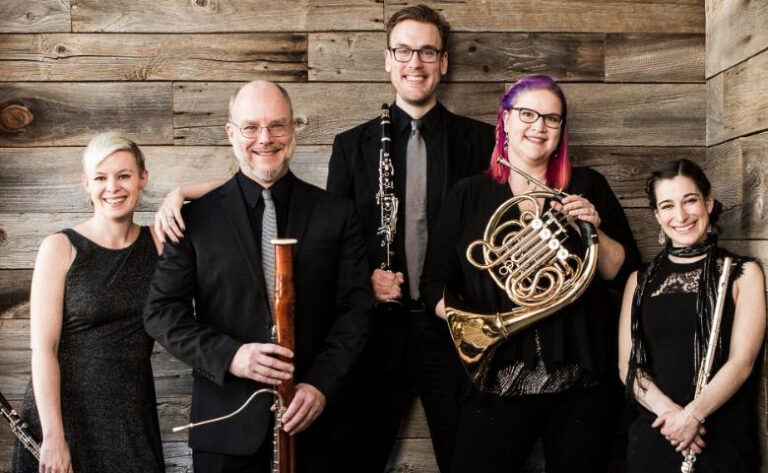
Capital Region based quintet Quintocracy has begun their new residency at the Troy Savings Bank Music Hall. Their first project with the Hall is a series of four concerts featuring women composers. All performances will be broadcast live from the Music Hall stage.
Coming together in 2019, Quintocracy was created with the goal of showing the beauty of chamber music to the masses. The group prides themselves on there unique live shows in which they instill a sense of community through their funny audience interactions. Members of Quintocracy have preformed at a wide array of New York based concert halls from the likes of Carnegie Hall to Lincoln Center. Quintocracy consists of Melanie Chirignan (Flute), Kelly Lockwood (Oboe), Michael Dee (Clarinet), Kathryn Svatek (Horn), and William Safford (Basoon).
The Troy Saving Bank Music Hall is a historic classic music hall located in the heart of Downtown Troy. The Hall of built out of what used to be a banking office, hence The Hall’s name, and has since been host to hundreds of music acts from around the world. Since the onset of the Covid-19 pandemic The Hall has pivoted to offering several online concert performances, postposing all live shows until further notice.
Teachers have been given the enormous and challenging task of teaching their students in person and, or virtually at the ready. Arts education has suffered during the pandemic. Tens of thousands of students would have visited any one of our venues for educational programming during this school year. Opportunities such Black Violin can straddle the disconnect of social distancing, support wellness and foster creative development and critical thinking.
Christine Sheehan, Director of Education at Proctors Collaborative
Black Violin normally consists of Wil Baptiste on viola and Kev Marcus on violin, but for the show DJ SPS and drummer Nat Stokes will join them. Together, the group describes themselves as a “classical Boom” because of their distinctive sounds of both classical and hip-hop.
Black violin has held strong for 16 years in the music industry. The pair gained notoriety for their mixture of modern tunes and vocals with old school orchestral music. Since their start, they have sold out headline concerts across the country at various notable venues. Performing around 200 shows, many have been for low-income students in urban communities.
“The stereotypes are always there, embedded so deep in our culture. Just by nature of our existence we challenge those ideas. It’s a unique thing that brings people together who aren’t usually in the same room, and in the current climate, it’s good to bring people together,” said Baptiste.
Capital Region teachers are able to register for the virtual event starting Jan. 5 on https://school.proctors.org/blackviolin/. Teachers who do want to participate will be given a study guide, link and access code prior to the show.