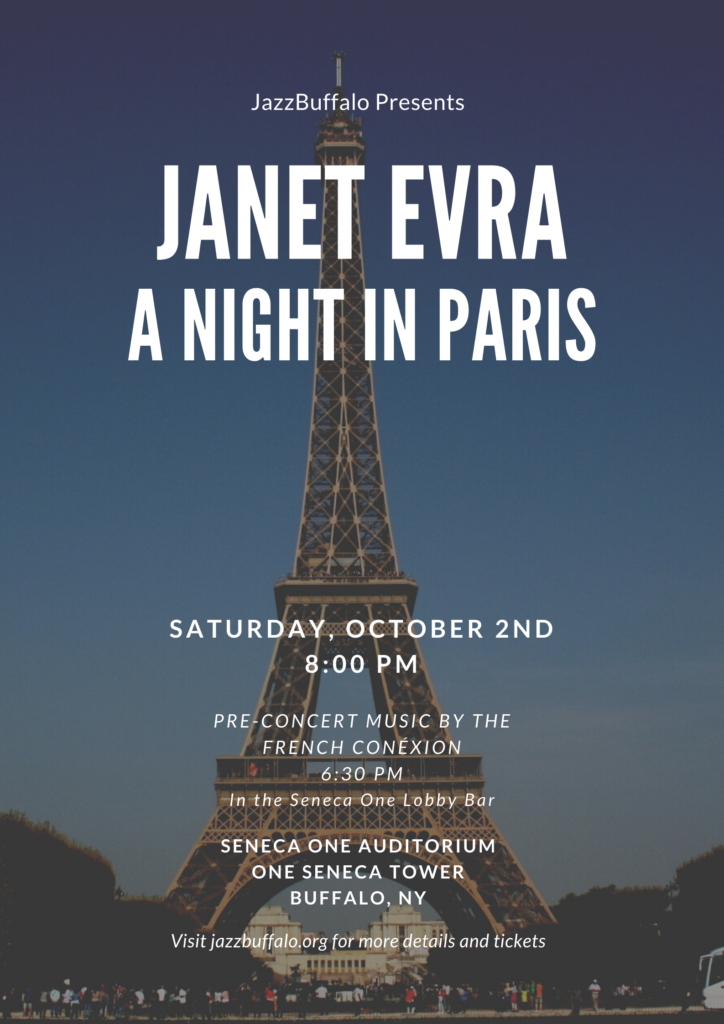
On October 2nd, Janet Evra performed her concert “A Night in Paris” to a sold out crow at the Seneca One Auditorium in Buffalo. This was a big moment for JazzBuffalo as it was their first use of the auditorium.
Photo by Samantha Rychlicki
Janet Evra along with guitarist Will Buchanan, sax and flutist David and drummer Tim Moore created a wonderful night of jazz that took the audience to Paris. Evra’s voice was soothing and pure. Plus, her ability to play the bass was equally as flawless.
With this performance, the audience at Seneca One was taken on a beautiful journey through songs by Miles Davis, Édith Piaf as well as Janet Evra originals. Those originals, Evra has been eager to play since pre-pandemic times. Tony Zambito, Executive Director of JazzBuffalo, said it best “The future of jazz is in good hands.”
Janet Evra and company provided an amazing night of music that was just what Buffalo needed.
Setlist: Comment te Dire Adieu, C’est Si Bon, Que Reste-t-il, Baila, Dream a Little Dream of Me, Solar, Paris, La Vie en Rose, Koop Island Blues, La Mer, Zou Bisou Bisou.
Photo by Samantha Rychlicki Photo by Samantha RychlickiPhoto by Samantha Rychlicki
Photo by Samantha Rychlicki
Photo by Samantha Rychlicki Photo by Samantha Rychlicki
Photo by Samantha Rychlicki
Photo by Samantha Rychlicki Photo by Samantha Rychlicki Photo by Samantha RychlickiPhoto by Samantha Rychlicki Photo by Samantha Rychlicki
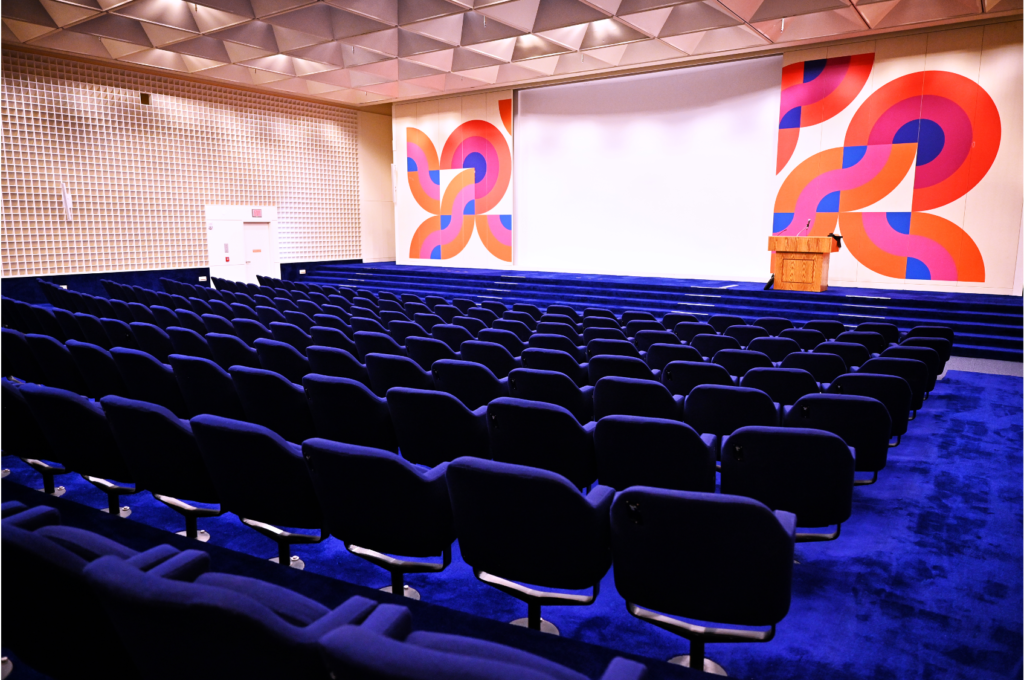
JazzBuffalo has announced an expansion of its partnership with Seneca One in its endeavors to further community outreach. Beginning Saturday, October 2 with a concert by international jazz artist, Janet Evra, the Seneca One Auditorium will serve as the new home performance venue for JazzBuffalo programming. Located in the revitalized Seneca One building, the venue offers spectacular views, audio, and comfortable seating for all.
The new Seneca One auditorium expansion | Courtesy of Jack Zuff
Accessible through the Seneca One Lobby, concert-goers for JazzBuffalo events will be able to experience the Seneca One Lobby Bar. The bar will enable pre-concert, intermission, and post-concert opportunities to gather with friends and family over drinks and food. The auditorium previously served as a business lecture auditorium dating back to the original Marine Midland Bank occupancy. However, efforts will be made to modify the stage for concerts. The Seneca One Auditorium seats approximately 230 and was carefully designed and constructed to serve as a high-quality acoustic facility, featuring acoustic walls and ceilings.
Seneca One Lobby
In an announcement from JazzBuffalo, the organization revealed it is seeking patrons interested in donating a baby grand piano to be used by performers during concerts. A fundraiser for obtaining a piano is also being considered. Seneca One and JazzBuffalo will hope for the community of jazz and music lovers to experience the auditorium and the new Seneca One Lobby Bar. Prior to the concert, the highly regarded French ConéXion will entertain in the Lobby Bar from 6:30 pm to 7:45 pm.
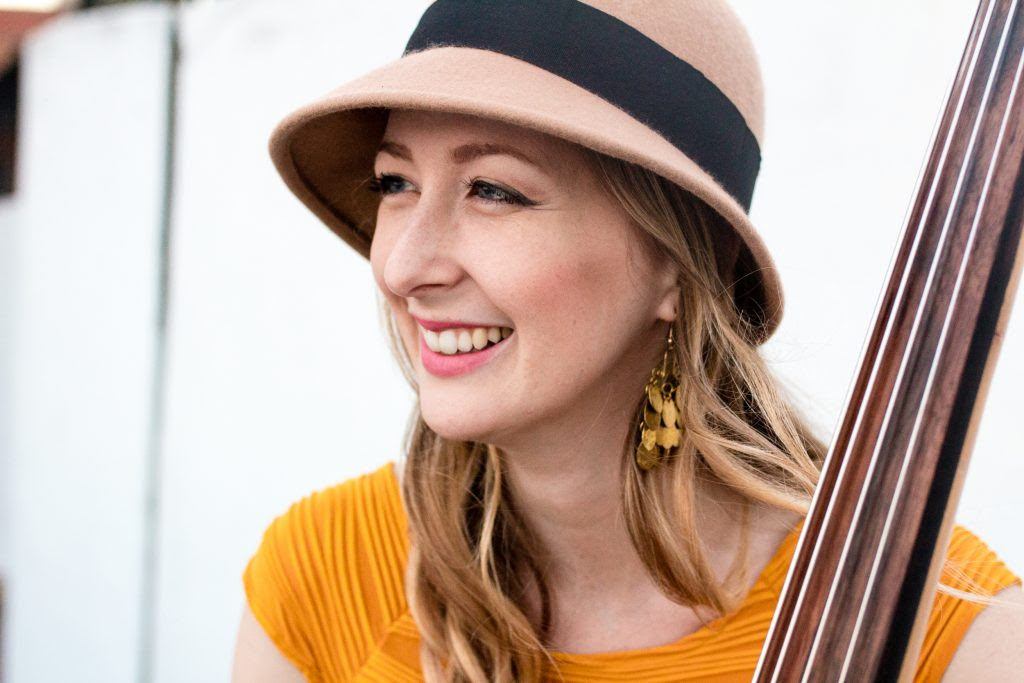
Janet Evra
Janet Evra is part of the emerging class of upright bassists and vocalists entertaining the world of jazz in clubs and festivals internationally. She performs on the premier international stage across the USA and Europe. She is known for her intoxicating interpretations of French jazz and Brazilian-influenced repertoire of traditional samba, bossa nova, and Latin jazz – all with an indie twist. Evra has also collaborated with Grammy winners and nominees as well as international jazz superstars: Taylor Eigsti, Randy Brecker, Eric Marienthal, Diego Figueiredo, and Chad Lefkowitz-Brown. Evra performs superbly in English, Spanish, French, and Portuguese. Her eclectic take on jazz beach-pop has also made her music a favorite on playlists across the globe.
Evra will be performing upright bass and vocals and will be appearing as a quartet featuring a stellar trio of musicians: Ryan Marquez (keyboards), Will Buchanan (guitar), and Tim Moore (drums). For more information and to purchase tickets to see the talented Janet Evra, as well as to experience the new home venue for JazzBuffalo yourself, visit Eventbrite.
Check out a video of Janet Evra singing her fan-favorite original song, “Paris”
America has an immensely rich culture of art in all its forms, spanning from the early years of the country through present day. Musicians, sculptors, painters, architects, illustrators and graphic designers give this nation a broad history of artistic accomplishment and appreciation that is found through all walks of life and every corner of the country.
We have heard for nearly a year about the plight of independent music venues and the #SaveOurStages campaign, seen musicians turn to virtual tip jars to make money while streaming performances on various platforms, and in some cases, venues have closed and musicians have moved on to other adventures. For all our love of the arts, there is no central advocate on the national level to ensure that we maintain and support those who use their talents to create a more vibrant world.
Art, freedom and creativity will change society faster than politics.
Victor Pinchuk
In Canada, the position of Minister of Canadian Heritage heads the Department of Canadian Heritage, which is responsible for culture, media, sports and the arts. This position was created on a quarter-century ago in 1996, and covers everything from the Canada Council for the Arts, to the National Arts Centre, National Film Board of Canada and the National Gallery of Canada, among other governmental organizations. With a minister (the Canadian equivalent of a Cabinet-level Secretary), Canada is able to further federal programs and funding that relate to Canadian identity and values, as well as cultural development and heritage.
England also has national office for Minister of the Arts, focusing on Culture, Communications and Creative Industries. Covering arts, media, museums, galleries, libraries and creative industries, the position has evolved since creation in the 1960s. Additionally, a Culture Secretary serves as Secretary of State for Digital, Culture, Media and Sport, was created in 1992 and has been dubbed ‘Minister of Fun,’ and much like their Canadian counterpart, covers arts and culture, libraries, museums and galleries, sports and tourism. Prime Minister John Major, who founded the office, said in his autobiography his autobiography, that prior to the office being created, the responsibility for cultural interests was shared among various departments, but specifically important to none of them. So a change was made to highlight the culture of the United Kingdom.
In America, the creation of a Cabinet-level Department of Arts and Culture could help save the live entertainment industry as we know it, and provide a centralized office for the various governemt agencies that deal with the arts. With the ongoing COVID-19 pandemic, and the lack of support the arts received under the Trump administration, the live entertainment industry is in desperate need of direction and support.
According to the National Endowment for the Arts, the entertainment industry generates $877 billion a year and creates more than five million jobs across the country in 2017. That is 4.5 percent of the nation’s gross domestic product (GDP). The entertainment industry is a needed and big part of the economy especially on the small and local scale. A local venue brings in people for a show and ends up helping the local economy extremely. People end up getting dinner, staying at hotels, parking facilities, and so on. The arts don’t just support the venues, artists/ performers, and industry works but also the local businesses that people end up visiting due to being in town for the performance. If these local venues end up closing due to COVID-19 the entire local community will end up suffering.
The National Endowment for the Arts, commonly known as NEA, was established by Congress in 1965 as the independent federal agency whose funding and support gives Americans the opportunity to participate in the arts, exercise their imaginations, and develop their creative capacities.
With these facts and figures in mind, people like Charles Segars, head of the Ovation TV network and a known arts advocate, think it’s time for the arts to be taken seriously by the White House and create a cabinet level Secretary of Arts and Culture. With the entertainment industry’s nation’s gross domestic product (GDP) being more than agriculture or transportation, a voice is needed in the White House to advocate for the arts and entertainment industry.
According to an NPRarticle on this concept, at one point there was a ‘The President’s Committee on the Arts and Humanities’ which founded in 1982 and was originally in place to act as an advocate for the arts to the president. However, everyone on the committee resigned in the beginning of Trump’s presidency after the way he handled the deadly white supremacist rally in Charlottesville. Since then, the committee wasn’t relaunched under the Trump administration, and the arts leaving the live entertainment industry to fend for itself.
Under the Biden administration, hopefully the arts will be better supported. Some organizations are asking, “What Will the Biden Administration Do to Protect the Performing Arts?” An article by JazzBuffalo discusses this question and how live entertainment needs to have a higher priority in the government’s eyes, and the need to develop a realistic plan for a safe reopening of venues to get them back on their feet during the ongoing pandemic, just like restaurants and even businesses like bowling alleys have been given. They explore different ideas of things the new administration could do. Some ideas include independent health insurance and retirement accounts, musicians being able to form an LLC or S-corporation, individual union contracts, and unionizing venues.
Shawn Townsend was made the director of the Mayor’s Office of Nightlife and Culture, a position made by Mayor Bowser in 2018 and established the District’s first Office of Nightlife and Culture in Washington D.C. Serving as an intermediary between nightlife establishments, residents, and the District government, the District’s first Office of Nightlife and Culture promotes a safe, economically and culturally vibrant night time economy. Additionally, the office tries to engage nightlife stakeholders by conducting outreach and providing assistance and solve nighttime issues by collaborating with District government agencies and educate nightlife establishments on existing district policies and regulations through quarterly trainings.
The city of Dallas in Texas has a similar position within their government. The City of Dallas Office of Arts and Culture (OAC) is a division of the City Manager’s Office and fosters support, partnerships, and opportunities for Dallas residents, visitors, artists, and arts and cultural organizations. They do this by trying to enhance the vitality of the city and the quality of life for all Dallas residents by creating an equitable environment wherein artists as well as arts and cultural organizations thrive, where people of all ages enjoy opportunities for creative expression, and celebrate multicultural heritage. Their mission is to support and grow a sustainable cultural ecosystem that ensures all residents and visitors have opportunities to experience arts and culture throughout the city.
If both of these positions already exist on a major city level, why couldn’t a similar type of position exist on a federal level?
Prominent figures in the New York State music community chimed in on the possibility of this position. Salvatore Prizio, Concerts and Events Manager for Proctors Collaborative, says “Given the enormous financial impact that the arts have on the country’s GDP it is long past time that the US government create a cabinet level position that can oversee this economic driver for the economy as a whole. It isn’t just a matter of advocating for the arts, but if you look at it strictly from an economic perspective it’s the responsible move to make. Having centralized guidance as well as a seat at the table with the president will allow the arts to thrive and once again lead the way for economic recovery on the micro and macro-economic scale.”
Larry Siegel, General Manager of SummerStage Central Park at City Parks Foundation concurs with Prizio’s sentiments. “I think having an arts advocate would be an amazing addition to the Cabinet for the President. It would give the arts and entertainment a voice that we don’t have and desperately need. We are an 800 billion dollar industry that should have a voice at a seat in government. It’s all about connections and giving voice to this industry and I am all for it.”
Would an addition of a Cabinet Level Secretary for Arts and Culture be able to bring about these changes and stability? Given that major cities and other countries highlight the importance of arts and culture, America would certaintly be well-suited to create a this position and support the arts at one of the greatest times of need in our collective history.