Grateful Retreats has announced a get away event featuring The Dire Wolves, set to take place from January 11 – 16, 2022 in Tulum, Mexico.
The event will celebrate the Grateful Dead community in the jungle paradise of Tulum. It will feature music with intimate live jam sessions by well known artists. People attending can explore wellness practices like meditation and yoga in the company of like-minded people. Learn from renowned healers, groove with talented musicians and hang at the beach at sunset with new friends. The retreat will supply catered gourmet meals and beautiful scenery while participants celebrate the “Ripple” of wellness, music and kindness in our lives over a peaceful week in a joyful community!
The retreat will be taking place at the Paledora Eco-resort which is located 15 minutes outside of Tulum, just minutes from the last protected beach of the Riviera. It has a private cenote on site and a hidden cave at the nearby sister campus, this magical jungle paradise creates the perfect place to disconnect and reconnect through music and wellness practices. It will feature 10 bedrooms, spread across 3 unique jungle homes, delicious local cuisine prepared by in-house chefs, a large yoga studio and event palapa on site, and a beautiful natural pool to soak in or lounge by during the heat of the day.
View this and more Grateful Dead shows from across the years in New York State with our interactive map below!
The amenities include a five night stay at beautiful Paledora Eco-Resort in Chemuyil, Tulum, Mexico. An all-inclusive catered gourmet meals with vegan options available. Workshops and lectures by renowned wellness experts and intimate jam sessions with The Dire Wolves. Private concert at the retreat venue and daily yoga and meditation classes.
The retreat will feature performances from The Dire Wolves Play DEAD: Al Schnier and Vinnie Amico of moe,, Jason Hann of String Cheese Incident, and Mark Joseph of The Big Wu.
For tickets and more information visit Grateful Retreats website.
The Grateful Dead’s first ever show in Rochester saw them bring a few friends along for the ride. Members of Jefferson Airplane joined them to cap off a mesmerizing night of music at The Palestra at University of Rochester. The late night gig allowed their fellow Californians, who played earlier that night at the War Memorial, a chance to get in on the fun. Jorma Kaukonen, and later Jack Casady, took full advantage, adding their unique styles to the psychedelic stew that serves as the second set. And the first one is essentially an entire Grateful Dead show crammed into a singular set, featuring more than 20 songs. All of this adds up to a simply unreachable bar for all future Dead shows in Rochester to reach.
The show starts off innocently enough with a leisurely run through of “Cold Rain And Snow” whose ending is unfortunately cut off in the recording. “Me And My Uncle” then picks things up a bit, sung ably as always by guitarist Bob Weir. An attuned Pigpen even adds some inspired fills on the organ as the song progresses. This paves the way for him to take center stage and lead the band through a blues cover of “Next Time You See Me” that has the Palestra now fully engaged. Things then get decidedly more psychedelic, starting with a “China Cat Sunflower” that’s accentuated with an early, effortless guitar solo from Jerry Garcia that hits home. A rapid, near chaotic, jam then transpires before a silky smooth landing into “I Know You Rider” as the Dead show off one of their signature song pairings to the Rochester crowd’s delight.
The Dead follow this up with a smoking take of “Sugar Magnolia,” a still relatively new song in their live repertoire at the time. Another furious Garcia solo and the drumming duo of Bill Kreutzmann and Mickey Hart fuel this one. The pace then slows back down again with the folksy pairing of “Friend Of The Devil” and “Mama Tried,” led by Garcia and Weir on vocals, respectively. An interesting little percussive jam then introduces “Good Lovin’” and the Dead are off and running again. Their cover of The Rascals’ hit song immediately goes deep, as the percussive vibe returns in a big way with a near immediate drum solo that doesn’t let up for several moments. It’s essentially the “Drums” portion of the show thrown right in the middle of “Good Lovin’.” Garcia eventually leads the rest of the band back into the fray and then he takes his turn exploring every aspect of the song in a jam that stretches out well past 20 minutes – a Type II “Good Lovin’” if there ever was one.
The Palestra at University of Rochester
A rowdy “Cumberland Blues” follows this, with the Palestra crowd clapping along joyously before an emotional and well harmonized “Candyman” that settles things back down once more. The first ever performance of “Truckin’” in Upstate New York comes next, as the Dead show off another new tune that will go on to become a classic. Although it doesn’t beget much of an extended jam, there’s some fun musical interplay between Garcia and Pigpen before another manic drum-heavy section that signals the beginning of “The Other One.” However, after an extended opening sequence, it’s a shortened “Other One” as the band quickly shifts gears and jumps into “Saint Stephen” after just one verse. Before “Stephen” is even finished, a noticeable “Not Fade Away”-like drum beat picks up, so it’s no surprise that they launch into that next. This kickstarts a truly vintage “Not Fade Away” > “Goin’ Down The Road Feeling Bad” > “Not Fade Away” sequence that has both the Dead and the Rochester crowd fully engaged.
As if that weren’t enough already, the set goes on afterwards as a bluesy shuffle starts up, clearing the path for Pigpen, with harmonica in tow, to take center stage once more for “King Bee.” The marathon set then finally comes to a close with a rousing “Casey Jones.” The Dead are then able to get their comrades from Jefferson Airplane out for a second set that’s short on songs but long on blues-infused psychedelic improv. It begins with a cover of “All Over Now,” a song popularized by The Rolling Stones. Jorma Kaukonen, who plays the entire set, steps right up and delivers a jaw dropping guitar solo with what sounds like Garcia on the pedal steel guitar and Weir belting out the vocals. A fun, short little “tuning” jam takes place afterwards before they jump into another cover, this time a ripping take Chuck Berry’s “Around & Around.”
Then the band just jams out for a while, with Koukanen and Garcia playfully trading guitar riffs back and forth. The rhythm section is locked in and it makes for one of the more enjoyable portions of this show as the West Coast-based musicians deliver their brand of psychedelic rock to an eager East Coast auditorium. It’s also probably one of the reasons that this sit-in has been dubbed one of the ten best ever with The Grateful Dead, per Rolling Stone.
As the jam progresses, Jack Casady joins in on bass as the music begins to take some structure. The group then goes through two verses of “Darling Corey,” a traditional song that Pete Seeger, among others, have recorded. This is just quick thought though, as the structure quickly devolves and soon dies out completely. After some extended tuning, the ensemble launches into another extended jam, now with dueling basses to go along with three guitars. They bounce and move from one loose melody to another, never stopping for too long. At one point, a jam reminiscent of a souped up “Cumberland Blues” seems to take place. “Uncle John’s Band” then closes out a lengthy night of Grateful Dead in Rochester, highlighted by a monumental sit-in from members of Jefferson Airplane.
View this and more Grateful Dead shows from across the years in New York State with our interactive map below!
Grateful Dead The Palestra at University of Rochester – Rochester, NY 11/20/70
Set 1: Cold Rain And Snow , Me And My Uncle, Next Time You See Me, China Cat Sunflower > I Know You Rider, Sugar Magnolia, Friend Of The Devil, Mama Tried, Good Lovin’ > Drums > Good Lovin’, Cumberland Blues, Candyman, Truckin’ > The Other One > Saint Stephen > Not Fade Away > Goin’ Down The Road Feeling Bad > Not Fade Away > I’m A King Bee, Casey Jones
Set 2: It’s All Over Now, Instrumental > Spring Song Tuning > Around And Around, Jam > Darling Corey > Jam > Tuning > Space Jam, Uncle John’s Band
For as many shows in New York that the Grateful Dead have played, it’s almost amazing that there are only three of them that took place in Queens. Today marks the anniversary of the third and final one. The Grateful Dead treated a ravenous crowd at Colden Auditorium on the campus of Queens College to a show featuring songs from, perhaps, two of their most iconic albums of all time. In just a few weeks, the band would release American Beauty, taking them to an entire new level of national popularity. And with Workingman’s Dead still fresh from earlier in the year, this shows falls in a time period where the band is simply rife with creativity as they continue to from their own unique version of country-folk blended with West Coast psychedelia.
Colden Auditorum
It begins with some extended tuning, during which guitarist Bob Weir tells the crowd that “Marmaduke stayed home,” a reference to their friend from New Riders of the Purple Sage – a band that often tagged along with the Dead for New York City shows. Weir chides that, “This is the economy package.” Elements of “Truckin’” and “Deep Elem Blues” can be heard in the pre show fine-tuning and that’s exactly how the show begins. Weir leads the band on vocals for the Dead’s brand new hit “Truckin’,” a song only months old at the time. Then, after some lighting and monitor directions, Jerry Garcia takes over for a modern take on a traditional blues tune, “Deep Elem Blues.” Weir throws in some well placed harmonies at song’s end before the Dead hand the proverbial baton off to Pigpen for a typically rousing cover of Otis Redding’s “Hard to Handle.” Pig’s bluesy vocal efforts bookend a winding, exploratory jam spearheaded by Garcia on guitar.
This opening sequence of Grateful Dead music has the Colden Auditorium crowd clamoring for more. The band responds in kind with “Sugar Magnolia,” another eventual classic still very much in its early stages. This is the ninth one ever performed. Garcia has the wah-effect in full gear for this one as the band rips into another brief, explosive jam after Weir deftly navigates the lyrics. The “Candyman” that follows may slow the tempo down a bit, but still serves as a first set highlight anyway with a sublime and harrowing Garcia guitar solo placed between more delicate vocal harmonies.
This clears the way for a dynamic closing sequence to the opening set, starting with “Cryptical Envelopment,” which gets an instant vote of approval from the crowd. At its conclusion, a “Drums” immediately emerges, shining the spotlight on drummers Bill Kreutzmann and Mickey Hart who take the rapt audience on a percussive ride, in the first set no less. This immediately segues into the explosive opening of “The Other One,” with all of Colden Auditorium now clapping along in time earnestly. It winds up producing perhaps the best jam of the evening, a searing, psychedelic journey that varies in intensity before rounding back into form. The opening set then closes with another rousing cover, this time Buddy Holly’s “Not Fade Away.” The jam briefly dips its toe into “Goin’ Down The Road Feeling Bad” but no lyrics are actually sung before “Not Fade Away” resumes and caps off a whirlwind ending sequence that would later finds its place closing out second sets instead.
The Dead’s second set at Colden Auditorium, after a false start of sorts, resumes with “Casey Jones,” along with more full-fledged audience participation via clapping. They follow this with a familiar cover of “Cold Rain and Snow” that gets considerable support from Pigpen on organ and Phil Lesh on bass. Bob Weir then resumes vocal lead for the dark, country western-themed “Me And My Uncle.”
Unfortunately, there’s a significant gap in the recording due to a tape flip issue that cuts out the portion of the second set that follows. And it’s likely another one of the more memorable parts of the show as it features “Good Lovin’,” sung with natural flair from Pigpen as always, sandwiching yet another “Drums” sequence that surely went deeper than its first set predecessor.
The recording picks up at the tail end of the “Cumberland Blues” that follows all of this. One last pre-song tuning session finally gives way to “Uncle John’s Band,” the last song of the evening. It’s fitting selection to end with another cut from their iconic Workingman’s Dead album as they, and the world, prepare themselves for the American Beauty era.
Grateful Dead – Colden Auditorium – Queens, NY 10/10/70
Set 1: Truckin’, Deep Elem Blues, Hard To Handle, Sugar Magnolia, Candyman, Cryptical Envelopment-> Drums-> The Other One-> Not Fade Away-> Goin’ Down The Road Feelin’ Bad-> Not Fade Away
Set 2: Casey Jones, Cold Rain & Snow, Me & My Uncle, Good Lovin’-> Drums-> Good Lovin’, Minglewood Blues, Cumberland Blues, Uncle John’s Band
With four multi-night runs at the Fillmore East already in the books for 1970, the Grateful Dead returned to their New York City headquarters for a fifth one in September. And, once again, they would be joined by their friends in New Riders of the Purple Sage for the festivities. This would be their third run of the year here in this “Evening with the Grateful Dead” format that featured music from both bands, with the Dead playing one acoustic and one electric set of music. This show also marks the first time David Grisman played along side Jerry Garcia in a live setting for the first time. September 20 was the final night of this particular run and features, arguably, one of the better acoustic sets known to Deadheads.
The opening set is accordingly introduced as “Acoustic Dead” and the band immediately launches into “Uncle John’s Band.” It’s a delightfully casual take on a Dead classic that’s harmonized nicely and sets the tone for the set. They even get some assistance from the Fillmore crowd which is gladly clapping along in time by song’s end. Jerry Garcia continues to man lead vocals on the “Deep Elem Blues” that follows, a song that would follow him around in live settings for the rest of his life. Grisman’s mandolin play blends in perfectly with the acoustic guitars, giving this one a unique feel. And with the added strings and acoustic influence provided by Grisman, a first set “Friend Of The Devil” sounds so crisp that one would think they were playing American Beauty over the PA.
“Big Railroad Blues” features David Nelson on yet another mandolin in a fun, fast-paced version that’s like no other. It was only the third performance ever of a song the Dead would go on to play for the remainder of their playing career. This is backed up by a splendid “Dark Hollow” with Bob Weir jumping in on lead vocals. There is so much acoustic firepower on stage, Garcia actually jumps on the piano for “To Lay Me Down,” quite a rare occurrence.
“Rosalie McFall” joins the fray afterwards, a Charlie Monroe cover and another acoustic song that would go on to be a mainstay for future Garcia acoustic performances. The remainder of the opening set has a decidedly classic Dead feel to it, beginning with “Cumberland Blues,” continuing with a riveting “New Speedway Boogie” that has a lovely little acoustic jam tied to it, and ending with the always emotional “Brokedown Palace.”
The second set then brings along the electricity, both literally and figuratively. “Casey Jones” comes rolling down the tracks to open things before the iconic opening licks of “China Cat Sunflower” ring out loud and true. While not particularly stretched out or extended, a perfectly seamless transition into “I Know You Rider” follows, and with each verse the Grateful Dead delighting the Fillmore crowd even further. It’s cut off a bit on the recording below, but “Candyman” then cools things down a bit, courtesy of the delicate singing and customary harrowing guitar play from Garcia.
This Fillmore show also features a few Dead rarities. “Big Boy Pete” is played for the only sixth time ever and the last one ever with Pigpen who finally gets some lead vocal action. It’s a quick. bluesy number that the band would dust off twice more in the future, with random unshelvings in 1978 and 1985. Perhaps inspired by the last number, or just turned up in the mix, Pigpen shines on the “Me And My Uncle” that comes next, supplying some inspired fills. Seizing the momentum, he then takes center stage and belts out one of his signature songs, “Easy Wind,” that also ably serves as one of the more extended jams of the evening.
A still raw “Sugar Magnolia” follows, but has a fun little vocal breakdown and shows all the signs of being a Grateful Dead staple for years to come. After a quick run through of the Weir-led “Mama Tried,” the Dead go big for this particular Fillmore closing sequence, starting with a massive “Not Fade Away.” This may as well have been the “Drums” portion of the evening as drummers Bill Kreutzmann and Mickey Hart lead the charge on this one, trading percussive punches back and forth that fuel a mesmerizing sequence of improv.
This sets the table for “Caution (Do Not Step On Tracks)” which, it could be argued, serves as the “Space” portion tonight. It’s the Dead at their finest: frenetic and psychedelic blues, powered by probing bass lines from Phil Lesh, and adorned with Pigpen riffing on vocals while feedback and other audio wizardry abound. The jam eventually devolves to only drums, bass and Pig on harmonica for a spell. Garcia then reemerges on lead guitar and the band begins to tie a bow on the second set the only way they know how – with a six-minute feedback jam. From this, the a capella “We Bid You Goodnight” emerges, serving as the de facto encore and officially closing out another memorable Grateful Dead run at the Fillmore East.
Grateful Dead Fillmore East – New York City, NY 9/20/70
Set 1: Uncle John’s Band, Deep Elem Blues, Friend Of The Devil, Big Railroad Blues, Dark Hallow, Ripple, To Lay Me Down, Truckin’, Rosalie McFall, Cumberland Blues, New Speedway Boogie, Brokedown Palace
Set 2: Casey Jones, China Cat Sunflower -> I Know You Rider, Candyman, Sittin’ On Top Of The World, Big Boy Pete, Me And My Uncle, Easy Wind, Sugar Magnolia, Attics Of My Life, Mama Tried, Not Fade Away > Caution (Do Not Step On The Tracks) > Feedback Jam > And We Bid You Goodnight
Jam band supergroup Dead & Company make their summer tour stop at the land of chocolate, Hershey Park, on August 28. With them as always, following is their eclectic, eccentric, and electric fanbase: the Deadheads, as colorful as their kaleidoscopic visions can take them. The fanbase is incredibly kind, tight knit, dedicated, and functions as a self sustaining community that follows the band.
The band started the night with “The Music Never Stopped,” a good way to get things going. “Touch of Grey” proved to be a most apropriate song, one whose message we can all relate to in the midst of a worldwide health pandemic. Mayer shines on “Tennessee Jed” with some fancy chicken picking and long time superstar vocals on “Mr.Charlie.” The band wrapped up the first set with an incredible “Cassidy,” featuring iconic Weir vocal parts and a fast, fun, everyone sing a long “Don’t Ease Me In” to end the set.
The second set blasted off with a psychedelic “Here Comes Sunshine”, featuring Mayer leading everyone into the sun, vocally and theoretically speaking ofcourse. Now Bobby gets to shine on vocals as the band goes into an epic “Estimated Prophet”. Dancing shoes are coming on and the band pulls of several extended, even for Grateful Dead standards, improvised sections on a massive “Eyes of The World”. Mayer gets to shine on vocals again with “Althea”. And now comes time for the rhythm devils as the rest of the band leaves.
After “Space” Dead & Co went into an unexpected Miles Davis cover of “Milestones,” a most psychedelic and sonically unexpected spectacle. They switch gears into “Going Down The Road Feeling Bad” and quickly again into “Death Don’t Have No Mercy.” This featured a somber Weir on vocals, really belting out about death and loss. And to close out the set, a most apropriate “One More Saturday Night” played with all the vigor and groove a Saturday night show should have.
Bobby declares that there is a strict curfew in play so they’ll skip the formalities of getting off stage and get right to the encore which was a thumping sing along, “Quinn the Eskimo.”
Dead and Company – Hershey Park Stadium, Hershey, PA – August 28, 2021
Set 1: The Music Never Stopped -> Easy Answers -> The Music Never Stopped, Touch of Grey, Tennessee Jed, Mr. Charlie, Black Throated Wind, Cassidy, Don’t Ease Me In
Set 2: Here Comes Sunshine > Estimated Prophet > Eyes of the World > Althea > Drums > Space > Milesstones > Going Down the Road Feeling Bad > Death Don’t Have No Mercy > One More Saturday Night
For their fourth and final show in the Empire State, Dead and Company made their annual stop at Saratoga Performing Arts Center, hallowed ground for seeing the Grateful Dead in the 1980s. And much like the Dead shows at SPAC in the 80s, the venue was as packed as ever, hosting a sold out crowd of 25,103 – a few short of the record set by the Dead in 1985.
On Friday, August 27, Deadheads of all ages – grandparents bringing their grandkids, parents going with friends, college kids meeting up with uncles and aunts, or just locals looking for a night of classic American music – filled in every corner of SPAC, and in this era of social distancing, the crowd at times felt like there were more than 25 thousand in attendance. Early entry was a smart move this night, as COVID-19 vaccine checks as well as ticket/security checks slowed entry down for many. If you’re attending a sold out show at SPAC this summer, the best move you can make is go in early and avoid the rush.
photo by Conor McMahon
Once inside, the Saratoga Springs crowd was as boisterous and congenial as you’d expect at a Dead and Company show, let alone a Phil and Friends, Ratdog, Billy and the Kids, Joe Russo’s Almost Dead, Dark Star Orchestra, or any other Grateful Dead side-project/tribute band. That’s what makes these shows so appealing to so many – you get that same wonderful vibe from those around you, all of whom are there for the music and allow themselves respite from the daily grind.
That collective release was felt when Dead and Company dropped into “Shakedown Street” to open a show, a resounding statement that tonight was going to be a barnburner. With Bob Weir wearing ‘Bobby Shorts,’ and Oteil Burbridge donning Section 119 shorts, even the band knew it would be a hot one. The “Bertha” that followed maintained the momentum out of “Shakedown,” which wound down so Weir could play a couple of acoustic numbers, the beautiful “Peggy-O” and “Me and My Uncle,” both of which were tour debuts.
photo by Conor McMahon, Oteil’s shorts by Section 119
Would be captain John Mayer took over vocals for “They Love Each Other,” and on “West L.A. Fadeaway” successfully pushed for a second jam with the help of Jeff Chimenti on keys. The set closing “Bird Song” was played at such a slow tempo it took Weir six minutes to get to the lyrics, while he and Mayer struggled for direction throughout the rest, clocking in at 22 minutes for the longest song of the night.
Set 2 opened up with “Let the Good Times Roll,” evoking memories of the show opener on “Downhill From Here,” and driving the bus towards “Scarlet Begonias,” which was paced at times as it meandered over 13-minutes. Surprisingly, “Help on the Way” arrived when “Fire on the Mountain” was expected, cranking up the energy once again, and diving into a “Slipknot” that was exploratory courtesy of John and Oteil, and is well worth a listen below. When “Fire” finally arrived, it lit the crowd up in a haze for 10 minutes, before an exodus of fans made their move towards the back of the lawn or parking lots with the onset of “Drums.” Oteil joined Rhythm Devils Bill and Mickey for the a tribal interlude, followed by Mickey getting to work on The Beam for “Space.”
Upon the band’s full return to the stage, “Cumberland Blues” brought the crowd back to their feet, then giving them a chance to rest during “Days Between,” the final tour debut of the night. “Not Fade Away” would close the set, bringing Buddy Holly’s lyrics to echo across SPA State Park and beyond. To balance out “NFA,” an encore of “Black Muddy River,” while soulful, zapped the energy that had been flowing all night.
While an up and down show tempo-wise, Dead and Company were energetic and polished throughout. It would be difficult to find a fan of the Grateful Dead who didn’t enjoy this performance at SPAC, or elsewhere on this tour, one that comes at a needed time for the fans after many months without live music.
Set 1: Shakedown Street > Bertha, Peggy-O, Me and My Uncle, They Love Each Other > West L.A. Fadeaway, Bird Song
Set 2: Let the Good Times Roll, Scarlet Begonias > Help on the Way > Slipknot! > Fire on the Mountain > Drums/Space > Cumberland Blues > Days Between > Not Fade Away
Dead and Company continued their Empire State run on Wednesday, August 25 at Darien Lake Performing Arts Center, with the amusement park behind the venue giving the performance an county fair vibe. John Mayer sported a pair of headphones after noticing a slight ringing in his ears post show in Bethel Woods and wanted to protect his hearing. The headphones also allowed him to hear the band better and in turn, play in the band better.
photo by Josh Davis
Mayer immediately lit up the show with opener “Viola Lee Blues.” In a Tales from the Golden Road conversation with NYS Music, Mayer said he loved bringing his approach to the Grateful Dead’s mixolydian blues catalog. “A song like ‘Viola Lee Blues’ I can really pull the Hendrix thing to it. It’s not that different.” Thus, “Viola Lee Blues” jammed and was weaved into both sets. Mayer stayed out front vocally on “Cold Rain and Snow” that hit inland from Lake Ontario to cool off the summer crowd. Bob Weir got on the mic for “Feel Like A Stranger” to remind the crowd that it’s “gonna be a long long crazy silky night” with Oteil Burbridge really fueling the funk level. He told NYS Music earlier this year “Well I mean there is so much funk in the Grateful Dead’s music. The Jerry Bands’ music. It’s just like there for the picking. So I just lean into it” Oteil and John really bring a new energy to this celebrated catalog and traded lead vocals on a swaying “Ship of Fools.”
The New York western plain vibe continued with “Friend of the Devil” that had Jeff Chimenti leading with saloon style piano – Chimenti has been playing with Bobby in “Ratdog” for a reason for over 20 years. Bob Weir started howling vocally on “Loose Lucy,” with a tone that night very in the moment and full of raw emotion. Mayer got another stab at the mixolydian blues to close the set with “New Speedway Boogie”. Mayer said of the musical concept in Dead and Co., “It’s very ascending and descending that’s what’s allows people to ride it”
photo by Josh Davis
The second set started with a nod to the western terrain of Darien, with “Truckin’” (up to Buffalo), followed by the first song Dead and Company ever played as a group, naturally, “Playing in the Band.” A beyond welcoming composition for Mayer, Burbridge, and Chimenti who joined the 3 core members on this musical journey six years ago. Burbridge said in an interview with NYS Music in Miami about the band’s first gig: “That was a harrowing night. That was a trip. That beginning time. But when Bill Walton says you’re good, you stop worrying.”
The ensemble then unfolded a “China Cat Sunflower” into a “I Know You Rider” that shone the light back on Weir’s vocals, taking on the spirit animal of an old wolf howling under the night tent at Darien. This sole survivor momentum lead into the band’s tribute to Rolling Stones drummer Charlie Watts who passed earlier this week with a cover of “The Last Time”. Again Bob Weir lead the pack in the moment, “This could be the last time, I don’t know.” Billy and Mickey’s “Drums” segment opened up some chakras with their vibrations, and the band returned for “Space.” After orbiting it was time to bring the children home with “Uncle John’s Band” The final song of the evening brought great imagery to a late August night with “Wharf Rats” and the band came full circle by closing the show with a reprise of “Playing in the Band.”
The encore was truly chilling as they covered Bob Dylan’s “Knocking on Heavens Door.” Although Bobby and John both sported cut off tees like Guns & Roses, this was truly their take on this song, a very heavy way to end a show. A night of music like this brings all your feelings to the surface. Jerry Garcia once said of music’s effects “I don’t know why. It’s the same reason why you like some kind of music and not others. There’s something about it YOU like. Ultimately I don’t find it’s in my best interests to try and analyze it. Since it’s fundamentally emotional.”
Dead and Company – Darien Lake Amphitheater, Darien Center, NY – 8/25/21
Set 1: Viola Lee Blues > Cold Rain and Snow, Feel Like a Stranger, Ship of Fools, Friend of the Devil, Loose Lucy > New Speedway Boogie
Set 2: Truckin’ > Playing In The Band > Viola Lee Blues > China Cat Sunflower > I Know You Rider > The Last Time* > Drums/Space > Uncle John’s Band > Wharf Rat > Playing In The Band (Reprise)
A New York Welcome at Citi Field – Review/Photos by Steve Malinski
It was otherwise just a typically warm summer NYC evening to usher in this past Friday night when Dead and Company took the stage at Citi Field. After some strange times in the two-year gap since their last stop in NYC (and some Covid-19 checks before entering), however, the music restored a sense of normalcy and familiarity with experiencing a large-scale concert.
Just as if Dead & Co. hadn’t skipped a beat since their 2019 tour, they took the stage without an ounce of rust from their pandemic downtime. As they shuffled into the first set with “Good Times,” John Mayer commanded the mic, signaling the core role he has developed in this iteration of the Grateful Dead family. Bob Weir stepped up to the plate sharing the lead with Mayer on vocals throughout the night, rallying the Queens crowd for the New York City line in “Ramble on Rose.” The youngest surviving member of the original Grateful Dead lineup, Weir was nimble on his feet as he enjoyed crafting the rhythms just as much as the crowd relished the sound.
Set two took a trip to the late 1970s-era Dead setlists, featuring the classic pairing of “China Cat Sunflower/I Know You Rider” and fluidity from the start to finish of the set. The night was capped off on a high note with an energetic “U.S. Blues” and an encore covering The Band’s “The Weight,” featuring a trade of choruses between Jeff Chimenti, Mayer, Weir, and Oteil Burbridge.
Dead and Company Citi Field – Flushing, NY 8/20/21
Set 1: Let the Good Times Roll, Bertha, Good Lovin’ -> Big Railroad Blues, Ramble On Rose, They Love Each Other, Cassidy -> Casey Jones
Set 2: Eyes of the World -> Uncle John’s Band -> China Doll -> China Cat Sunflower -> I Know You Rider -> Drums/Space -> Spanish Jam -> Althea, Stella Blue, U.S. Blues
Dead and Company Recreate 1969’s Woodstock Performance at Bethel Woods – Review by Matt Romano, Photos by Steve Malinski
It’s true, The music never stopped for the Grateful Dead. It’s newest reincarnation as Dead and Company continued its trip through the Empire State at Bethel Woods Performing Arts Center on Monday, August 23. The band played on a stage set among the rolling hills of the original 1969 Woodstock festival. A sense of delight was in the air for all those on the adjacent path of the site towards the stage for this year’s festivities.
They opened with “Hell in a Bucket,” this time enjoying the ride. Jeff Chimenti immediately stepped out as he would the whole night on the keyboards. The band really seems to play off Jeff and the musical ideas he passes onstage. John Mayer especially picks up on the mixolydian blues concept Pigpen started in the ‘60s by taking lead on “Easy Wind.” This track is ideal for Mayer’s blues background and the words, “Easy wind going ‘cross the Bayou today. There’s a whole lotta women. Out on the streets in a red today.”
Mayer also stepped out in front for “Brown Eyed Women,” singing as humbly as Jerry sang about Delilah Jones. The band then drifted off into the seas to end the first set. A “Row Jimmy” out in the mist led to a “Lost Sailor,” and they came back to shore with a “Saint Of Circumstance.”
Tigers in trance deserve a second chance. That’s what the band was able to get on the other side of the hill from their Woodstock ‘69 performance. The Grateful Dead may have been one of the more famous performers at Woodstock, but their set didn’t exactly knock it out of the park. They played from 10:30 pm to midnight on the second day, but their entire performance was filled with technical difficulties. The band was even subject to electric shock on stage although that truly could have been them representing their infamous logo.
But on this night on the other side of the hill, Bob Weir said at the start of the second set, “Now 50-some years ago right here, we tried this next little sequence and it didn’t go so well. It didn’t work so we’re gonna try it again.” With that, Dead and Company, in all their glory, recreated the five song setlist from the 1969 festival that includes covers by Merle Haggard and Bobby Blue Bland: “St Stephen,” “Mama Tried,” “Dark Star,” “High Time,” “Turn on your Lovelight.”
Weir, who was 22 during the original Woodstock, sang Merle’s “Mama Tried” with the same howl in 2021 that he had in 1969. “I turn 21 in prison doing life without parole. No one could steer me right but Mama tried.” Bobby Bland’s “Lovelight” percolated throughout the set with John Mayer, who is no gravity stranger, wanting to be where the light is. The old memory set faded into a “Drums/Space” jam that featured a new “bass” segment from Oteil Burbridge – who has joined the Rhythm Devils on Halloween at Madison Square Garden – took his own featured piece. He was left on stage solo with only pure bass notes to the crowd’s ears. The band joined Oteil on his sky journey for “Space” While up there, they decide to return to the Garcia classic “Standing on the Moon,” to remind of summer tours past. Bob Weir and John Mayer then brought out the acoustics to send everyone back on the tree lined paths with “Ripple.”
You certainly could feel Jerry’s spirit in the same rolling Catskill hills that his music happily haunts. His music helped Dead and Company continue to set the bar high for likely their only recreation of this old performance. “It’s not enough to be the best at what you do. You must be perceived as the ONLY one who does what you do”
Dead and Company hit Darien lake Wednesday night, then head to Saratoga Springs on Friday.
On your way to SPAC, don’t forget that Stewart’s Shops is your ice cream shop! With over 345 shops in 31 counties across New York and southern Vermont, the convenience store chain is known for their fresh & local dairy products. With dozens of choices at the cone counter, you’re bound to find something you love! Try a shake, sundae, or cone today, What’s Your Flavor?
Dead and Company Bethel Woods Performing Arts Center – Bethel, NY 8/23/21
Set 1: Hell in a Bucket, Easy Wind, Loser, Brown-Eyed Women, Throwing Stones, Row Jimmy, Lost Sailor -> Saint of Circumstance
Set 2: St. Stephen -> Mama Tried -> Dark Star -> High Time -> Turn On Your Love Light, Drums/Space/Oteil Bass Solo -> Deal -> Standing on the Moon -> Turn On Your Love Light
Few bands have a relationship with the state of New York like the Grateful Dead. Outside of California, the Grateful Dead have performed more shows in New York than any other state.
With 309 unique shows performed across the Empire State in a 28 year span, beginning at Tompkins Square Park on June 1, 1967, the Grateful Dead made New York a home away from home, with venues of all sizes welcoming them during their career.
Over the past few years, NYS Music has looked back on some of these shows, whether they be archival releases, or an iconic show worthy of a closer look. In 2020, we began to look intently at the history of the Grateful Dead in the Empire State, and in doing so, discovered some overlooked diamonds in the rough.
While performances at Madison Square Garden, The Knickerbocker Arena and Barton Hall garner the glory, there are shows that are equally compelling which we took a second look at. Whether the performance was in The Bronx, Alfred State, Oswego, Glens Falls, Lake Placid or Watkins Glen, each show gets a thorough analysis, with first-hand accounts and memorabilia, as well as audio and/or video of each performance.
We’ve taken all these articles that examine the long history of the Grateful Dead in New York State, as well as Jerry Garcia’s solo and JGB performances, and created an interactive Google Map that allows you to observe the history of the Grateful Dead in New York – So MaNY Roads. You can find info on each of these shows (were you there?), and dive into shows you may or may not have known about.
With more than 300 shows to include in this series, we so far have looked at more than 50 of these shows, all searchable in the map below. More will be added each month as we continue looking at the Grateful Dead and their history in NY.
We welcome Section 119 as a sponsor for So MaNY Roads, our Grateful Dead in New York series. Section 119 takes you from beachfront to stage front with the highest quality merchandise celebrating the Grateful Dead. Shop for a variety of officially licensed clothing and accessories including board shorts, polos, button-down shirts and more at Section119.com.
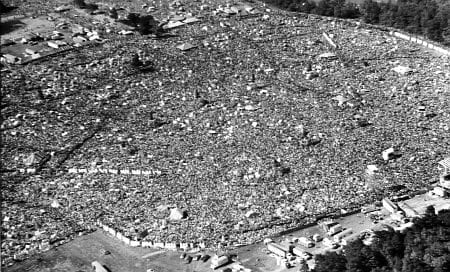
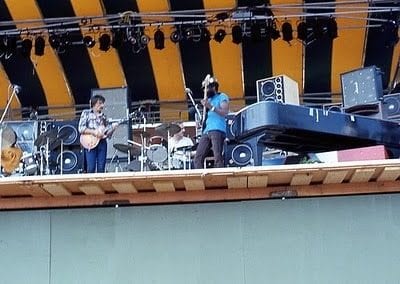
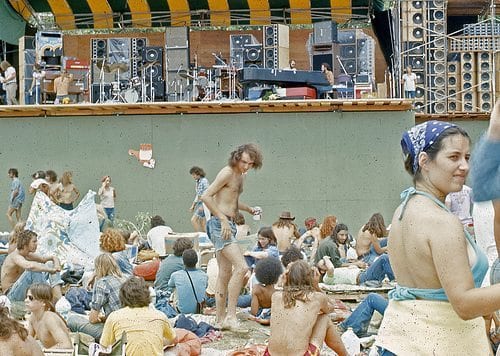
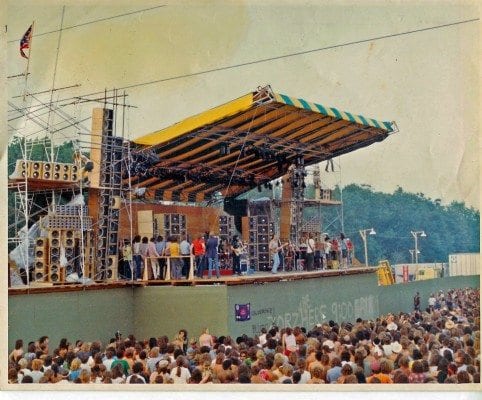
It was the Summer of 1973, the ‘Hippie movement’ of the 1960’s still existed, but only in isolated pockets, tucked way in the dusty cobwebbed corners of the counterculture. Groups like the Grateful Dead, Allman Brothers Band, and The Band were still playing to crowds that held tightly to the ideals of the mid 1960’s, which the groups themselves still carried on through their music. The bands were also undergoing personal changes reflected back at them through their audience. All three bands and more than 600,000 of their fans would descend on Watkins Glen for one of the largest concerts in recorded history, Summer Jam.
The genesis for 1973’s Summer Jam began as a brain storm by promoters Shelly Finkel and Jim Koplik who had discussed and planned on setting a line up for the ages. After seeing members of the Allman Brothers Band sit in with the Grateful Dead at a Summer 1972 concert at Roosevelt Stadium the seed was planted to bring together an astronomical set of musicians for a gathering to rival even Woodstock, boy, would they be surprised.
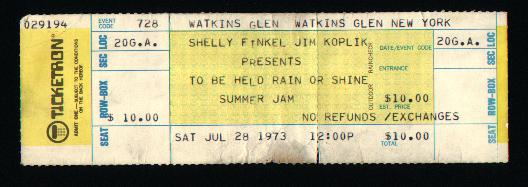
The decision to bring The Band on board came by the promoters asking the Dead and Allman’s which artist they would most like to have join them on the bill, the decision was easy and unanimous. Plans were put in place and and set in motion. Roughly 150,000 tickets were sold at $10.00 a piece for the show, large by any standard of measurement. To everyone’s surprise, by the evening prior to the concert that number of intrepid travelers had already showed up to the festival site. By show time on July 28 the number would exceed an estimated 600,000 fans.
Often overshadowed by other festivals in the annals of rock history, the show became something different than originally planned, but ended up being remembered fondly by all participants. The concert also seemed to signal the end of an era, ushering in a time where festivals became corporate interests instead of private excursions into the unknown. Soon to be gone were the days of Monterey, Woodstock, and the Isle of Wight, properly concluding with the biggest of them all ‘Summer Jam,’ situated smack dab in the middle of New York State. Two of the principal performing artists, The Grateful Dead and Allman Brothers had recently lost founding members, Pigpen for the Dead in March of 1973, and Duane Allman and Barry Oakley for the Allmans in 1971 and 1972 respectively. These deaths caused a restructure and reassessment of both bands musical futures which at this point seemed somewhat uncertain for both groups.
The Band on the other hand was also hanging by a thread because of personal issues regarding publishing, as well as substance abuse seeping into the fabric of the group. The ‘Summer Jam’ acts as a celebration of the recent past for the artists involved, as well as a signpost to an unknown future. For the Grateful Dead, the festival featured one of their usual blistering 1973 sets, in addition to an perfectly encapsulated instrumental journey tagged as one of their finest, hailing in true Grateful Dead fashion from the sound check. The Allmans played an extended and crisply executed set featuring new songs from their retooled line up and fiery soloing from Dickey Betts. Robbie Robertson has often been quoted that the Watkins Glen set was one of the legendary performing moments by the boys, and will go down in history as one of their best.
In spite of prior planning by the promoters and authorities leading up to the evening of the concert, roads and highways were still backed up for a hundred miles, stores in Watkins Glen and surrounding areas were wiped of groceries and beer, and over 150,000 folks were waiting at the 95 acre concert site a night early. Routes 14 and 17 were gridlocked, and even secret back road entries were congested with abandoned cars, forgotten ground scores and backpacking travelers making their way to the festival site.
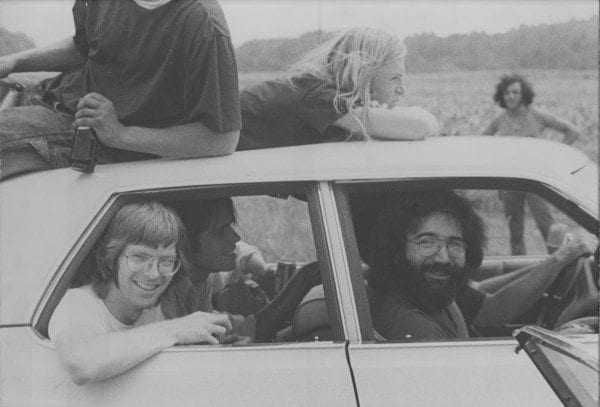
The day of July 27 found all three bands arriving, scoping out the situation, and standing slack jawed at the amount of people already at the festival site. Legend tells us that when Robbie Robertson guitarist of The Band inquired about a sound check in preparation for the expansive outdoor venue, all three bands decided to do the same thing that evening and make it a mini performance. What happened next is the stuff legends are made of. All three bands played beautiful sets to the lucky early arrivals. The Band ran through a couple of their well know classics as well as jamming on a few unique instrumental grooves that harkened back to their days as The Hawks, when they were still playing Toronto bars and clubs.
A crushing ‘The Night They Drove Old Dixie Down’ opens the ‘rehearsal’ and is answered by encouraging crowd feedback. The instrumental groove the group break into following ‘Dixie’ is jump started by Danko’s smooth fretless bass flourishes and the rest of the band falling in line with a jumpy Levon Helm swing. Robertson’s Stratocaster draws blood with its stinging ring cutting through the somewhat marginal sound quality. Another jewel of the practice session is the rare Danko sung version of ‘Raining in My Heart,’ a bit jagged, but oh so charming.
The Allman’s followed and also ran through a rough and ready sound check that was made up of a few songs planned for the next evening including ‘Ramblin Man’ and ‘One Way Out,’ short but sweet when compared to what would follow. When the Grateful Dead approached the stage for their ‘rehearsal’ segment little did the band or assembled throng know what they were in for.
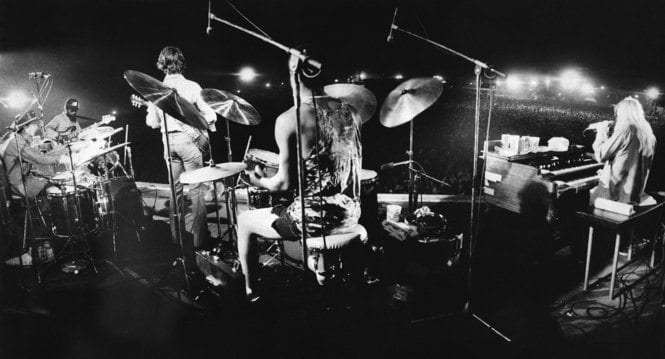
The Grateful Dead’s ‘soundcheck’ appeared as two sets lasted an hour and a half, but according to many opinions and in true Grateful Dead fashion possibly outshines the next day’s ‘official’ performance. The bonus being the performance circulates in pristine quality unlike songs from the other participants of the concert. The unique improvised instrumental jam that preceded ‘Wharf Rat’ is an anomalous display, never to recreated, and is one of those magical Grateful Dead moments made for the time in which it was born. The jam appeared years later on the official release box set So Many Roads, proof of its distinguished standing in the Dead’s long and varied history.
Prior to the sound checks first highlight ‘Bird Song,’ Phil Lesh states ‘This whole thing is a fraud, we’re really clever androids,’ as they band prepares to levitate off of the ground. ‘Bird Song’ comes skipping in, riding with Kreutzmann on the humid Summer evening breeze. Succulent and patient Garcia and Lesh probe the soft cloudy edges of the jam, floating in space. Expansive yet slightly tentative, the ‘Bird Song’ jams wings are lifted by the gusts of inspiration starting to stir.
After polished and well played versions of various first set classics, including a big fat ‘Tennessee Jed’, the band finds itself in one of those sacred spaces, where the music eventually plays the band, and all bets are off. The unnamed jam grows from silence, quietly, pensively, with light cymbal hits and the guitarists peeking around corners probing into darkness. Lesh increases the intensity with some fuzzy chording; Weir gives the musical drift a tangible shape with perfectly timed strums. Lesh then begins to drone and detonate, the band turns into particles and star dust, breaking apart, and then coagulating as a Garcia led jam rises from nothingness. Billy K catches on, Garcia sets the rhythm and the band achieves lift off. Slick, smooth and jazzy, the band improvises idea after idea. Weir strikes out with nervous lush rhythmic ideas, Phil hides and seeks, and Garcia peels off layer after layer of juicy skin revealing the jam’s plump and succulent center. The band sinks their teeth deep into the music creating one of their finest moments in front of the lucky crowd who descended early upon Watkins Glen that Summer night of 1973.
An endless stream of collaborative ideas pours from the group like the icy waters raging through the shady tree lined Watkins Glen only a few short miles away. Some of the melodies are familiar, some are brand new, some mix and match like oil and water, some blend like paints on an artists pallet. One of the finest musical moments in the Grateful Dead’s long and storied history has just occurred, thankfully captured for posterity. An audacious beginning to a concert event that hasn’t even ‘started’ yet! The jam eventually dissolves into a fitting and lucid ‘Wharf Rat,’ the previous journey to arrive there filled with drama and intrigue.
The Dead portion of the soundcheck concludes with a solid but anticlimactic ‘Around and Around’, that leaves the assembled throng looking to find a place to sleep, and prepare for the following days awe inspiring display of music, stamina, and mother nature, that would extend to extravagant lengths. The following day would start at 10:00 AM and conclude very early on the morning of July 30th; history was going to be made.
As the morning of July 28, 1973 revealed itself, the ground beneath the Watkins Glen, New York State Summer Jam concert site was preparing to hold the weight of 600,000 musical travelers ready to rock and roll. The largest gathering for a rock festival was about to take place with a legendary bill of bands that would play extended and legendary sets. After the previous evenings ‘warm up’, the groups as well as the crowd were primed for an all day event. Pleasant but humid New York Summer festival weather settled hazily across the bronzed crown of hippies slightly threatening summer storms. The awe inspiring event about to take place would make history in not only musical but social ways, the smoky remnants of that afternoon still smoldering in the annals of rock history.
The Grateful Dead took the stage promptly at noon to an introduction by Bill Graham who exclaimed, ‘From Marin County to Watkins Glen, the Grateful Dead!’ Blasting into an excitable ‘Bertha’ the Dead ran through a typical, that is to say, well played and amazing set of first set classics. The set is brimming with a typical East coast high energy, building to then detonating on a psychedelic pinnacle with the set closing ‘Playing in the Band’. Slithering through the some of the more familiar themes of the era, by half way into the jam Lesh and Garcia are exchanging husky scrubs and bombs, while the rest of the band is tied into a kinetic and electric fast paced groove. While not reaching the extravagant peaks of the jam from the night before, this is a thick and gooey ‘Playin in the Band’ from an era with many stand outs.
Following a marathon ‘China/Rider of epic proportions comes ‘Eyes of the World’, the peak of the second set and of the Dead’s performance for me; the post verse jam contains a plethora of melodic statements from Garcia, with the song morphing into a swelling and pulsating improvised drift. From fifteen minutes on, Garcia plays like a man possessed and hits on several syncopated grooves that band responds to in kind touching on the delicate spaces explored during the previous day’s sound check, before falling back into the recognizable ‘Stronger That Dirt’ theme. Garcia then deliciously liquefies the band into Weir’s well timed and well placed ‘Sugar Magnolia’. Observed as an entire piece of work the Grateful Dead played an amazing two days of music at Watkins Glen, a testament to their constant journey to strive for the golden note.
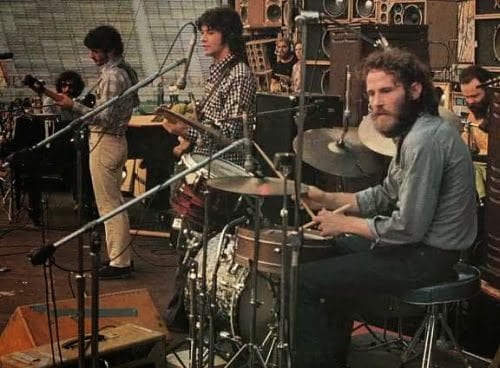
The Band’s set started at 6:00 PM after the Dead’s extended four and a half display concluded and became an amazing cross section of their legendary career, peppered with unique instrumental interludes specific to the Watkins Glen performance. Opening and romping joyously through ‘Goin Back To Memphis’, the Band’s music captured the feel of the festival perfectly through its pastoral imagery and down home instrumentation.
This is rock and roll, country blues distilled to its very essence; it doesn’t get much better than this! During these early moments of the Band set, the low point of the festival weekend occurred as a skydiver unfortunately missed their intended mark and perished on the grounds. As an addendum, there was a supposed ‘official’ release of the Band’s set from Watkins released in 1995, but after inspection and discussion it was revealed that this collection was/is a fraud and contains only two actual tracks from the event. The only way to hear the performance as it was is to hunt down one of the circulating audience recordings that exist in decent quality.
This concert takes place in the middle of a year of rest and uncertainty for the Band. Looked at historically, the concert is a towering peak in the landscape of the Band’s performing career. The songs are tight, dynamic and rise and fall like a high speed run down a country gravel road. Garth Hudson is especially on his game laying down a plethora of breezy and inspirational keyboard flourishes that would culminate with his divergent solo spot “Too Wet Too Work’. Danko and Helm are locked in tight, and the vocals of Manuel, Danko, and Helm wrap around one another like a snaky gospel revival. After rocketing through a series of exciting high tempo tracks including ‘Loving You Is Sweeter That Ever’, and a drunken romp through ‘The Shape I’m In’, the group is eventually forced to leave the stage for twenty minutes because of threatening inclement weather. During the jam on ‘Endless Highway’ prior to their leaving, the crowd can be heard on the recording discussing and preparing for the incoming thunder storm. The ‘fly on the wall’ aspect of this field recording is especially entertaining.
Levon Helm’s remembrance of this moment in his autobiography is that the group left the stage as the weather descended, gulped some Glenfiddich whiskey and watched Hudson return to his keyboard for his orchestral spotlight, ‘Genetic Method’ in this case driving away the rain in the process of the extended solo. Titled ‘Too Wet To Work’ in the case of this performance, Garth traveled through numerous musical landscapes, teasing dynamically, improvising, until the weather dissipated and the Band returned to the stage, slamming into a celebratory ‘Chest Fever’, that in Helm’s words would be forever ‘burned into his memory’. The crowd claps in time with the musical waves, a highpoint of the afternoon. The remainder of the Band set burns through an aggressive and elastic instrumental and then momentous and extended versions of smoldering rock classics like ‘Holy Cow’ and ‘Saved’, as well as crowd pleasing renditions of ‘Cripple Creek’ and ‘Life Is A Carnival.’ Absolutely legendary, the monumental nature of the day as well as joy emanating from the stage translates well to the field recording I am enjoying.
By the time Allman Brothers Band hit the stage at 10:00 PM, the almost one hundred acre concert site had become a swamp, and the happily soaked crowd swelled with anticipation for the upcoming musical onslaught. Opening with the recent for the time ‘Wasted Words’, the band is cooking from the get go with Betts and Allman dueling through vocals and slide guitar over the syncopated groove. The band receives a second introduction after the opener because Bill Graham wanted to make sure every band had each individual member introduced to the crowd. The Allman’s then swagger through beautifully crafted versions of ‘Come and Go Blues’ (featured on official release ‘Wipe the Windows, Check the Oil, Dollar Gas’) ‘Blue Sky’, ‘Jessica’, ‘You Don’t Love Me’, among others. Recent additions Chuck Leavell and Lamar Williams fill in admirably on keys and bass respectively. Leavell and Betts especially have developed an intense chemistry, bouncing hearty melodic ideas off each other throughout the show, with their interplay on ‘Blue Sky’ being a highpoint worth of inspection.
The centerpiece of the Allman’s extended set is the mammoth performance of ‘Les Brers In A Minor’ which bookends a pulsating and dynamic drum duet by Jaimoe and Butch Trucks, the second of the performance following an aggressive ‘You Don’t Love Me’ duet. Each member gets a chance to express themselves as ‘Les Brers’ like its distant cousins ‘Jessica’, and ‘Liz Reed’ navigates a series of death defying twists and turns while solving a series of delicate melodic mysteries. Rock and Roll veteran Chuck Leavell’s extended dance with the black and whites is a pleasure to behold and spreads out a plush carpet in which the band uses to step into drums. This song represents a powerful and confident jam by the retooled group, asserting their ability to move forward while still respecting their past brothers Duane and Barry. Betts guitar lines range from syrupy amber licks to sharp stinging fly bys, the central pole in which the group revolves.
The Allman Brothers set concludes with ‘Whipping Post’, hoped for, expected, and played like a runaway freight train headed down a dark track. Peak after peak is reached the crowd is astonished, amazed and taken to a unique place by the music played. The weekend ends bombastically, well past midnight following the Allman’s set when members from all three groups return to the stage for Summer Jam. Sincerely sloppy, and at moments stunningly brilliant the music continues into the dawn. Rick Danko appears first to drunkenly croon into the mic momentarily and quite endearingly, soon to be joined by Garcia, then Manuel and eventually Betts, Lesh, Allman and others for some more lengthy jamming to conclude the massive weekend of music to the crowds delight.
The music drifting from the stage meanders for a bit before falling into the highlights, ‘Not Fade Away’, ‘Mountain Jam’, and’ Johnny B Goode’, a momentous and special way to conclude the Summer Jam. The ‘Not Fade Away’ is pleasant enough, but the twenty plus minute ‘Mountain Jam’ the follows elicits speeding clouds, percolating rivers, and joyous wilderness romping. Garcia is especially active, intertwining and responding to everyone on stage. Betts and Garcia together create richly constructed summits during their journey, pausing at scenic overlooks that dance with collaborative playing by all of the principals on stage. The musical movement comes as a defining musical statement for the weekend, an instrumental climax, a joining of ideas and people and a perfect example of the magic available through collaborative musical interplay and willing participants.
Watkins Glen, Summer Jam 1973 is not only notable for its collection of an amazing group of musicians, but for its eclectic collection of fans. The collaboration between the two of these principals combined for a historic and alchemic weekend combining music and experience. The encapsulated moment in time for this weekend will never be recreated, but fortunately forever enshrined on recordings and in the memories of the participants.