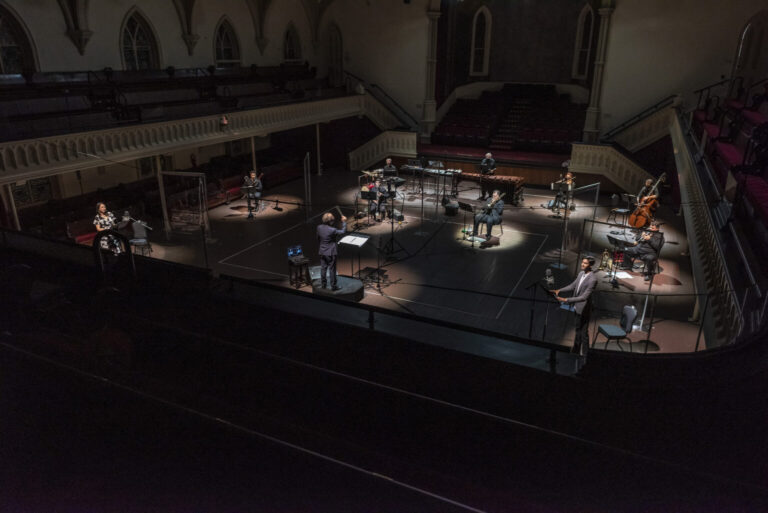
On June 24, members of the American Symphony Orchestra played Opus 40 in Woodstock. Winds Among Trees, a wind instrument sextet brought a new layer to experiencing the sculpture park. Both shared a story of creative survival amidst destruction, which made it the perfect time and place for the convergence to occur.
The sextet blending in the shadows
Senses Alive
Bright light, contrasting stone and stunning landscapes made for the perfect atmosphere. Placing the band strategically on the artwork itself, allowed for an elevated way of experiencing both the art and the music.
A welcomed visual obstruction
Ornate hedges and seemingly innocuous smaller sculptures partially obstructed nearly every view the music and the monolith. Senses were heightened as participants were compelled to be more present, and listening with a more focused ear and eye. As the post-solstice afternoon progressed, the sun started to blare into the eyes of the audience, which made viewers feel like they were part of a progressive performance art piece.
Enjoying the experience
Rare Music, Rare Location
The contrasting stone with all of the afternoon’s light made all the of the artist’s intentions clear. The monolith’s sun dial- like beacon of love was built on an old bluestone quarry after the land had been destroyed by construction.
Beautiful works like this achieved though years of manual labor.
The music played by the sextet was extremely rare in that it is not often played or performed, but also in the idea of it being chosen by the musicians. During shutdown, when all sought-after cultural celebrations of art and music were closed, members of the American Symphony Orchestra were given an interesting assignment. Captains were chosen to enlist a team to learn a collection of rare music.
A beautiful venu
This is not common and the idea to perform these collections in different interesting venues made this even more thoughtful. Being able to have creative control as well as the project and accountability hopefully helped some through the incredibly trying time.
Music stands excited they non longer have to socially distance
Visitors to Opus 40 took away a feeling of gratitude. They felt music in a unique environment during a new beginning for our society.
Setlist: Serenade for 2 Clarinets, 2 Bassoons, and 2 Horns (Matyas Seiber), Sextet No. 1 in Eb (F.H.J. Castil-Blaze), Sextet (Harald Genzmer), Adagio and Rondo (Carl Maria von Weber)
Setlist via americansymphony.org
To see more of what the ASO has done over shutdown, visit their website.
After a hiatus last year due to the COVID pandemic, The American Music Festival has announced a comeback with four days of events at Albany’s Palace Theatre.
The Albany Symphony Orchestra photo courtesy of Albany Symphony
Presented by the two-time Grammy award-winning Albany Symphony Orchestra and their music director David Alan Miller, the annual festival celebrates cutting-edge composers and musicians. This year, the festival will be held from June 10-13 and consist of a Composer Workshop Masterclass, outdoor neighborhood performances, and family activities.
Other events include a First Draughts reading session, which gives the public a glimpse into the weeklong Composer Workshop, as well as performances from members of the Los Angeles Guitar Quartet and the orchestra’s own Dogs of Desire.
A recent addition to the events include a collaboration between the Albany Symphony and NYSID (New York State Industries for the Disabled). They will be hosting a panel discussing how disabilities can actually provide more positive abilities than negative. The band Flame, made up of talented musicians with disabilities, will also be performing.
The festival will also feature works from composers Nina Shekhar, Clarice Assad, Molly Joyce, Christopher Theofanidis, Alexis Lamb, Kerwin Young, Bobby Ge, Jack Frerer, Carolyn Yarnell, and Tom Morrison, alongside other musicians. Many of the works will be premiered at the fest.
One of the composers, Nina Shekhar, writes in reaction to how classical music has lacked in responding to current social issues. Her piece, Above the Fray, pokes fun at this phenomenon by distorting Bach’s famous Prelude from Cello Suite No. 1.
“Unlike Western art tradition, which believes that classical music is a one-size-fits-all solution, this piece challenges that and asserts that we each have infinitely unique identities that morph under different circumstances. Art itself is not static, but rather something dynamic that we can allow to breathe, reshape, decompose, and reincarnate into new life forms over time,”
Nina Shekhar, Featured Composer at the American Music Festival
In accordance with New York reopening guidelines, the concerts will have limited in-person attendance for paid subscribers only. Livestream access will be available for free.
Concert livestreams can be accessed on the Albany Symphony Orchestra website. Check out the complete schedule below.
Composers Molly Joyce and Nina Shekar sit down for an honest talk about creativity, resilience, and embracing differences with Maureen O’Brien, President & CEO at New York State Industries for the Disabled (NYSID) and Greg Sorrentino, President & CEO at Center for Disability Services.
The American Symphony Orchestra announces plans for free nine-concert chamber music series, taking place in Manhattan’s Bryant Park and 34th St. Herald Square Plaza and will run through May 3–19, 2021.
The American Symphony Orchestra is a New York-based American orchestra that was founded back in 1962. Their mission is to make orchestral music accessible and affordable for everyone. The musical performances and works are curated around ideas drawn from a variety of disciplines such as history, visual arts, science, politics and literature. They often try to revive works that were rarely-performed in their hay day that audiences would otherwise never have a chance to hear performed live.
The nine concert series will include five different programs curated by American Symphony Orchestra musicians. The performances will feature music ranging from 20th century Mexican and all-American jazz composers to Afro-Cuban Batá drumming and classical works for horn quartet and woodwind trio. Some of the featured artists include percussionist and composer Javier Diaz, saxophonist Roxy Coss, and oboist Toyin Spellman-Diaz.
There will be a limited number of first-come, first-served chairs set up near the Bryant Park Fountain Terrace in front of the stage and at Herald Square for people to watch the live music from American Symphony Orchestra. Artists and audience members will be required to follow current public health guidelines including wearing masks and social distancing. All the concerts will last for at least one hour and will begin at 5:30PM.
For more information on the American Symphony Orchestra and their concert series visit their website.
The full schedule can be read below:
Modernism in Mexico – String Quartet
Monday, May 3 & Tuesday, May 4, at 5:30 pm
Bryant Park Fountain Terrace
Modernism in Mexico explores string quartets by some of Mexico’s most important 20th-century composers: Manuel Ponce, Silvestre Revueltas, and Carlos Chávez. Ponce was Mexico’s leading classical musician, and this performance of his well-known song Estrellita is a new arrangement for string quartet. Carlos Chávez was his student and heir apparent, touring extensively as a conductor and producing an impressive body of compositions. Chávez’s close colleague, violinist Silvestre Revueltas, was a notable conductor/composer whose work includes the score to the 1936 film Redes (The Wave), commissioned by the Mexican government.
Cyrus Beroukhim, violin
Philip Payton, violin
Will Frampton, viola
Alberto Parrini, cello
Manuel Ponce: Estrellita
Manuel Ponce: Petite suite dans le style ancien
Silvestre Revueltas: Musica de Feria
Carlos Chávez: String Quartet No. 3
Strike Force – Percussion Ensemble
Wednesday, May 5 & Wednesday, May 12 at 5:30 pm
34th Street Herald Square Plaza
This percussion ensemble combines Afro-Cuban Batá drumming and poetry with the sounds of contemporary chamber percussion, featuring Grammy-nominated Imani Winds’ oboist Toyin Spellman-Diaz in compositions by percussionist and composer Javier Diaz.
Kory Grossman, Javier Diaz, and Charles Descarfino, percussion
Toyin Spellman-Diaz, oboe
All-Javier Diaz Program:
“Chandani”
“Canciones del Idalgo”
“Maleza”
“Son Montuno Sinfonia”
“Sakpata”
“Lucumi Cycle”
ASO Salutes NYC/USA – Jazz Ensemble
Monday, May 10 & Tuesday, May 11 at 5:30 pm
Bryant Park Fountain Terrace
A truly American genre, the ASO presents this jazz ensemble as a salute to U.S. healthcare workers who have made it possible for New Yorkers to experience live music once again. The program, including works by Gershwin, Bernstein, Ellington, and Chick Corea, among others, celebrates composers who have defined the sound of this vibrant city.
Lee Musiker, piano
Lou Bruno, bass
Kory Grossman, drums
Eugene Moye, cello
Roxy Coss, tenor saxophone and flute
Harry Warren: “42nd Street”
George Gershwin: “It Ain’t Necessarily So” from Porgy and Bess
Duke Ellington: “Take the A Train”
Leonard Bernstein: “Some Other Time”
Leonard Bernstein: “Cool” from West Side Story
Gustav Holst: I. Mars, the Bringer of War, from The Planets, Op. 32
Chick Corea: Children’s Songs
Charles Mingus: “Nostalgia in Times Square”
Woodwind Trio
Tuesday, May 18 at 5:30 pm
Bryant Park Fountain Terrace
Woodwind chamber music had something of a renaissance in the 1920s; at the same time, works for reed trio—oboe, clarinet, and bassoon—were coming together with the formation of the Trio d’Anches de Paris, a collaboration of three virtuosi reed players. This program offers music from some of the greatest composers of wind music in the 20th century.
Alexandra Knoll, oboe
Shari Hoffman, clarinet
Marc Goldberg, bassoon
Charles Koechlin: Trio d’anches Op. 206
Jean Françaix: Divertissement for Oboe, Clarinet, and Bassoon
Alexandre Tansman: Suite for Wind Trio
Claude Arrieu: Suite en trio
Albert Roussel: Andante from an Unfinished Wind Trio: Adagio
Joseph Canteloube: Rustiques – I. Pastorale
Francis Poulenc: Sonata for Clarinet and Bassoon, FP 32a
Gilles Silvestrini: Oboe Etude No. 1: Hôtel des Roches Noires à Trouville
Horn Quartet
Monday, May 17 & Wednesday, May 19 at 5:30 pm
Bryant Park Fountain Terrace & 34th Street Herald Square Plaza
Perfectly at home in the outdoors, the horn quartet has enjoyed a rich history from the forest to the concert hall. This program features composers highlighted by Bard Music Festivals of the past with a few modern classics that will inspire.
Chad Yarbrough, David Smith, Lawrence DiBello, and David Peel, French horns
The Concerto for Viola and Chamber Orchestra was originally written for Kim Kashkashian. She sent Theofanidis a collection of Navajo poems that were wildly different in character, but had in common a supernatural sense of nature and an extremely evocative vocabulary. Each of the four movements is serious in sentiment, in turns lyrical and dramatic. Theofanidis wrote this work during the tragedy and turmoil of 9/11, starting the piece before and finishing it afterward, and was influenced by being in midtown Manhattan that day.
Portrait of Theofanidis
This is the second GRAMMY win for the Albany Symphony. The first came in 2013 for John Corigliano’s Conjurer with world-famous percussionist Dame Evelyn Glennie
For a full list of winners of the 63 Annual GRAMMY Awards visit their website.
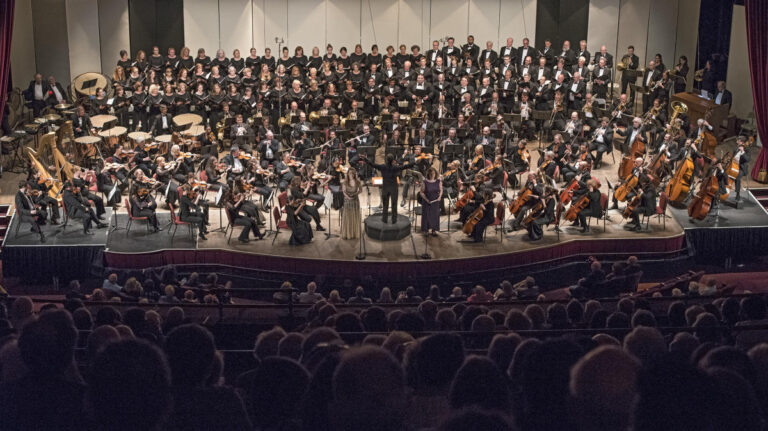
On February 13, the Albany Symphony Orchestra performed three works: Sir William Walton’s Facade: An Entertainment, Tyson Davis’s Distances, and Serenade in D, op. 11, by Johannes Brahms. The concert was streamed virtually from Universal Preservation Hall in Saratoga Springs.
William Walton was a British composer known for his instrumental writing, and was nominated for two Academy Awards in the 1940’s. He was inspired by a friend’s poem to write Facade. It started as a piece just for speaker and six instruments, but Walton later expanded it to an orchestra. The ASO did well on this piece. The speaker, Lucy Fitz Gibbon, navigated the tricky passages and was able to shine.
The next piece performed by Albany Symphony Orchestra was Distances. It was composed by Tyson Davis. Davis, 21, a young but talented composer. He entered the UNC School of the Arts, studying with Lawrence Dillon. Later, he wrote for Eighth Blackbird, the Attacca String Quartet, and UNCSA Symphony Orchestra. He worked with the National Youth Orchestra to premiere a work that was commissioned by the American Embassy in Berlin to commemorate the 30th anniversary of the fall of the Berlin Wall.
Written after the start of the COVID-19 pandemic, Davis wanted to explore themes of emotions and anxieties that the “New World Order” of a pandemic have caused. To do this, he left the piece with ambiguity and lingering passages.
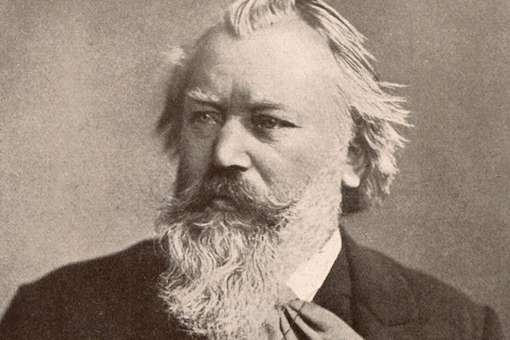
Brahms was a dominant composer of the nineteenth century; he was not revolutionary in terms of structural change, but he wrote beautiful, sweeping melodies. The Serenade was his first work for a “larger” group (originally eight people). The piece usually contains six movements, but the ASO opted instead for a rarity. Instead of those six, the ASO played four. Symphonies are traditionally four movements, not six, so the ASO played movements 1, 3, 4, and 6. With these four, it encapsulates what a traditional symphony is: a faster first movement, a slow second, a minuet or scherzo third, and a fast finale.
Brahms originally cast the work in four movements. Like so many of Brahms’ early efforts, that original form suggests a young composer wrestling with specter of the greatest of all symphonists, Beethoven, and trying to create a first symphony. The other movements were added later to create the Serenade.
Overall, the Walton was phenomenal, especially with the addition of Gibbon. If I had to describe Davis’s piece in one word, it would be, emotional. The piece evokes emotions that everyone is feeling. The symphonic arrangement gave better understanding of an earlier Brahms symphony.