Category: NYC Metro

  • Stuyvesant Casino: The East Village home for Jewish Gangsters and Dixieland Jazz

    The East Village of Manhattan has been home to immigrants, the working class, Beatniks, hippies and artists over the last 300 years. Originally home to the Lenape tribe before the arrival of Europeans, the East Village today is comprised of Alphabet City (the setting for the musical RENT), Ukrainian Village and the Bowery (home to CBGB). In the early to mid-20th century, it would be home to Jewish gangsters and Dixieland jazz at the famed Stuyvesant Casino.

    Stuyvesant Casino

    The name Stuyvesant has roots in America dating back to the 17th century, with the arrival of the Dutch in New York Harbor in 1624. Peter Stuyvesant would serve as Governor in Chief of Amsterdam in New Netherland, later named New York after surrendering the city to the British in 1664.

    While he was effective with trade in New Amsterdam and created a sense of law and order for a diverse colony, Stuyvesant was intolerant of full religious freedom in the colony. In 1657 he refused to allow Lutherans the right to organize a church, and later refused to allow the permanent settlement of Jewish refugees from Dutch Brazil in New Amsterdam, joining Jewish traders already there.

    Ultimately, directors of the Dutch West India Company needed to pressure Stuyvesant to allow Jewish immigrants to stay in the colony as long as their community was self-supporting. Still, Stuyvesant and the company would not allow them to build a synagogue, leading them to worship at a private house instead.

    The name Stuyvesant would end up having a negative connotation, as he did few favors in his life to gain support of those he was placed in charge of. Upon turning over New Amsterdam to Britain after no one would defend the city, his name was tarnished. He would eventually settle on a farm, a bouwerie, until his death in 1672.

    Two and a half centuries later, the name Stuyvesant would be fading as a surname, but was the given name of an East Village casino with a rich 20th century history.

    stuyvesant casino
    140-142 Second Avenue are indicated by the red arrow, and 138 Second Avenue is indicated by the orange one. Image via VillagePreservation.org

    The Bowery attracted Irish and German immigrants starting in the 1850s, Poles and Ukrainians arrived in the 1880s, and by the early 1900s, Italians and Eastern European Jews arrived.

    Originally a German YMCA beginning in 1881, the building was a pair of late federal-style houses, dating back to around 1830 when the area was known as “Little Germany.” The building stayed intact and in its original form, with sloped peaked roofs and dormers at the top, meaning the YMCA had not changed much of the exterior, and perhaps the interior as well.

    Around the late 1800s, this area of Manhattan’s Lower East Side became the center of Jewish life in America. Crowded and culturally vibrant, a rise in crime would lead to gangs forming by the end of the century. Second Avenue was a main road, bustling with theaters, cafes, nickelodeons, bars, and vaudeville houses, making the region a draw beyond its residents.
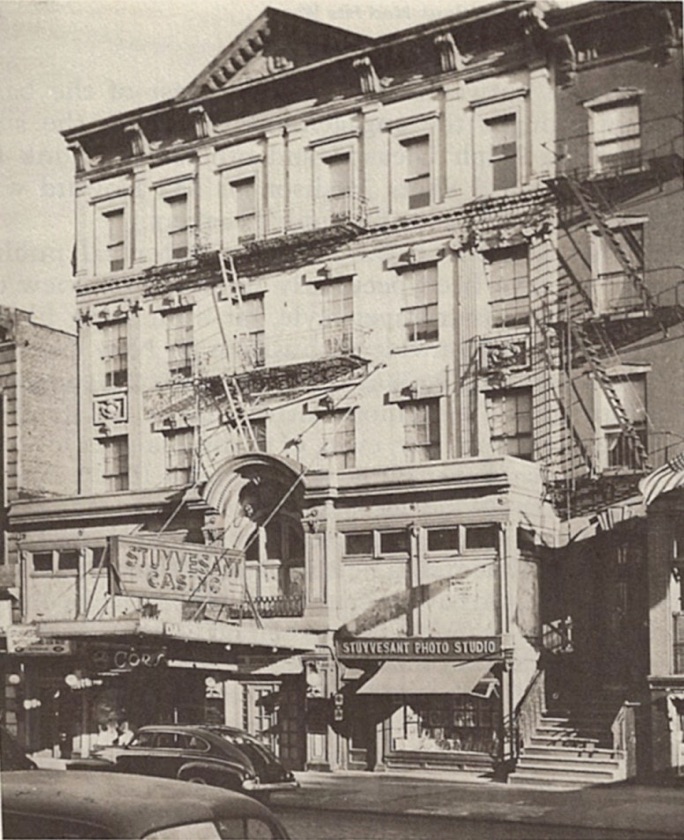
    Stuyvesant Casino
    Stuyvesant Casino

    In 1910, Stuyvesant Casino opened at 140-142 2nd Avenue, owned and operated by Gerson Schmidt, an Eastern Europe immigrant from Galicia (now located in Ukraine). This stretch of 2nd Avenue encompassed part of Stuyvesant’s farm, and thus the name was given to the business.

    The Stuyvesant Casino offered sumptous food, dazzling decor, and a first-class house band. High rollers and hitmen were among the clientele, particularly Big Jack Zelig, head of the Eastman Gang after the death of “Kid Twist” Max Zwerbach, in 1908.

    Big Jack Zelig

    During a party on December 2, 1911, Zelig lured a drunk “Julie” Morrello, an Italian gangster called “one of the most notorious gun and knife fighters on the east side, to Stuyvesant Casino. Around 1am, the lights went out and four shots rang out. As the lights flickered on moments later, Morrello was lying prone on the dance floor, filled with bullets.

    In post-World War I New York City, Stuyvesant Casino would be a notorious hangout for Jewish gangsters, but by World War II, the venue became known for music producing the hits.
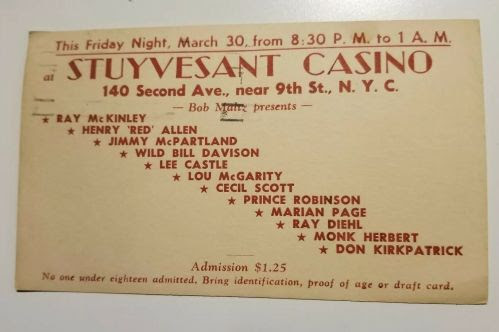
    Stuyvesant Casino

    In the 1940s and into the 1950s, Stuyvesant Casino became a popular destination thanks to the arrival of New Orleans and Dixieland jazz artists. Big names such as Sidney Bechet, Wild Bill Davison, Rex Stewart, James P. Johnson, Georgie Lewis, Joe Sullivan, the great Bunk Johnson, and the Conrad Janis Tailgate Jazz Band could be heard for the low cost of $1.25.

    Owner Gerson Schmidt was at one point encouraged by the Stuyvesant’s head waiter to allow a band consisting of his three sons to perform at the Casino. The three Perelmuth Brothers – Pinchas (violin/vocals), Michoyl (piano) and Sender (bass) – were a hit, leading to partygoer and movie theater impresario Samuel Lionel “Roxie” Rothafel, to discover Pinchas’ voice and recognize his potential. When Roxie asked why he was only singing in a “mere catering hall,” Perelmuth responded, “I would love to be an opera singer, but don’t have the money for a vocal coach.”

    Opera legend Jan Peerce got his start at Stuyvesant Casino as a child

    Roxie would take Pinchas under his wing and helped him get his break, helping him study voice and making his name among the opera elite of New York City. Perelmuth would make his debut at the Metropolitan Opera in 1933, under a new name, Jan Peerce. He would make his Broadway debut in 1971 in Fiddler on the Roof, a far distance for the son of Russian immigrants to travel from the Lower East Side.

    As noted in the book The Jews of Capitol Hill, Gerson had a son, Mordechai, who married Myra Bank, the daughter of Galician immigrants. The two would have a son, Lawrence Jack Smith, a Democrat from Florida who served five terms in the House of Representatives from 1983-1993. Smith, whose parents ran catering establishments in the New York kosher catering scene, would work for their business and at Stuyvesant Casino from an early age.

    Stuyvesant Casino

    When the Dixieland jazz made its way north, Gerson’s Stuyvesant Casino was the natural stop for an eclectic melting pot of music. Saxophone great Steve Lacy hung around the Casino as a teenager was exposed to early Dixieland Jazz greats, some of whom he would join there on a regular basis, including Henry Red Allen, Pee Wee Russell, Buck Clayton, and his teacher, Cecil Scott.

    New Orleans bandleader Bunk Johnson would frequently perform at Stuyvesant Casino, occasionally joined by Louisiana-born bluesman Huddie “Leadbelly” Ledbetter, who lived on nearby East 10th Street. Trumpeter Hot Lips Page recorded a version of the 1924 classic “When My Sugar Walks Down the Street” at the Casino, and would later open rival venue Birdland with Charlie Parker, who lived nearby on Avenue B, in 1949.

    Listen to Bunk Johnson recall his early days of recording and performing alongside Buddy Bolden.

    Portrait of Bunk Johnson, Leadbelly, George Lewis, and Alcide Pavageau, Stuyvesant Casino, New York, N.Y., ca. June 1946

    Robert Thompson, a Dixieland drummer known for his group The Red Onion Jazz Band, recalled Bob Maltz as an organizer of jam sessions at Stuyvesant Casino that attracted well paid world class musicians. The Red Onion Jazz Band served as legendary Dixieland revivalists, borrowing the name from Clarence Williams’ traditional New Orleans supergroup Red Onion Jazz Babies, which included Sidney Bechet and Louis Armstrong playing together for the first time in studio.

    via Jazz Lives

    The Red Onion Jazz Band would perform into the 1960s, just as folk music made its way through Greenwich Village. In the Tradition would bring together folk musicians by way of Dave Van Ronk and his Prestige label, along with jazz musicians for a unique album. Vocalist Natalie Lamb would perform with The Red Onion Jazz Band and in 1972, married Thompson. A few years later, the group’s long-time trombonist, Dick Dreiwitz and his wife Barbara – a Hunter College alumnus who switched from French horn to tuba so she could play Dixieland jazz – would welcome a son, Dave. Now the bassist for Ween and Joe Russo’s Almost Dead, Dave Dreiwitz continues a tradition forged in the East Village confines of Stuyvesant Casino. The Red Onion Jazz Band would continue to perform until Thompson’s death in 2010.

    Stuyvesant Casino
    From: A Pictural History of Jazz by Keepnews and Brauer. L to R, Buster Bailey, Vic Dickenson,Wilbur deParis, Omer Simeon, Hot Lips Page, Rex Stewart.

    A first hand account of Stuyvesant Casino from Mr. Madison Arnold, as shared with Jazz Lives:

    I was one of the steady jazz loving week-end customers at the Central Plaza and Stuyvesant Casino from around 1950 to 1952 and got these post cards weekly. This is the only one I kept. I started when I was still in Erasmus Hall H.S. (they didn’t card in those days). My favorites were Bechet & Wild Bill but I loved them all. Among my memories: I helped Pops Foster put his bass in a cab one night and we went to the Riviera on Sheridan Sq., Red Allen pulled me up on stage once and we sang “The Saints Go Marching In” together. I became friendly with Baby Dodds and invited him over for dinner one evening to our apartment in Brooklyn. I also visited his place in Harlem. I have a Xmas card he sent me, written, I think, by his lady friend as I don’t think he could write. My personal Louis Armstrong stories are even better! (at least to me). He was a wonderful guy.

    Mr. Madison Arnold
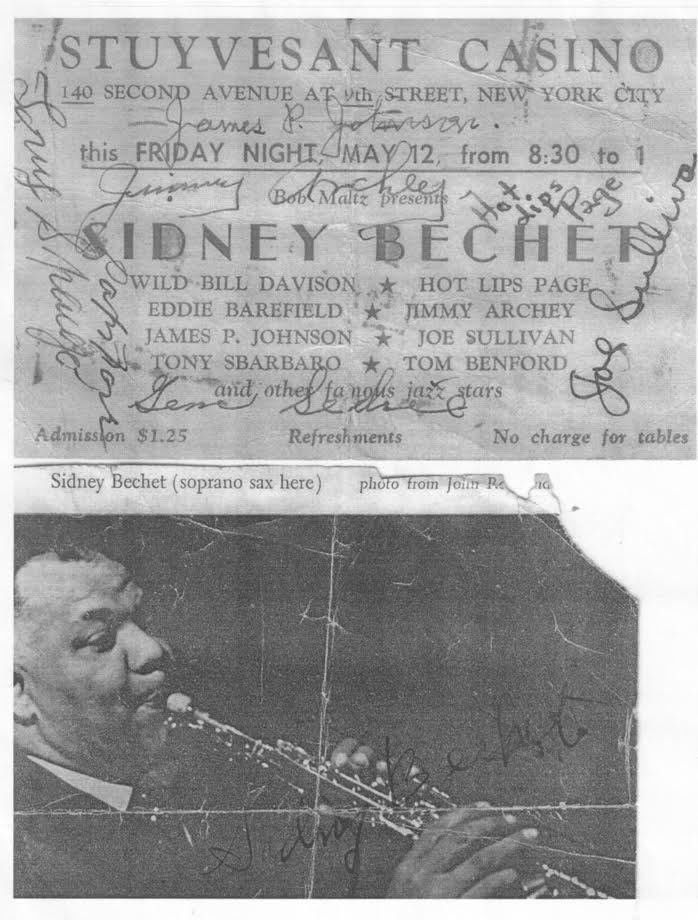
    An autographed show promo from Stuyvesant Casino

    By the mid-1950s, due in part to restrictive immigration laws and a rise in crime and building abandonment, Stuyvesant Casino would close its doors. A home for Eastern European refugees since the late 1800s, new immigrants from Poland and Ukraine headed to the East Village for an escape from communism in the mid-20th century, in addition to Puerto Ricans who had U.S. citizenship.

    Stuyvesant Casino also contained the Ukrainian National Home, a community center that opened in 1958, an effect of the change in neighborhood demographics. Offering cultural and social services to the East Village’s Ukrainian population, an area now known as Ukrainian Village, the “Ukie Nat” hosted a diverse array of artists in the 1980s including Elvis Costello, New Order, and the Misfits, as well as balalaika music filling the Ukrainian Home Restaurant.

    New Order would perform their first American show at Ukrainian National Home, testing out new material that built off Joy Division’s sound. During the 80s post-punk era, synth-based freestyle and electro could be heard at downtown clubs – a melding of white, Latino and Black artists who were mixing in the same area where punk rock inspired New Order’s early sounds.

    Looking back on Stuyvesant Casino’s heyday, jazz music from beyond New York would find a home in this region of the city that so many others had sought refuge in for centuries prior. Home to Germans, Jews, African-Americans, Ukrainians and many more, the area at 140-142 Second Avenue has been a bustling center of cultural diffusion and artistic growth for nearly two centuries, and continues to be so today. The original Stuyvesant Casino building burned down in 1985.

    In January 2023, Ev Grieve shared news that during renovations at 132 Second Ave, a flyer for Stuyvesant Casino was found on a pole, decaying but clearly showing an event on a Saturday night.

    photo by Kevin Goodman

    As we close out this look at Stuyvesant Casino, listen to a WMGM broadcast from Friday, March 14, 1952, via Jazz Lives, featuring Master of Ceremonies Aime Gauvin, joined by Jimmy McPartland (cornet), Ziggy Elmer (trombone), Bud Freeman (tenor saxophone), Bob Wilber (clarinet), Kenny Kersey (piano) and Don Lamond/George Wettling (drums). They perform a medley including “Saints, “Lady Be Good,” “Coquette,” and “The World is Waiting for the Sunrise.”

    Thank you to Russell Sage College Library for their help with research for this article.

  • Endearments Makes Debut With Catchy Low-Fi Single

    Left Side” is the debut single from Endearments (a.k.a Kevin Marksson). The Brooklyn-based songwriter and multi-instrumentalist began writing and composing by and for himself for the first time in fifteen years following the end of synth-pop duo Saint Marilyn in 2019. “Left Side” is definitely a way to start his single career strong.

    Endearments
    Album Cover

    The song itself is about how O.C.D. (Obsessive–Compulsive Disorder) affects Marksson and his relationships. The resulting track unspools unanswerable questions over mighty pulses from drummer Jonathan Schmidt and Marksson’s own multi-tracked vocals, which flicker, omnipresent and cool, around the edges of the song’s atmosphere. In this song the low-fi beat with his voice is one where you can just close your eyes and vibe out to.

    This single has Marksson leaning into his obsessive tendencies pouring over every sound and lyric, tweaking every riff and arpeggiation to convey the inner workings of his mind: disorder and parallelism.

    Endearments
    Photo Cred: Rita Iovine

    His chosen name, Endearments, is because “I wanted the name to convey affection, even though I knew the music would almost certainly be sad.”
    Taking inspiration from auteurs like Peter Gabriel and Justin Vernon, Endearments’ lush sonics and careful songcraft reflect Marksson’s avowed status as a hardware-focused composer. Marksson is a longstanding accomplice in the Brooklyn indie rock scene.

  • Book Review: Joel Selvin Dissects Rock-n-Roll High School LA-style in “Hollywood Eden”

    One of rock journalism’s most experienced, insightful and productive writers, Joel Selvin, has created a fresh take on the telling of the birth of L.A. pop and the California dream of the ‘60s with his latest book, Hollywood Eden: Electric Guitars, Fast Cars and the Myth of the California Paradise.

    hollywood eden

    When it comes to writing about rock music, and writing about it very well, few can match Selvin. From 1969 – 2009, he was a rock music critic for the San Francisco Chronicle, as well as a contributor to Rolling Stone, Melody Maker, the Los Angeles Times and many more. He has written or co-written excellent books on artists like Ricky Nelson, The Grateful Dead, Sly and the Family Stone and Sammy Hagar, events like Monterey Pop, The Summer of Love, Altamont and the birth of the dance craze The Peppermint Twist at one of the pioneering NYC club scenes, The Peppermint Lounge. 

    Joel Selvin, author.

    With his masterful 2014 book, Here Comes the Night: The Dark Soul of Bert Berns and the Dirty Business of Rhythm and Blues, Selvin rescues from obscurity one of the most innovative producers/songwriters of the ‘60s, a man who was largely forgotten after his death in 1967 at age 38. Berns was the man who brought Latin swing to rock with his first hit production, “A Little Bit of Soap,” in 1961, as well as the architect of many of Atlantic Records’ early hits for R&B stars like Solomon Burke, Esther Phillips, Ben E. King and Wilson Pickett. Berns was also the writer of classics like “Twist and Shout,” “Piece of My Heart,” “Cry Baby” and “Hang on Sloopy,” and the producer of mega-hits like the Drifters’ “Under the Boardwalk,” Barbara Lewis “Baby I’m Yours” and Van Morrison’s “Brown Eyed Girl.”

    If all his books have one thing in common, it is Selvin’s skill as a storyteller.  His books read like someone spinning a long yarn around a campfire. They are incredibly rich in fact and scene-setting details, and compulsively readable. Hollywood Eden is cut from the same mold.

    Selvin’s latest tells the story of a group of young musicians who came together at the dawn of the ‘60s to create the lasting sound that powered the myth of the California dream. Central to the saga is a group of sun-kissed teens from the University High School (Uni High) Class of ’58, which included surf music pioneers Jan and Dean, bizarro rock impresario Kim Fowley, drummer Sandy Nelson, Nancy Sinatra, the Beach Boys’ Bruce Johnston and Kathy Korner, the petite teen surfer who inspired the book and movie Gidget. They came of age in Southern California at the dawn of a new era when anything seemed possible. These were the kids who created the idea of modern Southern California, complete with surf music, hot-rods and electric guitars, that the rest of world saw as a teenage paradise on earth. 

    hollywood eden

    The forward to the book sets the Rock-n-Roll high school scenario by also listing the alumni of other schools, like Hawthorne High (Brian Wilson) and Fairfax High (Phil Spector, Herb Alpert, Wrecking Crew sax man Steve Douglas and songwriters P.F. Sloan and Steve Barri), sound-obsessed youngsters who would go on to revolutionize pop music. Some of the Angeleno legends referenced were native New Yorkers or had Big Apple connections, like the Mamas and the Papas and Phil Spector. With all their glorious accomplishments, some of the stories here end with the characters getting burned, for flying too close to the sun or driving too fast and crashing. The latter was the case for Sandy Nelson, who had a smash hit with the drum solo-driven instrumental “Teen Beat” and especially Jan Berry of Jan and Dean.

    Berry is the worthy centerpiece of the story, another legend whose accomplishments are getting lost with the passing of time. Tall, blonde, handsome, athletic and with a magnetic personality, Berry’s adventures in music started in the late ‘50s, when he formed a doo-wop group called The Barons, which included folks like Sandy Nelson, Bruce Johnston, actor-to-be James Brolin and, of course, his partner-to-be Dean Torrence. 

    hollywood eden

    With his father’s gift of an upright piano and two Ampex reel-to-reel tape recorders, Berry set to experimenting in his garage. He started bouncing tracks and stacking vocals to create a sound that would become the signature of the sunny California dream, it would also serve as the template for a legendary musician he would come to work closely with, Brian Wilson.

    When Torrence was conscripted into the army, Berry teamed up with Arnie Ginsburg and scored a hits, including “Jennie Lee” and “Gas Money” as Jan and Arnie. By 1959, he was back in business with Dean scoring a Top 10 hit with the Herb Alpert-produced “Baby Talk.” Even though he was attending medical school, Berry also had the energy to write and produce for other artists like The Rip Chords, The Matadors and actress-turned-singer Shelley Fabares.

    Jan and Dean’s commercial peak was from 1963 – 1966, when they scored sixteen Top 40 hits, many in collaboration with Brian Wilson like the Wilson-Berry penned “Surf City,” along with “Drag City” and “The Little Old Lady from Pasadena.” Berry’s fate would be presaged with his #8 hit from 1964, “Dead Man’s Curve.”  In April 1966, he would crash his speeding car right near this very curve and suffer serious brain damage and paralysis that would essentially put an end to his creative career.

    Also noteworthy in Hollywood Eden is the fascinating career of Bruce Johnston. A child of privilege from Bel-Air, Johnston also made some major strides while still in high school, playing with Richie Valens, The Everly Brothers and Eddie Cochran and producing and playing on  Sandy Nelson’s “Teen Beat.” He also produced the Rip Chords and his own string of surf and car singles, with future Byrds producer Terry Melcher. In 1965, he joined the Beach Boys and was featured on some of their classic albums like Pet Sounds, Sunflower and Surf’s Up.

    Drummer Sandy Nelson’s story is another interesting one that was, like his good friend Berry’s, derailed by driving too fast. Nelson served as a session drummer on early hits by Phil Spector and the Hollywood Argyles, before scoring a million-selling, Billboard Top 5 hit with the drum solo driven “Teen Beat” in 1959. Nelson pounded out two more Top 10 hits, including “Let There Be Drums,” before a 1963 motorcycle accident led to the amputation of his leg.

    Readers will also be intrigued by Selvin’s telling of the story of Nancy Sinatra. He tells how Ol’ Blue Eyes’ little girl went from nowhere in her singing career by playing the “good girl” before scoring a worldwide #1 as the “bad girl” who snarled  “These Boots Are Made for Walkin’.” 

    Selvin’s latest provides tons of enlightenment on the careers of more L.A. legends like performer/record company head Herb Alpert, the Mamas and the Papas and their producer Lou Adler, Phil Spector, Kim Fowley and, of course, Brian Wilson and the Beach Boys. The book ends with the release of Wilson’s crowning achievement, “Good Vibrations,” and beginning of his decline with the commercial failure of Pet Sounds and its abandoned follow-up Smile.

    With America hopefully finally coming out of the long Covid-19 quarantine, Selvin’s Hollywood Eden will be a great summer read for music-lovers who want to experience the sunshine sounds and some California dreamin’.

  • Trey Anastasio returns to Beacon Theatre, this time with a Live Audience

    Trey Anastasio will return to the Beacon Theatre on June 22nd and 23rd for two solo acoustic performances, this time with a full capacity audience. The shows will mark the first time the Beacon has had a crowd since March 2020.

    After 8 weeks of Beacon Jams in Fall 2020, which found Anastasio performing with TAB and assorted guests, including the Rescue Squad Strings, he returns this June for two nights solo. All guests over the age of 16 will need to be fully vaccinated for this event and provide proof upon entry.

    Anastasio has already sold out three nights of solo shows at Saratoga Performing Arts Center over June 18-20.

    trey anastasio beacon theatre
    photo by Jake Silco

    Tickets for the shows will go on sale Thursday, May 27 at Noon ET, here. Note – there is no pre-sale for these shows.

    Update – these shows are now both sold out. James Dolan, Executive Chairman and CEO of MSG Entertainment said the following in a statement:

    Trey was the only artist to play live at The Beacon during the pandemic, so we’re honored that he’ll be the first artist back on our stage playing for a packed house. There’s no question people are eager to start gathering to once again experience events they love — and are more than willing to get vaccinated to do so. We’re focused on opening up all our venues to not just usher in the return of live entertainment, but of New York.

    James Dolan

    For anyone looking to request to purchase a taper ticket for the shows at the Beacon Theatre, please email tapertickets@gmail.com by 9pm ET on Wednesday, May 26th. Access to taper tickets is extremely limited and not guaranteed.

    The Beacon Theatre venue vaccination policy and stipulations are as follows:

    Guests will need to be fully vaccinated for Two Evenings with Trey Anastasio at the Beacon Theatre, meaning the event must be at least 14 days after your second dose of the Pfizer-BioNtech or Moderna COVID-19 vaccine or at least 14 days after your single dose of Johnson & Johnson’s Janssen COVID-19 vaccine. The only exception is for children under the age of 16, who may provide proof of a negative antigen COVID-19 test, negative PCR COVID-19 test or full vaccination and are accompanied by a vaccinated adult. For more information, please visit beacontheatre.com/faqs.

  • Susan Darvishi: Five Years in NYC at 14th and 4th

    First Generation, born in America, and sitting in the back of her Iranian parent’s car, coasting through Northern Virginia as they all sing along to “How can you mend a Broken Heart” by the Bee Gees. 

    Moments like these are when Susan Darvishi started to feel connected with the music that surrounded her. And with her debut album 14th and 4th, releasign on May 26th, she is able to take her relationship with music and tell the stories of the past five years living in New York City on 14th and 4th, before moving out to California. 

    Susan Davishi
    Susan Darvishi

    Of the album’s eight songs, she is able to cover five years of emotions from living in the constantly loud pumping heart of New York City. Whether it is falling in love in the city (“Polaroid” or “Dance With You”), keeping with girl code and internal struggles with heart break (“Him” and “No Choice”), or the bitter sweet goodbyes you have to make in order to start a new chapter (“New Salvation” and “Drift Away”), Davishi is able to tell her stories beautifully through songs on this album. 

    Darvishi’s strong voice pairs appreciably well with the beats, giving most of her songs a fun upbeat electronic pop sound to them. That is said with the exception of “No Choice” and “Drift Away” where she is able to pull away from her other songs and use a slower electric sound to really show off her strong vocals and meaningful lyrics.

    From her “love [of] Latin music, I  listen to in my free time” and then the “Persian music I listen to with my family” she says “sometimes those two blend. They love fast beats.” These influences of music can especially be heard in songs such as “Him” that is a very upbeat song with almost a Persian music sound to it.

    This album has a very good mix between upbeat songs that make you want to get up and dance to songs that give you time to reflect on some of your past chapters. Her sound is with similar likes to artists such as Robyn and the sky seems to be the limit for her musical career. 

    The stories from her songs about her time in NYC still feel as though they are about a time in your life and manage to still be very relatable. Since she left her job in NYC to pursue her career in music right before covid hit she hasn’t been able to perform live but she is just as excited as her listeners for her to start performing on stage in front of a covid free audience. 

    Key Tracks: Drift Away, Him, No Choice

  • Flashback: String Cheese Incident at The Capitol Theatre – May 26, 2019

    On May 26, 2019, The String Cheese Incident played the second night of their Memorial Day Weekend run at the legendary Capitol Theatre in Port Chester, New York. 2019 marked the band’s 25th anniversary. SCI is Michael Kang, Michael Travis, Bill Nershi, Kyle Hollingsworth, Jason Hann and Keith Moseley. 

    string cheese capitol theatre 2019

    They opened the show with their 2018 single “Vertigo”. Kyle then kicked off a 16 minute version of “Black And White”. That was transitioned very nicely into “Can’t Wait Another Day”. They then kicked off the first of many cover songs with Peter Rowan’s “Midnight Moonlight”, followed by “Valley of the Jig” and “Siren’s”. Both songs were on their 2003 album “Untying The Knot”. The first set ended with “Restless Wind” from the 1998 album “Round the Wheel”. That really highlighted Nershi tearing it up on acoustic guitar.

    string cheese capitol theatre 2019

    The second set began with “Just One Story” that got the crowd immediately charged back up after a quick break. Next up was “Rosie” and  the title track to the 2014 album “Song In My Hand”, which both songs also appeared on. Then came the second cover of the night, The Jerry Garcia’s Band’s “Tore Up Over You”.  Some of The Grateful Dead’s most legendary shows happened at The Capitol Theatre in the early seventies. That was long before most of the people in the audience, including myself were even born. Then there was a lengthy version of “45th of November” from the 2005 album “One Step Closer”.

    string cheese capitol theatre 2019

    Another highlight of the night was the band’s’ cover of The Talking Heads “Burning Down the House”. They also performed “Wheel Hoss” which was written by one of the founders of bluegrass music, Bill Monroe in 1955. The set then ended with a cover of The Weather Report’s classic “Birdland” before they circled back to the sets first song, “Just One Story.” The 4 hour plus show ended with a one song encore of “Barstool.”

    String Cheese Incident – The Capitol Theatre – May 26, 2019

    Set 1: Vertigo, Black and White > Can’t Wait Another Day > Midnight Moonlight, Valley Of The Jig, Sirens > Restless Wind
    Set 2: Just One Story > Rosie, Song In My Head, Tore Up Over You, 45th of November > Burning Down The House > Birdland > Wheel Hoss > Birdland > Just One Story
    Encore: Barstool

  • Happy Birthday Lenny Kravitz!

    Born Leonard Albert Kravitz, the multi-faceted artist from New York City, celebrates his 57th birthday today. Known for his contributions to the world of music and acting, birthday boy Lenny Kravitz is known for his flashy style that translates into all areas of his creative endeavors.

    Born of bi-racial parents, actress Roxie Roker (The Jeffersons), and television producer Sy Kravitz, Lenny experienced several racial barriers at the start of his career. Often being told that his music was neither black or white enough to appeal to labels’ audiences, Kravitz took the initiative to put out his debut record, Let Love Rule, on his own. While his debut release only reached moderate success in the states, Kravitz used the momentum to land him the position of audio producer for the hit Madona single “Justify My Love” in 1990.

    lenny kravitz ride Birthday Lenny Kravitz

    His contributions to the world of record production combined with his 1991 hit ” It Ain’t Over ’til its Over” skyrocketed Kravitz to fame. Throughout his musical discography, Kravitz has shown his ability to blend influences ranging from blues, jazz, contemporary R&B and psychedelia. While collaborating with artists such as Steven Tyler of Aerosmith and even Jay-Z, Kravitz has well proved that his music transcends racial barriers and appeals to audiences of various backgrounds.

    Kravitz has several awards under his belt. He is the winner of two Grammy Awards for ‘Best Male Rock Vocal Performance,’ back to back for “Fly Away” and cover of The Guess Who’s “American Woman,” in 1999 and 2000, respectively. You may remember Kravitz stunning performance at the Pepsi Super Bowl XLIX Halftime Show alongside Katy Perry during which he performed a handful of hits. Also making a name for himself in the world of cinema, Kravitz has most recently featured in the Hunger Games trilogy playing the role of Cinna, a luxurious fashion designer. Ironically enough, Kravitz also is the founder of Kravitz Design which focuses on residential and commercial creative direction and design working with clients such as Swarovski Crystal.

    Kravitz keeps his home close to heart. Known for spontaneously busking on the surrounding streets of Manhattan and shooting several of his music videos in Times Square, Kravitz is certainly a celebrated New Yorker.

  • Kristen Merritt Releases The Perfect Song For Break Up Playlists

    Brooklyn-based neo-soul singer-songwriter Kristen Merritt is releasing her first single and music video off her debut self produced album Joi. The song, “I’m Done,” is available now on all streaming platforms.

    Marked with a soft, mellow guitar opening, and playful “Check, one, two,” the track sets up a bright instrumental to a sad story. The layered vocals are a refined touch to the full sound of the track. The chorus then also sees the welcoming of a warm, fun drum that pushes the song forward. 

    Merritt doesn’t overload the listener, she simply lets her lyrics tell the story while the music sets a leisurely pace. It’s a great break up song, but it’s also a fantastic song to play in a small COVID safe gathering, or out back by a bonfire. The tempo and vocals are perfect to both belt out in your car on the way to pick up the rest of your belongings and slow dance alone in your room. 

    The music video, with it’s spilt screen style, gives a visual representation to Merritt’s anger and sadness. On one side, a yellow adorned Merritt laments a failed relationship and the other shows a red dressed Merritt divulging all her frustration over a less-than partner.

    “I’m Done” is the beginning of a must-follow new era for the Detroit native that will demonstrate the breadth of her powerful artistry and ability to dissect and interpret our most intimate emotions from a relatable and personal perspective. Heartfelt and soulful, Merritt scorches with her poignant lyricism and passionate delivery. It’s vulnerable and cathartic, with each jazz-tinged inflection and mesmerizing line, she finds her voice and freedom. 

    Kristen Merritt

    Merritt has been inspired by Take 6 and neo-soul greats such as Lauryn Hill, Erykah Badu, and Jill Scott and their soulful musical compositions and lyrical storytelling ability. Newer inspirations of hers include artists such as Daniel Caesar, Jacob Collier, Hope Tala, and H.E.R. These elements in her own sound have led to music with a nostalgic twist and modern warmth. 

    My hope is that “I’m Done” becomes the anthem of the person who has both feet out the door, and wants to leave their former partner with a memorable goodbye. I want it to serve as the Millennial/Gen Z equivalent of Erykah Badu’s “Tyrone,” where the goodbye is short, direct, and permanent (and also a little humorous at points to cut the mounted tension).

    Since emerging in 2019 with her debut EP, Spectrum, Kristen Merritt’s storytelling has been the clear driving force at the heart of her craft. Last year, Kristen unveiled three singles, “Thyme,” “Never Again,” and “Ending.” Having been featured on Spotify’s playlists, the songs have already accumulating over 32,000 streams, with more on the way, Kristen Merritt is an artist you can’t miss. 

    Starting her musical journey in NYC Merritt scooped up local performance slots and open mics, building her confidence on stage while developing her sound and voice. During which she worked in the background on things that felt more raw, intimate, and worth exploring. the culmination of those efforts will soon be shared. 

    Follow Kristen Merritt on Facebook, Instagram, Twitter, Spotify, and Apple Music.

  • Flushing Town Hall Virtual Jazz Jam Celebrates LGBTQ+ Pride Month

    Flushing Town Hall announced their Virtual Jazz Jam for the month of June in celebration of Pride month and the LGBTQ+ community. The celebration will highlight works for LGBTQ composers and performers and will take place on Wednesday, June 9 at 7PM EST.

    Flushing Town Hall LGBTQ+

    Flushing Town Hall’s monthly Jazz Jam is supported by the Louis Armstrong Educational Foundation and has been led since 2016 by Astoria resident Carol Sudhalter. The house band members include illustrious musicians Joe Vincent Tranchina, Scott Neumann, and Eric Lemon. Since the COVID-19 pandemic hit the Jazz Jams have taken place virtually. On the second Wednesday of each month, the Jazz Jams embrace a theme, and this June will be no exception. The Jazz Jams will bring together both novice and professional jazz artists from near and far to celebrate the diversity and breadth of LGBTQ performing artists. 

    Carol Sudhalter who is Flushing Town Hall’s Jazz Band leader spoke on this upcoming month’s celebration saying, “The LGBTQ communities have had a strong influence in the history of jazz. This month’s Jazz Jam is a moment to celebrate the works of artists and composers who broke barriers in ways big and small, who were leaders in the fight for equality, and who have inspired – and continue to inspire – us to become a more accepting and compassionate global community.”

    Musicians interested in participating in the celebration on June 9 should email education@flushingtownhall.org with a suggested three- to four-minute tune they intend to play in line with this month’s theme. The performance can be live or a pre-recorded audio or video (but not a professional, edited recording such as a CD or YouTube video). Musicians who performed in 2020 are now welcome to return. Each month, up to five returning musicians and up to 15 new musicians can participate. Selection is on a first-come, first-served basis.

    The LGBTQ+ celebration will be streamed for free on Flushing Town Hall’s Facebook page or Zoom on Wednesday, June 9 at 7PM EST. For more information on Flushing Town Hall and the event visit their website.

  • Modest Mouse hit the road this Summer, stopping in Cooperstown and Brooklyn

    Modest Mouse announced their return earlier this month with two new singles off their forthcoming album and an extensive US tour. The tour includes an August 7 show at Brewery Ommegang in Cooperstown, and two stops at Brooklyn Steel on August 11 and 12. Tickets for the tour go on sale Wednesday, May 26 at 10 am local time. 

    Modest Mouse -- Credit James Joiner

    Newly released is “Leave a Light On,” the second single off their anxiously awaited seventh full-length, The Golden Casket, out June 25 via Epic Records. The song finds Modest Mouse frontman Isaac Brock navigating the existential threat of losing our humanity – and the interconnectedness that comes with it – amidst a constant societal barrage of physical and digital materialism.  “Leave A Light On” can be listened to here.

    Earlier this month, the band shared the first single “We Are Between.” The song explores the faults that make up each person’s character as it pertains to the wider world. With a hook that will get stuck in your head all day, the band made a great first single choice. “We Are Between” can be listened to here.

    Over the past 25 years, Brock has served as indie rock’s resident backwoods philosopher, pondering his infinitesimal place in the world at large and seeking balance in a universe governed by polar opposites. On Modest Mouse’s earliest records, he was surveying the changes in the world’s physical landscape from the windows of the tour van, lamenting the displacement of natural beauty with big-box blights.

    The band’s seventh studio album, The Golden Casket, heralds another new chapter in the band’s unpredictable evolution. The album explores the degradation of America’s psychic landscape through the glass of the smartphone screen and invisible technology. Brock also touches on a new theme in his life, fatherhood. 

    Produced with Dave Sardy and Jacknife Lee in Los Angeles and in Modest Mouse’s studio in Portland, the album hovers in the liminal space between raw punk power and experimental studio science. Pre-order/Pre-save The Golden Casket here.

    Brewery Ommegang is located on a 136-acre farmstead in Cooperstown, New York and offers tours, tastings, a 100-seat café, a well-stocked brewery store, and a calendar of public events including a summer concert series and a legendary beer festival, Belgium Comes to Cooperstown. For more information visit www.ommegang.com. To stay up to date follow Brewery Ommehang’s Facebook, Instagram, and Twitter.

    DSP Shows Presents: Modest Mouse Saturday, August 7, 2021 7:00pm (5:00pm doors). Tickets and a limited number of camping passes go on sale Wednesday, May 26 at 10am and will be available at dspshows.com. To stay up to date follow DSP’s Facebook, Instagram, and Twitter

    To find out more information visit Modest Mouse’s website. To stay up to date follow them on Twitter, Instagram, and Facebook.

    Modest Mouse 2021 Tour Dates:

    07/29 – 08/1 – Chicago, IL – Grant Park – Lollapalooza Music Festival

    07/30 – Madison, WI – The Sylvee

    08/03 – Columbus, OH – EXPRESS LIVE! – Indoor Music Hall

    08/05 – Philadelphia, PA – The Met Philadelphia

    08/06 – Boston, MA – Leader Bank Pavilion

    08/07 – Cooperstown, NY – Brewery Ommegang

    08/09 – New Haven, CT – College Street Music Hall

    08/11 – Brooklyn, NY – Brooklyn Steel

    08/12 – Brooklyn, NY – Brooklyn Steel

    08/17 – Washington, DC – The Anthem

    08/18 – Pittsburgh, PA – Stage AE

    08/20 – Detroit, MI – Meadow Brook Amphitheatre

    08/21 – Milwaukee, WI – Riverside Theater

    08/22 – Minneapolis, MN – Armory

    08/24 – Missoula, MT – KettleHouse Amphitheater

    08/27 – Portland, OR – McMenamins – Edgefield

    08/29 – Bend, OR – Les Schwab Amphitheater

    09/11 – Seattle, WA – Marymoor Park *

    09/16 – San Francisco, CA – The Masonic

    09/18 – Las Vegas, NV – Life Is Beautiful Festival

    09/19 – Phoenix, AZ – Arizona Federal Theatre

    09/20 – Tucson, AZ – Rialto Theatre – Tucson

    09/22 – San Diego, CA – Cal Coast Credit Union Open Air Theatre

    09/24 – Pioneertown, CA – Pappy and Harriet’s

    09/25 – Los Angeles, CA – The Theatre at Ace Hotel

    09/27 – Sandy, UT – Sandy City Amphitheater

    09/28 – Morrison, CO – Red Rocks Amphitheatre *

    09/30 – Oklahoma City, OK – Diamond Ballroom *

    10/01-10/03 – Austin, TX – Austin City Limits

    10/04 – Nashville, TN – Ascend Amphitheater *

    10/05 – Cincinnati, OH – Andrew J Brady ICON Music Center *

    10/08-10/10 – Austin, TX – Austin City Limits

    10/11 – Huntsville, AL – Mars Music Hall

    10/12 – New Orleans, LA – Fillmore New Orleans

    10/14 – Orlando, FL – Hard Rock Live

    10/15 – Miami Beach, FL – Fillmore Miami Beach

    10/16 – St. Petersburg, FL – Jannus Live

    10/17 – St. Augustine, FL – St. Augustine Amphitheatre

    10/19 – Richmond, VA – The National

    10/21 – Raleigh, NC – Red Hat Amphitheater

    10/22 – Asheville, NC – Rabbit Rabbit

    *with Future Islands

Built in Breakdance