Tag: Harlem

  • Billie Holiday: Improving the Improv

    Eleanora Fagan was born on April 7, 1915 in Philadelphia. As a child, she started going by Billie Holiday, Billie from Billie Dove and Holiday from her dad. She began listening to records by Louis Armstrong and Bessie Smith. Her mother Sadie cleaned houses, but could not make a living, so moved to New York City.
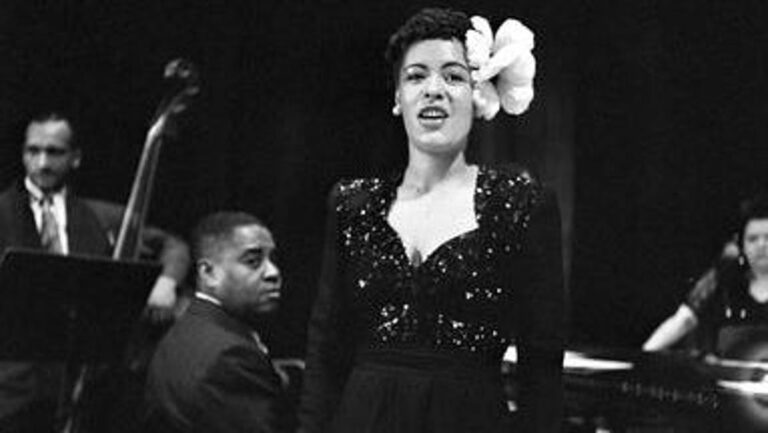
    Billie Holiday

    As a teenager, Holiday began singing in nightclubs. She teamed up with saxophonist Kenneth Hollan, performing at numerous clubs in Harlem. In 1932, Holiday replaced Monette Moore at a club where John Hammond, a producer, heard her and signed her to a record. At the age of 18, she made her first recording with Benny Goodman.

    The Depression Era

    In 1935, Holiday recorded pop tunes with Teddy Wilson. Holiday was allowed to improvise; her improvisation of the melodies to fit the emotion was revolutionary. Their first collaboration, “What a Little Moonlight Can Do” became Holiday’s ‘claim to fame’.

    Holiday soon achieved the title of big-band vocalist with Count Basie. She was able to choose her own songs, often opting to portray herself as a woman unlucky in love. “Summertime” a hit from Gershwin‘s Porgy and Bess became a hit for Holiday. Basie soon accepted Holiday’w involvement in the band, saying “When she rehearsed with the band, it was really just a matter of getting her tunes like she wanted them, because she knew how she wanted to sound and you couldn’t tell her what to do.”

    Soon, Holiday found herself in competition with Ella Fitzgerald, the singer for the Chick Webb Band, the direct competitor of Count Basie’s. On January 16, 1938, Basie and Webb’s bands had a battle at the Savoy Ballroom. Metronome magazine declared Webb the winner while DownBeat magazine pronounced Basie the winner.
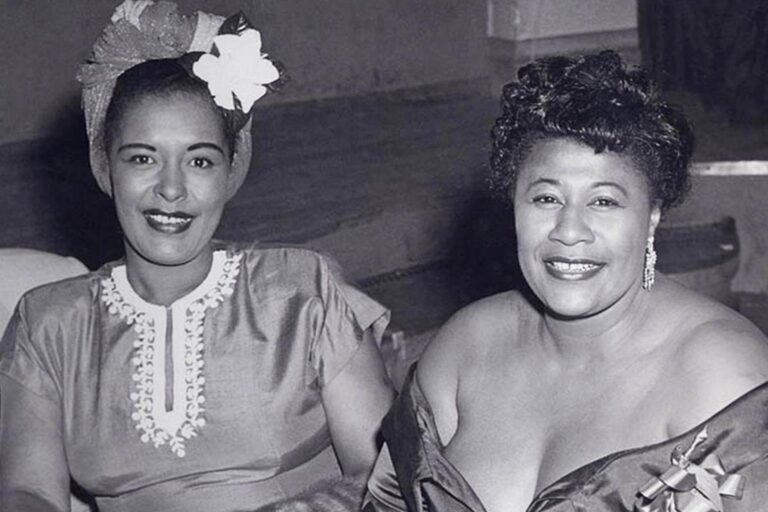
    Billie Holiday

    Holiday left Basie in 1938 and was picked up by Artie Shaw. This put her in a unique situation in that she was a black woman singing in a white orchestra in the segregated South. With Shaw, Holiday achieved notoriety, but could not sing as often as with Basie. Additionally, Shaw was pressured to hire a white singer with whom Holiday had to share time. In November 1938, Holiday was asked to take a service elevator at the Lincoln Hotel which may have caused her to leave the group soon after.

    Columbia and Commodore

    Holiday was recording for Columbia Records and when she was introduced to “Strange Fruit,” a poem about lynching. She performed it in 1939 with trepidation, later saying the song reminded her of her father’s death. He was denied medical treatment due to racial prejudice.

    For her performance of “Strange Fruit” at the Café Society, she had waiters silence the crowd when the song began. During the song’s long introduction, the lights dimmed and all movement had to cease. As Holiday began singing, only a small spotlight illuminated her face. On the final note, all lights went out, and when they came back on, Holiday was gone. Columbia Records found the subject matter too sensitive to record, so Holiday recorded it with Commodore Records. The song remained in Holiday’s repertoire for twenty years.

    Commercial Success

    Holiday got into an argument with her mother Sadie that ended in the daughter storming out, shouting, “God bless the child that’s got his own.” She then wrote “God Bless the Child,” her most popular and most covered record.
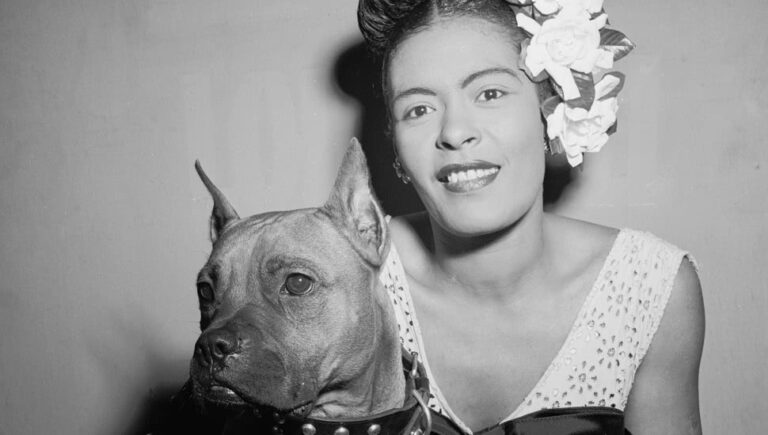
    Billie Holiday

    In 1942, Holiday recorded “Trav’lin Light” with Paul Whitman for Capitol Records, reaching number 23 on pop charts and number 1 on R&B charts. Holiday signed with Decca Records in 1944, recording “Lover Man”, another hit. In September 1946, Holiday began her only major film, New Orleans, in which she starred opposite Louis Armstrong and Woody Herman. Plagued by racism and McCarthyism, producer Jules Levey and script writer Herbert Biberman were pressed to lessen Holiday’s and Armstrong’s roles to avoid the impression that black people created jazz.

    On May 16, 1947, Holiday was arrested for possession of narcotics. During the trial, she heard that her lawyer would not come to the trial to represent her. Dehydrated and unable to hold down food, she pleaded guilty and asked to be sent to the hospital. She was sentenced to Alderson Federal Prison Camp in West Virginia. The drug possession conviction caused her to lose her New York City Cabaret Card, preventing her working anywhere that sold alcohol’ so she performed in concert venues and theaters.

    After her release in 1948, her manager, Ed Fishman, thought she should sing a comeback concert at Carnegie Hall. On March 27, Holiday played Carnegie Hall to a sold out crowd. A record number of tickets were sold in advance, a feat made more impressive since she did not have a current hit record. Holiday was again arrested on January 22, 1949 in San Francisco. That October, she recorded “Crazy He Calls Me”.

    https://www.youtube.com/watch?v=Z_1LfT1MvzI

    The loss of her Cabaret Card hurt Holiday financially. This problem worsened when Holiday’s records went out of print in the 1950s. She seldom received royalties in her later years. In 1958, she received a royalty of only $11.

    By the 1950s, Holiday’s drug abuse, drinking, and relationships with abusive men caused her health to deteriorate. She appeared on the ABC reality series The Comeback Story to discuss attempts to overcome her misfortunes. Her later recordings showed the effects of declining health on her voice, as it grew coarse and no longer projected its former vibrancy.

    In early 1959, Holiday was diagnosed with cirrhosis. She stopped drinking on doctor’s orders, but soon relapsed. She quickly lost 20 pounds. On May 31, 1959, Holiday was taken to Metropolitan Hospital in New York for liver disease and heart disease. The Federal Bureau of Narcotics had been targeting Holiday for the last twenty years. As she lay dying, they raided her hospital room, placing Holiday under police guard. Holiday died on July 15, 1959 at 3:10 a.m. due to heart failure caused by cirrhosis of the liver.
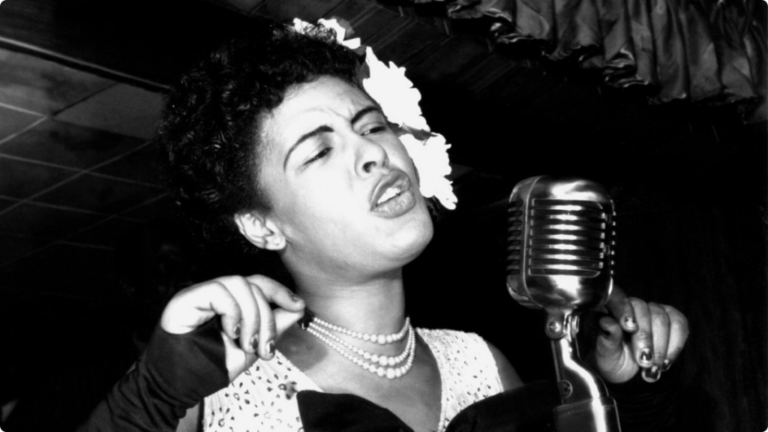
    Billie Holiday

    Legacy, Awards, and Accomplishments

    Holiday’s improvisation made up for a lack of training and was quoted saying that she wanted her voice to sound like an instrument. Frank Sinatra called her “the greatest single musical influence on me.”

    Billie Holiday and eight of her recordings have posthumously been inducted into the Grammy Hall of Fame. Holiday received a Grammy Lifetime Achievement Award (1987). “Strange Fruit” is also listed in the National Recording Registry by the Library of Congress. Four of her albums were awarded the Grammy for Best Historical Album. She is a member of the ASCAP Jazz Wall of Fame (1997), Rock and Roll Hall of Fame (2000), and the Ertegun Jazz Hall of Fame (2004).
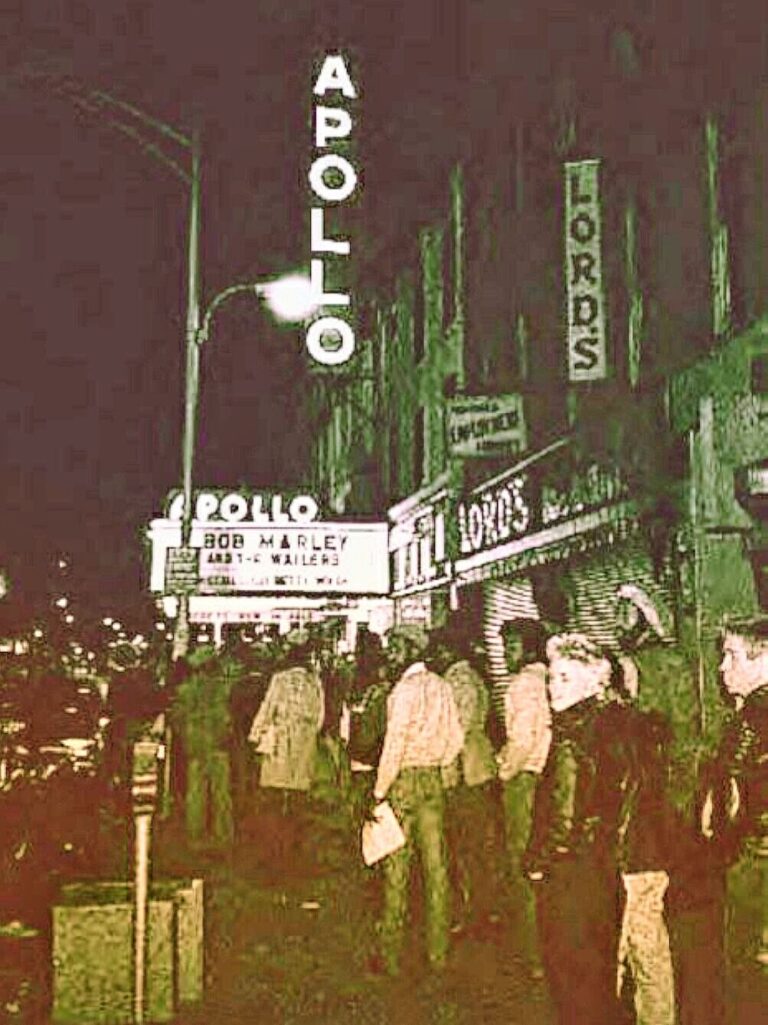
  • Lion in a Concrete Jungle: Bob Marley and The Wailers at The Apollo Theater

    Over four days in late October, 1979, Bob Marley and The Wailers performed seven shows at the legendary Apollo Theater, marking the first ever reggae performances at the recently reopened Harlem venue. The shows, beginning on October 25 and ending October 28, would add to the rich history of the Apollo and connect Marley with the one-time home of fellow Jamiacan, Marcus Garvey.

    bob marley apollo

    The shows at the Apollo were the third stop on his Survival tour, which had kicked off on October 21 in Boston at Harvard Stadium with Stevie Wonder. A day later, Marley and The Wailers would perform at Madison Square Garden in New York.

    Performing in Harlem was designed to broaden his reach to a demographic that had not yet tuned into his music, Black Americans. Dennis Thompson, one of four audio engineers and sound technicians working with Marley on these shows told the Jamaica Observer.

    Bob wanted to reach the African-American people and he liked the idea of an intimate setting, and the Apollo had it. Survival related to the struggles and oppression of people; Bob once said to me, how great it would be if there could be a United States of Africa, so these concerts were very important to him.”

    Dennis Thompson

    The album Survival still stands as one of Marley’s most politically charged albums, featuring anthems “Africa Unite” and “Zimbabwe,” the latter celebrating the fall of the white supremacist regime in Rhodesia.

    A mixed audience of African Americans, West Indians and whites was reported by Clinton Lindsay, a Jamaican student at the New York Institute of Technology. In covering the shows for college newspaper, Scope, he noted

    “The show on the Saturday night was the best, it was sold out and had the best vibes. The opening show was also sold-out and had lots of major stars attending. Each show, although the set list might have been the same, were never alike. Each had its own identity.

    Clinton Lindsay

    Part of the reason Marley sought to perform in Harlem was due to the connection of Marcus Garvey to the neighborhood. Garvey was a Jamaican-born writer and speaker in the early 20th century who encouraged the Pan-African movementa, emphasizing unity between African-Americans and their ancestral lands. Garvey would inspire Rastafarians advocating for Pan-Africanism. Marley would perform at the Apollo with three backdrops: one of the Ethiopian flag, one of Ethiopian emporer Haile Selassie I, revered by Rastafarians, and one of Garvey, Selassie and guerilla fighters.

    bob marley apollo

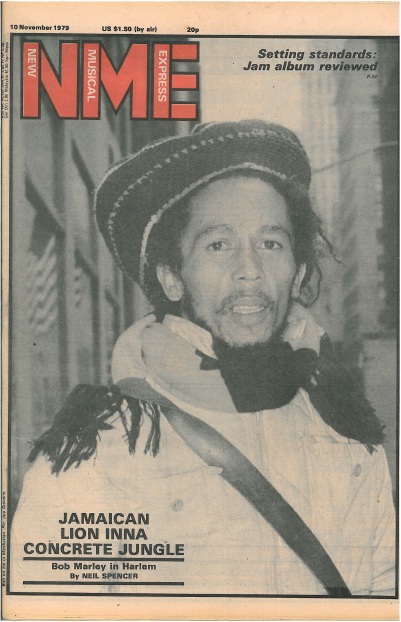
    One member of the Wailers shared with NME:

    The Apollo is an important part of black heritage, I can’t think of any major black international star who hasn’t played there at one point – Bessie Smith, Billie Holiday, right from them people there to all the soul stars, everyone. That’s one reason Bob has to play there, to put him in that tradition for people to understand.

    As told to NME

    The lineup for the Apollo residency included Bob Marley on vocals and rhythm guitar, Aston Barrett (bass), Carlton Barrett (drums), Junior Marvin (lead guitar), Al Anderson (lead guitar), Tyrone Downie (keyboards), Earl “Wya” Lindo (organ), Alvin “Seeco” Patterson (percussion), Devon Evans (percussion), Glen DaCosta (saxophone), Dave Madden (trumpet) and The I-Threes (backing vocals).

    A first hand experience from the show, shared with Marley Arkives, gives insight into the audience reaction to the peformances.

    “Concerning the Bob Marley concert at the Apollo….there were three shows, in three days….and I made sure I was present for all three…Each show was different…but each unique. The Apollo Theater has 2 balconies…I was in the first balcony …front row center…best seat in the house…I sooo wish at least one of the concerts were on film….Bob rocked the house…so much so, at one point I actually got frightened…at the end of the third and final show…Bob had everyone on their feet singing “Get up Stand up”…of course everyone got up…but it wasn’t until a few minutes into the song that I realized the whole balcony was shaking….literally moving…I kept still to see if it was movement that I was really feeling…sure enough…it was…that’s when I started to hope that the balcony would hold….the balcony was full…even the isles…the Apollo is an old theater…..After the concert , I left feeling fulfilled and exhausted…Bob had taken all my energy…..any time he played NYC I was there….have never been to a concert that could surpass any Bob Marley concert since…….BLESS.”

    As shared to marleyarkives.wordpress.com
    bob marley apollo

    Opening the shows was Betty Wright, known for “Clean up Woman” and “Tonight is the Night,” singing with a range from disco to soul. The New York Times said of the run of shows:

    The theme of Bob Marley’s four-evening stint (Thursday through tomorrow) at Harlem’s newly reopened Apollo Theater is “black survival,” and Mr. Marley’s own survival has been a subject of concern lately. Although he seems to have recovered fully from a shooting incident a couple of years ago in politically turbulent Ja- maica, his reggae nas sounnea ratner pallid on recent albums and his opening‐night performance on Thursday was his first New York City appearance in nearly a year and a half.

    While the Times felt that Marley was less energetic, he had begun to use his presence on stage to preach and inspire, with impassioned vocals and an audience that quickly warmed up and threw their energy back at the stage. These historic performances would be among Marley’s last shows in New York, returning the next September to open for The Commodores at Madison Square Garden in September, 1980; it would be one of Marley’s last performances.

    On September 21, 1980, Marley would collapse while jogging in Central Park, likely due to malignant melanoma cancer he was diagnosed with three years prior. He would perform one more time, at the Stanley Theater in Pittsburgh, before losing his battle with cancer at age 36.

    Setlist – Bob Marley and The Wailer at The Apollo Theater, October 25, 1979

    Natural Mystic, Them Belly Full (But We Hungry), I Shot the Sheriff, Concrete Jungle, Ambush in the Night, Ride Natty Ride, Running Away, Crazy Baldhead, Wake Up and Live, One Drop, No Woman, No Cry, Jamming, So Much Trouble in the World, Zimbabwe, Africa Unite, War, No More Trouble

    Setlist – Bob Marley and The Wailer at The Apollo Theater, October 28, 1979

    Positive Vibration, Wake Up & Live, The Heathen, One Drop, I Shot The Sheriff, Runnin Away, Crazy Baldhead, Zimbabwe, War, No More Trouble, Exodus

    Encore: No Woman No Cry, Jammin

    https://www.youtube.com/watch?v=GWcj3WRC8Dw
  • A$AP Ferg releases latest project: Floor Seats II

    On a day clouded by social media turmoil featuring Tory Lanez and Megan Thee Stallion, A$AP Ferg has quietly released Floor Seats II, the sequel to his 2019 EP, Floor Seats. Looking to follow-up on the success of its predecessor, which spawned hit records like “Jet Lag” and “Floor Seats.”

    This latest project comes on the heels of reported disfunction within the A$AP collective. A$AP mob founding member A$AP Illz has accused the 31-year-old Harlem-bred emcee of stealing ideas and claimed the “Plain Jane” rapper’s affiliation with the Mob was over.

    Not one to go back-and-forth through the media, Ferg has predictably kept quiet, relying on his art to do the talking for him. The 10-track project features a myriad of notable guest appearances that captures Ferg’s Kaleidoscopic approach to music.

    The intro features rock & roll legend Marilyn Manson, while the star-studded tape also features: Lil Wayne, Tyga, Nicki Minaj, Puff Daddy, New York City up-and-comer Jay Gwuapo, as well as XXL 2020 Freshman Class members Fivio Foreign and Mulatto. 

    Known for his hard thumping and anthem-like records, Ferg and A$AP Mob affiliate A$AP Rocky, serve as the lynchpins the the group’s success. With their ascension as major players in hip hop, the collective has been able to venture successfully into other fields. With A$AP Bari’s successful Vlone brand a prime example. While the group’s dissimilation may seem in effect. For now though, A$AP Ferg still carries the moniker, and with an impressive resume of Billboard charting hits, his descension is certainly not imminent.

  • Karma 3: Dave East still searching for his own Direction on New Album

    In the most recent installment of his Karma mixtape series, Harlem rapper Dave East makes his latest attempt at solidifying himself as one of New York’s head honchos. The 15-track, 53-minute project features notable guest appearances. Trey Songz, French Montana, Benny the Butcher, A Boogie wit da Hoodie, dancehall artist Popcaan, along with R&B legend Mary J. Blige, all lend-a-hand, in what felt like East’s best attempt at a commercially successful project. 

    The mixtape opens up with arguable its best record. “Handsome” is a thumping and fast paced track where East confesses his life’s agendum, which are “to not break the code,” “try not to die,” and “praying that he gets old.” It is an ode to the lifestyle that many from the inner-city can have an appreciation for. In 2:53, East captures the hopes and dreams of a generation of men, which is wealth and health, while staying loyal to their compatriots. What makes the record even better is that, while it has a radio feel to it, the authenticity remains. And with it being just shy of 3 minutes, the replay value is high. He follows it up with a record that feels straight of a Caribbean crime film. Backed by loud and distinctive horns, “Unruly,” features Popcaan and serves as an antithesis to its predecessor. While “Handsome” described the perfect outcome from a life in the streets, “Unruly” sees East chronicle the dangers that come with operating on the other side of the law. 

    The third track is where the album takes a turn, in the Trey Songz assisted “The City,” East tries recreating one of Jay Z’s better records “Heart of the City.” While a noble attempt, he lacks the soulfulness to pull it off. Not to mention, at the time of the original recording, Jay-Z was arguably the biggest rapper in the game and thus metaphorically was the “Heart of the City.” We do not think of Dave East in the same vain (or any current New York rapper for that matter). The same issue follows him on the fourth track, “Get the Money.” It’s a solid enough song, as he details his chase for financial prosperity. A god-awful French Montana chorus — along with a bridge that sees Dave East try his hand at harmonizing – completely derail it. He completes a hat-trick of melodically challenged songs with “Thank God.” Featuring A Boogie wit da Hoodie, East tries his hand at a club record, but the song never takes off, as the duo lack chemistry and it ultimately ends up feeling forced. 

    This ebb-and-flow continues throughout, as the best records see East stay in own pocket, solid beats, along with well put together verses, while his attempts at diversifying himself see him fall short. “Said What I Said,” “Broke or Not,” “Mission,” “Menace” and the Three 6 Mafia inspired “F**ck Dat,” are all good songs. While “Stone Killer,” — featuring Benny the Butcher — is absolutely explosive. The Mary J. Blige assisted “Know How I feel,” was a nice surprise as East meshed well with the r&b icon. Yet, for some reason, it did not serve as the outro. That was reserved for the self-reflective “Believe It or Not,” and while it is a good enough record, it left the project a bit anti-climactic. 

    All in all, this is a solid body of work, yet it feels as though the pressure for commercial success inspired a few of the songs. The problem is, Dave East isn’t and will probably never be a top-selling (or charting) artist and that’s okay. While he hasn’t led New York back to dominance as some predicted, his abilities as a rapper is still a rare and valuable commodity in this current era of New York hip hop. 

  • Movement to make The Apollo Theater an official Broadway House gains momentum

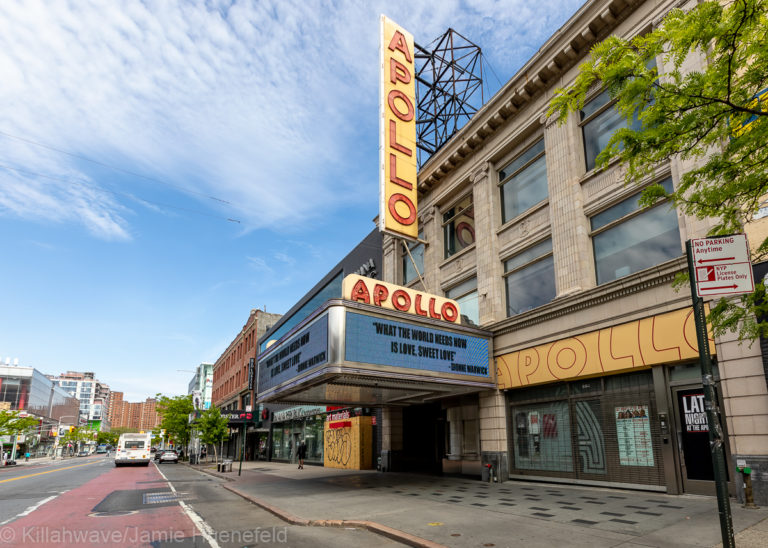
    There are 41 theaters on Broadway and they each have one thing in common: none are owned by African-Americans. The Apollo Theater, located on 125th street in Harlem, opened its doors to the public in 1914 and has been a vibrant piece of New York’s history and culture ever since. Many jazz, R&B, and soul legends began their paths to fame at the Apollo theater’s famous amateur nights. The theater has been both a state and city landmark since 1983 and still remains an important part of New York theater to this day. Despite this, it is not considered a Broadway theater.

    apollo theater broadway
    photo by Jamie Huenefeld

    The only thing which distinguishes Broadway from Off-Broadway is the number of a theater’s seats. All Broadway theaters must have 500 seats or more; theaters with 99-499 seats are deemed Off-Broadway. The Apollo Theater has 1,506 seats.

    A petition to make the Apollo Theater a Broadway theater has been attracting attention in the past few days. If it were a Broadway theater, yhe Apollo would be eligible for Tony Awards and become involved in Tony nominations. As the Apollo Theater works to represent the cultural diversity of New York City, many believe that more BIPOC actors and team members would be nominated for Tony awards were the theater given leeway in the nominations.

    The Apollo Theater is currently closed with no events scheduled through June 30.

  • Juelz Santana Releases ‘#FREESANTANA’

    It seems like not even jail cells can keep Juelz Santana away from what has been his life’s true passion. On March 3, the veteran emcee released the 9thfull-length project of his career, #FREESANTANA. Santana – born LaRon Louis James – was arrested in March 2018 after he fled the scene when TSA found a gun in his bag at Newark Liberty International Airport in New Jersey. Seemingly counting down the days until his rumored summer 2020 release, the rapper’s Twitter page recently posted on behalf of the incarcerated artist, acknowledging the one year anniversary of his incarceration.

    The surprisingly cohesive mixtape is packed with star power, featuring the likes of Lil Wayne, 2Chainz, Jeremih, A Boogie wit da Hoodie, Dipset cohort Jim Jones, and younger Harlem native Dave East, along with samples of Drake’s number 1 record, “God’s Plan.” 

    https://www.instagram.com/p/B9QlboQlOhK/?utm_source=ig_web_copy_link

    Juelz Santana uses the 36-minute project to touch on a myriad of topics. On records like “23 & 1,” “Do You Believe” and “In My Life,” he raps introspectively about past friendships and relationships, while reflecting on his incarceration. On “Pink Eagle” and “Ez Work,” he spends time reminding listeners that he’s a respected hustler, with plenty of street tales. The project’s outro record is a sample of Jay – Z’s classic record “Dead Presidents.” Titled “The Get Back,” with a feature from A Boogie wit da Hoodie, Santana reflects with a mixture of street tales, lessons and hope for his future post-release.