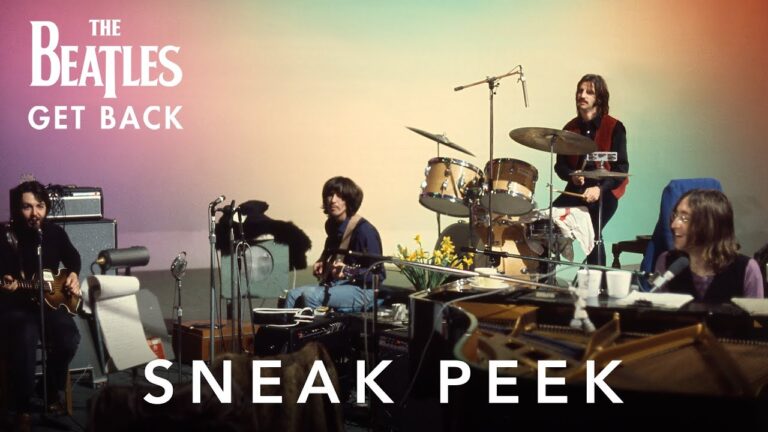
Oscar winning filmmaker Peter Jackson has collaborated with The Beatles for the upcoming documentary, The Beatles: Get Back, due out in August, 2021.
Get Back looks at the Fab Four in 1969 and 1970, when John Lennon, Paul McCartney,George Harrison and Ringo Starr were preparing for their first live show in two years, showcasing the camaraderie and spirit between them, as they wrote and rehearsed 14 new songs.
The film draws from 56 hours of previously unseen footage of the band, shot by Michael Lindsay-Hogg in 1969, and includes more than 150 hours of audio. Also included in the documentary is the band’s final live performance as a group in London, England.
Paul McCartney said in a tweet:
Peter Jackson has released an exclusive sneak peek of his upcoming documentary “@TheBeatles: Get Back” for fans everywhere to enjoy.
In a video message, Jackson introduced an extended preview, noting that the film was due to be finished by now, but has been delayed due to the COVID-19 pandemic, saying “Hopefully it will put a smile on your face in these rather bleak times that we’re in at the moment.”
Jackson’s native New Zealand has COVID-19 under control, leading him to be able to resume work on the film. He stresses that the video shared is not a trailer, but a montage of scenes so far collected for the film, set to a rehearsal recording of the movie’s title track.
The Beatles: Get Back will be released with a new book of the same name, the first official book credited to the band since 2000’s The Beatles Anthology. The new book will be out on August 31, 2021, and features an introduction by Hanif Kureishi.
The Beatles: Get Back will open in theaters on August 27, 2021.
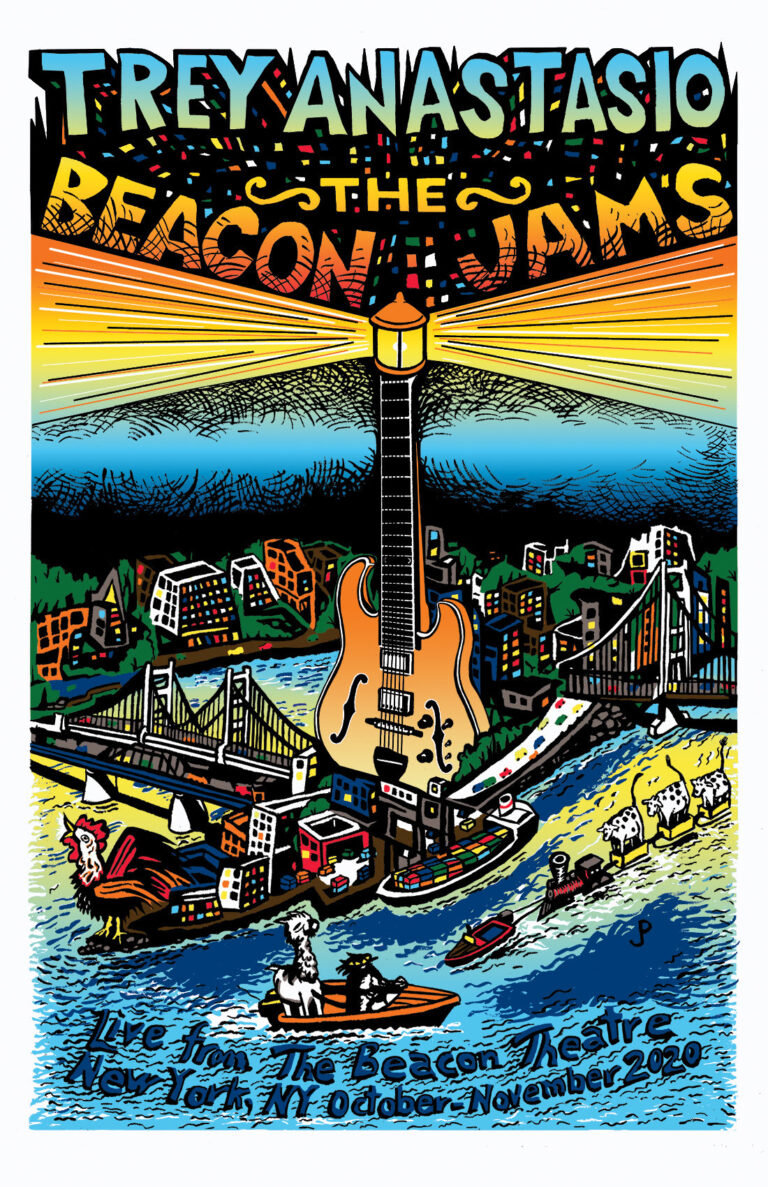
A surprise for anyone who caught any of the eight weeks of The Beacon Jams – “What Calls You Home” – a 17-minute short documentary featuring interviews and behind the scenes footage was released on Thursday, December 10. .
Created by the MSG Entertainment team, “Whatt Calls You Home” features exclusive performance highlights and in-depth conversations with Trey Anastasio and members of the production who helped bring the virtual residency to life.
The Beacon Jams was an overwhelming success – held at the historic Beacon Theatre, Trey along with his band and several special guests performed 151 original songs (with no repeats) and more than 20-hours of live music. Over eight weeks, hundreds of thousands of fans tuned in for the live streams, and in turn helped raise $1 million in donations for the Divided Sky Fund, part of Phish’s WaterWheel Foundation, which will help fund a drug treatment center in Vermont.
“What Calls You Home” is a fascinated look at how this unique residency came together at such a critical time in the music industry and across the nation and world, a true tribute to the power of live music.
Read NYS Music’s reviews of each weekend of The Beacon Jams here.
In the gatefold of “Freak Out!,” his stunning double disc debut from 1966, Frank Zappa includes a telling quote from Edgar Varèse, the composer he idolized first and maybe above all others. It’s a creative call to arms in seven words, one he lived virtually round-the-clock for most of his 52 years: “The present day composer refuses to die.”
With Alex Winter’s long in the works documentary ZAPPA, we get an all-access and bravely unvarnished view of the life of this epic American creator and thinker. It’s the story of a man, a composer first and foremost, who would defy any obstacle to get the music dancing in his head out and heard. And the most important audience for it, the only one that really mattered though millions would come to love it, was Zappa himself.
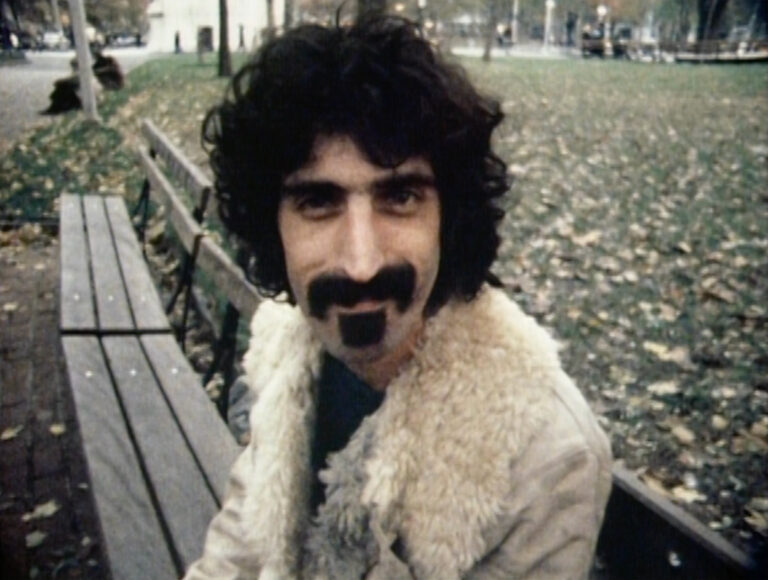
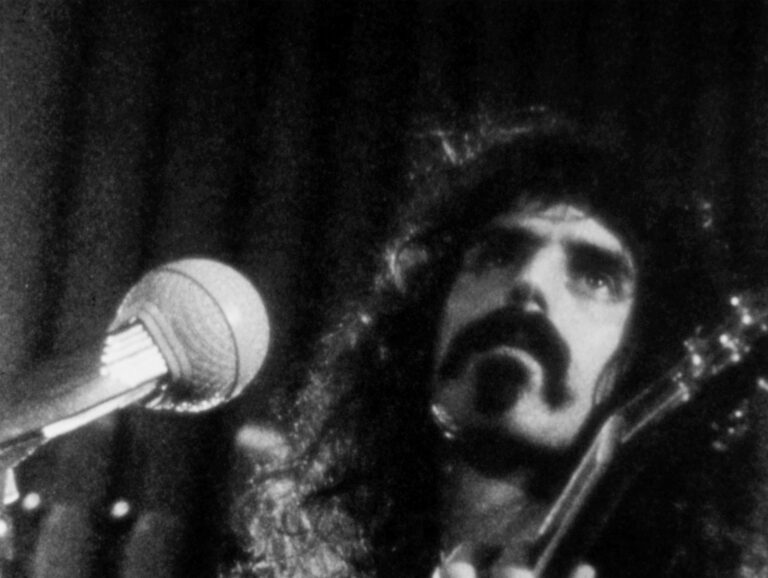
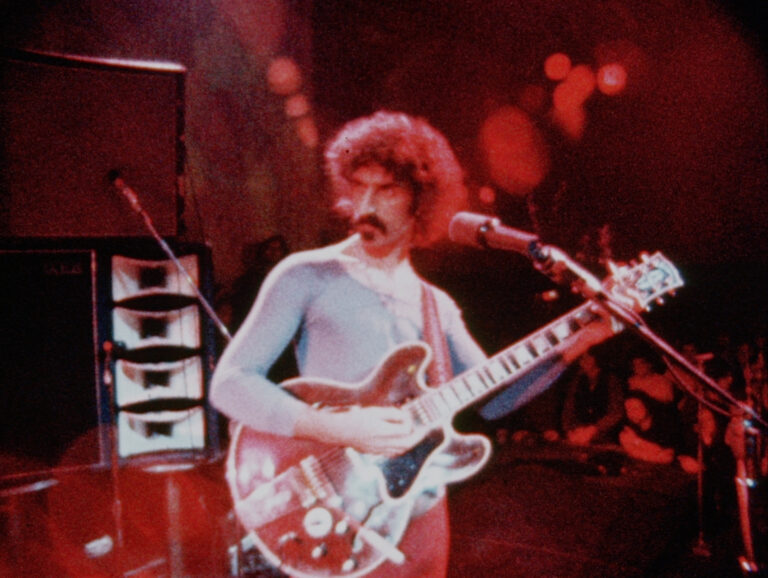
Frank Zappa in ZAPPA, a Magnolia Pictures release. Photo credit Roelof Kiers. Photo courtesy of Magnolia Pictures.
ZAPPA is anything but the formulaic rock doc of “rise-fall-rebirth” pioneered by the likes of VH-1. It’s a comprehensive and surprisingly honest look at a cliché, that holds a hell of a lot of water in this case – the agony and ecstasy of the artist.
Winter’s documentary follows every chapter of Zappa’s struggles and triumphs, from his childhood and teens in Baltimore and the California desert, to the global adoration he was beginning to enjoy at the time of his death in 1993. In the end, Zappa was finally acknowledged as both a serious composer in the grand classical tradition and a singularly eloquent champion of freedom. This was for his almost solitary anti-censorship battle with the Parents Resource Music Council (PMRC) in America and Eastern Europe, where his free-spirited music helped power the “Velvet Revolution” against the Soviets.
Importantly, the doc also spotlights the sacrifices and conflicting emotions of many musicians who worked to bring his challenging music to life, and the family that took a backseat to the ceaseless writing, recording and touring his muse demanded.
Through Zappa’s widow Gail, Winter and his creative partners were granted exclusive access to a voluminous collection of unreleased recordings, concert footage, incomplete films, unseen interviews and home movies. It’s the latter, spanning his childhood through his final days, which really shed a fresh, relatable viewpoint on this genius music giant.
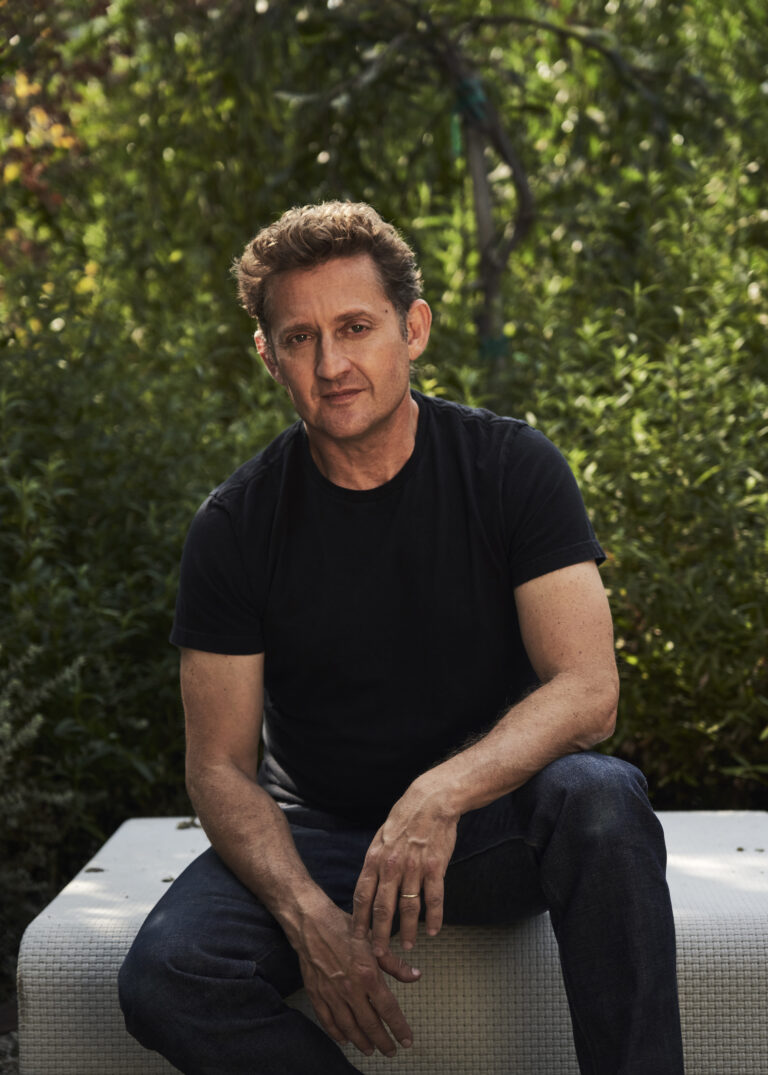
Portrait of Alex Winter. Photo Credit: Philip Cheung
The film begins at the end, with Zappa at his final public performance in Prague in 1991. Here he is playing guitar for the first time in three years to help the Czechs, who had a special love for him and their Zappa superfan President, Václav Havel, celebrate their independence. Then come clips of the many news stories worldwide that marked his passing. Following is a scene of Frank walking the corridors of his vast “Vault,” an archive containing tens-of-thousands of hours of music, film and other artifacts, the entirety of nearly 40 years of his creative labor.
From there, Winter takes us to the beginning, with some remarkable home movies that humanize this larger-than-life figure as a child. There’s young Frank in the kitchen with mom and dad, in the backyard cavorting with brothers and sister. He’s an all-American boy for sure, but one already carrying an all-knowing smirk, even then. There are also scenes from a goofy horror movie he made with his dad’s film camera in 1956. Experimenting with his dad’s 8-millimeter gave Frank a love of editing and splicing, something that would go on to inform much of his musical output. It is the flowing editing of all the unearthed material above smartly juxtaposed with his many eras of diverse music to it, that makes this film such a rewarding and dreamy viewing experience.
Perhaps inspired by his dad’s work as a munitions scientist, Frank developed a love of chemistry. He reminisces in the film about learning how to make gun powder at 6, and his last experiment, when he was suspended for attempting to blow up his high school at age 15.
It was another thing that went boom, the work of Edgar Varèse, that drew Zappa to music. The fun loving Zappa just had to seek out an LP that a magazine claimed was the “ugliest” and “most frightening ”music ever committed to vinyl, Varèse’s 13-percussionist heavy “Ionization.” With this as inspiration, Zappa takes up the drums and states his intention to become a classical composer, just like his idol. Watch for the great footage of a military haired Frank banging away on the trap kit, with pork pie hat on his head and ciggie in mouth, with his first real band, The Blackouts.
The film then proceeds in chronological order through the many chapters that seeded his career, told with a remarkable collection of unseen footage, interviews and sounds.
There’s the teen years in the California desert, where he discovers a love of R&B with his good pal Captain Beefheart. Don’t forget his experimental days with his own recording facility, Studio Z, which he bought with the proceeds from scoring two films. There’s more intriguing footage from a never-completed sci-fi film he worked on with Beefheart. Also, the details of his bust for obscenity, for making a racy audio tape for an undercover cop who wanted to shutter his studio. According to Zappa in the film, “that little escapade was the most informative part of my political training.” There’s also great images of the Mad Magazine-inspired greeting cards Zappa created in his day job as commercial artist, all to supplement his musical aspirations.
Frank Zappa in ZAPPA, a Magnolia Pictures release. Photo credit Zappa Trust. Photo courtesy of Magnolia Pictures.
“If I was ever going to hear what I wrote, I would have to put a band together”
Zappa
This quote leading to some suitably psychedelicized footage of the early Mothers at the LA’s Whiskey A Go Go and their six-month, nightly stint at the Garrick Theater in New York in 1967. It’s the latter that proved most formative to the non-musical parts of Frank’s oeuvre.
“The Garrick was like the Beatles in Hamburg,” says Zappa’s wife Gail. “The attention to the theatrical side grew because they needed to do a new show, every night. It was like the theater of cruelty… the same people came again and again. But it really helped him perfect what he could get away with on stage.”
Two of the most meaningful interviews in the film come from early Mothers, saxophonist Bunk Gardner and Ian Underwood, Zappa’s musical second through the early ‘70s.
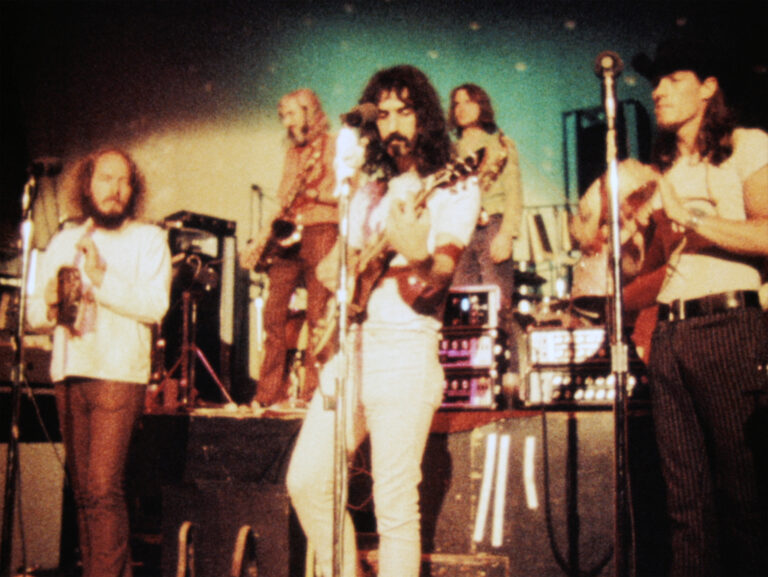
Frank Zappa performing with The Mothers of Invention in ZAPPA, a Magnolia Pictures release. Photo credit Cal Schenkel. Photo courtesy of Magnolia Pictures
“Not too many bands had horns, and no bands were playing Stravinsky, which made me feel good about what we were doing,” says Gardner. “Perfectionism became our duty. We would go in for eight, 12 hours, him drinking black coffee. He didn’t stop. It didn’t matter if it was Christmas or Thanksgiving, we were going to rehearse. He was writing all the time, introducing new stuff.”
“But in the four years I was with him,’ Gardner laments, “he shook my hand and said, ‘good job’ maybe once.”
Underwood states the bottom line: “The band wasn’t anything other than Frank’s ideas, and each show was like a new composition.”
The film tells of Zappa’s decision to break-up the much-loved original Mothers in 1969. He was $10,000 in debt and didn’t want to be responsible for other people. He wanted to make new and varied musical statements and would put together the ideal musicians, often undiscovered virtuosos, to make them happen. It was an ever changing lineup, one that made the careers of new stars like Adrian Belew and Steve Vai along the way.
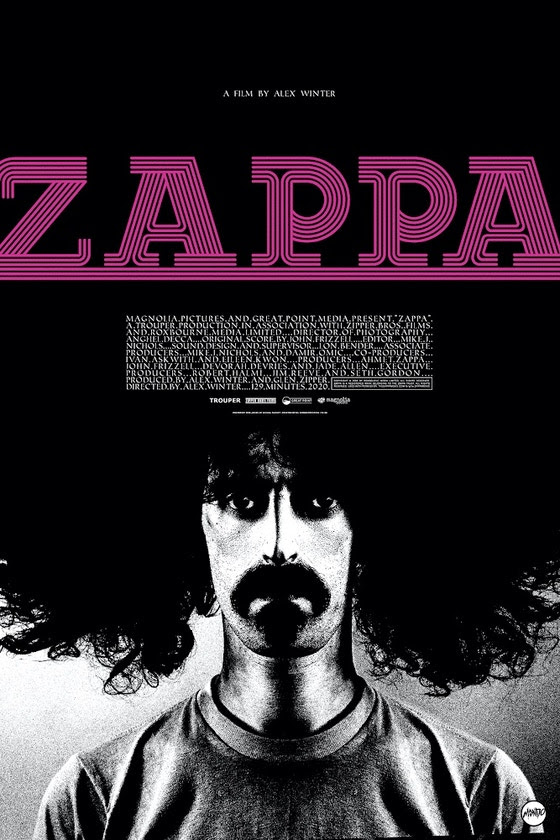
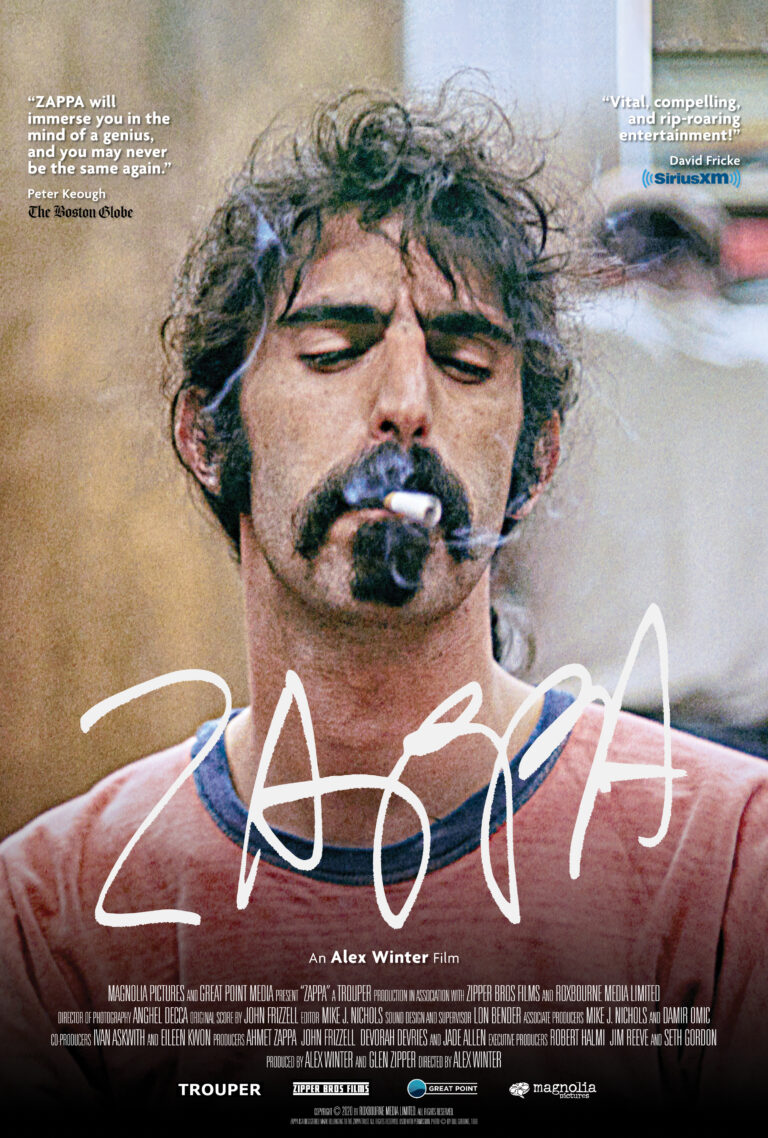
Theatrical one-sheet for ZAPPA, a Magnolia Pictures release. Bill Gubbins. Photo courtesy of Magnolia Pictures
The film closely details the many musical chapters and aggregations that follow. There’s his film “200 Motels” with his band with the Turtle’s Flo & Eddie and their Fillmore East jam with John and Yoko. There’s the “Waka Jawaka” jazz big band, the incredible fusionoid “Roxy & Elsewhere” band with George Duke, Ruth Underwood and the Fowler Brothers thru to his final 1988 ensemble which broke up in the midst of what would be his final tour.
“I was a tool for the composer and (Zappa) used his tools brilliantly. Frank was a slave to his inner ear. He tried to manifest it in a world of limitations, financial and performance limitations. That led to a lot of suffering for his art.”
Steve Vai observes
Ruth Underwood, the brilliant percussionist who was with Zappa on and off from his Garrick days, recalls. “He was a mass of contradictions, but very consistent with them.He had great feelings for us. He was human, at times cruel, but very passionate. He had real love, and the people he loved he kept bringing back.”
ZAPPA is perhaps the first officially sanctioned Zappa content that doesn’t sugarcoat the emotional impact of Frank’s workaholism on his marriage and children.
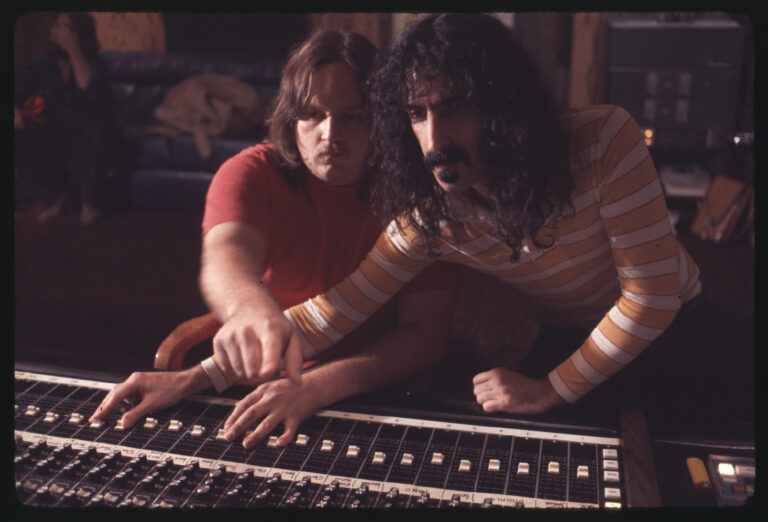
Frank Zappa in ZAPPA, a Magnolia Pictures release. Photo credit Roelof Kiers. Photo courtesy of Magnolia Pictures
One thing I was clear about is that I married a composer, and you have to be out of your mind to take it on. There’s no guarantee you will earn an income and nobody cares, the odds are pretty fantastic.
Gail Zappa
The film has more unseen home movies and details, provided by super groupie and Zappa family nanny Pamela Des Barres, about Zappa’s time at his famed “Log Cabin” in Laurel Canyon. His home served as the “centrifugal point” for homegrown stars like Jim Morrison and The Byrds and visiting rock royalty like Mick Jagger and Jeff Beck.
Des Barres, Gail and Frank himself confirm what had been kept somewhat mum until now – his horn dog ways as a touring musician. “She didn’t like it, but she knew,” says Des Barres of Frank’s affairs on the road. And in a never-before-seen interview, Zappa says of his time on the road: “I’m a human being, I like to get laid.”
Ruth Underwood observes, “Frank had a polarity of passion. He couldn’t wait to get out of the house and go on road, but he was happy when he got to come home.”
When Zappa was home, he was largely away from his family, working the night shift in his basement studio, then sleeping all day. One poignant chapter in the doc is the genesis of his only Top 40 hit, “Valley Girl.” This came about when his daughter Moon figured that the only way she would get to spend time with him was to suggest they make music together. She slipped a note under his door telling him this, and their collaboration led to mainstream acceptance and a Grammy nomination. Another beautiful scene is of baby Moon being cuddled by her parents and they dance to the strains of a classical favorite that Zappa quoted often, Stravinsky’s “Firebird Suite.”
Kerry McNabb and Frank Zappa in ZAPPA, a Magnolia Pictures release. Photo credit Yoram Kahana. Photo courtesy of Magnolia Pictures
The film makes clear Zappa’s true obsession. “My desires are simple. All I want to do is get a good performance and a good recording of everything I ever wrote, so I can hear it. If anyone else wants to hear it, that’s great too. Sounds easy, but it’s hard to do.”
A good portion of the final third chronicles Zappa’s classical works, and the struggles to not only finance their production, but to have them performed on a level that would meet his exacting standards. It spotlights his work with the London Symphony Orchestra and Kronos Quartet, whose David Harrington puts Zappa in league with “American experimentalists like Harry Partch and Sun Ra, who reimagined what music could be.” Also covered is his explorations of doing it all by himself, with the then edge-cutting computer music station, Synclavier, with snippets from the final work released in his lifetime, “Civilization Phase III.”
The film ends with a positively jaw-dropping 13-minute sequence of the Ensemble Moderne performing Zappa’s acclaimed “Yellow Shark,” at his last public appearance in November 1992. With Ensemble Moderne, Zappa felt he had finally nailed it in the classical realm. And here, this remarkable music serves as backdrop for a lengthy montage, where the scenes of his life rewind before viewer eyes in true Hollywood tradition. After a music and dance encore of his treacherously beautiful “G-Spot Tornado,” and a 20-minute standing ovation, Zappa winks to the audience and concludes: “I guess there’s no accounting for taste.”
In the end, whether it was his true feelings or a put-on, Zappa gives this advice to aspiring composers. “Get a real estate license. If you want to be a composer, you must have another job to support your habit.”
I would be remiss not to add a few more important thoughts about this movie. The first is that it is a product supported by the fans, by a two-year crowdfunding campaign that raised more than any other documentary, nearly $900,000 which went to restoring the archival material. And all the fans who put up their hard earned cash up receive mention in the lengthy credits.
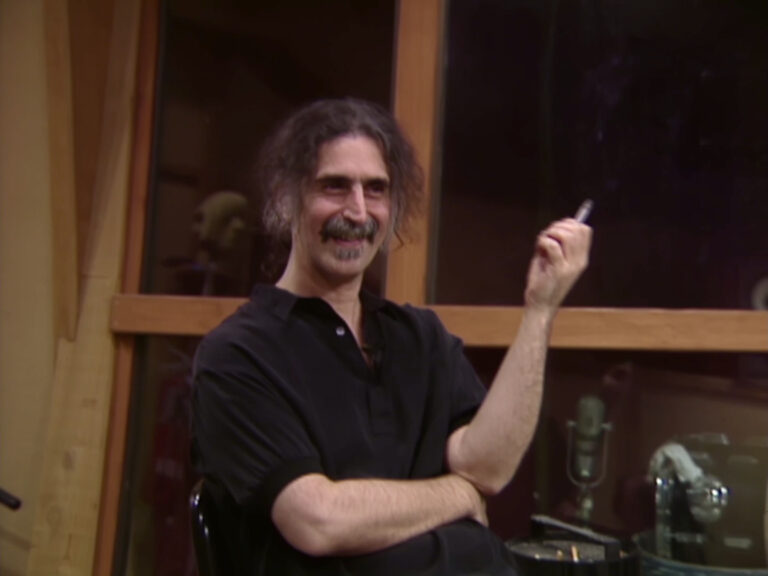
Frank Zappa in ZAPPA, a Magnolia Pictures release. Photo credit Dan Carlson. Photo courtesy of Magnolia Pictures
Unlike recent rock documentaries like “Once Were Brothers: Robbie Robertson and the Band,” this film is all the stronger for not being afraid to show Zappa’s missteps and personal failings, the people who also suffered and might’ve felt slighted as he pursued his sonic calling. Unlike the aforementioned documentary, where Robertson does a somewhat dishonest job of PRing his own contributions and sweetening over his massive conflicts with his bandmates, there’s none of that here. And with Frank being the control freak he was, this documentary could’ve only been done in such a way after his passing.
For a Zappa lover like me, this film was a truly rewarding and emotional experience. Zappa’s music was and still is an important soundtrack to my life. It’s the work of a fearless free thinker and experimenter, a self-reliant visionary who inspired me seek out sounds and thoughts from out of the mainstream.
For those not in the know, it’s the perfect primer. It’s an artfully constructed, comprehensive cinematic introduction to a man who made as broad and lasting an impact as any 20th Century musician. It’s also a study of the resourcefulness and fortitude needed to succeed in any creative endeavor, and a salute to a brave and much missed warrior for the causes of creativity and freedom of expression.
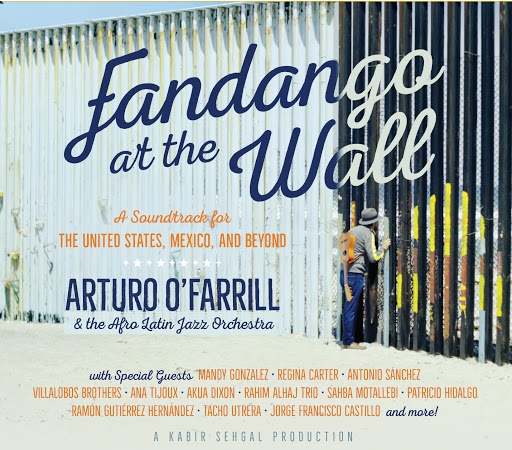
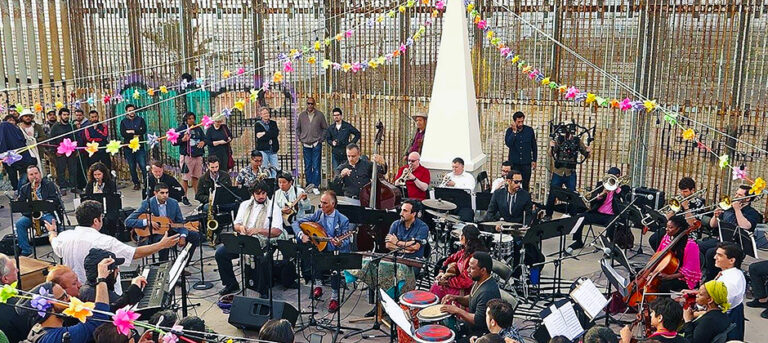
The music documentary Fandango at The Wall premiered on HBO Latino on Friday, September 25 and is now streaming on HBO Max. Taking place on both sides of the United States/Mexico border, founder Jorge Francisco Castillo invited multi-GRAMMY Award-winning musician Arturo O’Farrill and multi-GRAMMY Award-winning producer Kabir Sehgal to Veracruz.
The intent behind the film was to meet the masters of Son jarocho, who perform 300-year-old folk music. Musicians took their places on both sides of the Tijuana-San Diego border, playing big band, jazz arrangements. People gathered on both sides, enjoying the presence of the harmonious music despite being on alternate sides of the United States/Mexico border.
Since the election of our current president, border tension has been rising in the past few years. The wall may be symbolic of division, but the annual “Fandango Frontierizo” music festival aims to unite all people together, regardless on whatever side of the wall a person is on.
The film was directed by Varda Bar-Kar and executive produced by Quincy Jones, Andrew Young, and Carlos Santana.
Our film shows how the border can become a place of friendship and amity by harnessing the power of Afro-Mexican music known as Son jarocho I’ve been making music for decades, and I’ve never experienced a more enveloping and transformative artform.
Fandango at The Wall features Son jarocho legends Andrés Vega, Martha Vega, Ramón Gutiérrez, Wendy Cao Romero, Tacho Utrera, Fernando Guadarrama, and Patricio Hidalgo. Guest appearances include multi-Grammy nominee and MacArthur Foundation fellow Regina Carter, CNN historian Douglas Brinkley, Mandy Gonzalez, The Villalobos Brothers and Grammy nominees Rahim AlHaj and Sahba Motallebi. For more information regarding “Fandango at The Wall,” visit the film’s website, as it sure to present a diverse, and interesting, expression of music on visual platform.
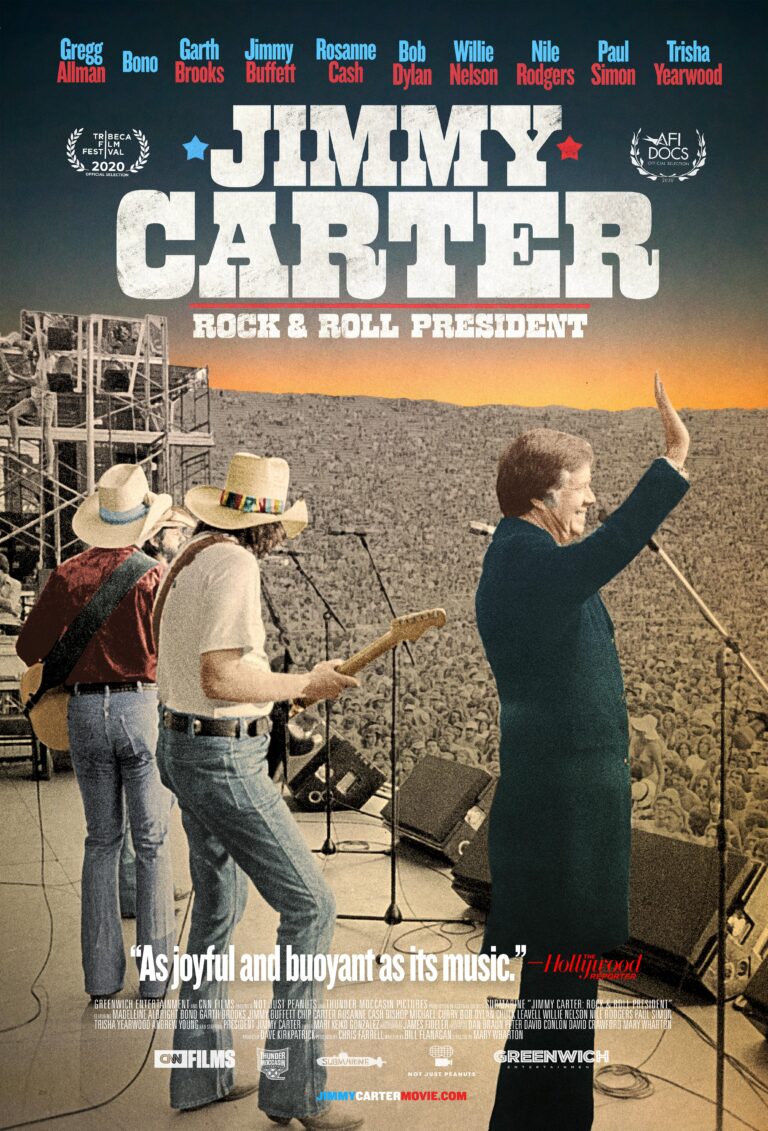
Jimmy Carter Rock & Roll President documentary hit theaters across the United States and the virtual cinema stage on September 9, 2020. The documentary covers how Jimmy Carter relied on musicians’ support during the Democratic primaries to build up his name recognition and support from the general public.
The documentary focuses on how youth culture and politics join forces in Jimmy Carter being elected as the 39th President of the United States. Jimmy Carter’s love of music was crucial to who he was and he made that known throughout his presidency and his campaign. His love of music affected who he was as a father, a citizen, a man of the South, and as a leader and he made that known to everyone and anyone he could.
The documentary includes interviews with big names like Bob Dylan, Bono, Willie Nelson, Paul Simon, Gregg Allman, Garth Brooks, and many others. There will also be interviews included with former President and Nobel Peace Prize winner Jimmy Carter.
The film is directed by Mary Wharton and written by Bill Flanagan. It is produced by Chris Farrell and Dave Kirkpatrick. The executive producers include Dan Braun, Mary Wharton, Peter David Conlon, David Crawford. Peter Afterman and Tracy Falco are the consulting producers on the film. The film is edited by Mari Keiko Gonzalez and has Tom Beard, Jim Free, Frank Moore as consultants on it. The production coordinator is Linzy Hayes. The drone photography is done by Brad McColl and James Fideler worked as the director of photography on the documentary. All the original music is composed by Bradley Cole Smith and Bill Wharton (The Sauce Boss).
People interested in seeing the film have two options for viewing it. They can see it in select theaters across the United States or on the virtual cinema stage. All the theatrical listings and locations can be found on here. The virtual cinema tickets can be bought here for $9.99 and will be available for 14 days once the viewer unlocks the film. Once the viewer begins the film, they will have 72 hours to finish watching it.
For more information on Jimmy Carter Rock & Roll President documentary visit the films’ website.
Oscar winning film director Martin Scorcese has announced plans for a documentary on David Johansen of New York Dolls fame. The film will explore Johansen’s teen years growing up in Greenwich Village, his alter ego Buster Poindexter, feature footage of Johansen’s recent performances at New York’s Café Carlyle.
To be released on Showtime, the Queens-born/Little Italy-raised Scorcese will co-direct the film with David Tedeschi, who has previously worked with Scorcese on music documentaries No Direction Home and Shine a Light.
The film plans to take an intimate biographical look at Johansen, looking at his upbringing on Staten Island and later his arrival in New York’s East Village in the late Sixties. While known best as lead singer of the New York Dolls, the documentary will also explore his time in the 80s as alter-ego Buster Poindexter and later the Harry Smiths.
“I’ve known David Johansen for decades, and his music has been a touchstone ever since I listened to the Dolls when I was making Mean Streets. Then and now, David’s music captures the energy and excitement of New York City. I often see him perform, and over the years I’ve gotten to know the depth of his musical inspirations. After seeing his show last year at the Café Carlyle, I knew I had to film it because it was so extraordinary to see the evolution of his life and his musical talent in such an intimate setting. For me, the show captured the true emotional potential of a live musical experience.”