Utica’sall grown up boy wonder guitar god, Joe Bonamassa, has just unleashed another fantastic solo album, Royal Tea. Recorded at London’s iconic Abbey Road Studios. Bonamassa’s latest is a tip of the hat to his British blues rock heroes, Jeff Beck, John Mayall & The Bluesbreakers, Led Zeppelin, Cream and more. It is also as much a showcase for his increasingly progressive and mature songwriting, as is his always sizzling six-stringery.
The 10 originals here were co-written by Joe and Brit notables including former Whitesnake guitarist Bernie Marsden, ex-Cream lyricist Pete Brown and piano man Jools Holland of Squeeze fame. Bonamassa’s long-standing producer Kevin Shirley and his touring band, Anton Fig (drums), Michael Rhodes (bass) and Reese Wynans (keys), flew in for the sessions.
While Royal Tea is a nod to British blues masters, it is not at all about retreading the classics, or the simple but saintly joys of going round and round the 1-4-5 pattern. It’s an album full of songs that are firmly rooted in a blues feel, but with very progressive and surprising leanings. It’s all about the unexpected chordal turnarounds and multi-movements that span epic length, things that owe more than a bit to Brit prog acts of the ‘70s.
Bonamassa sets the tone with the album opener, “When One Door Opens.” It kicks off with baroque strings and brass that could’ve been mustered up by another true Abbey Road legend, Beatles’ producer George Martin. It’s a mournful ballad that feels a bit like Guns N’ Roses “November Rain,” until it shift into a nasty Led Zep-styled groove and then a boogie for a screaming wah-fueled solo. It solo winds down with rhythmic quote from “Beck’s Bolero,” before returning to the mournful orchestral mood for the close. A ballsy move, as this one clocks in at 7:34, making it the longest track on the album.
The title track follows. It’s another hard blues with a thick slamming groove and unexpected descending chordal turnaround, and yet another Beck-era Yardbirds’ quote in the solo. Here and everywhere on the album Joe’s guitar tones are killer, honey thick and biting. And his solos here are kept brief, always in service of the song. And why not? Joe’s got one of the world’s best employed vintage guitar collections to make these varied sounds, a virtual museum that can be viewed here.
“Why Does It Take So Long to Say Goodbye” is another of the many slow grooves here. Joe wrenches every bit of emotion out of the melody, with his guitar playing and his vocals, the latter which gets better in each passing album. This is another blues in a few epic movements over its six and a half minutes, where he complements thick power chording with sweet flourishes on his acoustic.
For a John Lee Hooker-styled boogie, with extra crunch, turn up “High Class Girl;” for a bit of Southern rock and slide, tap into “A Conversation with Alice.” On “Lonely Boy,” Joe and company go for broke, with a sprightly big band jump blues with rocking’ horn parts. Some beautiful soloing from Jools Holland and what must be flashy chromatic runs on a vintage Telecaster from Joe. This is a track that would be totally at home on a Brian Setzer album.
One of my favorites is the offbeat “Lookout Man!” This one combines another Jimmy Page-styled riff with Space Rock sound effects a la Gong/Steve Hillage, with a nasty blues harp and a chorus of female singers that sound like Ike and Tina Turner’s Ikettes. “Savannah” ends the album on an up tempo, with slamming’ country picking and a droney fiddle.
This week Royal Tea made a big splash on the charts, earning Joe Bonamassa his 24th #1 album on the Blues Chart, an incredible feat, more than any other artist in the history of the chart! More importantly, it’s gaining Joe fans beyond the narrow blues niche. He’s #5 on Current Albums, #6 on Indie Albums, #7 in Rock and #7 in Rock charts.
Bands like Cream and Zeppelin were successful because they took to the wonderful foundation of American electric blues and did something new and different with, with each album as their careers progressed. Bonamassa deserves their level of success because he is following in their progressive and bold footsteps.
KeyTracks: When One Door Opens, Why Does It Take So Long to Say Goodbye, Lookout Man!
Award-winning blues and Americana vocalist Shemekia Copeland has released her new song, “Uncivil War.” “Uncivil War” takes no sides and speaks to every person’s desire to be safe and free. Featuring iconic mandolin Sam Bush, dobro master Jerry Douglas and background vocals from popular alternative band The Orphan Brigade, the song is simultaneously comforting and challenging, as Copeland sings, “Same old wounds we’ve opened before / Nobody wins an uncivil war.” Copeland delivers the song with passion and insight about the uncertainty in the world while still finding hope for the future. The song, written by John Hahn, will be featured on Copeland’s upcoming Alligator album.
Copeland express the message she communicates in this song:
It’s not just a song. I’m trying to put the ‘united’ back in the United States. Like many people, I miss the days when we treated each other better. For me, this country’s all about people with differences coming together to be part of something we all love. That’s what really makes America beautiful.
When she first came onto the scene at age 18 with her debut album, Turn The Heat Up, Copeland quickly became a blues and R&B force to be reckoned with. Copeland’s previous album, America’s Child, won the Blues Music Award for Album Of The Year, and was named the #1 blues album of 2018 by MOJO magazine. Copeland recently received the 2020 Blues Music Award for Contemporary Blues Female Artist Of The Year, during a special online ceremony. Copeland is currently hosting her own blues radio show on SiriusXM’s Bluesville.
The Chenango Blues Association announced on their website that their 2020 summer festival will be cancelled. The festival which was originally scheduled for Friday August 21 through Saturday August 22 is postponed to next year. Statements from the association can be seen below.
We agonized over this, and we held out as long as we could , but we have arrived at the conclusion that there is no responsible way to move forward with any of our planned events for 2020. We are all as disappointed as we know you are, and it was difficult to contact all our artists and break the news. At this point in events no one was very surprised, and everyone shared the belief that it was the safe and reasonable thing to do. Our artists, our volunteers and of course all our fellow music lovers mean the world to us and the thought of an event that would put anyone’s well being at risk was reason enough to take pause. An event next year where we will all be present to enjoy it means a lot more than rushing in to something we don’t understand well enough to prepare for. We like all of you too much to do that! It came as quite a blow to have to do this but I have to tell you-we were uplifted by the many kind words of vendors, volunteers and artists about how much the event means to them and how excited they were to participate next year. In fact, most of our artists have already agreed to perform at the 2021 Fest, and we are all thrilled to death because we thought it might be our best lineup yet! Hope to see you all next year-it will be bigger and better than ever. Until then-wash your hands, cover your face and stay safe!
While the Chenango Blues Fest is off for 2020, check out NYS Music’s coverage of past Blues Fests from 2019.
Dating back to the late 1800s, the blues have set a musical foundation for many to grow on. From Memphis to Chicago, and Leadbelly to B.B., a great debt is owed to those 12 bars. Giles Robson is just one of those musicians who has drawn from this enduring musical genre. Originally from Jersey in the Channel Islands (a British Crown dependency) and now living in France, he is a Blues Foundation Blues Award winner and the first British or European artist to appear on the prestigious Alligator Records blues label. I had the opportunity to sit down with this harmonica-touting blues man recently as the New Year began, after he wrapped up a 5-day promotional showcase introducing himself to the U.S. – a tour that included his debut American performance at the Colony, in Woodstock, NY.
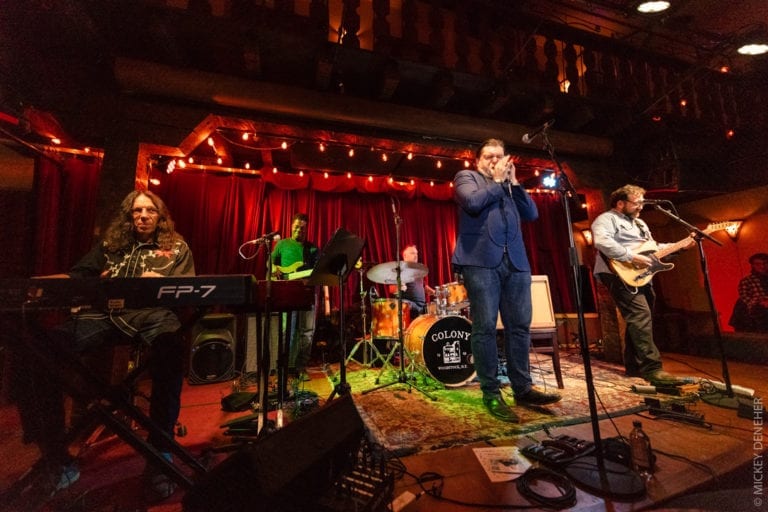
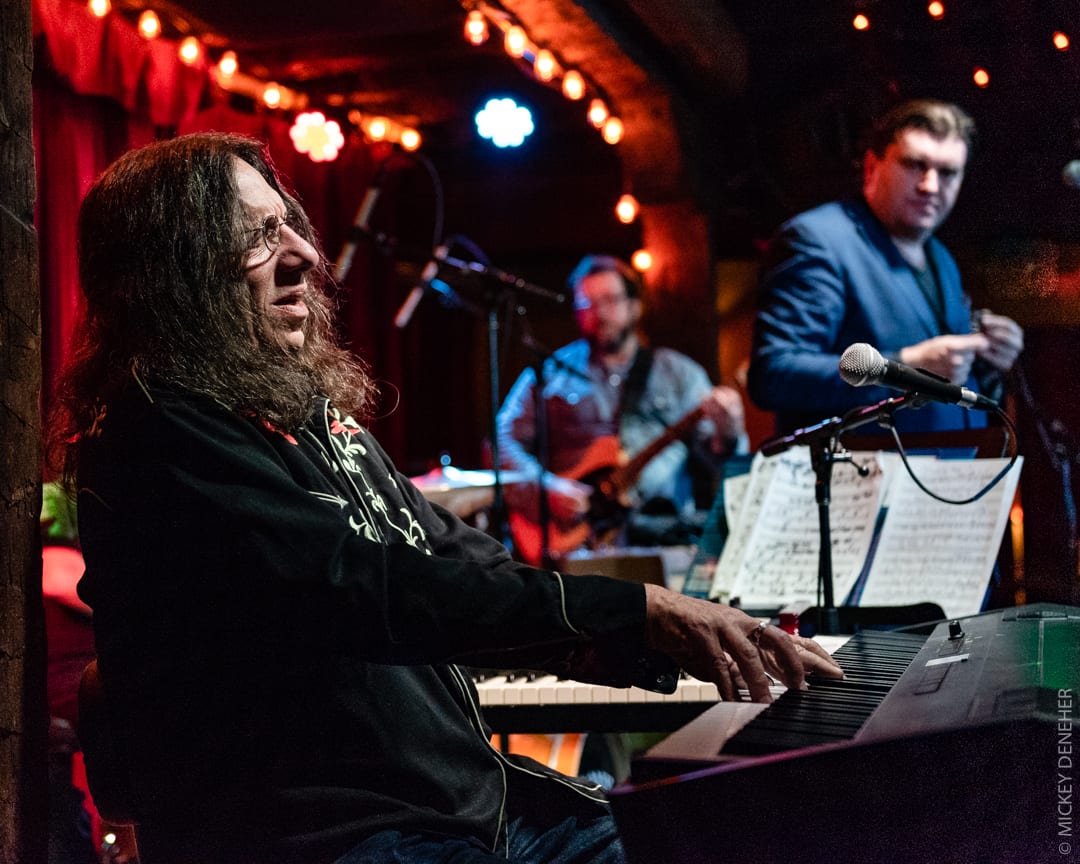
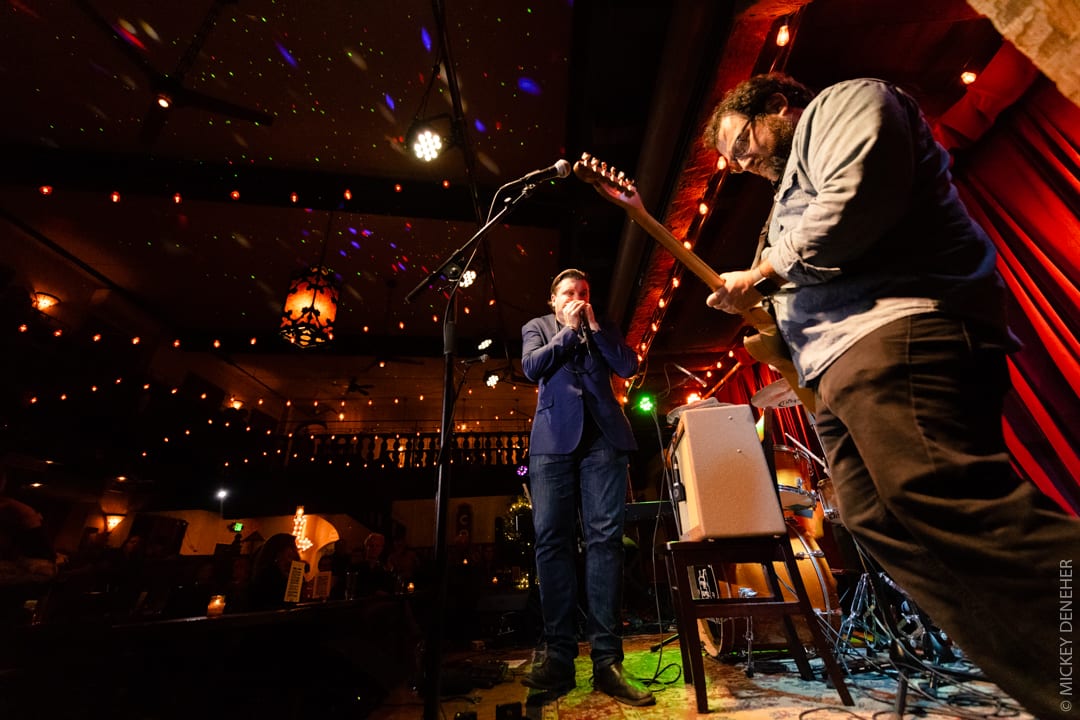
Bruce Katz, keyboards; Antar Goodwin, bass, Ray Hangen, drums; Giles Robson, harmonica; Aaron Lieberman, guitar; at Colony, Woodstock N.Y.
A disciple of the blues, his beliefs are straightforward, “I am under the opinion that the blues is the most incredible, communicative music in the world. So simple, yet it has so much feeling. I feel fortunate I fell in love with it and progressed in it.”
His journey into music started with the violin at age seven, then on to the saxophone three years later “because I watched a lot of old movies when I was ten or eleven year old,” Robson shares. “They always had the big bands, and I really fell in love with the swing horn lines.” While on a school art trip to Spain, he picked up his first blues harp. “I (had) heard it on the theme tune to Roseanne, a guy named John “Juke” Logan, and I heard Will Smith play it on the Fresh Prince of Bel-Air. I was intrigued by it. When I got back to Jersey, it just so happened that there was an African-American harmonica and guitar duo, Cephas and Wiggins, playing within a week of getting back. My parents sent me to see them and the rest is history. I just got hooked.”
Formal training helped prepare Giles for his foray into the blues. “My sax teacher was an acid jazz player and got me playing Charlie Parker heads (challenging melodies) and showed me the basics of improvisation. So when I started playing harp, I had that little bit of knowledge to help me out.” When it came to learning the harmonica, “I was teaching myself,” Giles divulges, “I would pretend I was a member of the Muddy Waters band and I would play the same solo along with the record, over and over again. “
I am under the opinion that the blues is the most incredible, communicative music in the world. So simple, yet it has so much feeling.
Giles Robson
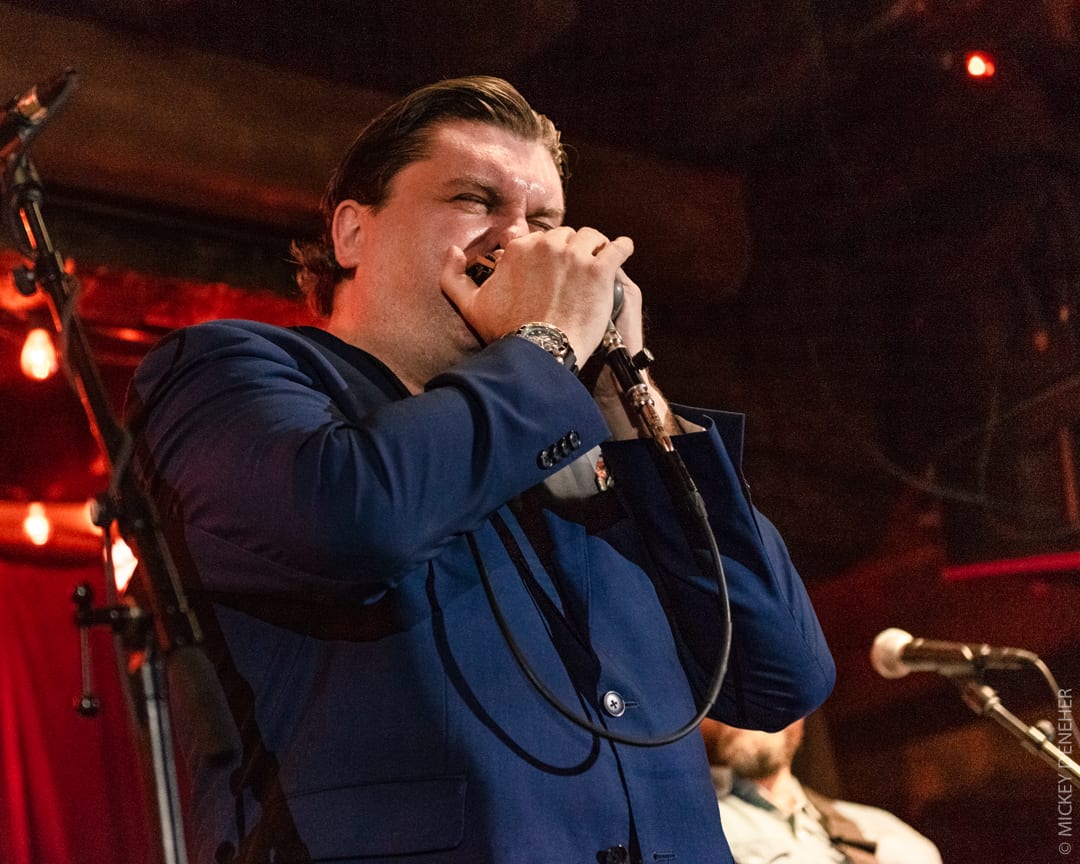
Giles Robson, pre-show at Colony, Woodstock N.Y.
His efforts took hold and in 2007 Giles Robson and The Dirty Aces stepped onto the European music scene, receiving praise in the UK press. “That was an interesting band,” he notes. “I was trying to do a crossover with lots of different elements in it. I was trying to be as original as possible. But I realized my strength was in doing the blues, the pure blues with a little twist. I was getting too rock for blues and too blues for rock. It showed me what can and cannot work. “
After three recordings with The Dirty Aces, Robson signed with V2 Records in Holland. Now a solo artist, For Those Who Need the Blues was later made. “ We recorded that album in six hours. This was my return to the pure blues,” he professes. With a new record in hand, he was booked at an upcoming festival in Holland under the name Giles Robson and The Dirty Aces. “They were expecting this garage rock. I went over with the band I had just recorded with and did the pure blues. The people went crazy. From that moment on things changed around for me.”
Giles Robson, Colony, Woodstock N.Y.
Reflecting on that moment of musical purification, “The blues is always there, and it needs to be. I met a lot of people on this (current) tour that told me that they got into this music as they got older. Once you get to 40, you’ve probably been through several life events that the blues tackle. Divorce. Relationships. When you’re in your early twenties, pop music works because you’ve not been through any of that heartbreak and such. When you get older you’ve been through it. It’s not a shallow thing. You can’t help but think about things in your life that blues sings about.”
In December 2017, while performing at a festival in Europe, Robson crossed paths with Grammy-nominated, W.C. Handy Award-winning blues guitarist Joe Louis Walker. Walker saw his performance earlier that day and invited him up to jam during his set. “We got on musically very well. Then we talked for hours after the show about lots of blues music,” Giles recalls. A few months later while touring around Europe and listening to acoustic blues while traveling between shows, Robson started thinking, “I’d love to do an album with someone who could really do this (acoustic blues) music justice, and then the idea came, it was Joe. ”
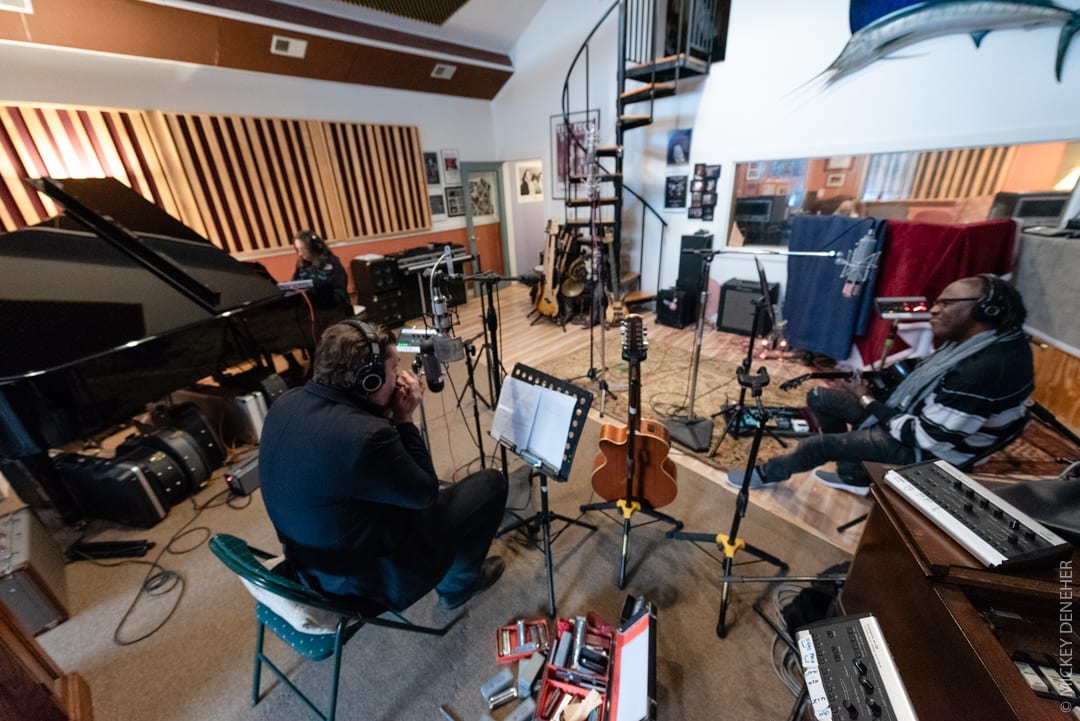
Recording session for Journey To The Heart Of The Blues
“I wanted to hear his voice, which is one of the most incredible voices in the blues,” Robson declares. “I wanted to hear his voice without a band behind him, in an intimate situation. I wanted my harmonica next to that voice. I contacted him and he was very keen on it. It was a beautiful experience.” Journey To The Heart Of The Blueswas the end result of this homage to acoustic blues, garnishing a 2019 Acoustic Album of the Year Blues Music Award. Bruce Katz (Gregg Allman, Ronnie Earl, Delbert McClinton, John Hammond,) joined the pair on piano for the recording sessions. “Joe brought Bruce in, an excellent sort of foil for the music. He is a funky player, but has this level of finesse that gave it an extra depth and added synergy in the studio.” Alligator Records picked up the album and it was tracked and mixed at NRS Recording in Catskill, NY for distribution in the U.S.
I was teaching myself … I would pretend I was a member of the Muddy Waters band and I would play the same solo along with the record, over and over again.
Giles Robson on learning to play the harmonica
“The beauty of the blues,” Giles lauds, “is the people already know the chord changes. They are really familiar with it and you put in your own individual harmonica style, or song style, or lyrics. It’s a magical thing. Sometimes musicians lose their way with the music because the technical ego takes over. They say on something as simple as that, I have to do something more complicated. As you get older, it becomes a lot easier to be naturally simple. Just do what is able.”
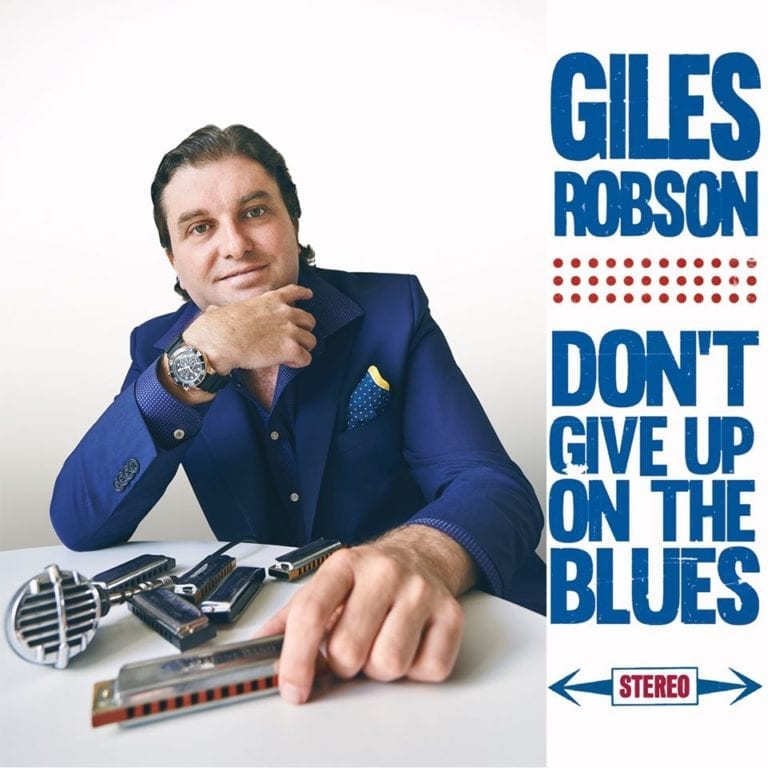
Don’t Give Up On The Blues artwork
His latest recording, Don’t Give Up On The Blues, which came out late September 2019, isa shift from Journey to the Heart of the Blues. Robson puts it this way, “I wanted to do original songs with blues structures. We’ve got original riffs in there, but we wanted to respect the structure and rhythm of the blues.” Capitalizing on their previous success, Bruce Katz joined on for this project. “Bruce is incredibly versed in the traditions of the piano.” Expanding on the approach to the album, “We didn’t use an out and out traditional guitar player or traditional bass player. We didn’t want to be too fussy about it. It is an album that has both the traditional and a splash of dirty.”
Bruce Katz, keyboards; Aaron Lieberman, guitar; Giles Robson, vocals/harmonica
As part of the Robson’s showcase tour, Don’t Give Up On The Blues was presented front and center. Backed by Bruce Katz on keyboards, Aaron Lieberman on guitar, Ray Hangen on drums, Antar Goodwin on bass, (who all played on the album) and joined by special guest vocalist Katie Henry, Giles and crew showed why this latest recording has been called, “Retro. Timeless with an edge of modernity so the sound is relevant and fresh today,” by the UK’s Bluesdoodles.com. I attended the Colony show in Woodstock, NY, where the music expanded and contracted throughout the set, allowing each song the opportunity to offer it’s own blues narrative. As the New Year begins, Don’t give up on the Blues continues to chart high on American and European blues radio.
Giles Robson, Aaron Lieberman; Colony, Woodstock
When it comes to blues harp influences, Giles points to the Chicago players. “All of them,” he says. “Everyone has their own distinct style. Some are very simple but still captivating. Some are very technically advanced and still captivating. They all had feeling and emotion. It’s pretty miraculous what they did with the instrument. The two main guys were Little Walter and Sonny Boy Williamson for me. I listen to them almost on a daily basis. “
The blues are based in suffering and heartache, but for Robson’s blues, 2020 is looking bright. A new record getting global recognition combined with a touring schedule filled with club and festival dates across the US and Europe, it will be hard to find a downside for this rising blues man. Perchance you run into Giles out on the musical highway, take a moment and imagine you’re both in a James Bond movie. “How would you like your blues, Mr. Robson?” “Pure. Not stirred.”