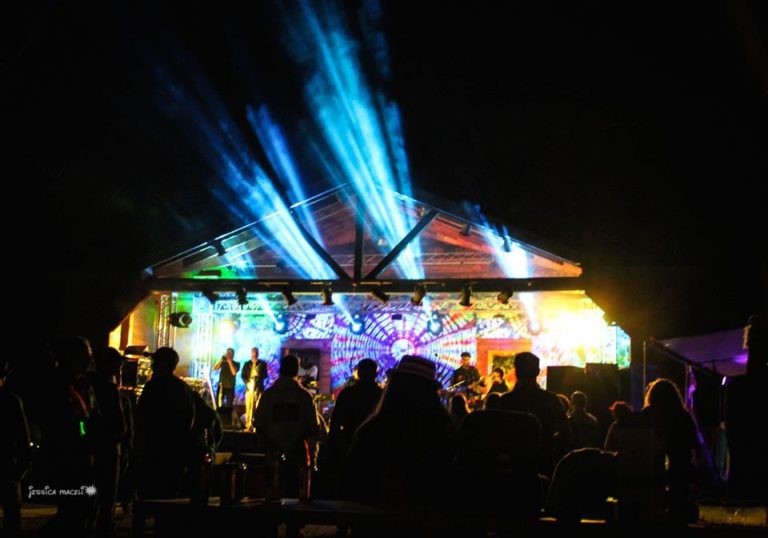
The 4th Annual Flyday Music Festival will postpone until September, and once again return to the Blackthorne Resort in the Northern Catskill Mountains. Taking place over the course of three days from September 10 – 13, this year festival attendees can expect music from all different types of genres including rock, jam bands, soul, R&B and so much more.
With over twenty acts already scheduled to perform headliners include Lespecial, returning favorites The Magnetic Pull, Hartley’s Encore, plus first-timers Consider The Source, Schleigho, Now vs Now led by Jason Lindner (keyboardist on David Bowie’s final album Blackstar as well as a member of Meshell Ndegeocello’s touring band), Jonathan Scales Fourchestra, Expansion Project, Space Junk Is Forever, Muscle Tough, Cats Under Stars featuring Adam Czolowski, Acoustic Trauma, bassist Nigel Felony (of Floodwood), The Mark Basil Band, Level:Memory and K-Weef.
Sun Colored Chair is set to host the first annual Flyday Open MicNight on Thursday in the Phoenix Pub at Blackthorne Resort, in addition to being part of the festival lineup. Other acts are set to be added to the lineup via the website at later dates.
Originally scheduled in May, the spring festival was moved to September in response to the COVID-19. As of now tickets sales are set at 250 this time to allow for 6 feet of social distancing. Additional ticket sales will happen at the door if there is a lift in the gathering bans. Tickets are available for purchase here.
We’ve all been in need of some new live music and thankfully The Mountain Carol has come to our rescue. Their latest offering, How The West Was Won, is a live album containing incredible versions of their previously released work. Around since 2017, they have established themselves in the past with their undeniably unique sound, a combination of psychedelic and atmospheric electro-pop with a low-fi sound that permeates throughout this live release. Oh, and just a dash of alien abductions.
This album was recorded live at Light Club Lamp Shop in Burlington and the band really uses the space to their advantage. The reverberation from Matt Hall’s percussion through the room adds an incredible depth to the overall sound as it blends with the ebb and flow of Charles Bruce’s incredible vocal talent. Charles’ cosmic keyboarding also balances perfectly with Austin Petrashune’s bouncy, spacey but laser-focused guitar playing. From the giddy opening track, “Under Neith” to “Essex Ferry,” the mountainous closer, this entire album is a sonic adventure.
On their Facebook page, The Mountain Carol boldly claims to be “quite possibly the most important band to emerge from the North Country New York music scene.” Having listened to How The West Was Won multiple times, one cannot dispute their claim. Throw this on when you’re socially distancing at your next campfire, driving home from a day hike in the Adirondacks or enjoying the evening on your porch. It is available to stream on BandCamp, Apple Music, Spotify, Google Play Music and YouTube.
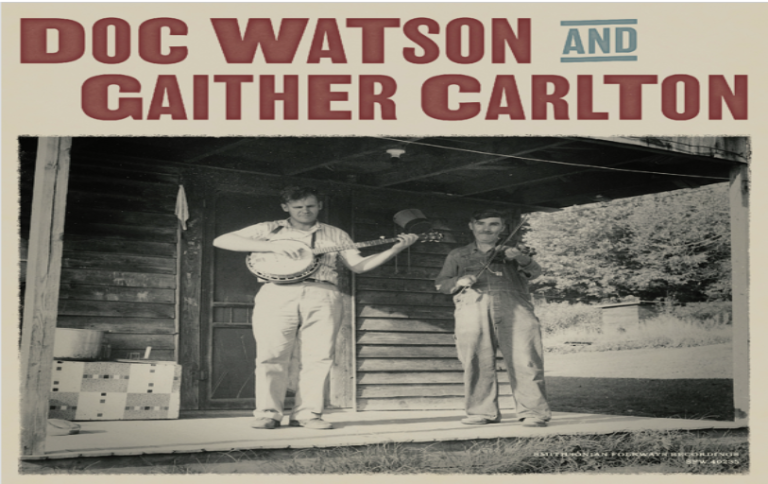
Smithsonian Folkways has released an album of recordings from legendary bluegrass musician Doc Watson and fiddle player Gaither Carlton. The recordings on Watson and Carltoncome from two concerts in New York City in October 1962; one concert at the NYU School of Education and the other at Blind Lemon’s (a folk club in the West Village that was gone the next week).
In the early 1960s, Watson was playing rockabilly tunes on his electric guitar near his home in tiny Deep Gap, NC when he was discovered by folklorist Ralph Rinzler. Watson became known for his heartfelt, powerful singing and the distinctive sound of his acoustic guitar.
Ralph Rinzler set up the concerts as Watson’s debut in New York, but it was a young PeterSiegel, who recorded both concerts in New York. Siegel still lives in New York, and founded the Nonesuch Explorer Series. He went on to produce music with Watson, and other talented artists such as Paul Siebel, Tom Paxton, Roy Buchanan. Peter Siegel shared his thoughts on how Doc Watson influenced future guitarists:
Today there are all these great flatpicking guitarists we know about. Clarence White, Tony Rice, all kinds of people. Billy Strings too now. At that time, nobody had ever heard a folk guitar player play like that! In folk music, the guitar was an accompanying instrument, which was usually strummed in a specific way. So when Doc showed up, it blew my mind. It blew everyone’s mind!
The music that is played on these recordings is not the virtuosic guitar style Watson is known for. Throughout the album are songs like “Double File” and “He’s Coming to Us Dead” that are comprised of the fiddle, guitar, and banjo to demonstrate the roots of Scottish and Irish music.
Ella Joy Mier, under the moniker Iris Lune, delivers her debut album ‘Lovelosslovee,’ a poetic and sonic masterpiece that examines the seamless relationship between love and loss.
The Brooklyn native is a songwriter who came inter her own, via the folk music of her heritage, Israel. Bringing a contemporary take on the sounds she is familiar with, Mier showcases her ability to tie rich, sonic passages along with beautiful poetry and wordplay. She exhibits a palpable mystique focus but diverse mood board throughout.
After loosing her mother from a six year battle with cancer, Mier has been desperately trying to piece her life back together, trying to survive in a world without her mother’s physical presence. These songs take the audience through that emotional journey.
The project starts with a well thought-out drum intro, followed by a rumbling, synthesized bass line. Intertwined vocal melodies, textured guitar and well organized percussion hits are a constant throughout the albums track list. With a central theme of love and loss, the tracks on this album mend together creating an emotive and captive tapestry of sound. With a clear knowledge of radio friendly pop structures as well as dreampop-like instrumentation, Mier falls inter her own on this album, creating a space that she is clearly confident in.
The production lets her vocals shine and remain the focal point from song to song. The album being co-written and produced by Asher Kutz, is full of highs and lows along with dynamic songwriting. Lovelosslove fulfils Miers’ want to let us in briefly to the journey of the endless relationship between love and loss.
Buffalo Iron Works, in partnership with The Transit Drive-In in Lockport are bringing the “LIVE AT THE DRIVE” concert series to life. The concert series will be featuring many artists starting with Aqueous on Friday and Saturday, June 19 & 20.
The socially distanced concert series will be held at The Transit Drive-In and will feature two concerts a week through August. Future artists performing will be announced in the weeks to come. The concert series aims to have 16 shows in total. Thursday nights will feature a concert and movie combo night while Saturdays will host concerts in the afternoons between 2PM-5PM.
Aqueous will be starting off the concert series on June 19 & 20. They are a groove rock band that hails from Buffalo, NY. Aqueous is a locally famous band to the Buffalo area and have been involved in many live-stream shows since the halt on live shows due to COVID-19.
Tickets will be available for purchase though the Transit Drive-In website. Gates for the concert series will open at 1pm both days with the show starting at 2pm. GA tickets are $40 per person and VIP are $80 per person. VIP tickets will include a ticket to the show, a vehicle spot in the front two rows, and a limited edition poster. All ticketing will be through internet pre-sale only, and tickets need to be purchased for all occupants of each vehicle under one transaction. A minimum of two people per vehicle must be purchased, with a maximum of six people.
For more information visit Buffalo Iron Works website and The Transit Drive-In website.
Music has the power to bring people together in the name of solidarity. Throughout protest history, there have always been songs to aide in carrying the cries for social justice. Protest music came into mainstream popularity during the civil rights movements of the 1960s and 70s, with folk and gospel artists such as the late Pete Seeger and Mahalia Jackson. In todays current political state however, protest music has chosen a different voice. Hip-hop along with punk music have provided the loudest songs of racial protest during the black lives matter movement.
“Sound of da Police” by KRS-1
Off of the Bronx natives’ debut studio album, Return of The Boombat, “Sound of da Police” takes a hard look at police brutality. Although released in 1993, the song remains relevant in the current Black Lives Matter movement. Throughout the song, KRS-1 makes comparisons between the police and overseers who would police southern plantations while keeping slaves in check.
Key Lyrics:
“Officer, Officer, Officer, Officer! Yeah, officer from overseer You need a little clarity? Check the similarity! The overseer rode around the plantation The officer is off patrolling all the nation”
“One Four Love (Pt.1)” by Mos Def
The second track off of Mos Defs’ Hip Hop For Respect EP released in 2000 is another song centered around police brutality and racially-centered violence. With a hook that sings ” My people unite and lets all get down.”
Key Lyrics:
“My people unite, hop up and do it right We gotta have what? love peace and understandin One god, One love, One light One aim, One voice, One fight”
“Changes” by 2Pac
Riddled with commentary on the life of an inner-city black man, “Changes” is 2Pac’s timeless meditation on racial injustice. The song consists of verse after verse of 2Pac calling for change.
Key Lyrics:
“I see no changes all I see is racist faces Misplaced hate makes disgrace to races We under I wonder what it takes to make this One better place, let’s erase the wasted”
“Sunshine” by Pusha T
Bronx rapper Pusha-T takes a conscious approach in his 2015 release “Sunshine” telling America that the country is in need of a miracle. Pusha remembers Freddie Gray, another victim of police brutality and neglect.
Key Lyrics:
“These ain’t new problems, they just old ways I see one time turn sunshine into Freddie Gray Just another n**** dead, just another n**** dead Send another to the FEDs, send another to the FEDs”
“Banned in D.C” by Bad Brains
Well affiliated with the Afropunk movement of the 70s and 80s and regarded by many as the pioneers of hardcore, Bad Brains deliver this rage filled track about racial solidarity.
Key Lyrics:
“We, we got ourselves Gonna sing it, gonna love it, gonna work it out to any length Don’t worry, no worry, about what people say We got ourselves, we gonna make it anyway”
“Don’t Shoot” by Dave East
Dave East takes a creative approach, altering his voice to reflect on his encounters and experiences with NYPD through out his childhood, as a teenager, and as an adult. Born and raised in Harlem, Dave East delivers descript bars verse after verse detailing life in the city and coming to terms with racism and police neglect.
Key Lyrics:
“Left and right I’m seeing homies get interrogated, we ain’t safe where we live, this America ain’t it?”
“Spiritual” by Jay-Z
https://www.youtube.com/watch?v=TFW5p2Qlx7M
In 2016, “Spiritual,” was Jay-Z’s first solo release in 3 years. Penning the lyrics after the shooting of Michael Brown in 2014, Jay-Z said he held onto the release because he knew ” his death wouldn’t be the last” in a statement released with the song. Jay-Z calls out police brutality and the cycle of poverty and depression many in the black community are stuck in.
Key Lyrics:
I am not poison
Just a boy from the hood that got my hands in the air
In despair don’t shoot
I just wanna do good”
“Oppressor” By Jesus Piece
East Coast hardcore band, Jesus Piece target the oppressive behavior of police in the song “Oppressor” off of their 2015 EP release. Fronted by Aaron Heard, one of the most prominent black vocalists in the current hardcore scene, the song is delivered along with a brutal instrumental and has since been a highlight of many hardcore festival performances, bringing together people of color in the hardcore scene, all taking turns grabbing for the microphone.
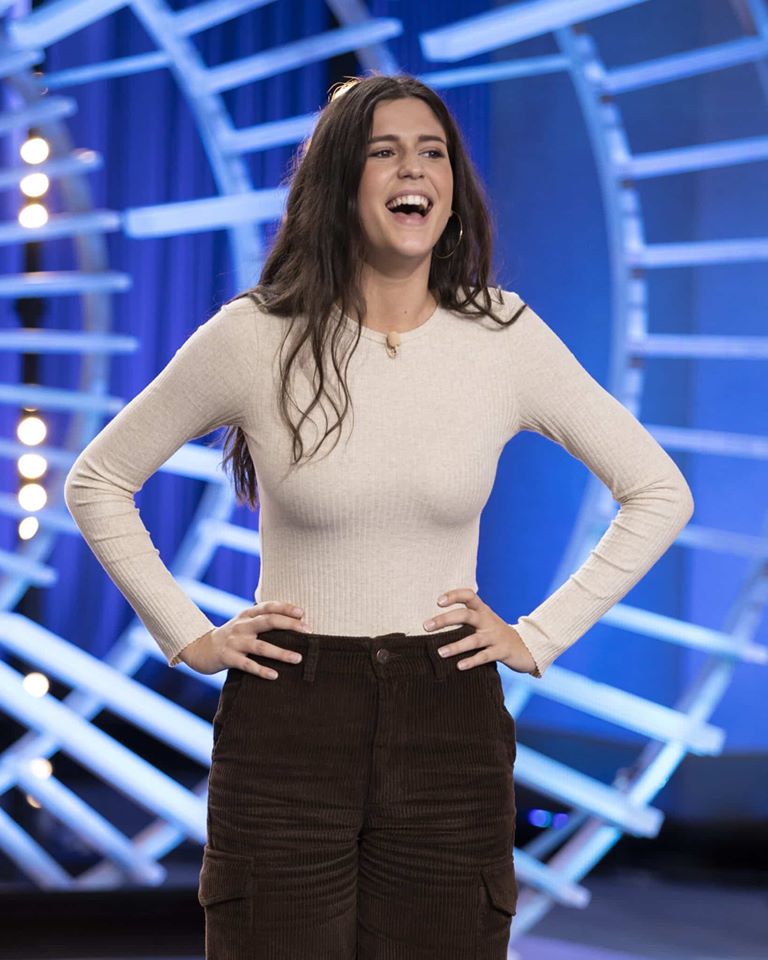
Even though schools have been closed since March 16, the College of Saint Rose in Albany has given former season 18 American Idol contestant Julia Gargano and a small group of former classmates special permission to use the Hearst Center for Communications and Interactive Media, the Times Union recently reported.
From Staten Island, Gargano was a senior in the music-industry program at Saint Rose when the opportunity presented itself to travel to Brooklyn and perform in front of Idol producers. She continued on to impress all three judges, singing her way onto the show. Each week her performances were top notch until an unprecedented coronavirus pandemic caused the show to halt and send contestants home.
Idol production resumed from each of the contestants’ homes where Gargano sang her way into the top seven for the finale. Even though the singer-songwriter did not win she feels that Idol has impacted her career in ways that she did not imagine. Gratitude for how recent experiences have impacted her life has been Gargano’s outlook since the ending of the show.
Gargano told the Times Union “‘Idol’ totally lit this drive inside me, I’m in work-work-work mode. The show will really help me be my own artist, my own singer-songwriter.”
The show might be over but it is not the end of the road for Gargano’s music journey. Now a Saint Rose graduate, Gargano and four of her previous classmates are working on three singles that are set to be released on streaming services later in the year. For now check out Gargano’s original song ‘Growing Pains.
The Apollo Theater and Gibson have partnered together to bring music fans “Let’s Stay (In) Together: A Benefit To Support The Apollo”, a live streaming benefit concert. Airing June 4 at 7:30 PM ET, the concert will be free for views made possible through Apollo’s media partner Tidal. Originally planned for June 2, The Apollo decided to postpone the show and stand with others in the music industry to observe Blackout Tuesday.
This special event will feature performances by “Captain” Kirk Douglas of The Roots, Kool & The Gang, Gary Clark Jr, Robert Randolph, Ray Chew and many more artists. Not only will the artists perform songs from legends like B.B. King, Patti LaBelle and Stevie Wonder, the Apollo’s 86 year contribution to the arts and culture will be highlighted. Viewers will also witness poems and performances dedicated to the memory of those whose lives have been lost due to the Coronavirus Pandemic.
Proceeds are set to benefit an emergency relief fund to financially support the theater now and into the future once it had to cancel live events through the month of June due to the coronavirus pandemic. Portions of the funds will also be used for micro grants to support local merchants and businesses in the 125th Street neighborhood that Apollo Theater calls home.
By partnering with Gibson through the Gibson Gives foundation, this marks the beginning of a new partnership that in the future will include brand new show programming, music preservation, music education initiatives, and support established and emerging talent.
“Music has the incredible power to connect, transform and heal. We hope you will support the legendary Apollo Theater and join us for a special event featuring music that lifts our spirits, shapes our lives, and continues to unite us all.”
With divisions across the country on display through peaceful protest and violence, songs of unity and calm are not the first thought, but can provide an escape, even if briefly, giving pause amid the chaos in cities throughout the state and America. One of those songs is “My Sisters and Brothers”
Originally written by Charles Johnson of The Sensational Nightingales, Jerry Garcia Band would perform “My Sisters and Brothers” numerous times from the 1970s through the 1990s, and is featured on Jerry Garcia Band. The version below is the encore of the October 28, 1987 (late) show from the Lunt-Fontanne Theatre in Manhattan.
Brooklyn based singer-songwriter Lorelei Rose Taylor released a gift to the world on May 22. Stepping into the studio for the first time to record her music gave light to her debut EP, Versailles, which lyrically navigates her own stream of emotion, intertwined with dreamy baroque-pop sounds. As Taylor explained to NYS Music, she treads on the strong influence of The Cranberries’ Dolores O’Riordan, evident in her flawless singing, which also subtly nods to Florence Welch and Lana Del Rey.
Taylor grew up between Texas and Upstate NY and began exploring music on her own at a young age. But it wasn’t until 2017 when her interests returned to music following her college studies. With the help of the friendship of Robbie Grabowski, she began writing her own music and was given the courage to step into the studio in 2019.
Versailles EP
Taylor recently spoke with NYS Music about her experience bringing her music to the world for the first time and some of the inspirations into her songwriting.
Steve Malinski: The Versaille EP is your debut audio portrait to the public. How would you introduce yourself as a musician/songwriter?
Lorelei Rose Taylor: I would introduce myself as someone that’s very consistent in my message and my sound. I think I’m overall pretty melancholy, as much as I try to fight it that’s kind of just what happens.
SM: One thing I noticed about your sound is that it’s very clean and refined – particularly on one the songs, “If You Love Another,” almost right away I can hear the influence Dolores O’Riordan has on your singing. How has she been an influence on you and your songwriting?
LRT: She’s huge. I mean The Cranberries in general…when I think of my past and you know, out of my experiences in childhood that really shaped my direction, she stands out tenfold and it really comes back to growing up. I felt like it wasn’t a glamorous childhood by any means. So I’m in my room and I had this white boombox and I would like to sneak out to the living room. Remember those rotating CD things with the velvet interior that held the CDs? So I’d go in there and grab all the CDs I could find and shove them in the back of my room.
I would just like sit there for hours listening to all the weird stuff, and everything like that. I was kind of obsessive in that way. That was my outlet. No Need To Argue was that album that stayed with me and never left the rotation and I feel that way because I think Dolores sings like there’s a pain in her voice – that’s definitely her style – but she’s also really strong like you’re safe under her wing, in a way. I just I felt very understood by her.
And then “If You Love Another” was actually inspired by W.B. Yeats who is an Irish poet legend. I love the Irish. But yeah, I feel like it’s twofold, like there were a lot of strengths that I was trying to channel which I found in Dolores.
SM: Now that Versailles been released, what does that milestone – reaching that accomplishment mean to you?
LRT: I feel like I’ve always…this sounds so cliche, but like… dreamed of this moment. And now that it’s here, it feels a little bit like that false beginning, you know, when you’re like watching a show and they tease the beginning, and then they start the bullshit of the intro and the music. And I think it’s like the real show, the real beginning. That’s kind of what it feels like for me. Because I think… I don’t think like I’m doing the Lord’s work here. Like, I love the EP, and I’m so proud of it but I think that there’s so much growth to come and like so much exploratory work that I’d love to do from here. So it’s the beginning, but I don’t think it’s like the big moment for me, but I’m excited to see what happens.
SM: You’ve been exploring music since a young age…so what drew you into eventually writing your own songs?
LRT: So growing up, I spent a lot of it solitary and I feel like when you don’t have an outlet you kind of build your own and I feel like the writing and music that I turn to when I’m alone or whatever I was going through experiencing and it just always stuck with me. I recorded the Robbie Grabowski (from I Can See Mountains, Super American) and he like, kind of pulled the rest out of me.
SM: So the motivation to actually bring your material into the studio was that driven by Robbie?
LRT: Oh, yeah. Before that, I was just fucking around, like I wasn’t really… I mean, I dreamed of recording but I didn’t have that motivation or confidence to do anything with it and then he was like, “put your shoes on, we’re going to the studio today!”
SM: So this being your first recording project, how was the recording experience?
LRT: Oh my god. terrifying. I think it was last August [2019] – was the first time I’ve ever sat down in the studio. I was just right in front of a mic, that’s not my comfort zone. I don’t pretend to be a performer. So it was traumatizing. And I’m really grateful that I recorded with Robbie and Stephen Kellner and Jesse Cannon and Roderick, kind of like this very tight-knit circle which I’m grateful for. So Robbie just became a mentor and he was just like “pick up from the beginning, relax, chill out, it’s gonna be fine,” because I was terrified and it’s really difficult.
And you know, I learned a lot because when you’re singing a cover, for instance, “When You’re Gone,” that came super easy because I was just spinning the musical machine, you know, you have to channel the emotion, the performance, are you on TV?, the lyrics…there’s so much in one moment that you have to articulate and get right and I was just learning a lot the first time. I think “Casanova,” the first track on the EP, was the first song that Robbie and I wrote together, the first one we took to the studio and it took me probably eight months, nearly a year to like come around with that song and say “okay, we can just push it to the public,” because I just hear fear and I hear trauma because I was so scared in the studio. I guess it adds to the vulnerability a little bit.
SM: So now that you’ve learned a lot from that experience, do you think that might influence how you write your songs going forward? Or do you think you’ll still have the same approach?
LRT: Yeah, I’ve learned so much. And I think like, it really comes down to going back to being alone and just alone with my thoughts and not having to worry about any other element. It’s just me and the music and I feel like, especially during quarantine, recording by myself, there’s a different… It sounds very different when I’m writing alone and recording alone. There’s a different confidence. There’s a different way. I’m excited to share what I’ve done now alone in my own little studio to bring that to studio that’s going to be very different.
SM: You’re very introspective with respect to writing your songs and the emotions flow from what you’re feeling in that moment. So, when you go and you listen back to the songs especially in these current times, do they have a different meaning to you?
LRT: Yeah, I definitely think so. I mean, from like a personal standpoint…My favorite piece of was that our job is not to like our own music. It’s just to like keep making it. And I feel like the biggest thing in quarantine and creating (or trying to), removes that element to it. Hearing back the EP there’s so many moments where I’m like, “oh, I wish I did that differently” or “I wish this was scratched completely” but I think that removing that and just living in the moment more… I mean with COVID there’s just so much that we took for granted and I feel like just so lucky to be in a position to keep making music and I’m eager to get back to it. I feel like I’m more grateful for the music that I’ve made and more proud of it. I hope to make… all I have right now is that fucking record, so I hope to make happier ones because everything is very sad right now.
SM: You’ve also had a full length album in the works too?
LRT: Yeah, that was in the works. I mean, I’ve been writing for so long, but with everything that happened I didn’t have time to go back to the studios. I was like, well, I could either release an EP now or just have radio silence for the next… who knows how long. But yeah there’s a full album which will likely be called After Party. And it’s nearly done. It’s just like, you know, the finishing touches. But to your point now that everything has happened, I suppose there’s gonna be a lot of changes that I want to make to it with so much time to think.
SM: Have you been able to create any new content in this quarantine?
LRT: I’ve written one song from beginning to end. I was sad one day about two months ago and I was like, I’m clocked out, I’ve got nothing. So much of what I write is thriving off other people’s energy and people that I meet and see and right now I’ve only seen one human being for a few months now. It’s just very hard to find that inspiration. But I did write one song, a demo I recorded which was really an interesting experience because I wrote the whole track. I bought a MIDI controller and I produced the whole thing which I…that’s not my element… so I sent it to Robbie and he was just like “okay keep going.” It was kind of like a little pat on the back like, “okay this probably sounds like shit but like, I’m not gonna tell you that.” But yeah, great to bounce ideas off of him. Hopefully I have at least one more on the way in this infinite era.
SM: Once this whole thing blows over and you’re finally able to get the album recorded, what do you think you’re gonna be up to as far as live shows? Do you want to go out and perform these or just share them?
LRT: Yeah, definitely performing is on my roster. Especially around New York. New York has been home to me for eight years so there’s like a bond I have here. I’ll probably get back up to Syracuse. I spent a lot of my time there and all my friends are there, having like that space to have the energy to go off of which is very nice to perform to. Looking forward to that, looking forward to the album. My first music video for Versailles will be out soon, waiting for the final cut and my album will be out sooner than later.
You can stream Lorelei Rose Taylor’s EP Versailles below.