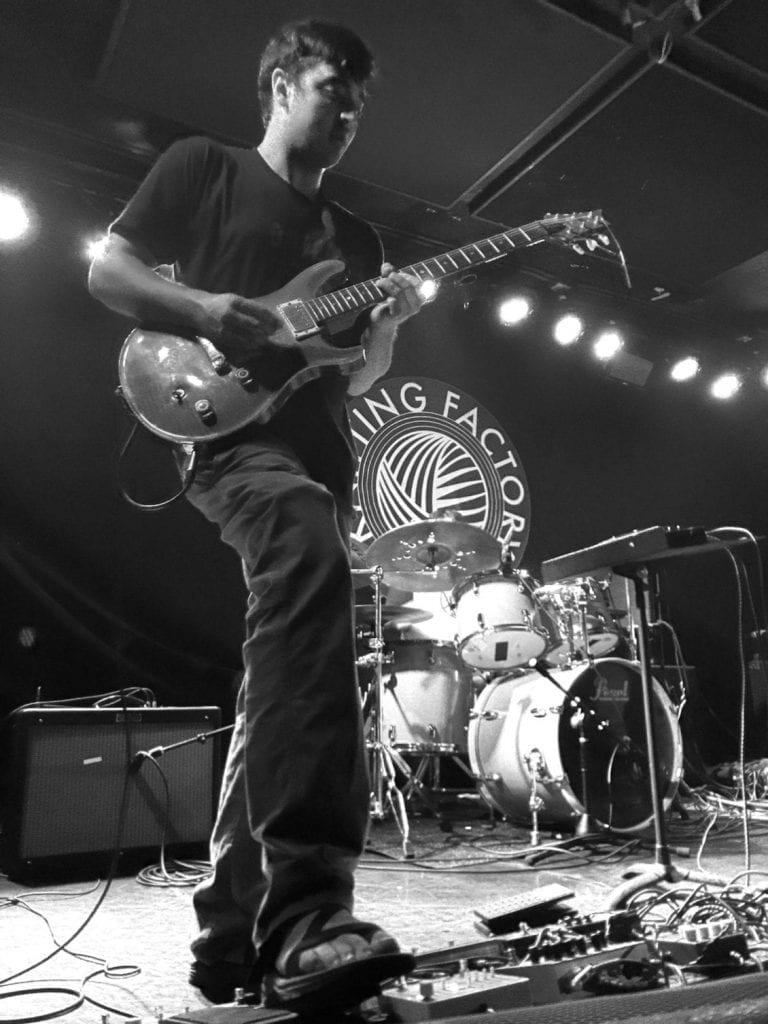
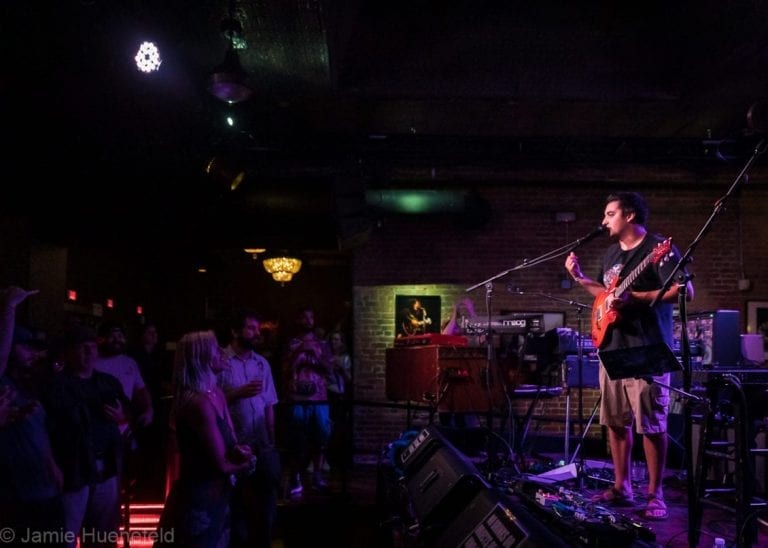
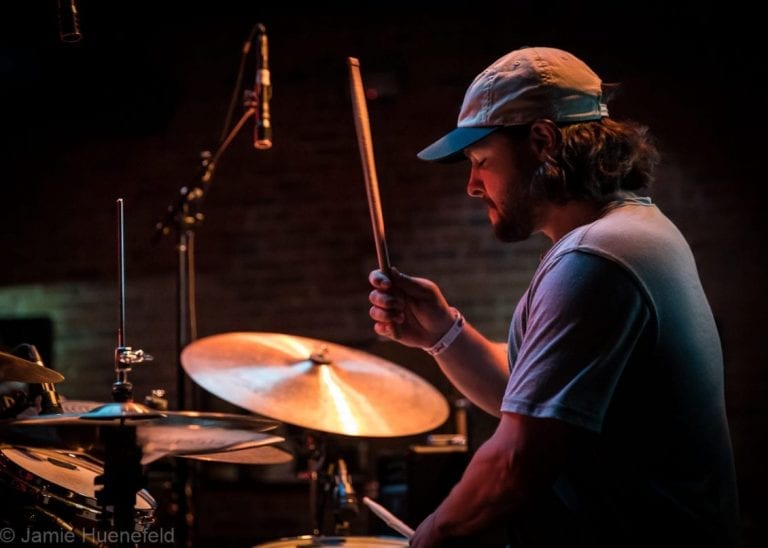
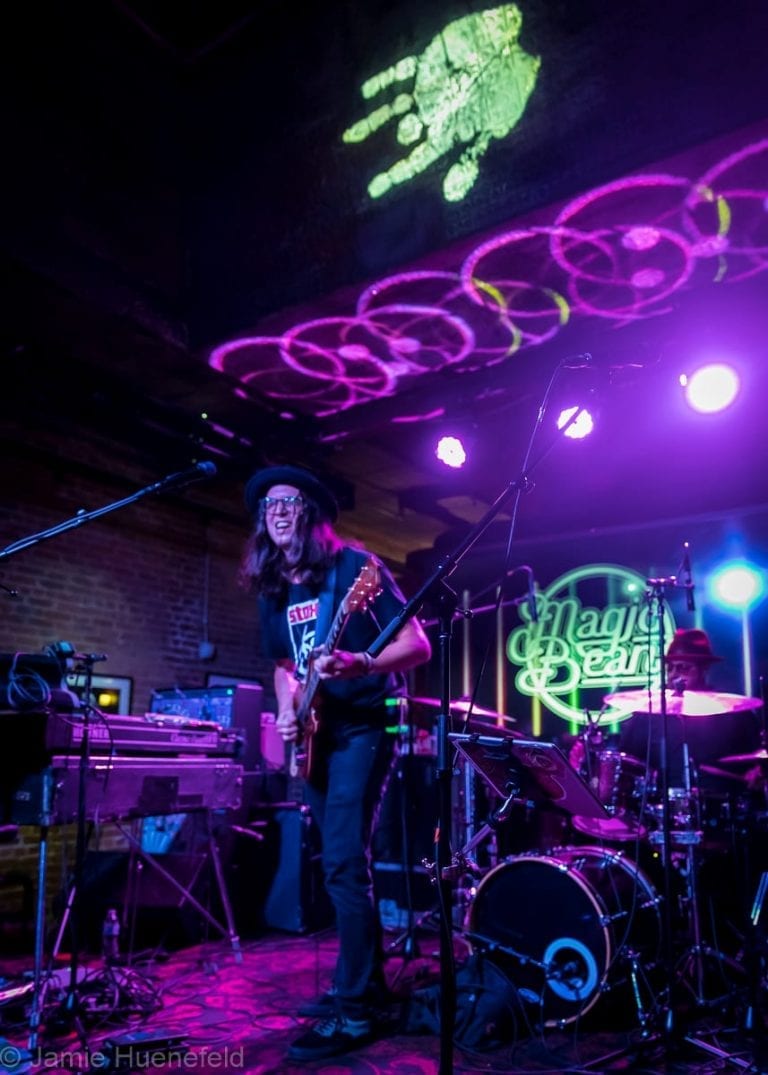
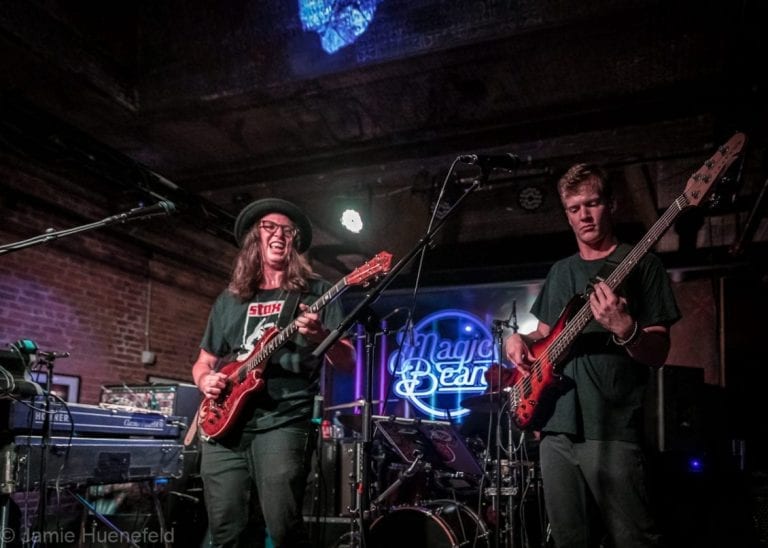
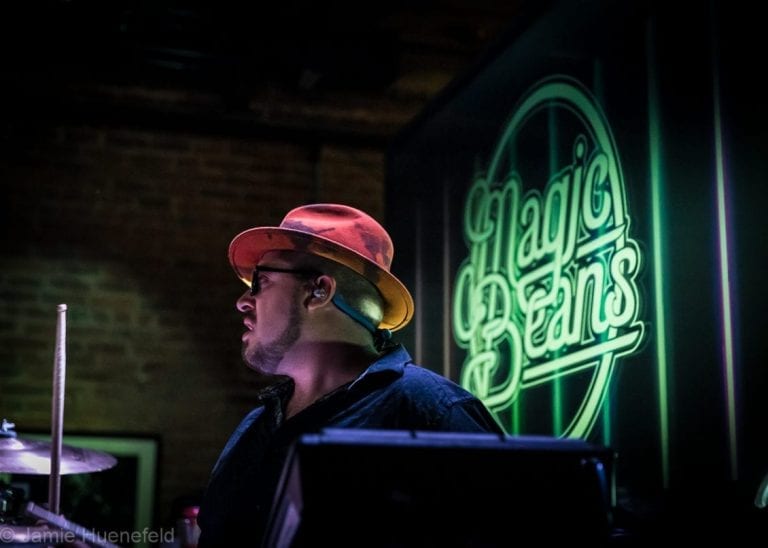
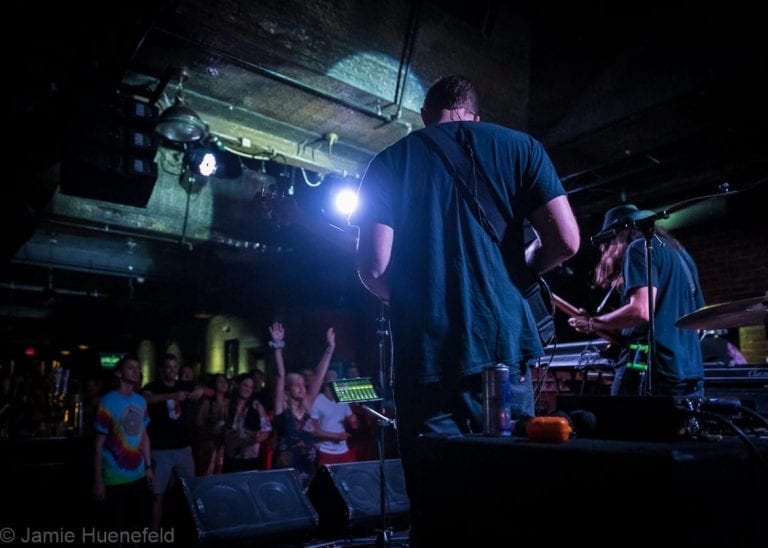
Denver, Colorado psychedelic jam-trio Cycles are making their way through the northeast this week, performing a series of shows throughout New York state as part of an extensive 2019 fall tour. Last night, the band played at Buffalo Iron Works, with Colorado’s The Magic Beans and Connecticut’s Eggy, for a commemorative night celebrating the venue’s tenth anniversary. This past Wednesday, Cycles sat down for an interview with NYS Music in Brooklyn, NY, just before performing a set at famed music club The Knitting Factory.
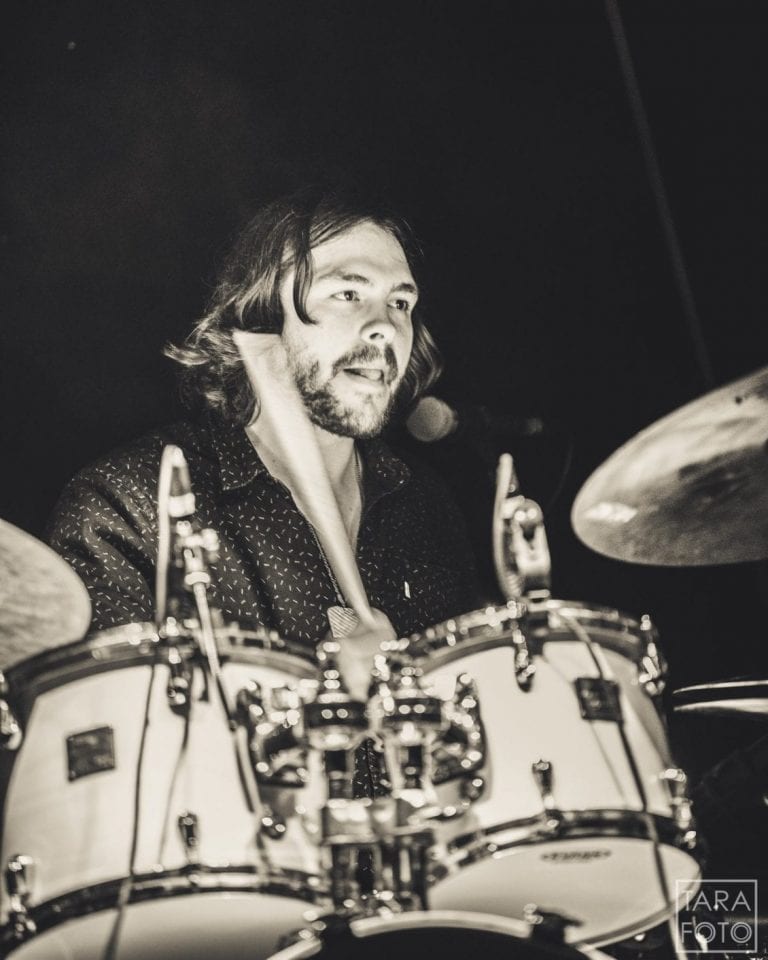
This was a first time appearance for the trio’s drummer Collin O’Brien, not only at the venue, but in Manhattan altogether. “I haven’t been to New York in like fourteen years,” he told NYS Music. “I’ve been freaking out walking around all day.”
It was a return, however, for the band’s guitarist Patrick Harvey and bassist Tucker McClung, whom have performed as Cycles in NYC before. “We’ve played New York a few times,” said McClung. “There was Brooklyn Bowl, and then we played at American Beauty once, for a Phish after party. That was really fun.”
“There’s a really sick jam from that [Phish] show,” said Harvey.
Sick jams were definitely in full supply for their The Knitting Factory show, which saw the band deliver a full range of musical styles, from jazz to funky-metal to soulful rock, across a dizzying set of songs that were all linked together via impeccable technical abilities.
While new to the city, O’Brien is also a relatively new addition to Cycles, at least as a full time member. The Chicago-born drummer moved to the band’s home base of Denver earlier this year and jumped on board with the band just in time for huge gigs like Arise Music Festival, Peach Music Festival, and Resonance Music Festival just last weekend. “I love it,” he said. “This has been the best summer of my life.”
He certainly fits into Cycles’ live musical experiment, with constantly shifting drumbeats and tempos thrown up against barrages of shrieking guitar solos from Harvey and slap-happy bass rips from McClung. As a unit, the band navigates an amazing balance between improvisational spontaneity and technical precision, and the results fuse together unique, often even quirky, song material with a sustained sense of freewheeling whimsy. A sense that, musically, anything could happen at any moment.
In their Knitting Factory show, they showed this resolutely. Some songs bled out into super spacey, affecting moments of trippy space rock. Other moments saw battles for highest intensity between chromatic guitar picking and dramatic drums fills—sometimes while McClung was balancing his bass on one finger like a vaudeville performer. At one awesome point in the set, Harvey broke from a melodic guitar solo to incorporate audio samples of an eighties’ sounding, glam rock tune into a hard-driving metal-funk jam from bass and drums. Does that sound odd? Absolutely. It is exhilarating and actually pretty groovy.
“I think when we first started, it used to be challenging to make it sound really full,” commenting on the three-piece driving force behind such heavily improvisational shows night after night. “But now, it just feels like I get to do whatever I want all the time. We’ve been playing together so much over the past three years, I feel like we all know where to get in and fill space, or where to leave space.”
Tucker McClung, Bass.
“Yeah, there is a lot of freedom in not having a lot of people on stage,” said O’Brien. “It’s easier to communicate ideas more instantaneously.” This sense of freedom is what gives the band the inspiration to perform a live musical game show next month, at Denver’s Cervantes’ Masterpiece Ballroom (where they will actually have many people on stage).
Tucker broke the concept down to NYS: “It’ll be one set of us performing as Cycles, but we’ll open up the night with a set of this game show. It’s going to be a super interactive experience. We might have as many as 30 to 40 people coming up intermittently and participating in the show, and we’ll be the host band for this Johnny Carson mixed with Wheel of Fortune kind of experience.”
“And,” added Harvey, “we have a game show host who is the freakin’ man! Dennis Craig. Definitely the best host any game show could ask for.”
“It’ll be a healthy amount of uncertainty,” said O’Brien. “Stuff will go wrong in the best possible way.”
Cycles Guitarist Patrick Harvey. Photo: Miles Hurley
The rest of Cycles’ schedule coming ahead has them linking up with jam scene contemporaries like The Magic Beans, Sunsquabi, and others. The trio looks forward to a huge hometown show in December: a debut at Denver’s The Fillmore Auditorium opening up for Umphrey’s McGee.
“I used to see them all over the place when I lived in Chicago,” said O’Brien. “They’re so nice. They’re just some normal guys that are like really, really freaking talented.” McClung, meanwhile, talked about seeing the six-piece staple act for the first time at this year’s Resonance Music Fest. “Yeah, they did an acoustic set which was pretty awesome. I was getting really pumped watching it.”
This week, catch Cycles as they finish their New York stretch with a show tonight at Syracuse’s The Westcott Theatre, followed by shows next week at Olive’s in Nyack and at The Hollow in Albany. While this season of touring seems to continue a road-tested sense of hardcore gigging for the band, they show no sign of slowing down, an instead an invigorated and grateful attitude for the experience.
When you’re as blessed to be doing what we’re doing, it’s foolish to be agitated at the world. Because you have this awesome opportunity to rock out. There’s nothing better than this. If there was something better than this, I’d be doing it.
Patrick Harvey, Guitar.
For more information about the band, their music, and their upcoming shows, head to their website.
On Thursday July 25, three bands from Denver, Colorado descended on Port Chester, New York for a night of musical magic at Garcia’s, the bar adjacent the famed Capitol Theatre with Cycles, The Jauntee, and Magic Beans who have all had an extremely successful year, riding the waves of headlining sets at festivals throughout the summer, recent album releases, and upcoming releases.
Before the music began, I had the opportunity to sit with Chris Duffy (bass, Magic Beans) and Caton Sollenberger (guitar, The Jauntee) about their feelings playing together, influences, and plans for the future.
Tom Dillon: Being that you’re all from Colorado, can you comment on what it feels like to be playing together out east?
Chris Duffy: It feels really relaxed. Cycles, they’re good friends from Denver. We played Baltimore together last night and will be at Peach Festival tomorrow. Jauntee just moved to Denver last year and we all sort of share a fan base. It’s a good vibe, there’s more conversation in the green room.
Caton Sollenberger: (Laughs) Yeah, it’s cool to be in this “family” setting. All three of us played Beanstalk last year and we’ve all been able to help each other out. We (Jauntee) did five weeks out east in the spring and it feels great to be in this kind of a homecoming. This is our fourth time at Garcia’s so it’s good to be here.
Scott Ferber of The Jauntee
TD: Speaking of Beanstalk, this was the 7th year for the festival, how was that?
CD: Ah man, it was awesome! (Tucker McClung of Cycles chimes in “Favorite Beanstalk so far!) Yeah it was incredible. Each year it feels more dialed in, the crew just gets tighter and tighter.
CS: Unfortunately we missed Beanstalk this year, but just moving to Colorado was a big thing for us. We started going out west a while ago, which always seemed impossible from Boston, so we feel like we have a good home base out there. The scene is really welcoming.
TD: It’s been a great year for the Beans between the 7th year of Beanstalk, opening for the Disco Biscuits, and debuting at Red Rocks. What are your thoughts on the space you’ve carved out for yourselves in the jam band scene?
CD: Well, we are pretty aware of our influences. There is so much good production happening right now in neo-soul and hip-hop – which we listen to a lot of, so we try to show that through the jam band lens. We like to see how the jam band crowd will react to different sounds and influences and we’ve been pleasantly surprised at how much people are grabbing onto the more heartfelt singing and songs. Those are some of our most streamed songs, the ones that are more songwriting heavy.
Scott Haschey of Magic Beans
TD: You seem to take a more rhythm-based approach to improvisation, is that intentional?
CD: We try to interpret our influences and not just copy them. We have a lot of peaking guitar solo jams like a lot of jam bands but that doesn’t really satisfy all our desires creatively. Scott (Haschey, guitar) really values good songwriting and puts a lot of thought into arrangement, lyrics, and digging deep into human emotion as opposed to singing about some fabled jam band monkey in a tree – even though we love that stuff too.
TD: So what’s next and what are you looking forward to?
CS: Jauntee has a live compilation coming out with takes from our last New England run. It’s going to be called Jaunts Of Our Lives. We picked the best stuff that we liked and mixed it all down. There won’t be any print but it’s all high quality and will be out on streaming and on Bandcamp as a pay-what-you-want deal. It should be coming out real soon, like any day. To be honest it might even already be out!
CD: Well, we just released Off Leash and are really happy with the way the album came out. We were able to inject a lot of different styles so there’s something for everyone but we feel like we’ve barely scratched the surface of accessing our inner producers as far as using other sounds – drum machines or samples on stage. We just keep pressing on. We’ve talked about getting together and releasing maybe a hip-hop EP or a remix or dance thing, but you might hear us swing into a more acoustic or Americana sound also.
Cycles
First up was the eclectic trio Cycles, comprised of guitarist/loop-master Patrick Harvey, bassist Tucker McClung, and newcomer drummer Colin O’Brien in his fifth official gig with the band. Cycles are completely unique in their sound and approach, blending genres from rock to soul into a mix of progressive power.
Through their opening hour set, the rhythm section was relentless. Offering a batch of material that can also be found on their recent live release Selections, Vol. 1, the trio covered all their bases. From the opening instrumental “Strife” and the bouncing “Be Yourself” to the more delicate “Everything Must Go,” the mood shifted but the sound was consistently huge. This is in large part due to Harvey’s control over his gear. While his guitar playing is ferocious, his use of a looper is equally as impressive. As he layers swells over chords, he creates massive sonic landscapes that reverberate through every corner of the room. He has mastered the art of painting with sound and it seems to be something he has taken hold of as totally his own.
The Jauntee
After a speedy equipment swap, The Jauntee got straight into some easy-going funk with “When The Love Is.” With tasteful riffs and well-placed transitions from section to section, The Jauntee is one of the few bands on the scene who explores free improvisation to a level where they begin to touch on what a band like Phish was doing or has done.
Adding the first sounds of piano and organ to the night, The Jauntee carried the groove steadily throughout their set. Their uplifting content is explicitly demonstrated in “Way To Grow” as the lyrics reference, “Feel good music to let your spirit free.” The progressive number “Flutterby” is an impressive run through ascending melodies, quickly moving scale patterns, and was executed flawlessly. It’s obvious that this group has been together for a while and the members are comfortable together. The jams are patient and poised. They take the time to really settle in, letting the crowd feel the beat, giving the music room to breathe, allowing it to grow by feeding off the moment. This was most honestly exemplified in the second half of the set during “Dirty Job” as the band slowly raised the energy level from foot-tapping funk, building anticipation through a series of tense syncopations, to a final release of sustained guitar under a canvas of organ.
Magic Beans
It’s easy to see why Magic Beans has steadily, and quickly, built momentum as a band to see. Though they live some 2,000 miles away, fans showed up in force to watch them in Port Chester. One fan even thanked Chris Duffy for putting on such a good show the night before in Baltimore.
The Beans are locked in to their feel-good sound. It’s music that’s meant to not only make you dance, but make you feel good about it. Kicking things off with the party-funk single “Feed The Beast” from their newest album Off Leash, the band exhibited that they came prepared to lay it down. Keyboardist Casey Russell kept a wide smile all throughout the affirmative “Always Cool” off of 2017’s Common Mind. Two songs in and raving with jubilance, guitarist Scott Haschey broke a string and didn’t miss a single note. While he stepped off to re-string, the rest of the band wasn’t going to wait up. After a short filler with Casey on lead vocals and a impassioned organ solo, the rest of the set was indeed magical.
Casey Russell of Magic Beans
With just 6 songs on their setlist, Magic Beans intertwined all styles, incorporating a variety of sounds from their respective toolkits during an hour and fifteen minutes. Lush organ, euphonic synthesizer, filtered bass, drum samples under tight beats, and vibrant, rich guitar tones were all on full display. A touch of each was compiled into the finale “Contraband,” another track from Off Leash, bringing this night of magical music to it’s conclusion.
Off Leash is available on all streaming platforms now and Magic Beans can be seen in the Northeast once again on their soon-to-be announced Fall Tour.
When diving into the music of Vera Sola, the inevitable result is a transportation. You’re picked up and delivered into a pensive, intimate, cathartic, often moody and sonically lush environment. It’s a world that is curated, with a meticulous intentionality towards each ambient instrumental flourish, and at the same time, wild with emotional abandon.
Before delving into playing her own music, Danielle Aykroyd was a seasoned storyteller and performer. Stemming from a love of poetry and prose, Aykroyd married her story crafting with music. With the release of 2018’s Shades, her full-length debut, Aykroyd achieved a personal and public triumph. Personally, it was a powerful fist-thump to the chest, as she took her music from the “smoky city hookah bars,” or “poorly lit open mics” she describes frequenting in an interview with Ravelin, to the public stage. In music news, it was a highly praised piece of work, lauded for its virtuosity and dynamism – a bold piece of work powered by a “unique talent,” as described by The Line of Best Fit.
“Someone once told me they find my sound to be ‘frustratingly influenceless,’ but I think that comes from the fact that there are so many disparate influences that a single vein is hard to find.”
Her songs are often a wrestling act, as she seeks to come to conclusions and confront often-harsh truths. There is an intoxicating, cathartic freedom to the heart-beat rhythms and layered harmonies abundant in her work. At the same time, there’s an astute self-reflection and caution – like someone who’s gathering courage to step over the line between darkness and light. It’s a balancing act shaped by the expressive vibrato of her voice. When she repeats “I want to hurt you,” in Shades’ “Small Minds,” it belies the complicated feelings beneath the surface – the feelings of somebody who couldn’t bear the thought of hurting somebody they love, yet wishes that person could feel a semblance of the pain they’ve caused.
Faced with a bit of downtime between tours, we connected with Vera to gather her thoughts on performing, songwriting, time spent in NYC and (local) plans for the future. Before heading off for a new round of shows, Aykroyd will join Sad Songs Summer Camp, an immersive songwriting workshop where guests will learn and craft music directly with the Milk Carton Kids and guest hosts.”Nestled in a remote camp in Big Indian, NY, she’ll be a featured songwriting and lyricism coach, working directly with camp goers to help them hone in and craft their stories. The camp takes place from July 23 to July 26 and space is limited. Learn more about joining.
Rob Simakovsky: You’ve recently finished a tour, traveling nationally and internationally. What was that experience like? Any highlights or favorite moments?
Vera Sola: The whole thing is so surreal. Two years ago I was holed up in my bedroom alone with my songs, and now I’m singing them out to faces around the world… in wild places like Alpine caves, or Prince’s club from Purple Rain, or a sold-out Saturday night at Irving Plaza. It’s like a fever dream. I still don’t believe it. When people tell me they like my music I experience this brain glitch, pure cognitive dissonance—“How do you know I make music?”
My very favorite show was the last one on this U.S. leg… there was a violent thunderstorm and the electricity cut out a number of times during my set. I ploughed through unplugged and unmic’ed, and the power kept dying and coming back for certain crucial moments in the set.
RS:Now that you have some down time, is there anything in particular you’re catching up on?
VS: I have trouble winding down, especially after working for so long without meaningful time off, so I’m just trying to be easy on myself. Allowing for days where I just watch TV and read and do laundry and don’t feel guilty that I haven’t written anything or solved some intense problem. I guess I’m just catching up on being a normal person in a house with a solid foundation.
That and writing and demoing. I have a lot of songs rattling the cages right now.
Photograph by Damon Duke
RS: You’ve performed with a full stage, but also often perform in your own intimate sets, supporting artists like The Milk Carton Kids. What’s the solo experience for you like on stage?
VS: The full band can be comfortable in that there’s a cushion to fall back on—other energies to draw on if I’m tired, other noises to cover for my mistakes. It’s far less vulnerable and easier to hide my humanity.
Solo there’s nothing but the self to confront and be confronted with. It’s harder to capture and keep the attention of an audience when one’s just up there alone. But if the landing sticks, it’s more rewarding because of how stacked the odds feel. Either way, bad show or good show, I think there’s great beauty and power to getting up there alone. And I like the more difficult route, I’ve never been one to just take what’s easiest.
RS:Many artists approach songwriting in different steps. Some write either the melody or lyrics first, and some may flesh out an entire story. How do you usually formulate your songs?
VS: Sometimes they come together, lyrics and music, sometimes they’re separate. I’m constantly writing, accounting for ideas. I write a lot in the notes on my phone, both fragments and fully fleshed poems. Sometimes there’s a melody to the words and sometimes not.
It depends on the situation. There are songs I’ve written in minutes, and songs I’ve been slaving over for years. There’s one in the bank right now that has my very favorite chorus I’ve ever written, but the verses—both lyrically and melodically—are objectively terrible. Don’t know what’s going to happen with that one. Hoping for a breakthrough at some point.
RS:Are there connecting themes between your music, or recurring themes you find yourself revisiting?
VS: I think a lot of my work comes out of longing. Not just a lovelorn longing—but for a better world, for reconciliation, for understanding. Longing, to me, is best described as a searching for something not immediately attainable. In that process I make a lot of music, fill that void, whatever it might be, with song.
RS:You mentioned you have a particular love for 70’s and 80’s punk. “The Cage” could almost be rearranged into a punk song with a drum and snare 4/4 rhythm. Does the “punk” pathos, or your history of punk influences play a role in your songwriting?
VS: Absolutely, all the music I’ve ever loved finds its way into my compositions. Someone once told me they find my sound to be “frustratingly influenceless,” but I think that comes from the fact that there are so many disparate influences a single vein is hard to find.
When it comes to punk, I’m definitely hindered by the fact that I barely know how to play guitar with a pick. Down-strokes are not my strong suit…That said, I do still have a rather hard-hitting sensibility to my stuff, especially when I’ve got the band going.
But I think even more than the sound itself, I’m influenced by the raw nature of punk, a sort of purity of expression. At a certain point I discovered that same unbridled truth in the work of early folk and blues songwriters like Skip James. And that’s what moves me most. I don’t like being limited by genre, I just want to play and sing and let fly what will. I need that freedom or I lose touch with myself as a person and a performer.
Vera Spla
RS:Let’s talk about your voice, particularly your expressive vibrato. Was it there before you found your songwriting niche, or did it develop as you found your own style?
VS: I’m not sure if I’ve found my songwriting niche yet! I have trouble locating what I do and how I write in any particular place at all.
As for my voice, it sort of appeared out of nowhere. I’d been writing songs for years, but was too afraid to sing them, and that fear was a literal choke-hold. Even when I decided I was going to record something (I didn’t know yet what it would be), I had a very limited vocal range. It wasn’t until I actually opened my mouth to sing in the studio that I let go of all that tension and fear, and that’s when the vibrato arrived. What’s particularly cool (to me) about the album I made is that it truly is a ‘record’ of that moment of catharsis. You hear, on those songs, me quite literally hearing my own voice for the first time.
That was just over two years ago now. I’ve grown stronger and more self-assured. I’ve certainly developed my voice—but it’s completely true that I didn’t even really have one until February 2017.
RS:A few of your songs seem to have thematic dualities: Peace and struggle; joy and longing; betrayal and forgiveness. There’s an acceptance of balance. Would life be too boring if things were always good, or as they should be?
VS: I’ve lived a very privileged life, but it surely hasn’t been without its sorrow. I’m lucky in that even in the darkest moments I’ve been able to hold on to my sense of humor. There’s a lot of laughter and good-hearted self-deprecation in my work. That’s where I find a sort of radical acceptance.
Otherwise I’m a person who feels very deeply, and everything around me deeply too. I’m quite a pessimist, so it’s hard to even imagine a perfect world. To be completely honest, I play music as a way to process and conquer and come to terms with what’s hard about life. So I probably wouldn’t be a musician if everything was awesome all the time.
RS: You spent a good amount of time in New York growing up, and have said that the NYC environment had an impact on your work. How?
VS: The city’s got this special coexistence of cold detachment and deep empathy. Growing up in that environment I learned to observe and to listen and to draw from the diversity of the surroundings for comfort and creativity.
RS: Any particular local spots you’d visit for artistic inspiration?
VS: I like to walk long distances alone and compose in my head as I do. Doesn’t really matter where, as long as I’m moving through the streets at a clipping speed, it’s good.
RS:After going on tour with The Milk Carton Kids, you’re now going to be a guest instructor on July 23 at their Sad Songs Summer Camp, where guests can workshop their songs directly with some amazing artists. How did the opportunity come about?
VS: Kenneth has been a dear friend for a little while. He says he’s always admired the way I approach lyrics in particular. I think the kicker, though, was a discussion we had about a couple of Dylan songs. I was giving him a run-down of various critical interpretations, as well as what the words meant to me personally, and he invited me to teach a course on lyricism and poetry. I told him that I was deeply unqualified but he made a compelling case for why I should do it, and it was such a great opportunity and he’s such a doll I couldn’t say no.
RS: How does it feel to be able to have a chance to coach others in their songwriting?
VS: Totally wild. I guess I do have a few tricks up my sleeve thanks to a striking combination of personal error and schooling. I’ve been lucky enough to study under some incredible poets and it’s cool to be able to pass along what they taught me.
RS:You recently released a couple of new singles,and are going to be playing a new set of shows in July and August. What exciting news should our readers keep in mind?
VS: More music as soon as humanly possible. I’m excited about what I’m making now.
RS:Being a storyteller, how might you give guidance to somebody who might have a start and end of a story, but not a middle?
VS: Oh gosh, I have a number of those going right now. I have no idea…make a list of possibilities and roll some dice maybe?
Last week, NYS Music covered staple jamgrass group Railroad Earth during the incredible northeast run of their 2019 winter tour. While all musicians put on a strong showing every night, one performer stood out in particular: Mike Robinson, special guest musician for the run that shined on pedal steel, guitar, and banjo.
Many music fans may have discovered Robinson during this tour, or maybe already knew him from his days with the progressive grass outfit Jeff Austin Band. Yet, soon enough, the musical world will get to know the singer-songwriter in his own right, when he releases his debut EP, Clevidence, on March 7. Featuring five emotionally and sonically rich songs, Clevidence comes as a great introduction to not only Robinson’s prolific talent across a number of instruments, but also his natural affinity for songwriting and singing.
The album’s release on March 7 will be celebrated with a special performance at Owl Music Parlor in Brooklyn NY, with singer songwriter Emma Frank opening up the show. In anticipation of the date, NYS Music talked with Robinson about the making of the record, his musical upbringing and more.
Miles Hurley: My first question is on your experience with working in the studio. Being that Clevidence is your debut solo EP, was the making of this album a new kind of experience to other recording stuff you may have done in the past?
Mike Robinson: Recording almost all of this project at home was a big departure from other studio experiences I’ve had. I was able to give everything the time it needed without the pressure of the clock that comes with being in an expensive studio. I find that in fancy studios with high hourly rates I am never I able to fully relax. Doing a majority of the recording in my home studio in Brooklyn made it possible for me to focus on the nuances that might have been otherwise overlooked.
MH: One thing that stands out on the EP are the lyrics, which are pretty intense throughout. Do you feel like you were able to express the ideas or messages behind the songs in the way that you wanted?
MR: In the process of writing, I found that using hyper-specific language was a potent way to paint a clear picture of an emotional situation. My goal was to give a listener clear mental images to hold on to. I think the specificity of the lyrics contributes to the ability the songs have to convey an emotional message. This can make things seem especially intense and revealing personally, but not sharing the whole story would feel fake. Songwriting is cathartic for me and can be super helpful for me if I’m struggling in my life. Hopefully it can also be helpful to listeners struggling with their own experiences.
MH: Listening to “How Do You Know” in particular, I’m interpreting a sense of something like self-doubt, or worry. Would that be a close guess? Could you comment on what this one means to you?
MR: “How Do You Know” is about a generation that is terrified, broke, and leaning on substances to deal with it. I’m twenty-six and I’m struck by how many conversations I have with people my age evolve to this conclusion. I don’t want to get into the politics of the specific things that could be to blame for a generation wide problem, but I do want to address that it is a real thing that many people are going through. From lack of health insurance, to being buried in student loan debt, to facing an uncertain collective future, there is a general sense of uneasiness in the air. And I see those around me relying on substances to cope. I don’t know if these are new problems. I just know that they are real ones.
MH: The range of instruments you perform, in general and on this record, is nothing short of impressive. Did you develop an interest towards learning these instruments around the same time in your life, or has your progress as a multi-instrumentalist been more spread out across your career?
MR: My dad plays a few instruments so I grew up with guitars, fiddles and mandolins around. My older brother played bass and drums in high school and my grandpa is a classically trained pianist and even played the cello for a while. I started guitar at age six and it has always been my main instrument. But being surrounded by different types of instruments, I wanted to learn how to play more of them. My first serious double was banjo which I picked up around 15. I didn’t become interested in the pedal steel until a few years ago, but I really got into it. That thing will make you crazy! I was listening to these lush records from the 60s and 70s and wanted to be able to relate to those sounds on a deeper level.
MH: Follow-up question to that, asked by a non-musician interviewer: how hard is pedal steel to learn?
MR: My cousin is studying to become a helicopter pilot and it sounds similar to that with lower stakes. The toughest thing for me was to be able to establish independence in all of my limbs. your left leg is responsible for 3 or 4 pedals and 2 or 3 levers, right leg is on a volume pedal and 2 levers, right hand is picking and stopping strings from ringing and the left needs to make sure the bar is in the right place and in tune. Physically, it’s a very complex instrument to master. While it’s also challenging mentally, it would be even harder if you are a non musician to start. Most of my knowledge came from guitar and I was able to transfer the theory to steel.
MH: There are some great harmonies on the album. Can you give a little background on who’s there with you?
MR: I sing all of the lead and some of my own harmonies, most of the female vocals are an amazing singer and composer based in Brooklyn named Emma Frank with the exception of “How Do You Know” which is sung by Abby Hollander.
MH: Speaking of the pedal steel, it sounded great in the Railroad Earth setting—I caught The Egg show and you sounded fantastic! You’ve been on tour with the band and have performed many shows with them now. Can you speak a little to what that’s been like? Has playing with them met or been different from any expectations?
MR: I did three shows with them that week: Albany at the Egg, Boston at the Wilbur, and the Capitol Theater in Port Chester. That’s been it so far, but I will play with those guys whenever they want. That band and crew are incredible. The songs are great, the players are great, everyone was very supportive and positive. It was a complete lesson in how the business is done and how to keep the music as the focus. The fans are some of the most genuine music fans I’ve had the pleasure of playing for and I would be very fortunate to do some more work with those guys. One of the highlights of my career so far, without a doubt.
MH: You moved to New York at an early age, and is where you are based now, if that’s correct? Have you found NYC to be a fruitful creative environment towards your career as a performer or songwriter?
MR: I’m from Colorado. I moved out here at 18 for college. I was pretty overwhelmed by the city but determined to study with all the inspiring New York musicians I grew up listening to. I had every intention of moving right back home to Colorado when I was done with school but right about when I graduated I had just started seriously gigging in New York. I decided to give being a full time freelance musician a try for a few months. One thing led to another and I found myself living with some of the most inspiring musicians in my generation, touring in several bands and growing as an artist. My life was working too well that I didn’t have a compelling reason to leave. I’m constantly pulled towards a the desire to live somewhere more calm and connected to nature. But 8 years later, New York has yet to let me down in the ways I’ve feared.