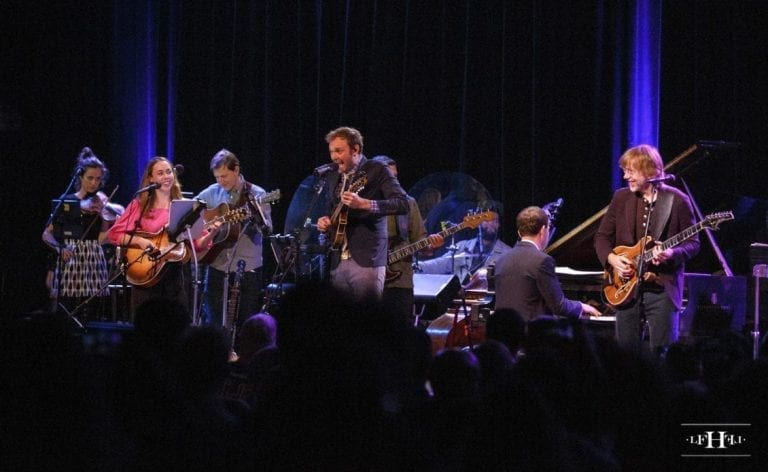
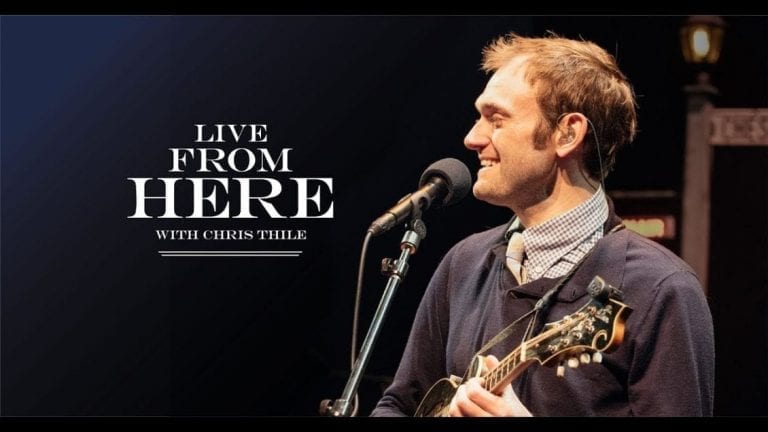
As Live From Here continues its fall run from their new home at The Town Hall in New York City, fans were treated to another glorious episode (with slightly more than the usual phanfare) due to one particular name on the guest list. Being a live air show with a strictly dicatated schedule, 6:00:00 PM sharp brought on the opening notes of “Fugue State,” a Vulfpeck tune in its second year as the LFH theme song. After a mulit-faceted and highly layered “C Q,” this week’s song of the week (yes, Chris Thile writes a song every week!), which sounded somewhat like a venue appropriate mini Broadway musical, Thile announced this week’s first guest.
Photo courtesy of Live From Here
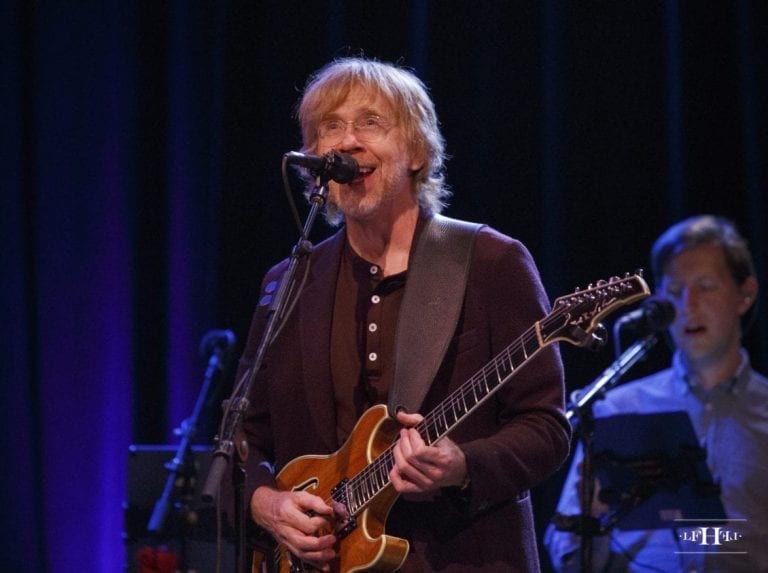
Trey Anastasio entered to thunderous applause as there were many Phish fans in attendance who probably saw their first and only episode of LFH last night. “Theme From the Bottom” was Trey’s first offering, rearranged to play alongside the house band of Chris Thile (mandolin), Mike Elizondo (musical director/bassist), Chris “Critter” Eldridge (guitar), Kush Abadey (drums), Brett Williams (keys), Brittany Haas (fiddle) and guest Sarah Jarosz (vocals, banjo, mandolin, guitar). “If I Could” was Trey’s next choice, and if you didn’t know better you might think it was a duet written specifically for he and Sarah Jarosz. Trey really opened up a beautifully composed solo for this one, his tone so clean as he played out of a very stripped down set up and not his usual Phish rig.
Photo courtesy of Live From Here
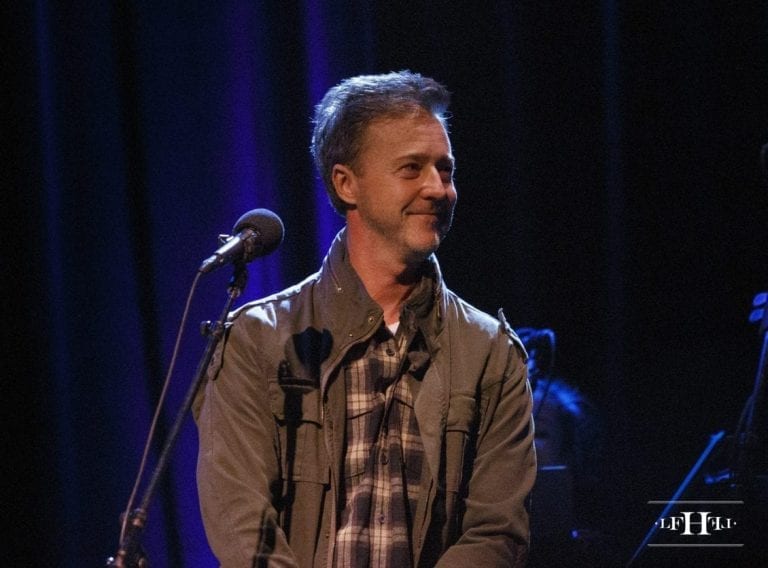
Tom Papa left the audience in stitches with his Out in America segment, followed by a jazzy house band number and then Sarah Jarosz covering Joanna Newsom’s “Book of Right-On.” Edward Norton was next up, explaining how he got hooked up with Thom Yorke and guest Wynton Marsalis for music for his new movie premiering November 1, Motherless Brooklyn, a 1999 book by Jonanthan Lethem from which he read like the world class actor that he is.
The Jazz at Lincoln Center Orchestra with Wynton Marsalis quietly assembled on stage during Ed Norton’s segment and wowed the crowd with two numbers, the second of which saw them joined by Chris Thile. Fifteen members strong with twelve horns, an upright bass, baby grand piano and drums, Wynton immediately distinguished himself from the rest of the similarly clad ensemble, treating the room full of Phish phans to a heavy dose of culture from one of New York’s finest professional jazz outfits. The birthday segment was next, where Thile recognizes musician’s birthdays and plays their songs. Sarah Jarosz shined bright again and showed off her range during a cover of Natalie Maines “Cowboy Take Me Away,” followed by Fela Kuti’s resounding protest song “Zombie” and Sweeney Todd’s “A Little Priest,” a nod to Miss Lovett and Angela Lansbury’s birthday. One more birthday for this segment and another opportunity to introduce Trey Anastasio, who quipped, “Everyone who’s ever strapped on a guitar owes a little to Chuck Berry,” before covering “Back in the USA,” again sounding so clean on his minimalist rig.
Photo courtesy of Live From Here
Before Trey’s next selection, Thile asked him just how he chooses only four songs from the mighty catalog at his disposal, “You know, I play in a band that goes on stage without a setlist so a lot of it is just feel and the vibe from…you people {pointing to the audience}. This is just a song I like a lot right now,” as he launched into a chilling “Life Beyond a Dream,” which was a perfect song choice for the setting.
Photo courtesy of Live From Here
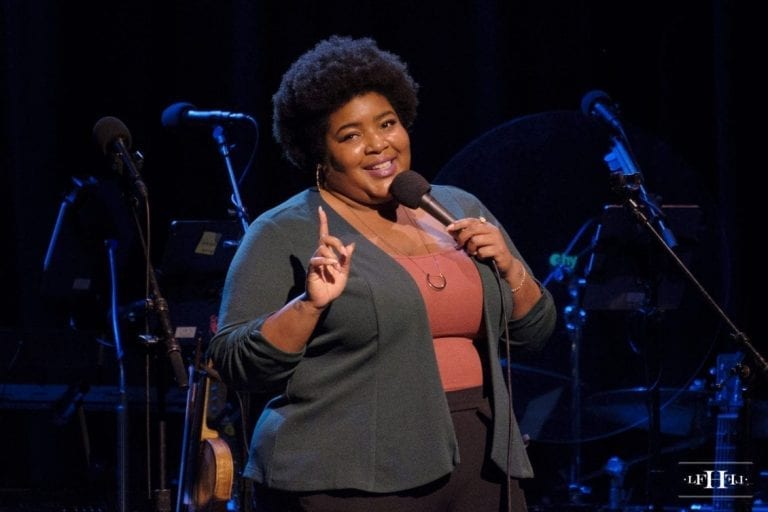
Dulce Sloan was next with an outstanding set of stand up comedy as she opened with, “I can’t believe I’m gonna do stand up after the chillest song I’ve ever heard,” and, “did you notice the only black people here are me and the drummer?” A trio of fiddle songs featuring Britanny Haas was next before Tom Papa had a belly-laughing, eyes-tearing reading about parenting. “I used to listen to Phish,” he quipped, “now I do it quietly…in the bathroom.”
Photo courtesy of Live From Here
The Jazz at Lincoln Center Orchestra played another mind-boggling number (best music city in the world, anyone?), again highlighted by Mr. Marsalis though his company of professional musicians was almost equally impressive, and was soon joined by phan favorite Trey Anastasio, now set up stage left in front of the orchestra, for what would be the On-Air finale of “Blaze On.” Watching these musicians watch and marvel at each other, Thile and Trey at Wynton, Wynton at Trey, along with Thile’s endearing and wild gesticulations, just drove home the fact that the Live From Here faithful (and a roomful of LFH first timers) were treated to something special last night. A final off-air performance of Lester Flatts’ “I’m gonna sleep with one eye open,” with the audience on their feet sent everyone home reeling.
Photo courtesy of Live From Here
The crowd was grateful for the intimate performance, and that New York City is the new home of LFH, along with Trey, Winton, and the Jazz at Lincoln Center Orchestra. Just another ho-hum night in New York of world class music and collaborations.
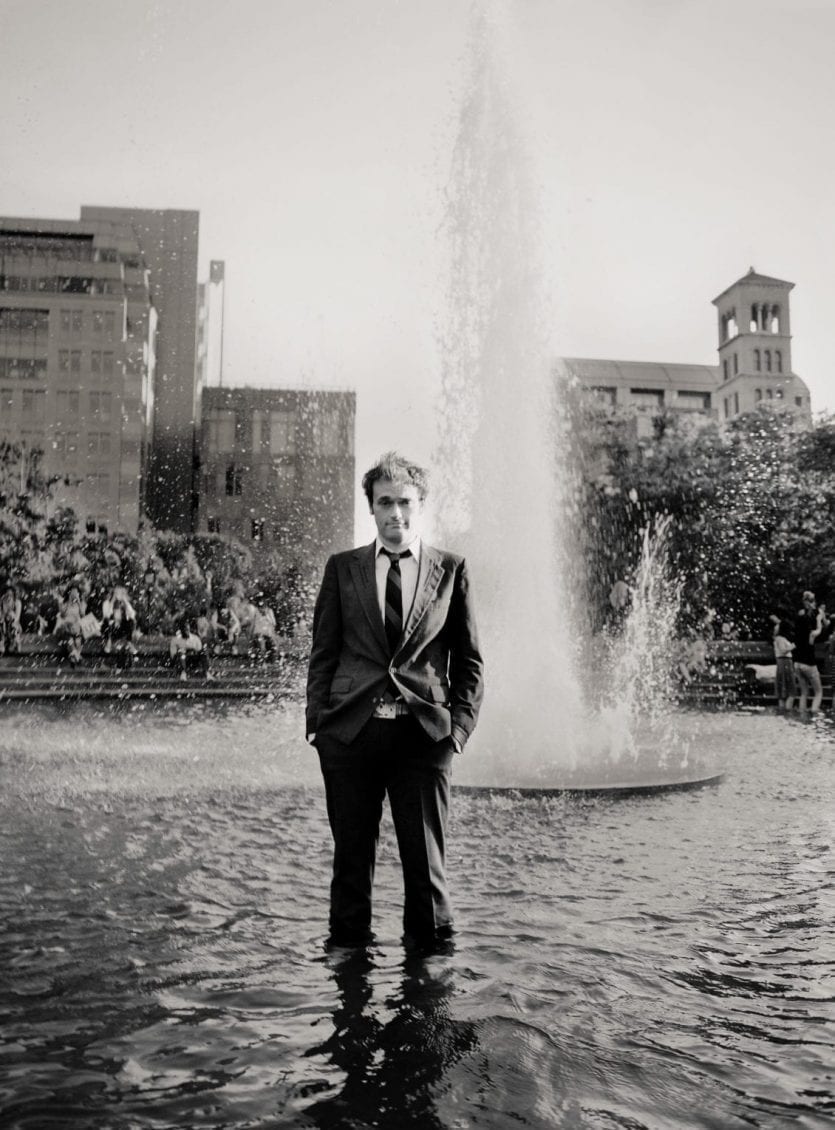
Chris Thile, as a member of Punch Brothers and Nickel Creek, has won multiple Grammy Awards and sold millions of albums. As the host of Live From Here, he has spanned genres and brought a wide range of musicians together for weekly performances at Manhattan’s Town Hall, where the latest season kicked off earlier this month.
Thile looks at art as a conduit to conversation, and towards collaboration with the audience as creating art together. It is in this way that he fits as a natural host of a two-hour weekly show broadcast on public radio, one that will see very special guests appearing each week this season – Grace Potter, Dawes, Trey Anastasio, and Wynton Marsalis, to name just a few.
Chris performs this Saturday, September 21 at Bethel Woods Center for the Arts as part of Vibrations Series which celebrates the power and possibility of the ’60s and what that decade means to us today. Launched in 2019, “the series has brought together change-makers, artists, and influencers to open conversations, inspire thinking and awaken purpose.” With an emphasis on the arts and civic engagement, Vibrations brings the legacy of the past into conversation with the movements of today, something that Thile can relate to. Chris spoke with NYS Music about the role of artists in bringing about change, music that has engaged audiences, and what gave him an early glimpse at what hosting a show like Live From Here might be like.
Pete Mason: With the upcoming Vibrations Series at Bethel Woods this weekend, when growing up, how did you come to discover the era of the 1960s – the change, the conflict, the music – and in what way did that seep into your songwriting and understanding of American culture?
Chris Thile: That’s a spectacular question. The Beatles were the first non-rootsy thing I was intentionally exposed to by my folks. Up to that point, I was listening almost exclusively to folk music in various forms and a very specific swath of folk music at that. For example, bluegrass music and fiddle tune music and almost no popular music of any kind, and just a little bit of classical music on the radio and jazz via my dad’s record collection. All of a sudden, my parents were raising a child with no real sense of popular music, particularly the popular music of their childhoods. So they checked out Rubber Soul from the library for me and it blew my mind. People writing songs about things other than having a little home on a hill and “Mule Skinner Blues” and “John Henry.” These were songs about people’s lives and they were contemporary songs, not that “John Henry” wasn’t in their day, but just updated by 100 years or so. I think it was becoming socially difficult to write about a vast amount more than it had been up until that point. It would still be many years before I heard Dylan at that point and, generally, cover songs by artists from the roots community, such as Tim O’Brien who made a beautiful album of Dylan songs called Red on Blonde.
So it has seeped in there. Particularly, the biggest lesson is that its ok to write a song about anything, provided that you do it well – that’s the big rule. I think above all, that’s a lesson to learn from the ’60s.
PM: How do you see your role, and the role of artists, in capturing pivotal moments in American history, especially from the past 20 years or so?
CT: I think that art exists for a variety of reasons. It turns on a camera in the documentary film of our life, our experience in the world, and we gain some perspective. I think that is one of art’s most noblest responsibilities – to help us gain perspective on the world and what’s going on and what it means to be alive, not just in our moment but in the moments previous and be able to better serve our respective moments if we’re aware of other people’s moments. And it also serves as respite, what we’re collectively experiencing. There are so many different things that it can do that I would hesitate to look at one thing and point that out and say that’s the one thing that art’s supposed to do in times of turmoil and in times of peace. It’s just so good at doing a variety of things.
PM: What can aspiring artists do to bring about civic engagement through their music and performances? What is there that they can do beyond inspiring an audience to step away doing something more?
CT: I think that the very best thing an artist can do is to make their art well. I think there’s a lot of reasons you make what you can make. Sometimes I think that art made with the specific intent to elicit a particular reaction can actually be fairly compromised, by dictating the feeling your audience should have. For instance, Dylan is at his best as a lyricist (and at his best very often). I think that any one of us could have a unique reaction to a Dylan lyric, that he leaves a great deal of room in every lyric for you to cultivate your own sense of meaning. And so when you talk about things like ‘what an artist can do to bring about civic engagement,’ I would be wary of art that makes that its directive and explicit aim, because I feel like the way to engage a person… I think the best art is collaborative with the audience, with the person who is sitting in front of it, listening to it, looking at it, reacting to it. And that if you as an artist attempt to dictate what your listener is to think or experience, then they’ll switch off, they’re not going to engage, they’ll feel manipulated, bullied into feeling a certain way. I don’t think art is good at proving points or answering questions, it’s good at asking questions and good at getting people talking to one another about things. So I would go back to the way an artist can engage his or her audience is engaging them as artists, and asking them to enter into a collaboration as to the meaning of the art that they are working on.
PM: Can you think of any songs that stand out to you that fit this mold, where they don’t go in with a specific intent, but it just naturally comes out and the audience is engaged rather than pressured?
CT: I would say that Stravinsky’s Rite of Spring did a pretty spectacular job engaging its audience. Along with Diaghilev’s ballet, his choreography, it engaged people to the point that they rioted over it. That seems like it was pretty powerful, it really came out of the clear blue sky, not that there weren’t hints to the possibility of this beforehand, but I think a lot of musicians interacted with that piece. And it’s called Rite of Spring, it depicted a certain kind of reality and the art was so good that people got talking about it. “Is this OK? Can we do this?” Meaning not “Is ritualistic sacrifice OK?” but rather, “Can we make art about it?” I think that piece did an extraordinary job engaging its audience and I sincerely doubt that riots were the intended result, but that’s what happens when you pose a specifically well-worded question.
I feel like Radiohead has been excellent in writing art that gets people thinking about climate change and just the environment in general. It often is in the abstract lyrically. I think that someone like Gillian Welch has done an extraordinary job in the ways in which lives led, say, 60-100 years ago and the study of those lives might be relevant to the living of theirs. I think she operates in this beautiful, undefined aesthetic that has a foot in American folk music of the early part of the 20th century but also right now. There’s so much, I don’t even know where to begin.
Think of someone like Ornette Coleman with a record like The Shape of Jazz to Come. Kind of making people think about music that is made up on the spot, and in what ways is that music to you and in what ways is it not. I think a lot of people talked and debated about that and we ultimately felt that Ornette’s take on that was ultimately brilliant, but it created a lot of controversy in its day. I love that. I do think that art is better at asking questions than answering them. I’ve noticed that in young writers and in my young writing. It always seems like I’m answering a question and I see young writers now… it starts to sound like we think we know what’s going on. Looking back on particularly younger lyrics, I think, “My god, you really thought you knew what you were talking about and you really did not. You thought you had an answer to something. At least from where I’m standing, at 38, I do not think there’s an answer to that question, my 23-year old self. Nice try.”
PM: With two weeks of Live from Here in the books, how has the transition from Minnesota to NYC been, and how has curating and preparing shows at Town Hall been?
CT: I love Town Hall, I adore making music there, it feels like home at this point. Last year we did more shows at Town Hall than at any other place, so the transition has been happening, just gradually, and this year was sort of completing something that was already happening pretty naturally. I live in New York, and there are so many people, so many artists coming in and out of the city. Regardless of where they live here, everyone comes through here – this is one of America’s biggest windows to the world and the world’s biggest window to America. It’s nice to be here for that reason. We have this two-hour canvas that we get to paint every week and there is a lot of space for things to happen and it feels good being in a place like this where on any given night there are hundreds of wonderful things happening and it seems maybe like it’s a little easier to coax a few of those things onto the show week in, week out. And that’s nice, it takes some of the edge off.
PM: With all the years of Nickel Creek and Punch Brothers, was there ever a point where you expected to be the host of Live from Here, or any similar roles? Looking back, did you ever think ‘oh yeah, I always wanted this job.’?
CT: Certainly not this specifically. There have been times when I wondered whether doing something of this sort would be interesting. Punch Brothers had a residency at The Living Room on the Lower East Side of Manhattan and we called it P-Bingo night. It was a one-band musical variety show, with one guest per show who would do a couple things with us. And we’d try to make funny things happen, some covers, an original of sorts each show, and stylistically try and get all over the place, in service of our general mutually held belief that genre is really a discussion of the cover of the book and not the book. Which is fine, it can be interesting, the aesthetics of the thing can be really, really interesting, but it is a question of aesthetics largely. And that’s one of the thesis statements of Live From Here, but I had a great time doing that, particularly because it was thrilling and hair raising to come up with a show that was entirely different on a weekly basis.
With Punch Brothers it was a shorter show but also it was all us, so it was a lot of material and we ended up stressing ourselves out so we did it less and less. But we did at a certain point wonder if we could make the thing it into a show, a radio show or television show, and even pitched it to a couple people, although we never got any interest. So when this came along, it wasn’t thinking about whether I wanted to do it, but this legendary time slot was being offered to me with a chance to commune with the public radio listening faithful on a weekly basis. It was too tempting to resist and it put me back in the mind of doing P-Bingo night with Punch Brothers and how much fun and how thrilling and dangerous it felt making all that new content. The energy that comes with thinking about the transition from doing that at a 100-person club on the Lower East Side and doing it for a couple million people on the radio live, it got a little too exciting to resist and I’m really happy and having a great time.
Live From Here hosted by Chris Thile will return this month with the fourth season of the weekly variety show from their new home at New York City’s Town Hall. Thile and producers American Public Media announced in May that the show’s creative and production teams would move from St. Paul, MN to NYC.
“Next season, our public radio listeners and live-stream viewers will get the best and broadest selection of music and musicians we can possibly present,” Thile said via press release, “and they can also expect an expanded range of spoken word content, including poetry, literature, comedy and storytelling.”
Live From Here‘s fourth season kicks off Sept. 7, with additional performances on Sept. 14 and 28, Oct. 12 and 26, Nov. 2, 16 and 23; and Dec. 7 and 14.
Guests for the season premiere include Ezra Koenig, frontman for Vampire Weekend, Natalia Lafourcade, Sarah Jarosz, Jake Gyllenhaal, Matt Braunger, and Holly Laurentand. The season continues with The Lumineers, Raphael Saadiq, Aparna Nancherla, Maria Popova, and Rachael Price on Sept. 14, then Jamila Woods, John Cameron Mitchell, Ann Patchett, and Tom Papa Sept. 28.
Oct. 12 brings Trey Anastasio plus The Jazz at Lincoln Center Orchestra featuring trumpeter Wynton Marsalis, Sarah Jarosz, and Tom Papa, and Oct. 26 features Lake Street Dive frontwoman Rachael Price. Guests on Nov. 2 include Gregory Alan Isakov and Aoife O’Donovan. More artists and guests will be announced soon.
Tickets for the fall season are already on sale. To sign up for the Live from Here newsletter and for more information, visit LiveFromHere.org.