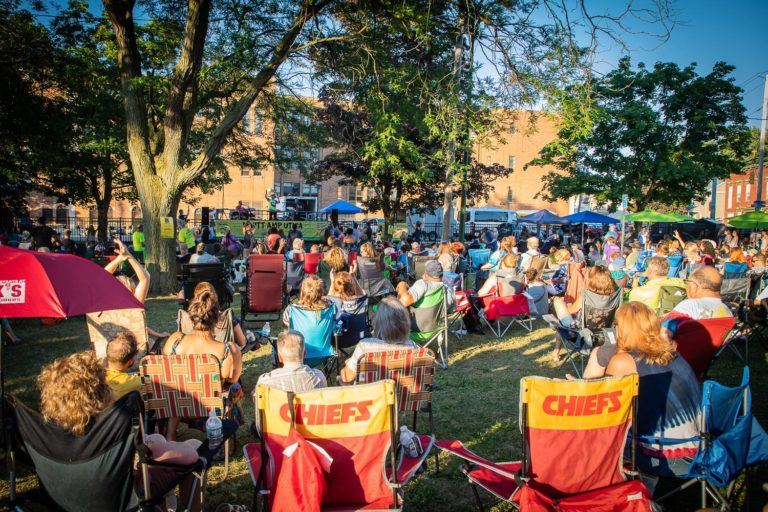
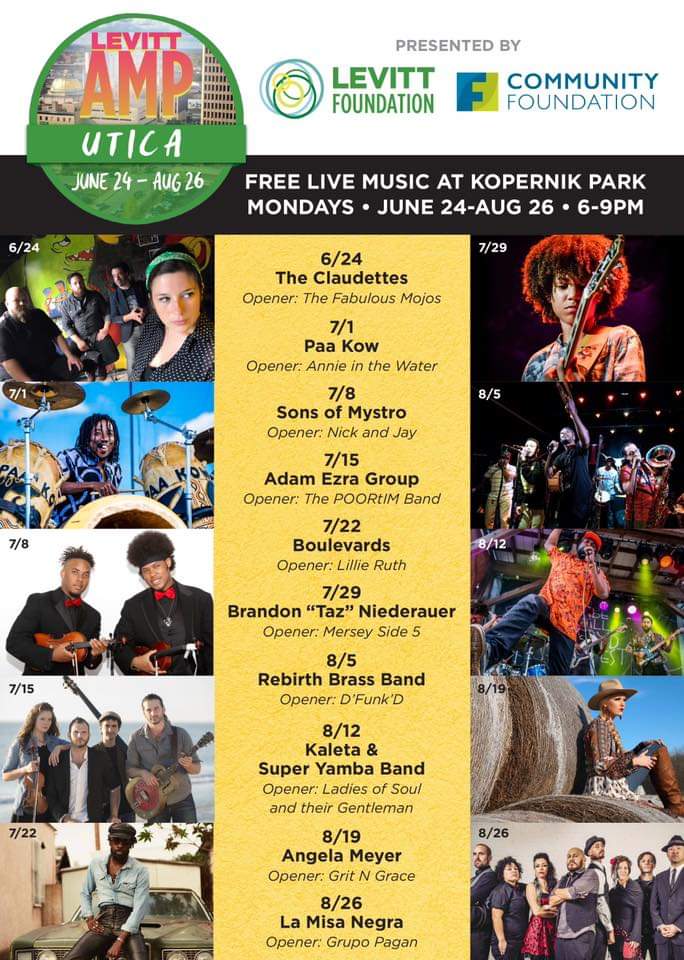
The City of Utica has been awarded a Levitt AMP concert series for the fourth consecutive year. The ten week free concert series will take place in Kopernik Park in Oneida Square on Monday nights beginning June 24 and continuing through Aug. 26.
The Levitt Foundation awards matching $25,000 grants to non-profits in select small to mid-size cities across the U.S. each year, creating a network of live music in underused spaces across the country. Eighteen cities have been selected to host the Levitt AMP series. This year, the Community Foundation provided a $25,000 match to help fund the series in Utica.
This year’s Utica Monday Night shows include a wide range of artists; from young Hendrix-influenced guitar phenom Brandon “Taz” Niederauer to the Grammy winning Rebirth Brass Band from New Orleans. Other artists include Paa Kow, a native of Ghana who combines the rhythms of West Africa with jazz to provide listeners a unique percussive sound, and La Misa Negra, a seven piece Afro-Latin collective from Oakland, CA that incorporates elements of hip-hop, metal, Caribbean and African poly rhythms.
Brandon “Taz” Niederauer
Each show will feature a local opening artist beginning at 6 p.m. See the complete schedule below. For more information about the artists performing, visit the Levitt AMP Utica website here.
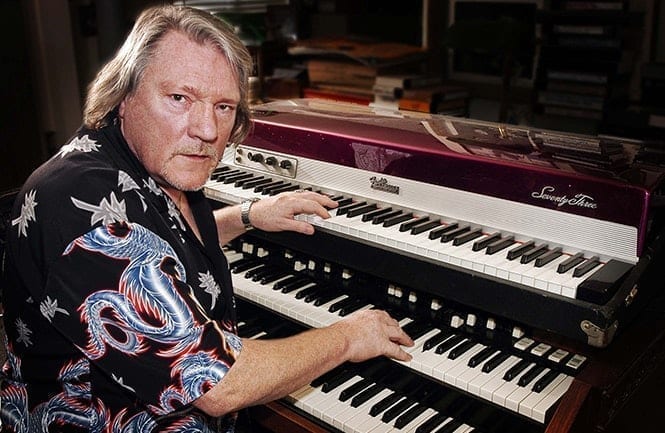
Brian Auger and the latest incarnation of Oblivion Express played just six songs in each of their hour-long sets on Sunday, May 5 at The Egg. The modest but appreciative audience was treated to plenty of marvelous solos from both 79-year-old English keyboardist, Auger, and the incredible Australian guitarist, Frank Gambale, a mere stripling at 60.
Earlier versions of Oblivion Express recorded six studio albums from 1971-1975, mining a progressive vein of soul-jazz that also incorporated traces of funk and rock. The current band somehow manages to make all these elements sound relevant and contemporary, even when they’re covering jazz numbers such as Dizzy Gillespie’s “A Night in Tunisia,” Wes Montgomery’s “Bumpin’ on Sunset,” Eddie Harris’ “Freedom Jazz Dance” and Gene McDaniels’ “Compared to What.”
The current quintet was filled out by relative youngsters: singer/percussionist, Lilliana de los Reyes; bassist, Andreas Geck, and Karma Auger (yes, he’s Brian’s son) on drums. Anyone who thinks nepotism accounts for Karma’s presence should just listen to him – he’s an excellent drummer who doesn’t overplay, yet made the most of his brief solo-spot during the coda of “Whenever You’re Ready.”
Reyes has a lovely voice and she gained confidence as the evening progressed, stepping out from behind her percussion array, really emoting on a beguiling version of Donovan’s “Season of the Witch.” It was first cut by Auger with Julie Driscoll and the Trinity on their 1967 debut Open.
“We were recording on clay tablets at the time,” noted Auger. “This tune was a smash all across the Roman Empire.”
Reyes’ ebullient vocals and the energetic solos from Auger and Gambale were well-suited to the positive messages conveyed by songs such as “Happiness Is Just Around the Bend,” “Straight Ahead,” “Whenever You’re Ready” and “Sundown.” Auger is best-known for a robust Hammond B-3 organ sound, though he also deployed a Korg M3 synthesizer. Gambale was dazzling throughout, with such a clean tone and precise articulation, he demanded attention even when playing rhythm accompaniment behind Auger’s lead on “Compared to What.”
Brian Auger finished this performance by saying “drive carefully because you never know: I might be walking back to the hotel. Thanks again everybody we will see you in the future.” Though he turns eighty on July 18, he’s got a European tour booked for the fall, and shows few signs of slowing down. Mr. Auger, long may you run.
The 20th annual New York Guitar Festival has a long-standing tradition of paying homage to the cultural impact and musical legacies of iconic guitar players. This year, the festival opens with a tribute to influential blues artist, Memphis Minnie. This free outdoor event takes place Saturday, June 1 at 7 pm at Brookfield Place’s Waterfront Plaza in lower Manhattan.
The concert will feature musicians across an array of genres, and will include:Marc Ribot, Rafiq Bhatia, Rachael & Vilray (featuring Lake Street Dive’s Rachael Price), Nicole Atkins, Binky Griptite, Kaia Kater, Jontavious Willis, Toshi Reagon, Brandon Ross, Amythyst Kiah, Alsarah and the Nubatones, Brandee Younger, Abdoulaye Alhassane Toure, Banning Eyre, and, Grammy Award-winners, Vernon Reid and Fantastic Negrito.
Elegant, stylish and tough as shoe leather, she epitomized everything the world loves about America’s most enduring folk music.
Banning Eyre
Memphis Minnie was a gifted Delta Blues guitarist who was one of the first to use electric. She pioneered a sound that influenced generations of music to come, including Muddy Waters, Willie Dixon, The Rolling Stones, and Cream. Her song “When The Levee Breaks,” written about the Great Mississippi Flood of 1927 was later covered by Led Zeppelin.
Additional 20th Anniversary New York Guitar Festival events will be announced soon. Stay up to date at www.newyorkguitarfestival.org
Soulive has confirmed a six dates at Brooklyn Bowl. Bowlive VIII spans two weekends, from July 11-13 and July 18-20. Tickets go on sale April 19 for individual nights or three-night passes.
Formed in 1999, Soulive is celebrating twenty years of making music together. The jazz-funk trio consists of Alan Evans on drums, Eric Krasno on guitar and Neal Evans on keys. In past years, Bowlive has included such guests as Lettuce, Marco Benevento, Chris Robinson, and Aaron Neville. Follow Soulive on Facebook, Instagram, and Twitter for updates on Bowlive VIII.
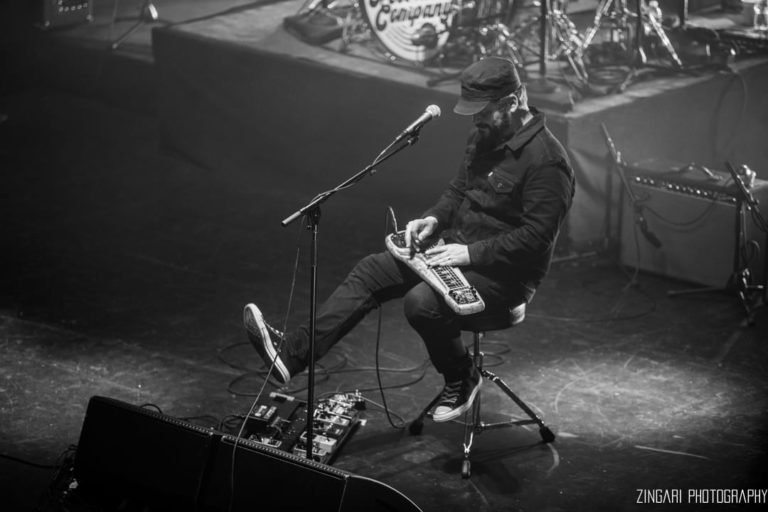
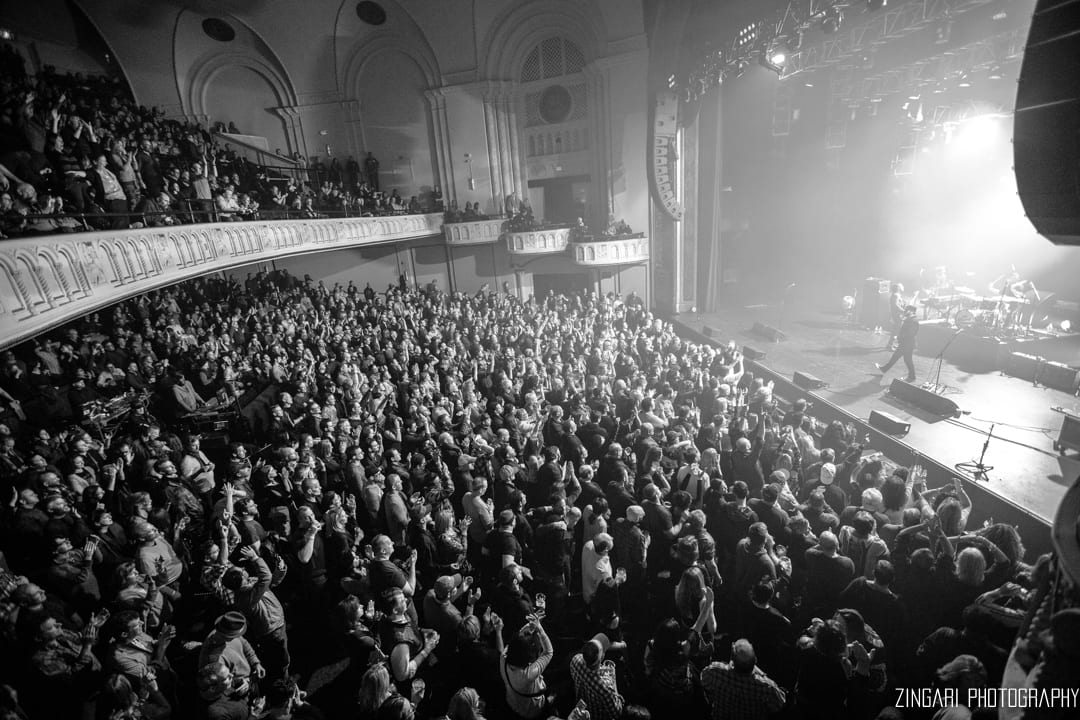
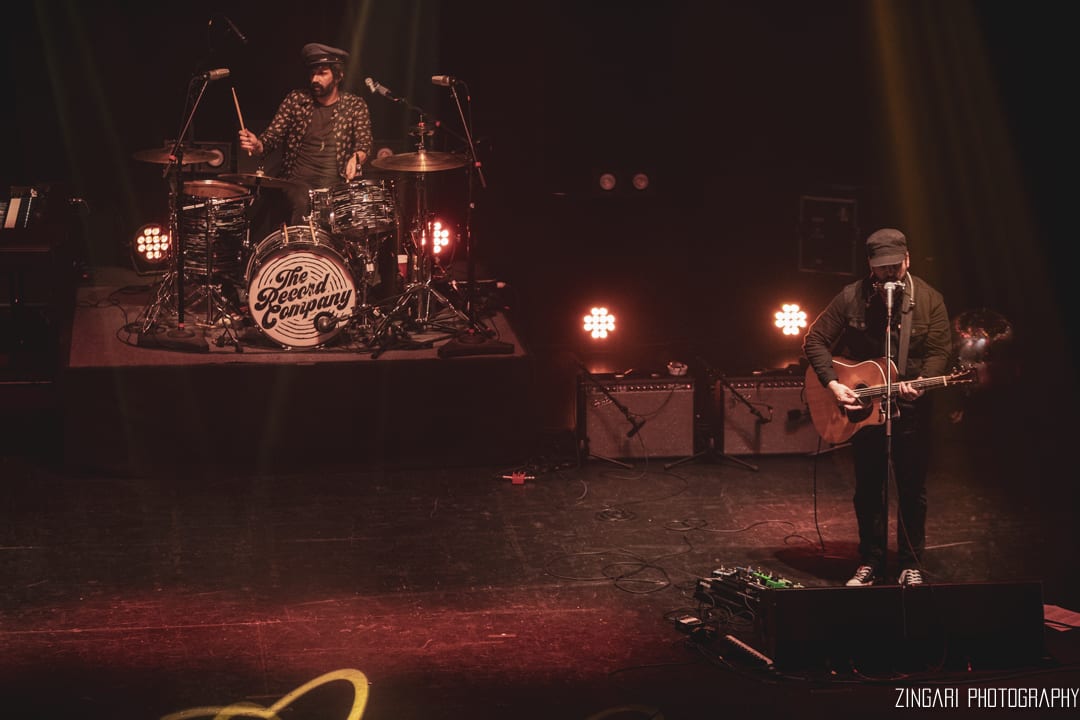
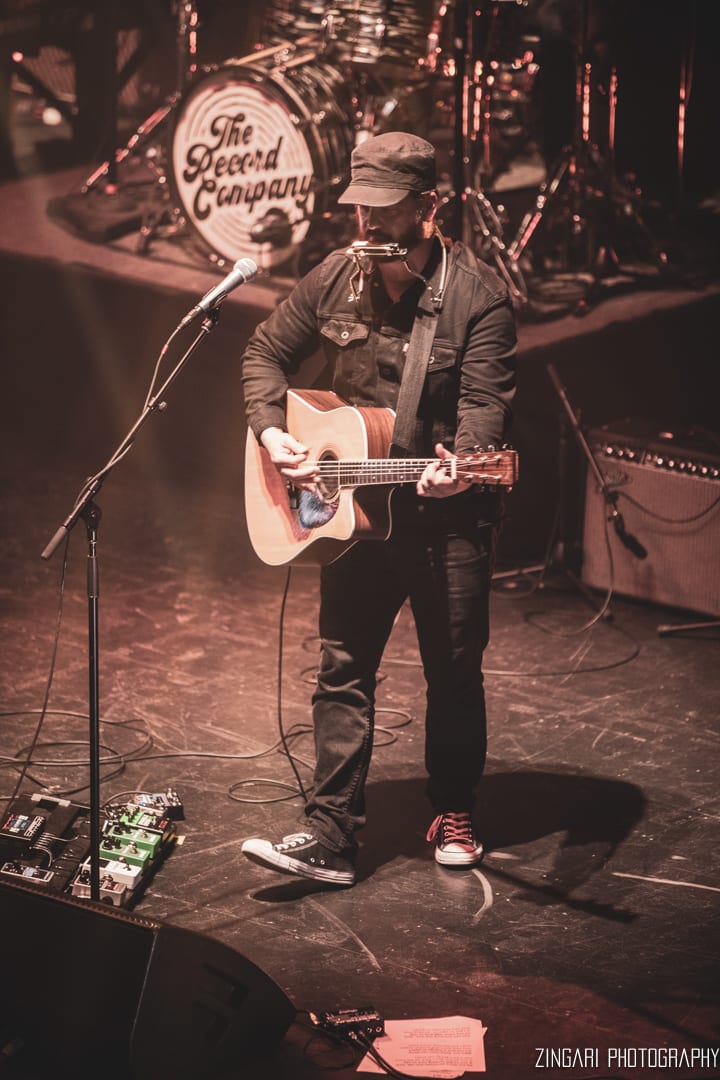
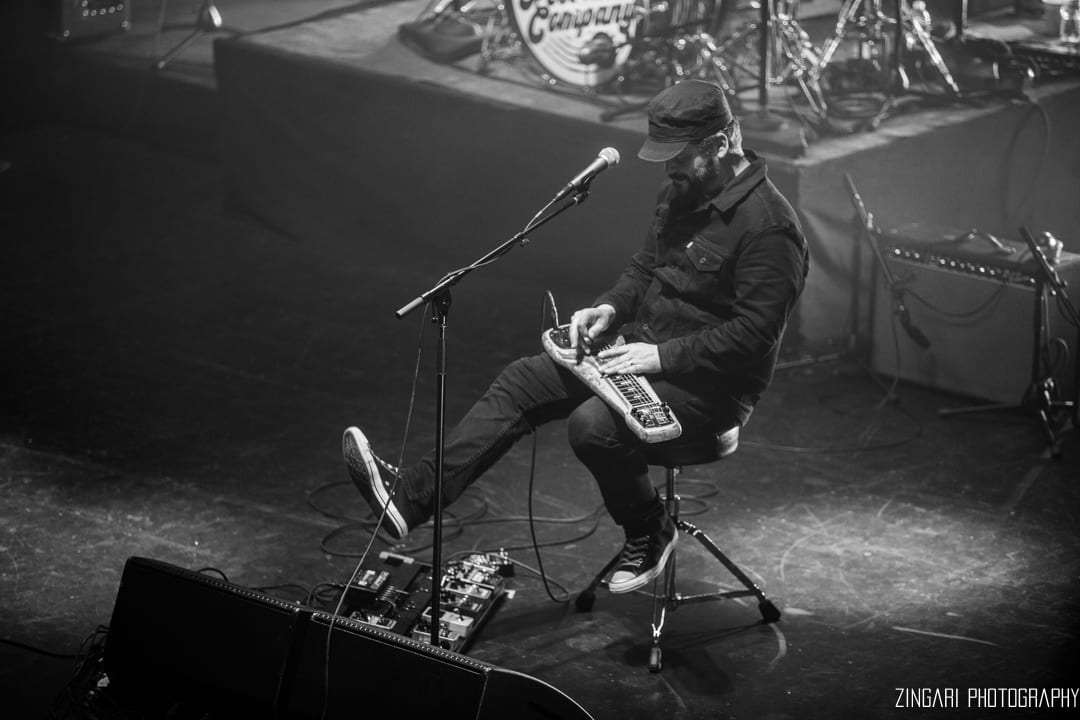
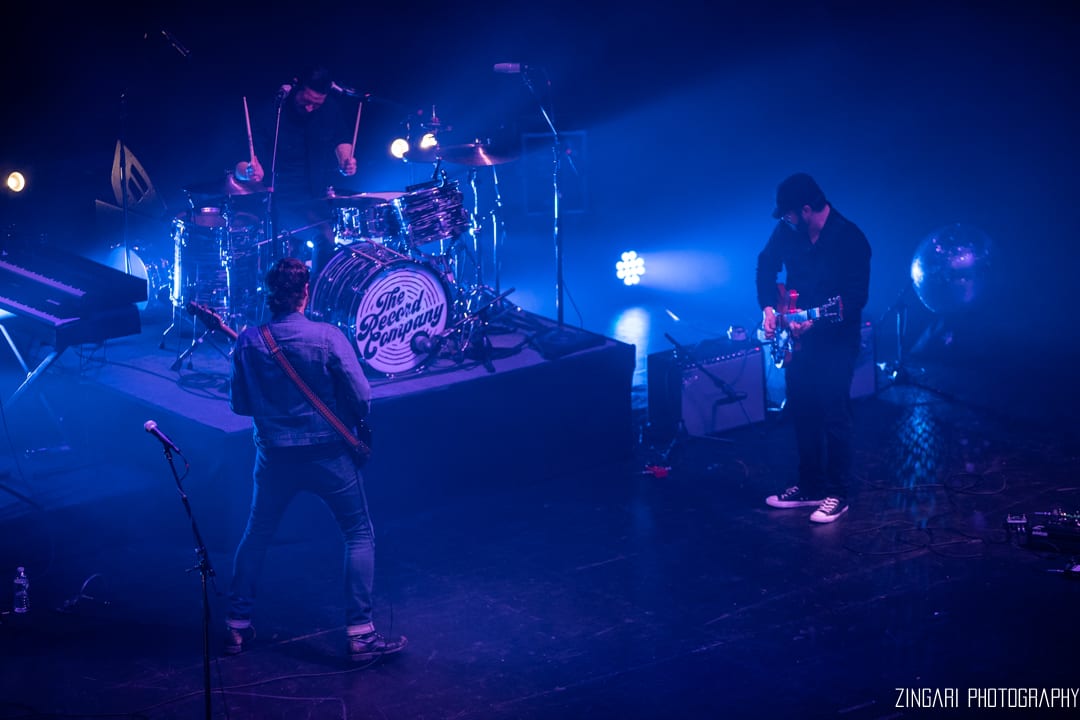
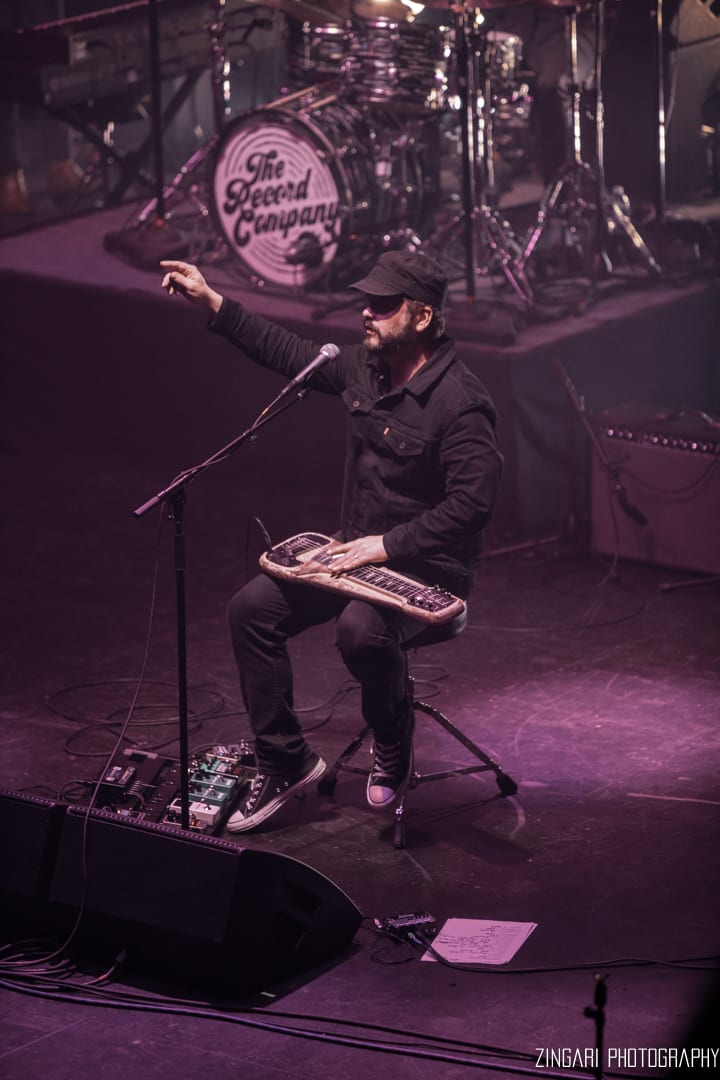
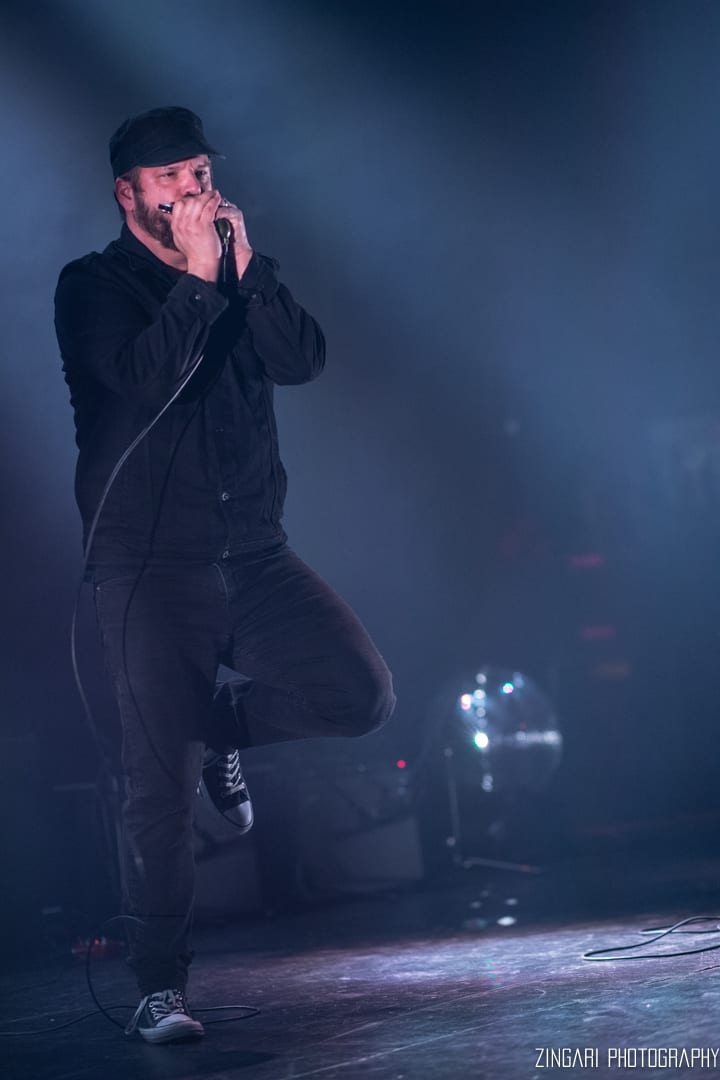
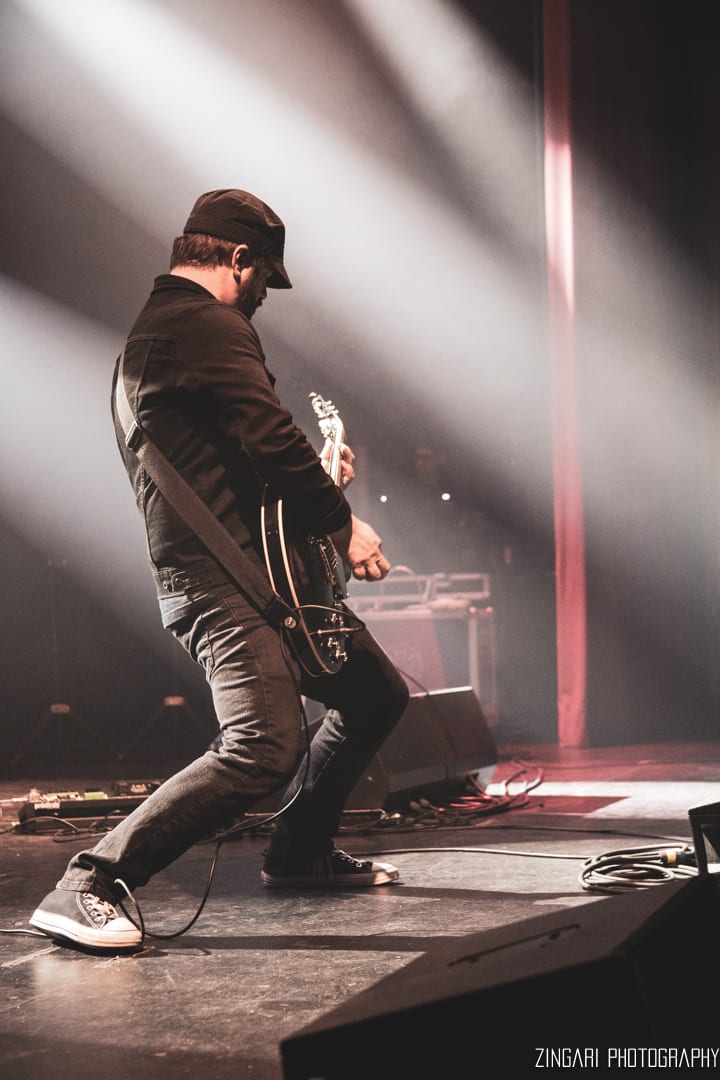
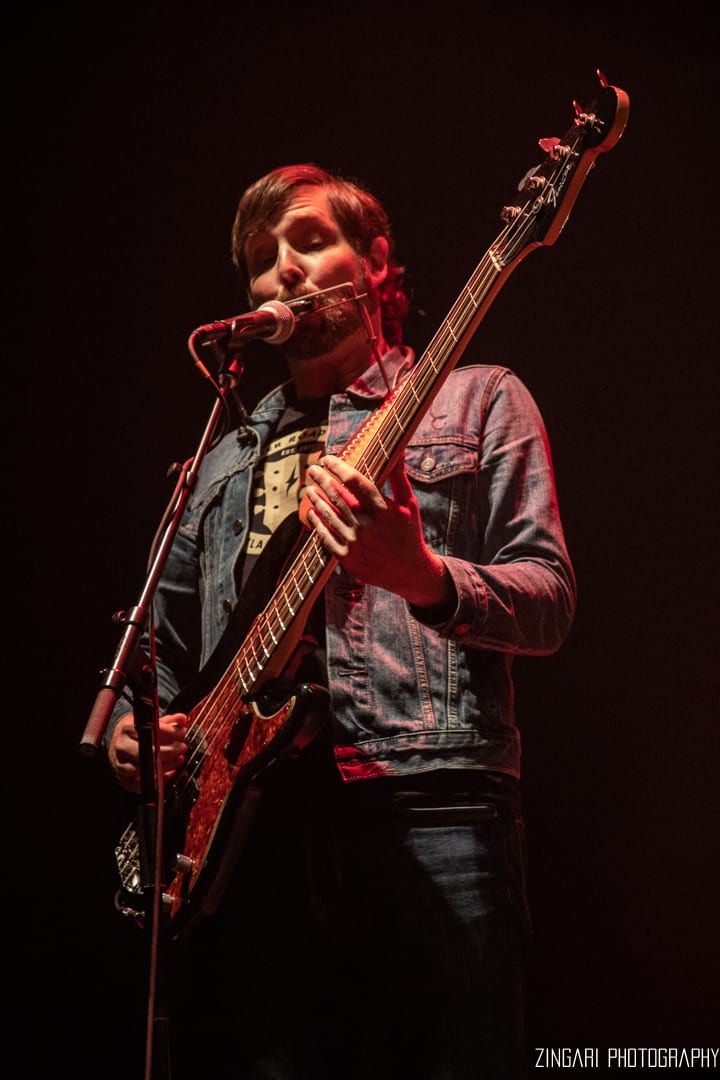
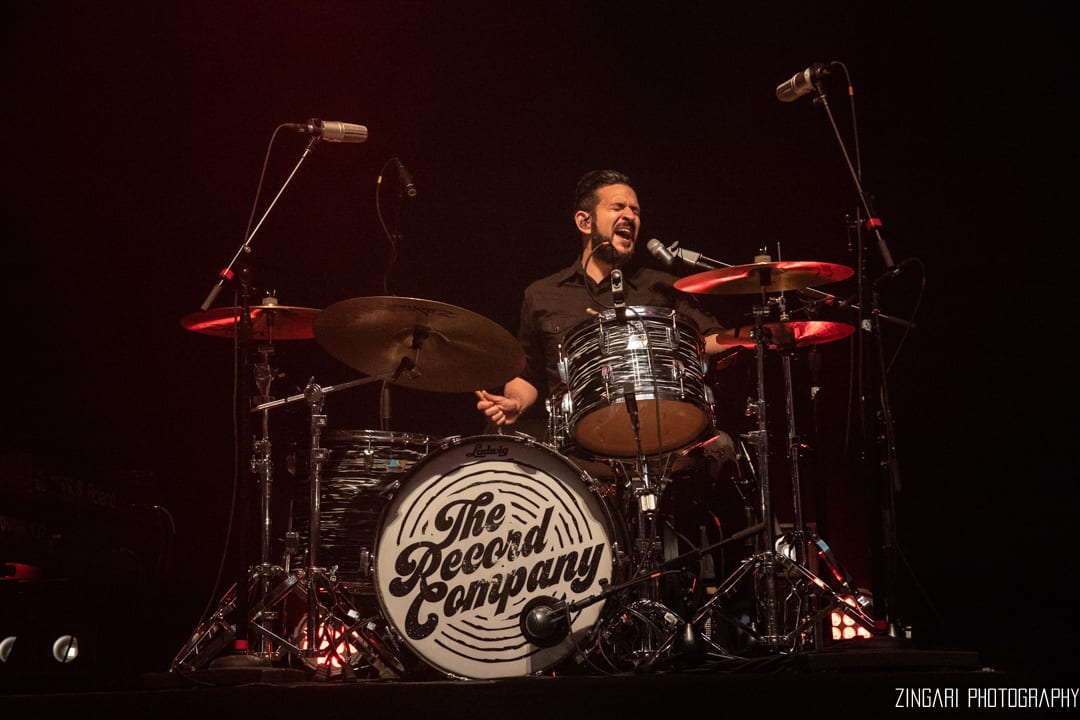
On Friday April 5, The Record Company made their debut at the historic Capitol Theatre in Port Chester, NY. A cold and rainy evening did not deter fans from a night of foot stomping soulful Rock and Roll, that included covers of the Beastie Boys and Grateful Dead.
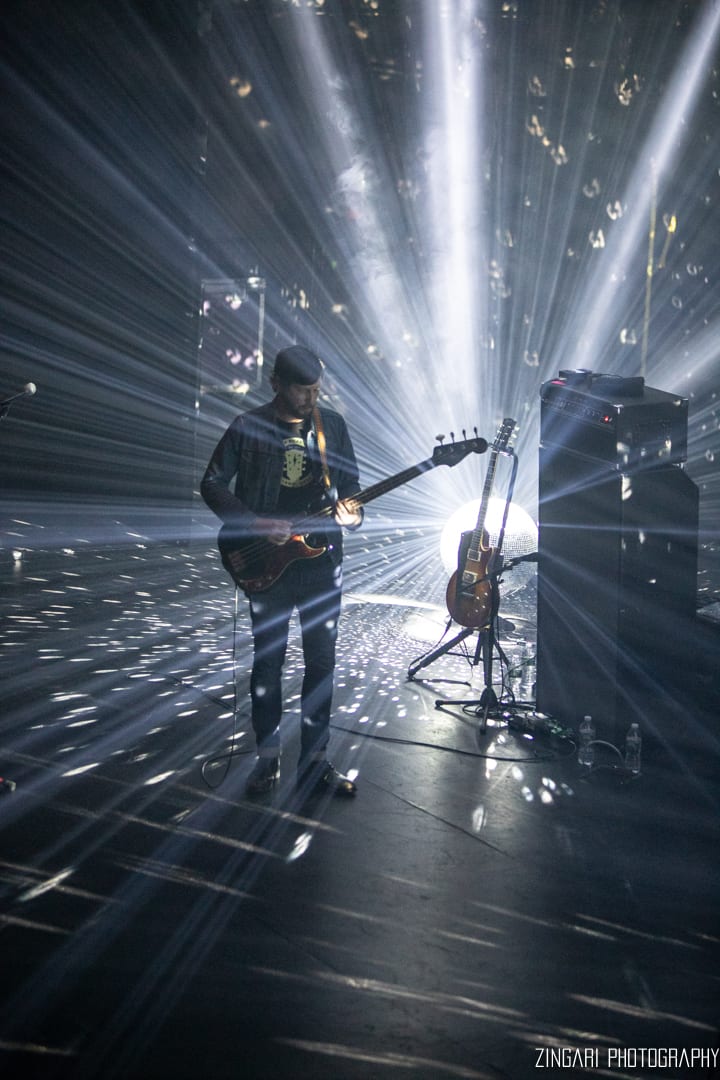
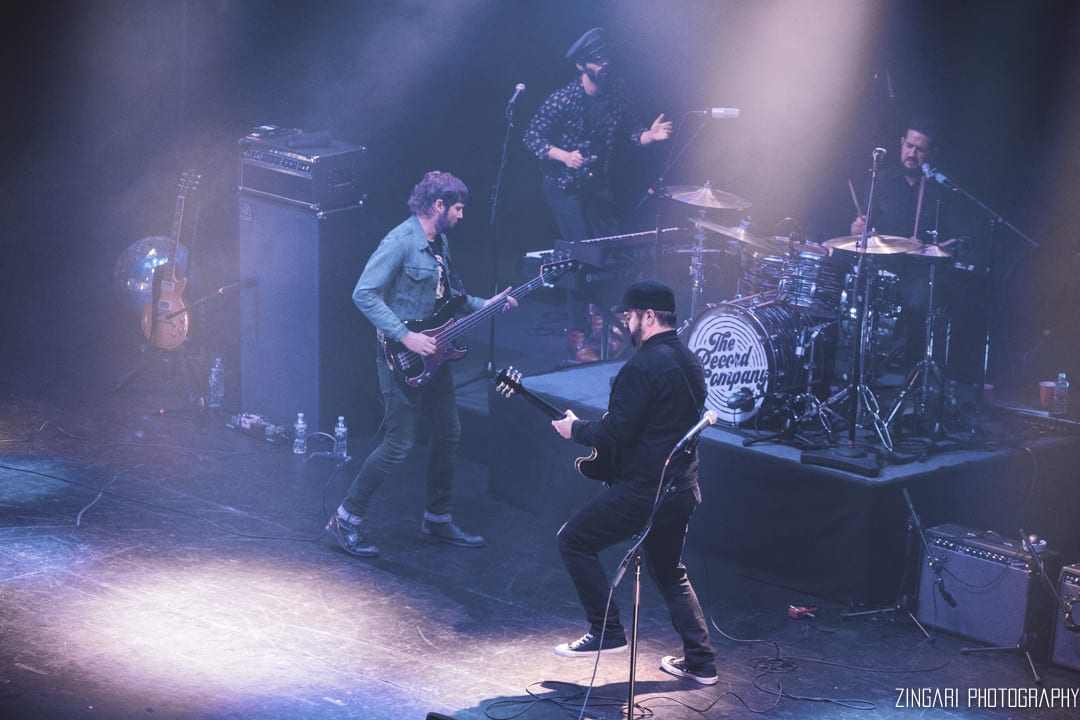
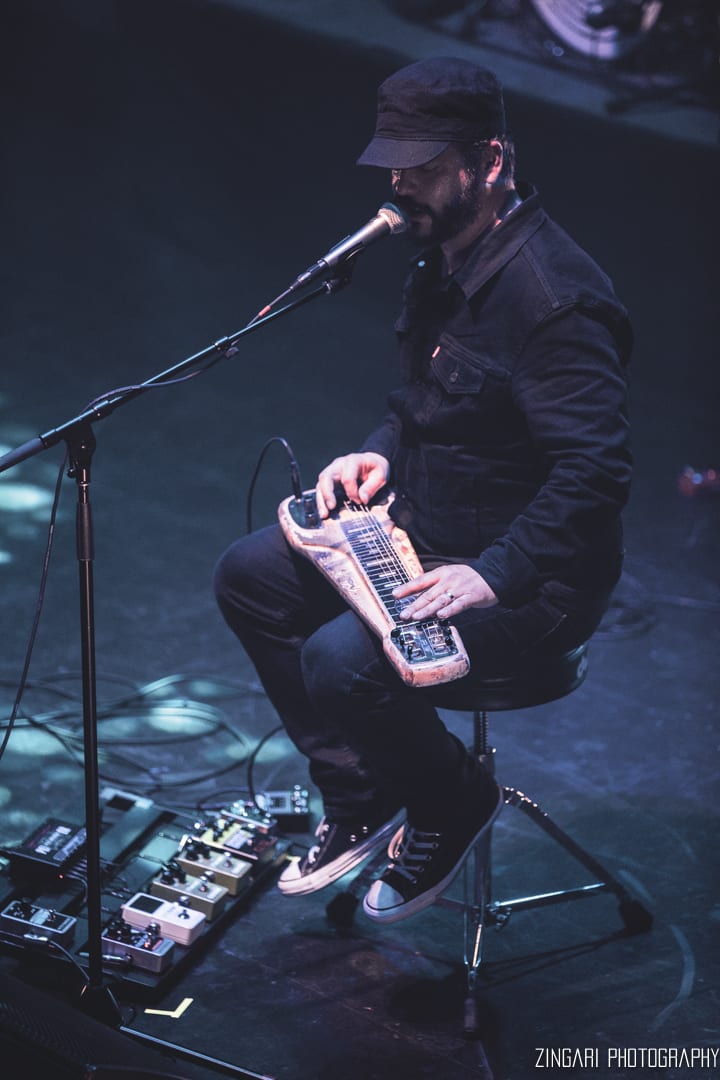
Their sound incorporates slide guitar, distorted bass, Mark Cazorla’s Ludwig drum kit, and the enormous vocals of Chris Vos. It was a joy to see fans young and old come out and enjoy and appreciate a hard working rock band starting to make a name for themselves in the music scene.
The Record Company formed in a living room in 2011, playing farmer’s markets parking lots and in front of crowds of three, putting in the time to build this three-piece band to the powerhouse it has become. “Tears have been shed, stress has happened, Fuck it; it keeps you together,” said bass player Alex Stiff. All that time and experience shines through the music of The Record Company, showing why the popularity of this band is growing daily.
In a world full of mumble rap and this week’s newest pop star, it is a relief to see a hardworking band like The Record Company gain traction and success. Their music is refreshing and reassuring that Rock and Roll is here to stay.
The Record Company – Capitol Theatre, Port Chester, NY
Setlist: Baby I’m Broken, On The Move, Rita Mae Young, New Speedway Boogie, Goodbye to the Hard Life, Hard Day Coming Down, The Movie Song, Life to Fix, Off the Ground
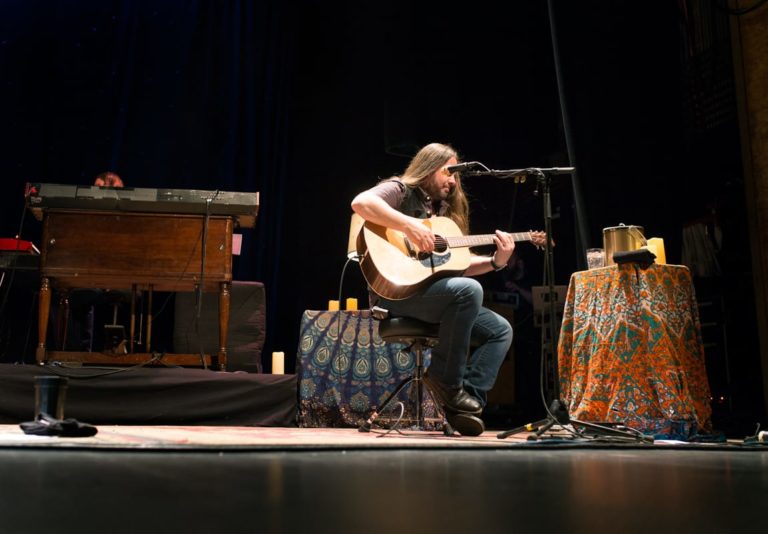
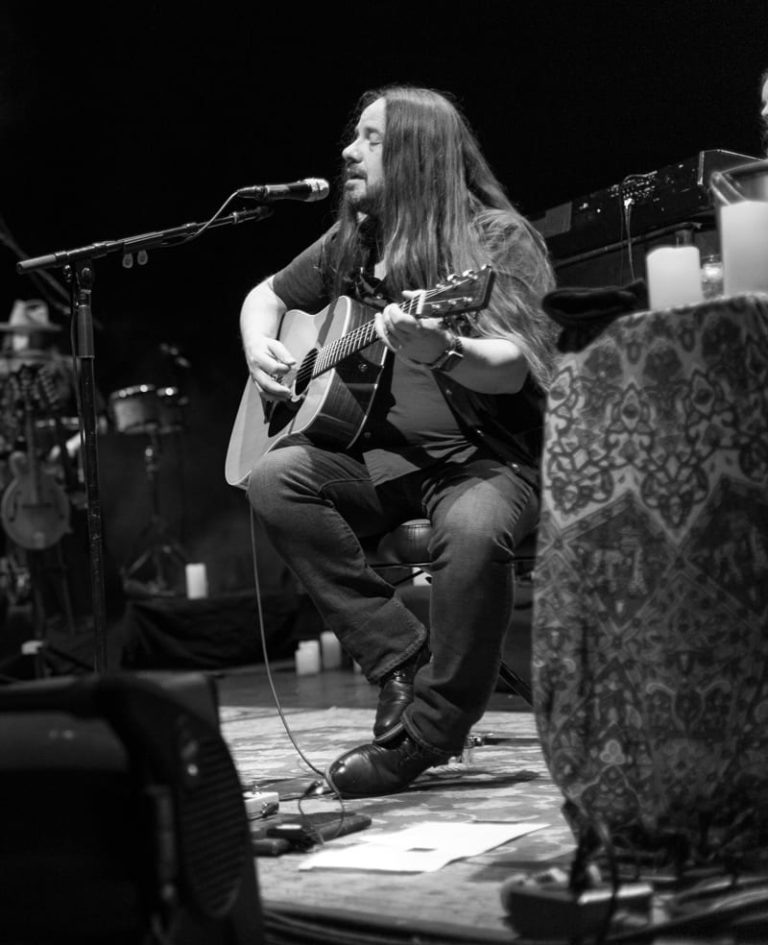
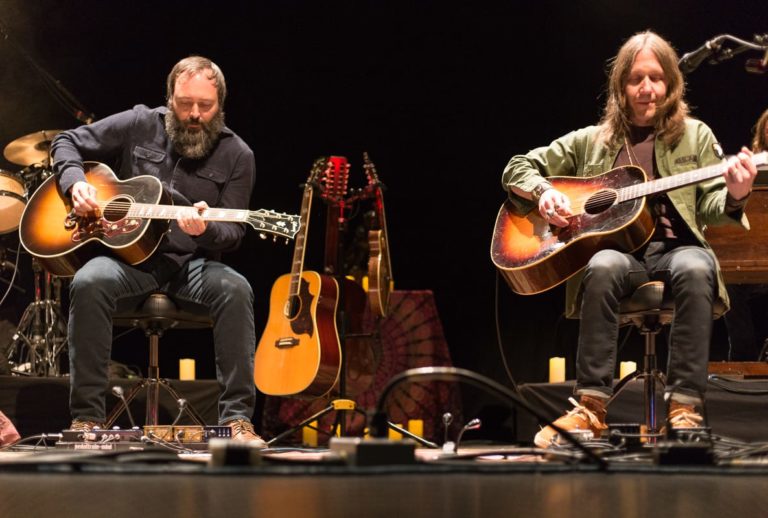
On Thursday April 4, 2019, the Atlanta, Georgia southern rock band Blackberry Smoke pulled into the historic State Theatre in the beautiful downtown Ithaca Commons area as a stop on their 2019 “Break It Down” spring acoustic tour.
Blackberry Smoke is currently on tour promoting their newly released EP, The Southern Ground Sessions, during this spring 2019 tour. This is the band’s first ever acoustic run. Blackberry Smoke has been a staple in the rock and southern rock genre since the early 2000s, however, it has been quite difficult to accurately define their sound which has most definitely become their own, combining an eclectic mix of rock, blues, country and folk.
Blackberry Smoke’s line up consists of Charlie Starr (lead vocals, guitar), Paul Jackson (guitar, vocals), Richard Turner (bass, vocals), Brit Turner (drums), Brandon Still (keyboards, piano). Joining the band on stage was first call touring guitarist, session player and producer Benji Shanks.
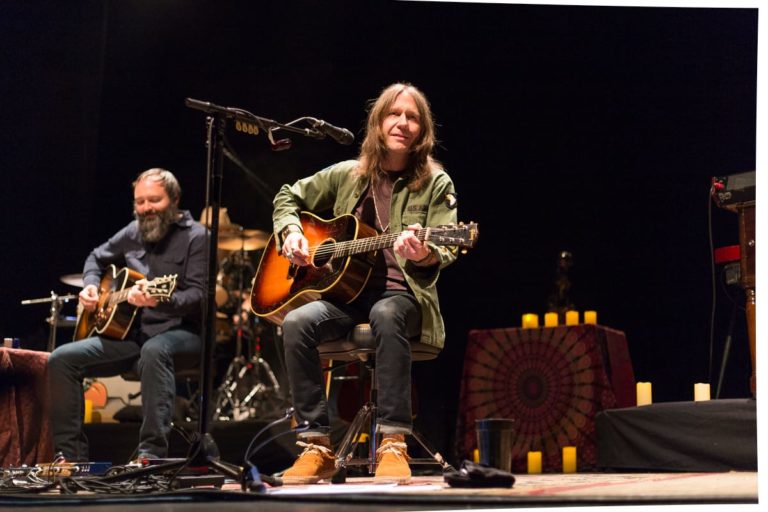
Benji Shanks and Charlie Starr
With six studio albums under their belt, including Bad Luck Ainât No Crime (2004), Little Piece of Dixie (2009), The Whippoorwill (2012), Holding All the Roses (2015), Like an Arrow (2016) and Find a Light (2018), Blackberry Smoke has two Billboard chart-topping country albums and an enormous catalog of songs to choose from. Hailing from Atlanta, these Southern boys are no stranger to the road, touring and performing throughout the United States. Blackberry Smoke have headlined as well as opened for major artists such as Zac Brown Band, ZZ Top, Lynyrd Skynyrd, Eric Church and more. For nearly two decades they continue to tear up the charts and the road with mega hits and touring, playing on average, 250 shows a year. They have developed quite the eclectic fan base as well, ranging from the classic Southern rock, country, rock and roll, grassroots and jam band fans. They have been known to frequently break into long jams, throwing covers into the mix of their music and play all night long.
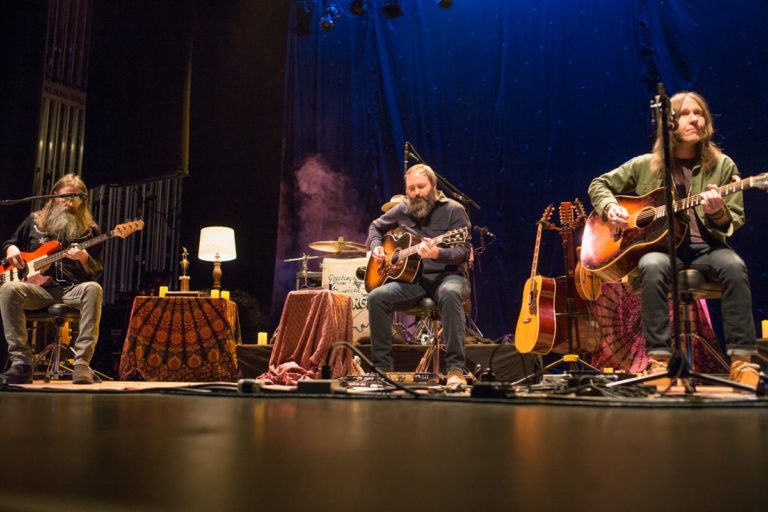
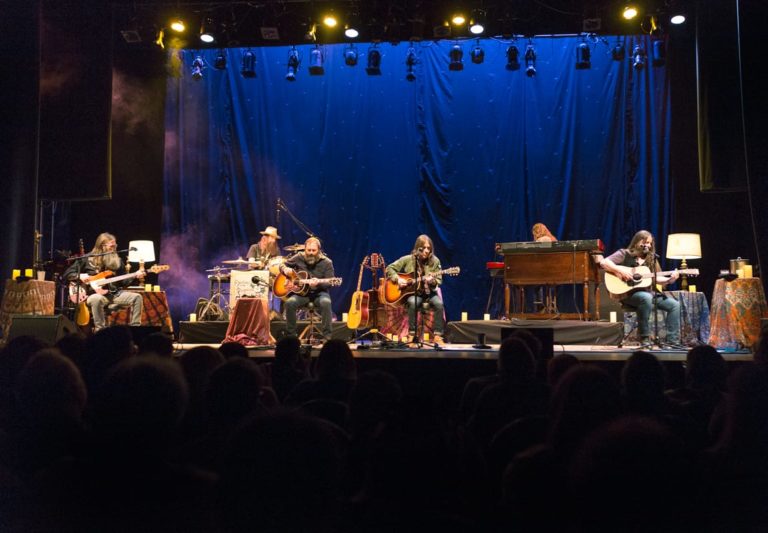
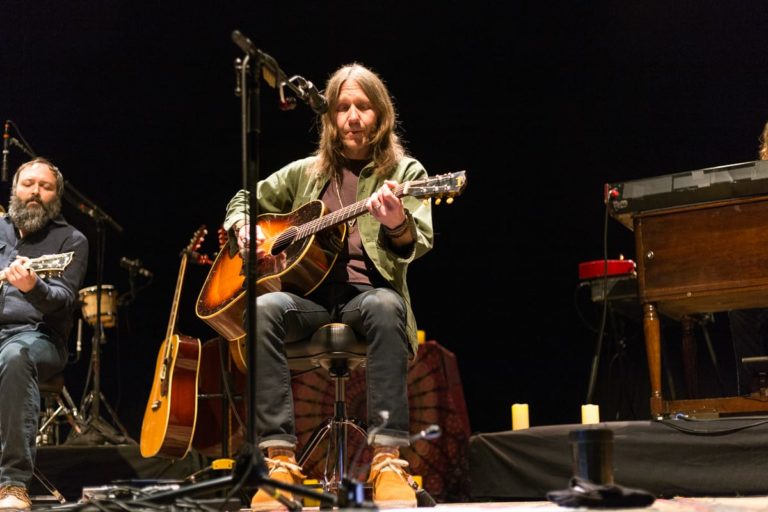
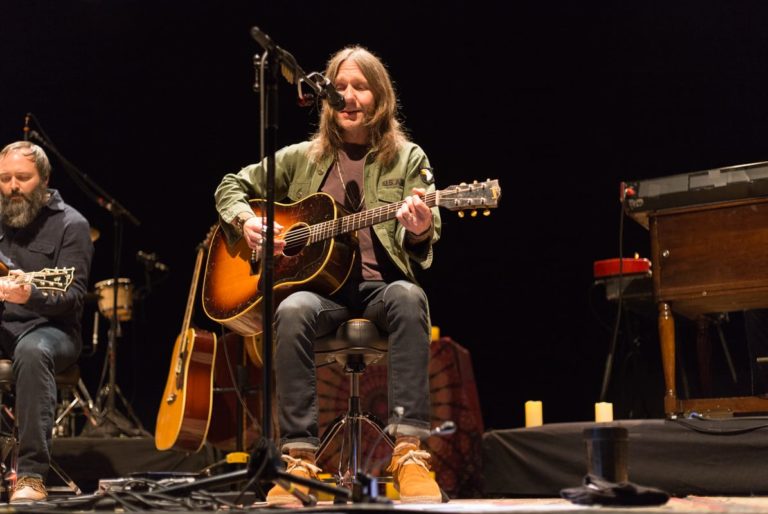
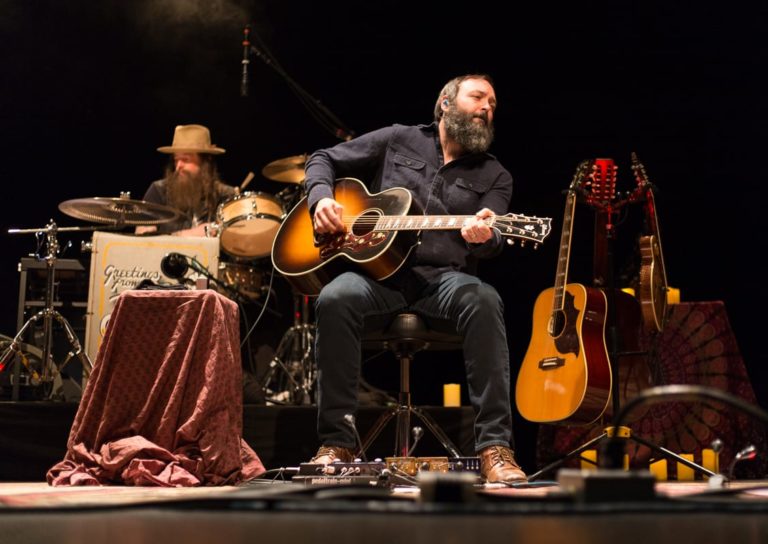
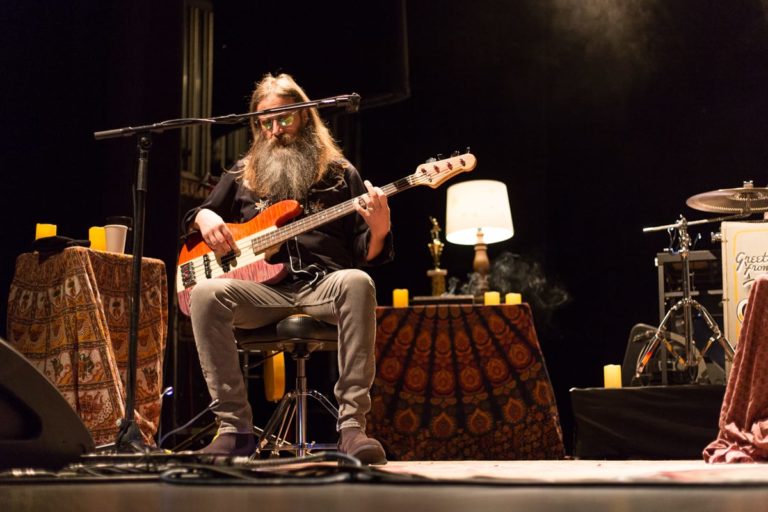
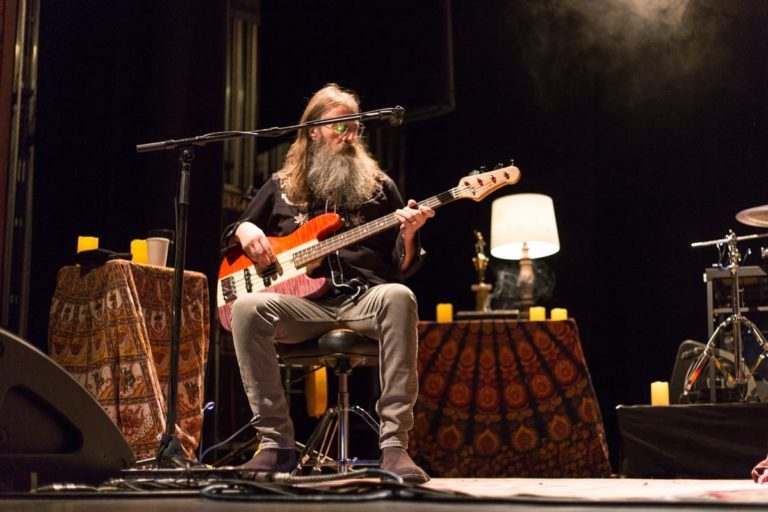
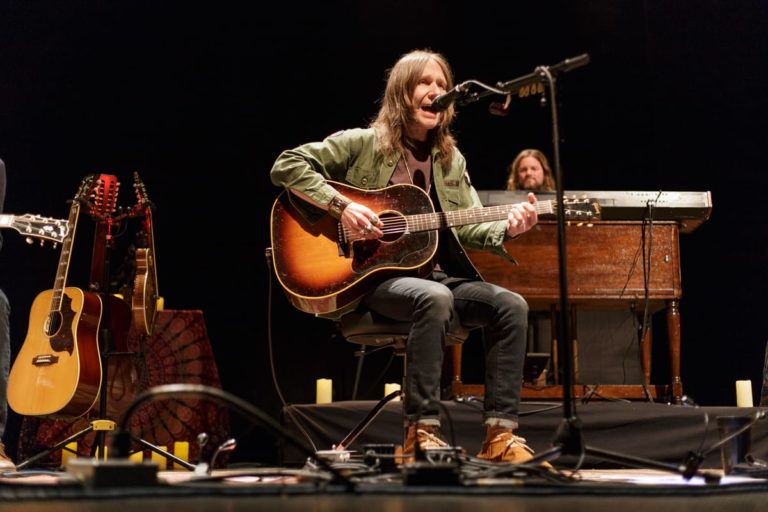
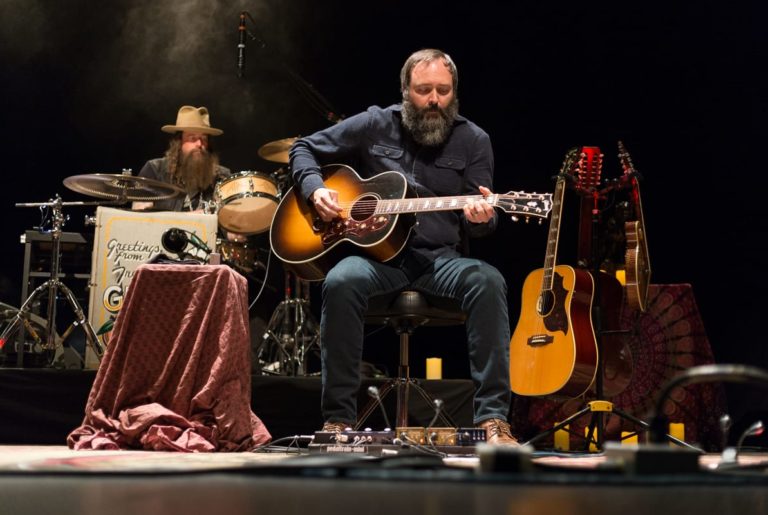
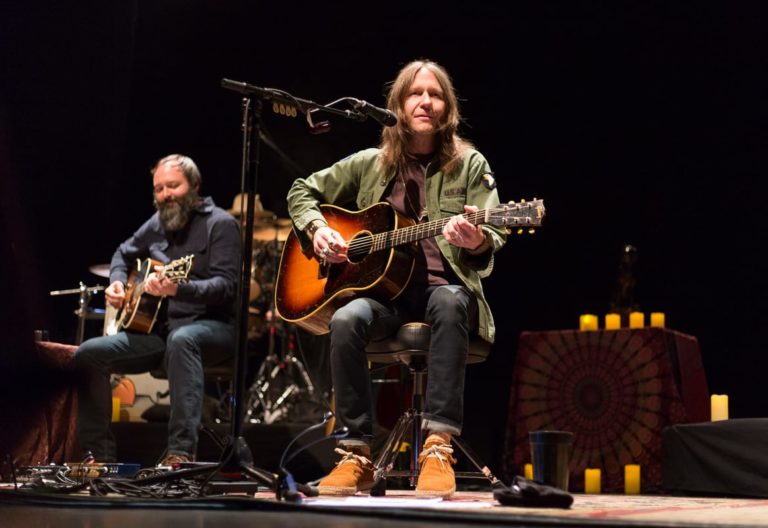
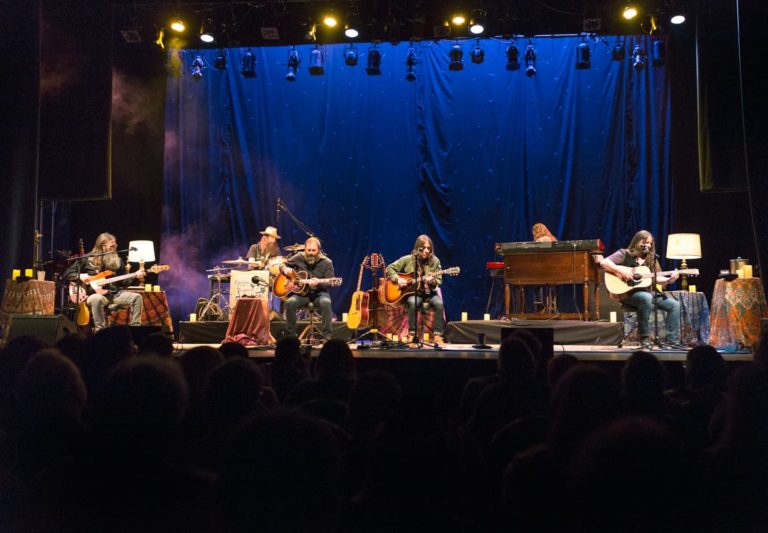
After a mesmerizing opening set from Ida Mae, a talented husband and wife duo from the UK, Blackberry Smoke casually strolled onto the stage around 9 p.m. and played a two hour set, featuring nineteen songs which included three encores. The stage was intimately set with four stools in the front along with the small acoustic drum set stage right and the vintage looking keyboard stand stage left surrounded by table lamps set atop draped curtains and throws most likely covering amps. There were dozens of dimly lit amber electric candles throughout the stage as well making for a relaxing and comforting atmosphere. As lead singer/guitarist Charlie Starr was taking his seat before kicking off the set, he greeted the State Theatre audience by saying “welcome to our living room”
From L-R – Richard Turner, Benji Shanks, Charlie Starr
Blackberry Smoke kicked off their set with the 1927 Thomas Darby and Jimmie Tarlton classic “Columbia Stockade Blues,” followed by “Believe You Me” from their 2016 album Like an Arrow and “Too High” from the 2015 album Holding all the Roses. The band continued to play many of their well known hits as well as some lesser know songs from their immense catalog throughout the two hour performance. Nevertheless, all the songs lended favorably to the acoustic arrangements that these seasoned musicians performed for the exhilarated crowd at the State Theatre. The band kept their performance light and fun, interacting with the crowd and telling some interesting stories behind many of the songs or from their road escapades. At one point Charlie talked about touring the city of Ithaca, from visiting a vintage music store, yet forgoing a purchase during this trip, to visiting Cornell University’s Barton Hall and commenting about the diverse musical history at this famed field house. He commented that he learned that the Grateful Dead’s performance here in 1977 is considered one of the best shows of their career and that they were indeed in good company as fellow Georgian rap artist Ludacris too roamed the Big Red Campus at one point. Charlie and the rest of the band seemed to connect well with the crowd in Ithaca during this stripped down, personal feeling “Break It Down” acoustic show.
Benji Shanks and Charlie Starr
Blackberry Smoke Setlist – State Theatre Ithaca, NY 4/4/2019.
1.Columbia Stockade Blues 2. Believe You Me 3. Too High 4. Sure Was Good 5. Crimson Moon 6. Old Shoes 7. Best Seat In The House 8. Medicate My Mind 9. Lay It All On Me 10. Ain’t Wastin’ Time 11. Run Away 12. Like An Arrow 13. Ain’t Gonna Wait 14. Free On The Wing 15. Ain’t Got The Blues 16. Up The Road . ENCORE: 17. Loser 18. One Horse Town 19. Ain’t Much Left
Blackberry Smoke perform at the State Theatre in Ithaca, NY
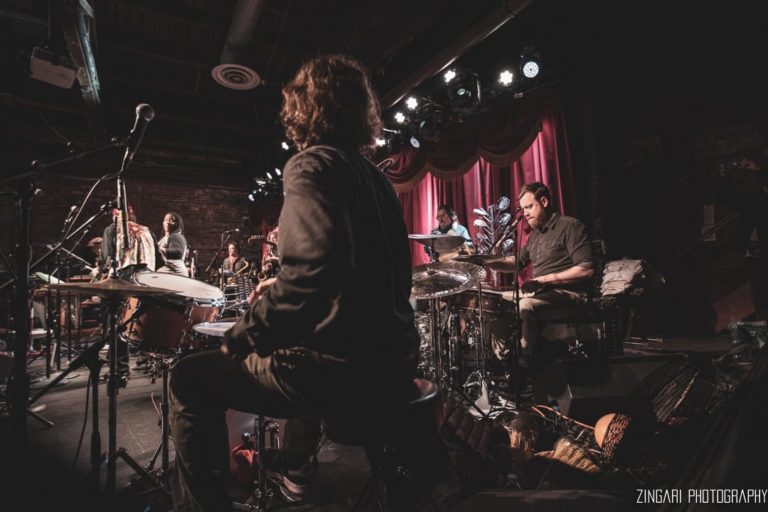
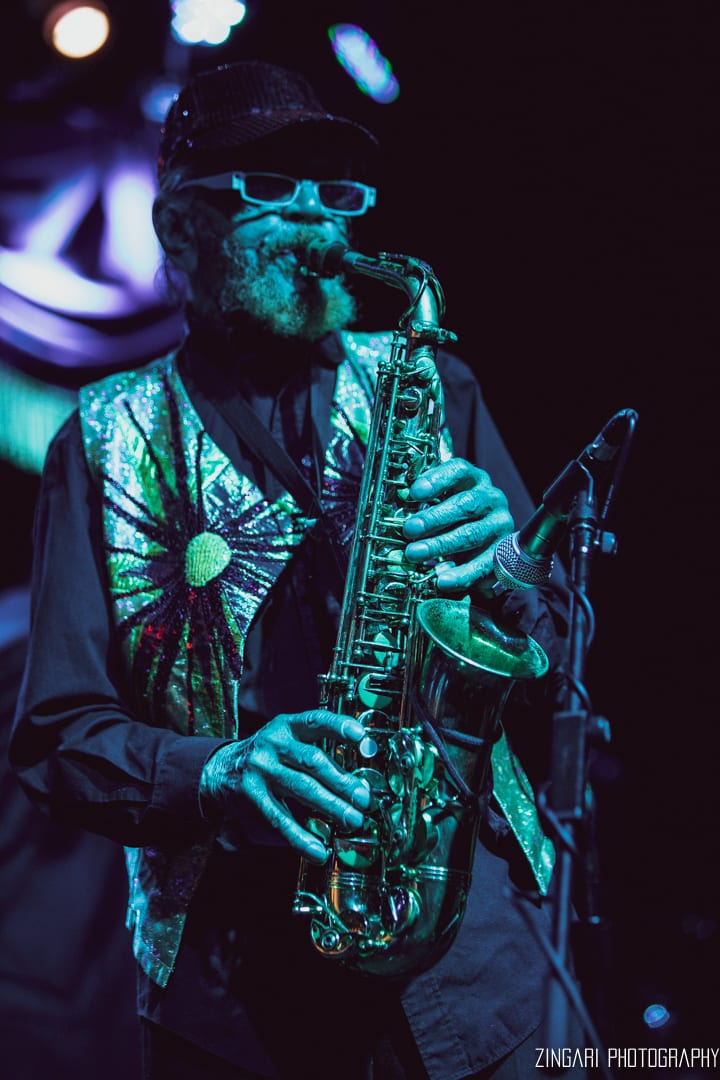
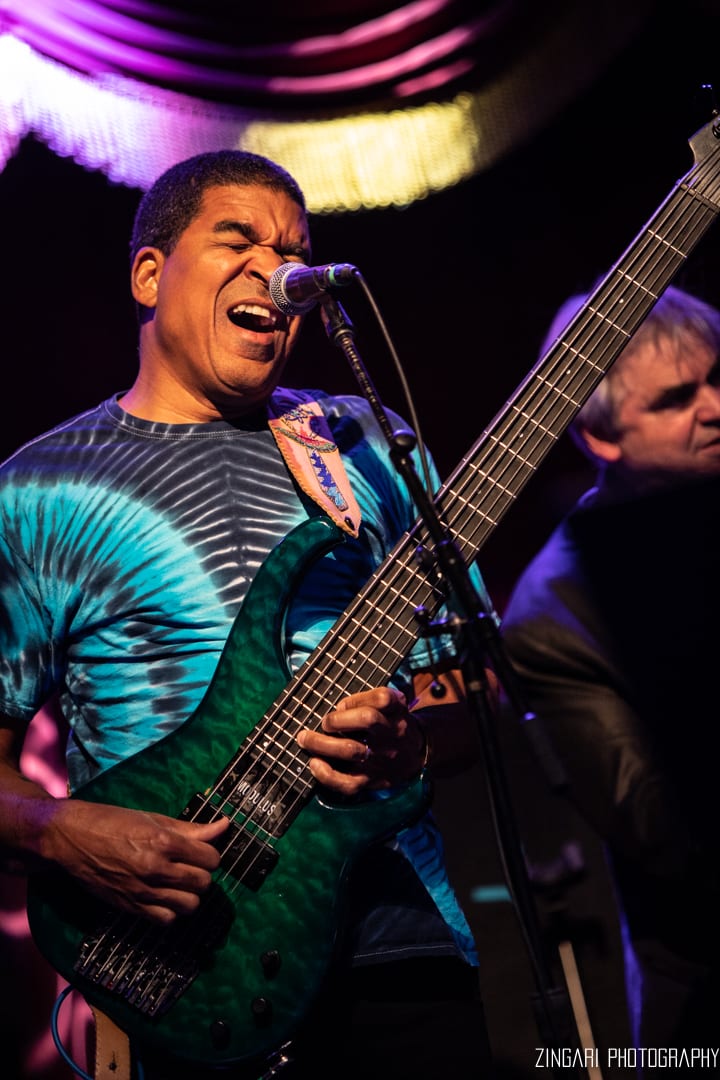
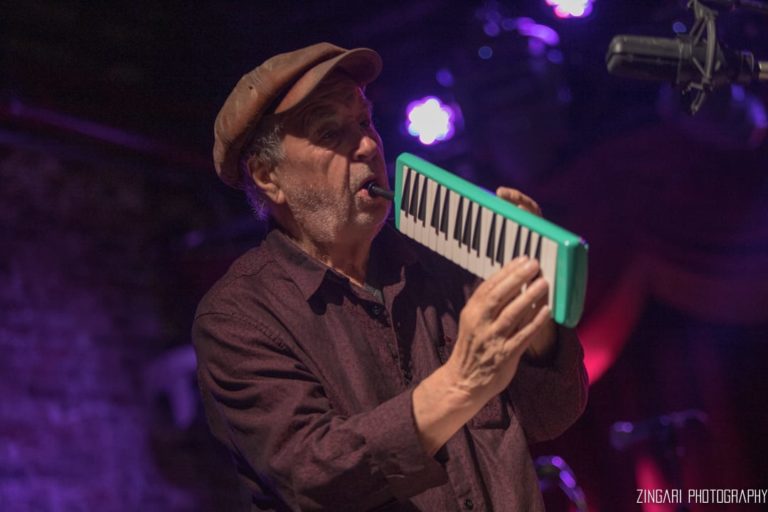
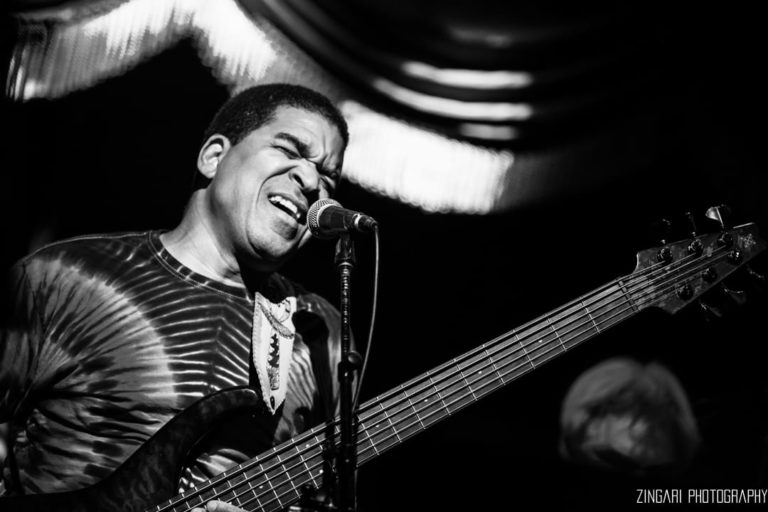
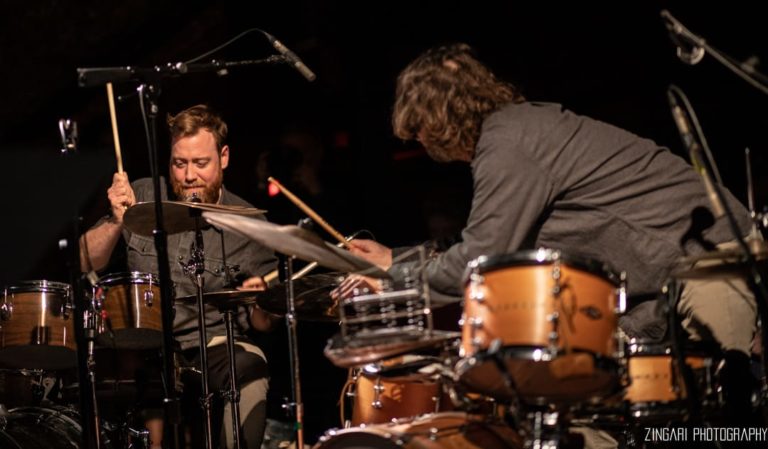
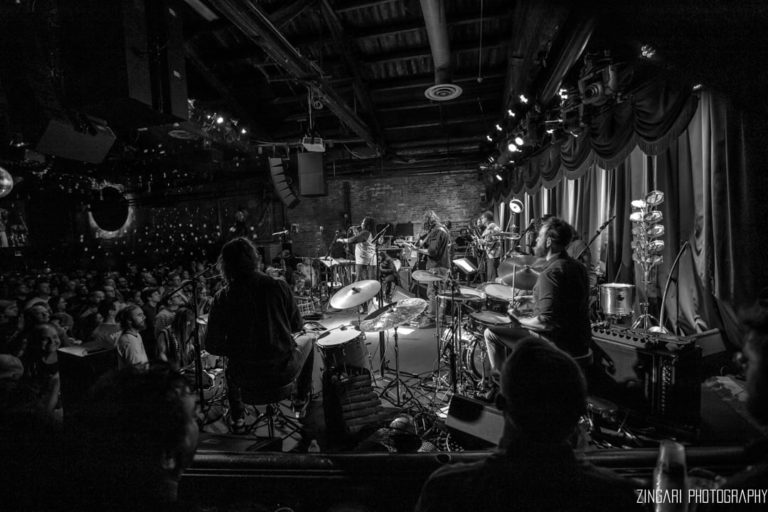
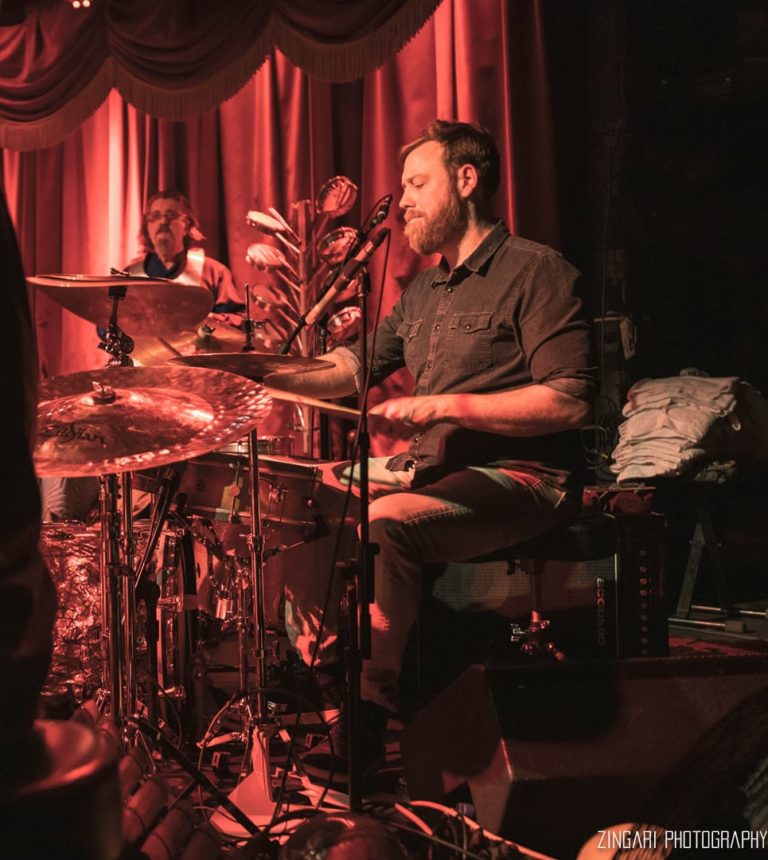
On Wednesday April 3 The Brooklyn Bowl played host to a Benefit for Creative Music Studio. An amazing lineup of musicians including Billy Martin, Oteil Burbridge, Joe Russo, Marshall Allen, Dave Harrington, Cyro Baptista, Jonathan Goldberg and many more paid tribute to an amazing cause with two hours of jamming – blending of many different styles of music in true fashion of the foundation. The culmination of the performance came when founder Karl Berger conducted this amazing group of musicians, just as he’s done since he began this foundation.
Karl Berger, Ingrid Sertso and Ornette Coleman founded the Creative Music Studio in 1971. Their Goal was to establish a nonprofit organization focused on improvisation and musical cross-pollination that complemented musician’s academic studies. It’s a place where music as a universal language can be explored and expanded. The organizations main program was a place where over 500 hundred performances were recorded. Hundreds of guiding artists lived, played, and shared musical wisdom with thousands of participants many who went on to become well know musicians.
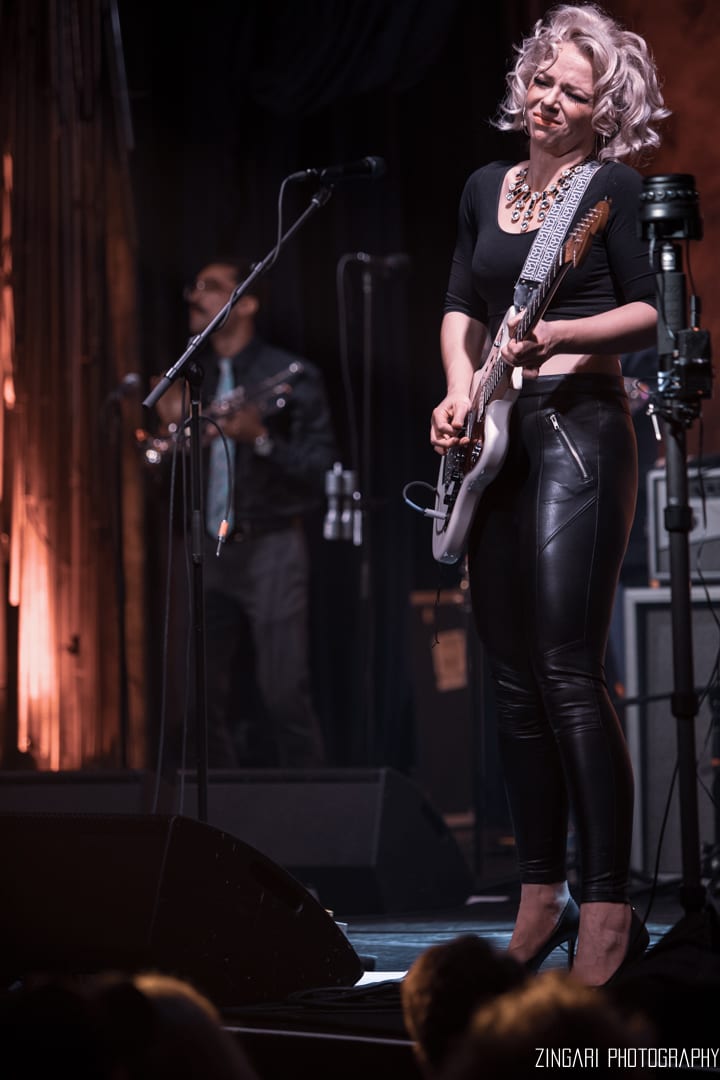
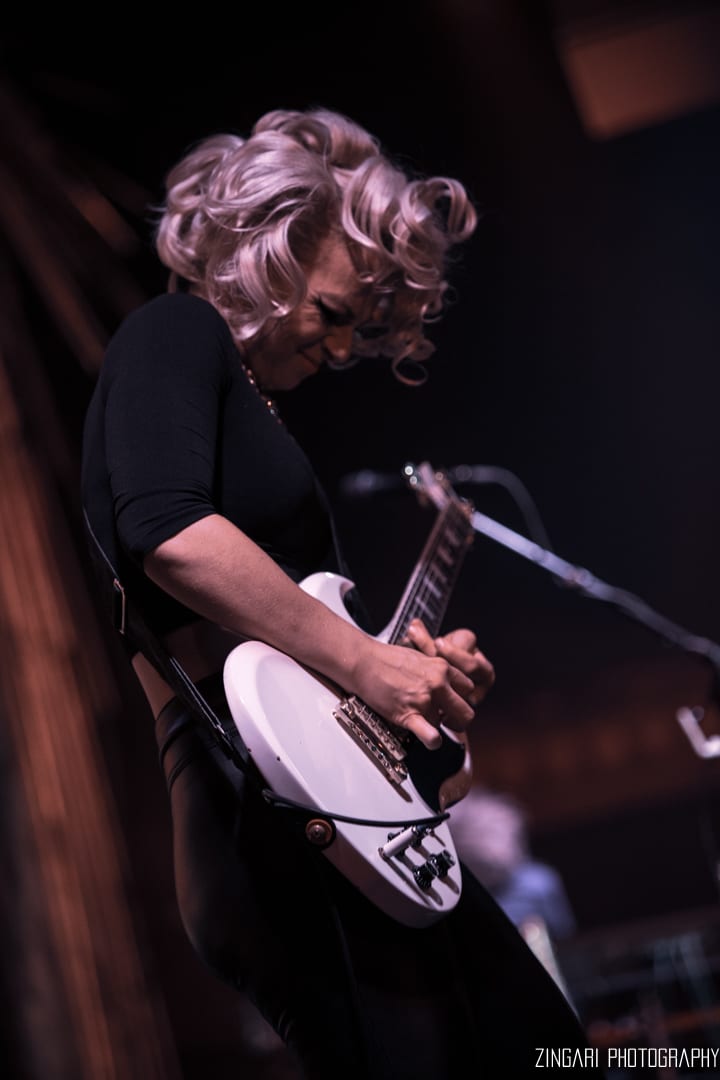
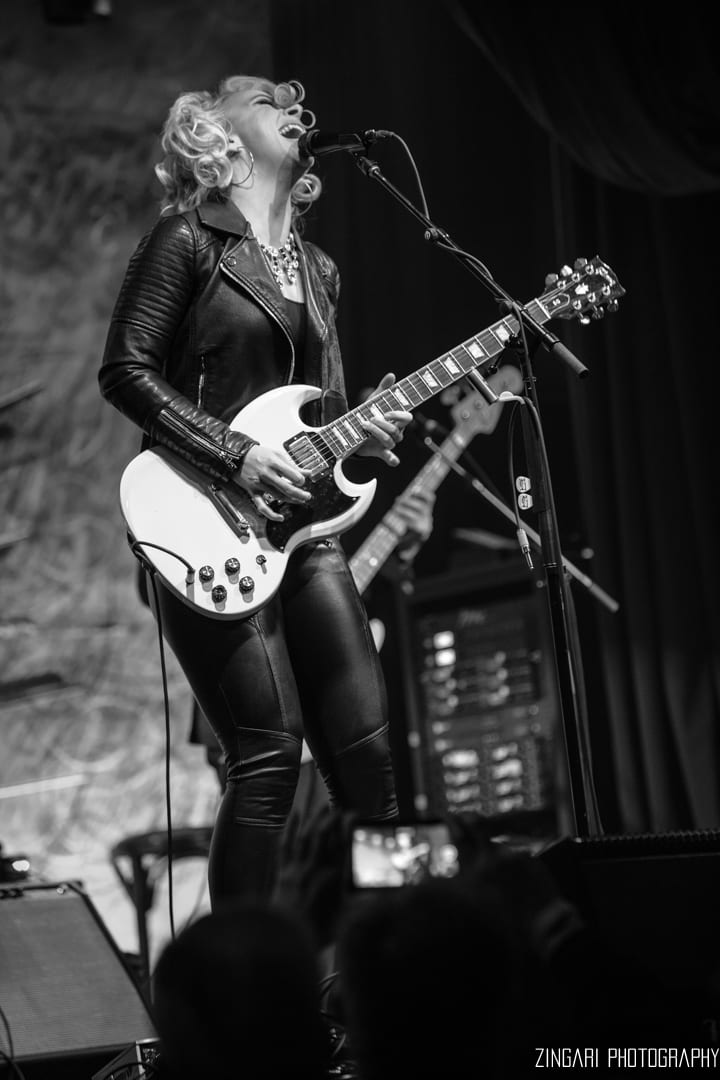
On Thursday, March 21, blues artist Samantha Fish played to a sold out audience at Sony Hall. The historic vaudeville theatre from the 1930s, recently renovated and reopened as New York City’s newest premier music venue, was at capacity for a night of the blues. Now as Buddy Guy once said, “The Blues will never die, it may go away for awhile but there will always be someone who loves it enough to chase it and make it relevant again.” Samantha Fish is continuing the blues legacy and making fans pay attention again. Her deep soulful voice combined with the fact that she shreds on guitar in four inch heels makes her a must see.
Setlist: American Dream, Hello Stranger, Don’t Say You Love Me, You Can’t Go, Blame It On The Moon, Lost My Self, Little Baby, Blood In The Water, No Angels, Chills and Fever, Need You More, Somebody’s Always Tryin, Gone For Good, Daughters, ENCORE: Crow Jane
When you’ve won four Blues Music Awards, been inducted into the Blues Hall of Fame, nominated for a Grammy, and are a W.C. Handy Award recipient, your mark on the world of blues is pretty much set. Add a close friendship with B.B. King, James Cotton and Willie Dixon, and you get a glimpse into the life and career of a Blues Master: Mr. Joe Louis Walker.
Named “A legendary boundary-pushing icon of modern blues” by NPR, Walker started playing the guitar as a young boy, growing up in the Fillmore District of San Francisco in the early 60’s. Now living in the Hudson Valley for the last 10 years with his wife Robin, Joe has a non-stop schedule traveling the world; touring, writing, recording, and producing. I sat down with Joe after sound check at The Towne Crier in Beacon, N.Y. The band had just gotten in from Buffalo N.Y. and was wrapping up a few dates in the U.S. before heading off to a remote island in the Caribbean for a blues festival.
Charles Sullivan the promoter, he would give us free tickets. So we got to see the Temptations, the real Temptations. We got to see James Brown when he got a brand new bag. I got to see Little Richard with Jimi Hendricks on guitar. I got to see all of that sh#t for FREE! And plus, I got to play the Fillmore.
Mickey Deneher:Your career, over 50 years?
Joe Louis Walker: About 53 years. I’m 69 now. I turned 69 on Christmas (2018). I’ve been playing since about ’61. I joined the union in 1964. I joined the musician’s union. Been a union man all my life. Been living on my own since I was 16.
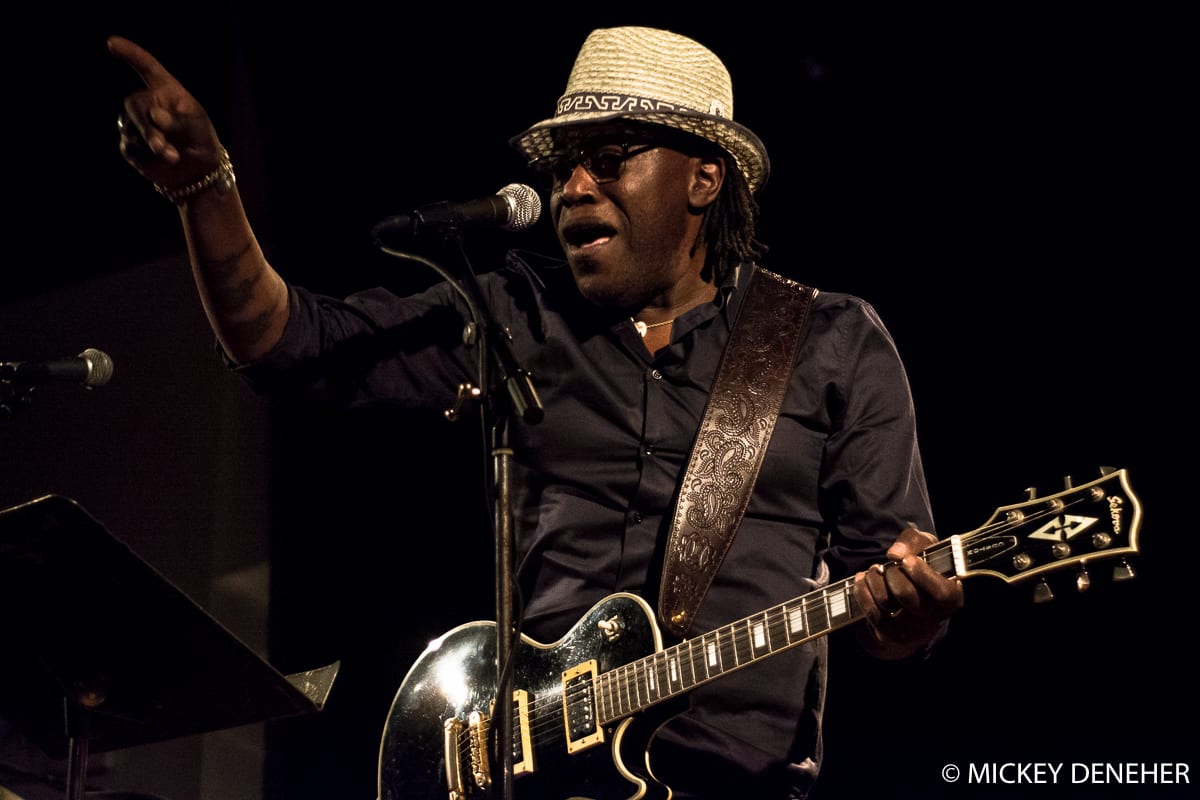
Joe Louis Walker
MD: You started playing music at a young age. What brought you to the guitar?
JLW: Well the guitar, when I was a kid, was the most accessible instrument, as it is now. The guitar was, when I was 12, 1962, only something you could look at. I went to a catholic school and at that time, you could check instruments out. If you had an aptitude, a little bit of an ear for the talent, they would nurture it. If you really had a talent, you would make a deal with your parents and they would rent you an instrument. Rent you an instrument. Not buy you one. Rent you one. With renting the instrument, come lessons. So I first rented, I checked out the violin when I was about 9, cause I could carry that home. But I really couldn’t make too much (out of it) when you’re fixated on that sound; that electric sound.
My parents had a temporary split and we ended up moving to the Fillmore District, and my world began. We moved to the projects, me and my mom and all of five kids, all of us. One project over, one housing (project), my cousins. I hadn’t seen or hung out with my cousins too much. But the first day I go there, they are on the 3rd floor of the projects; 3rd floor! I walk from the first floor. I am going to walk up three floors. You don’t want to catch the elevators. That’s where a lot of stuff goes on. All the way on the 3rd floor, all the way, the first floor to the third floor, wall-to-wall girls. Just standing and listening to my cousins play. I’m like; I am definitely going to do this now. [Laughing] Wall to Wall!
Dorian Randolph, Bruce Bears, Joe Louis Walker, Lenny Bradford.
MD: Ulterior motives!
JLW: But just to know, that there was something that we could do as young guys and make a few bucks. Buy our school clothes. Become popular without being jocks. Without being serious gang guys.
We literally, had the whole thing for ourselves. Of course there were bands all in the area. There was Sly’s (Sly and the Family Stone) brother Freddy Stewart who had a band with my cousin Ted Weisinger; Freddy Stewart and the Stone Soldiers, one of the big bands in San Francisco. This was before the hippies came to San Francisco. The hippies didn’t come till ’62, ’63, ‘64. I was in the Fillmore district in ’61, ’62. I was 12 years old in ‘62. I was lucky because there was this convergence among all the soul groups. The Fillmore at that time was like Harlem in the Renascence. It was, I would say, 75% African-American, huge amount of Japanese, a nice amount of Chinese and different, various people.
When the hippies came in to the Fillmore Auditorium, in it was sort of interesting because me and my cousins and all of us had been playing the Fillmore since we were young. That’s where we would have our battle of the bands. I went to junior high school a block from the Fillmore Auditorium. So we used to have our rehearsal there, battle of the bands there. Then, if we clean up some times, Mr. Sullivan who owned the Fillmore, Charles Sullivan the promoter, he would give us free tickets. So we got to see the Temptations, the real Temptations. We got to see James Brown when he got a brand new bag. I got to see Little Richard with Jimi Hendricks on guitar. I got to see all of that sh#t for FREE! And plus, I got to play the Fillmore.
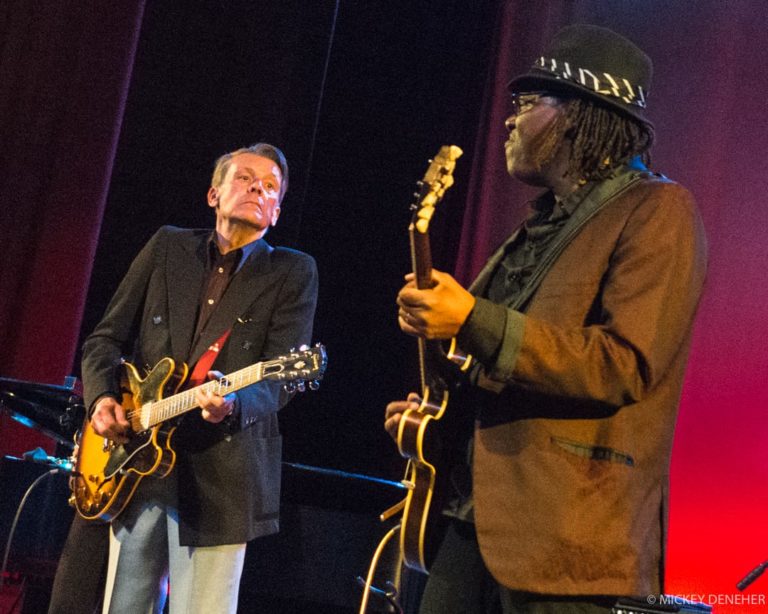
J. Geils, Joe Louis Walker
So when the hippies came there it was like ok, you know, I am cool with this. But as somebody said, very adroitly, they said “you know one of the best things to happened for a lot of the old rock and roll and blues guys was the English invasion, because they brought back interest in them.” But it was also one of the worst things to happen. Cause they put all their heroes out of work. The English guys did not mean to do that. That is not what they started for. There was like maximum R&B. That was, their heroes. That is not what they were about. Period. To note that it turned out that way, was a real drag. That is not what John Lennon and Mick Jagger and all those guys were about. They just weren’t about that. The Yardbirds, they just weren’t about all that. But that’s what it sort of turned into.
But, be that as it may, I was fortunate to be able to see all the Fillmore stuff, then play at the Fillmore. When Graham owned it; Bill would let me come any time I wanted. So I got to see all the shows.. I was fortunate to becoming up in all that stuff. It wasn’t just that; it was the young guys who were finding their musical paths.
MD:At 16 you had a name in the San Francisco music scene. Who were you were playing with?
JLW: Lowell Fulsom, Troyce Key, Percy Mayfield, Erle Hooker. You name it, I backed everybody. Katy Webster, Sly, (Mike) Bloomfield. John Lee, Earl, just on and on, and on and on. I played with all the hippie groups. I was in Blue Cheer, The Oxford Circle. We did a little fusion stuff with some other groups later. The coolest thing about that time, and that place, was that everything was progressing at the same time. What people wore, what people thought, the way the people responding to old mores, the Vietnam war, Richard Nixon, interracial marriage. Everything was happening at the same and the biggest thing I think, was what we invented in the United States in the San Francisco area, was FM radio. That was the biggest thing. Cause without FM radio we’d still be listening to The Monkees, 2 minutes, 40 seconds.
MD:You’re right. Wow, I did not think of that.
JLW: And jam bands.
MD:It wasn’t just blues, experimental, psychedelic.
JLW: It was so much. Oh my God. You could literally go out every night, hit three spots a night… You go to the Avalon Ballroom, The Family Dog (Ballroom), go see John Mayall with Mick Taylor and Muddy Water’s with his band, Big Mama Thorton. Go to the Fillmore, maybe see an Airplane with Quick Silver and Charles Lord Quartet, and Howlin’ Wolf. Four acts, that’s all in one night. That’s all in one night! Then you go to clubs after that.
Joe Louis Walker
The 60’s counterculture movement brought hippies, flower power and alternative life styles to the bay area. While the 70’s found San Francisco awash in a psychedelic haze. Walker made a conscious decision to take a detour from the 70’s status que and attended San Francisco State University, where he earned degrees in both English and Music. “It (was) important for me. Because it was something I started and didn’t finish.” Joe says. Applying his personal growth directive to music, Joe joined the gospel group The Spiritual Corinthians, in 1975.
MD:You went into Gospel. You did that for 10 years?
JLW: Longer than that.
MD:When I think about gospel, to me there is a blues base, a bluestone, that feeling.
JLW: Look at it like this: Gospel, Blues, and Soul music. Just take a for instance. For instance, in blues I mean B.B. King. I don’t mean Eric Clapton. No disrespect to Eric Clapton, ok. In blues, that is the template. Or Howlin’ Wolf. Say B.B. King, cause B.B. to me always was, and I used to have fun telling him this, “you’re just a gospel singer in a blues singer’s body.” When he was young, cause he hit all the high notes, his range was limitless.
JLW on B.B. King, Blues and Soul:
So you take a B.B. King for blues. So you take for soul music (pauses for a second), Sam Moore. Just a voice that’s just wicked, or Al Green. And say in gospel music, you take somebody like my friend, Clarence Fountain (Blind Boys of Alabama). When you have those three, all those three guys are cousins. I could take Bobby Blue Bland and interject him into soul, he wouldn’t miss a step, wouldn’t miss cause he helped invent it. I could take Sam Cooke and interject him into blues. Sam Cooke had a number 3 record; hit record with “Little Red Rooster.” A lot of people don’t know that and it’s cool. I could take Sam Cooke and interject him into soul, wouldn’t miss a step. I can take Sam Cooke, of course, interject him into gospel, wouldn’t miss a step. I can interject B.B. into gospel, wouldn’t miss a step.
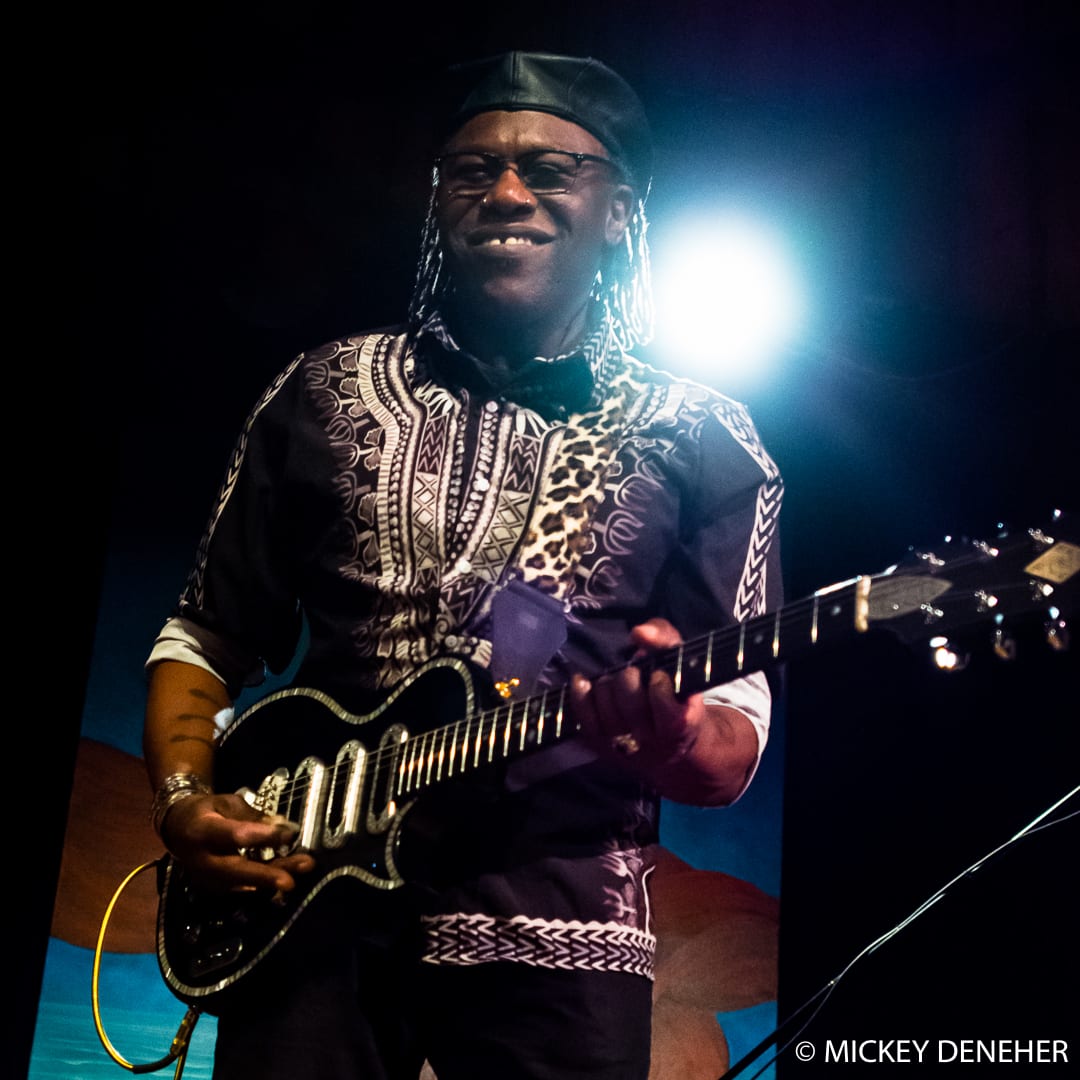
Joe Louis Walker, Lenny Bradford
But now I could not interject Eric Clapton into gospel. No disrespect. I could not interject Joe Bonamassa into soul music. I can interject him as a player. But I couldn’t interject him in like Bernie Worrell or Catfish (Collins); Bootsy Collin’s brother; or someone like Jimmy Nolen who played with James Brown; or Freddy Stewart, Sly Stones brother; or Bobby Womack. I’m sure he could play all that, don’t get me wrong, but that style of playing within itself is the total opposite of this (Joe motions moving fingers all over a guitar neck at rapid speed.) Cause when you playing soul music and gospel, you are playing as an accompaniment to the voice. The lyric of the song is the star. Everything else is secondary. With blues now, and I should say blues rock, because its changed. It used to be, which it just blows your mind, go home and put on any record you like. Put on “Little Red Rooster” by Howlin’ Wolf, put on “Boom, Boom” by John Hooker, put on “Baby What You Want Me ToDo” by Jimmy Reed, put on “Got My Mojo Workin’” you will not hear one solo. You might hear four, five notes; but you are not going to hear (Joe makes sounds like a cacophony of notes played at lightning speed.) That is sort of what a lot of stuff has morphed into now. So when it’s morphed into that, and it’s morphed into screaming as loud as you can, singing as loud as you can, with a lot of fake ass emotion. I’m sorry I grew up in the same project with Etta James, I grew up in the same projects man. She never screamed on “I’d Rather Go Blind.” In that particular song she doesn’t scream. She really doesn’t.
Joe Louis Walker
So I guess we all have our points of reference. We all have what we feel moves us. The same things, it moves me all my life. Once I heard the Wolf, I loved it. I loved it just as much now. When I heard “Satisfaction” I loved the song then, I love it now. But blues has morphed, you know it’s just morphed into more of a me thing, as apposed to a we thing. Muddy Waters was great. But he sounded really good with Little Walter, he sounded really good with Otis Spann, you know what I mean. He sounded really freak’n good with Willie Big Eyes Smith. When he didn’t have Willie, when he didn’t have Otis Spann what did he do? He got Pinetop Perkins!
Those guys could literally solo over each other and not step over each other. They could solo a little during the song, but not step on each other. That it was all about we. A lot now is about me. It’s about the individual. That’s sort of the way the music business has morphed.
[bs-quote quote=” B.B. King to me always was, and I used to have fun telling him this, ‘you’re just a gospel singer in a blues singer’s body.’ When he was young, cause he hit all the high notes, his range was limitless.” style=”default” align=”center” color=”#000000″ author_name=”Joe Louis Walker”][/bs-quote]
While attending the New Orleans Jazz and Heritage Festival with The New Corinthians in 1985, Joe had an epiphany that the blues were his calling. He realigned his musical direction and has not looked back. His resume of musical accomplishments include 25 albums to date and countless guest appearances supporting the likes of B.B. King, James Cotton, Branford Marsalis, Peter Green, Elvin Bishop, Issac Hayes.
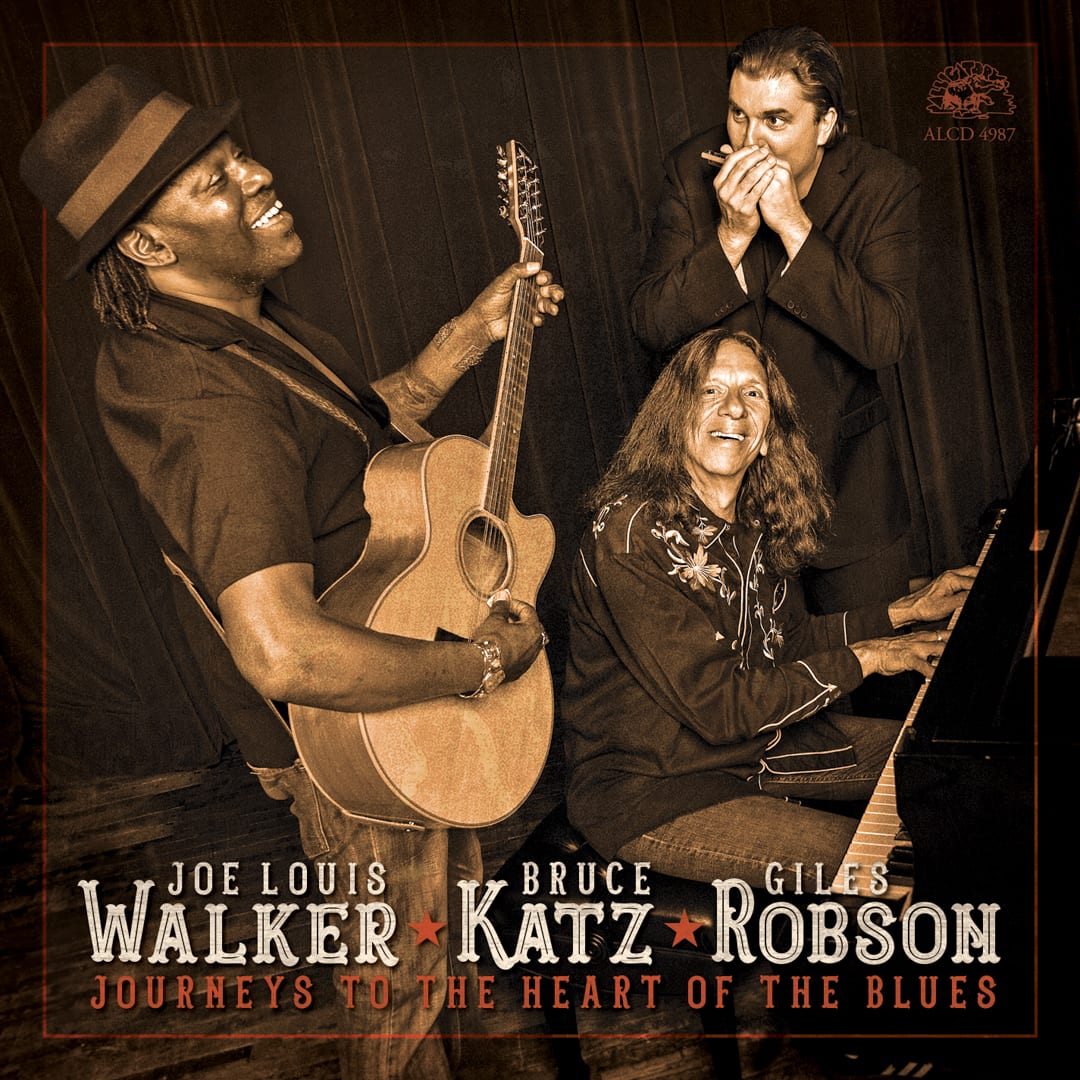
Joe’s latest project is Journeys to the Heart of the Blues. An acoustic blues album nominated for two 2019 Blues Music Awards (Album Of The Year, Acoustic Album.) Joe recorded with renowned keyboard player and fellow Hudson Valley resident Bruce Katz (Greg Allman Band,) and next-generation British harmonica ace Giles Robson. The album is out on Alligator Records throughout North America, Australia, New Zealand and Japan. Munich Records, a division of V2 Records Benelux, will release it in all other territories. The sessions were recorded at NRS Studios in Woodstock.
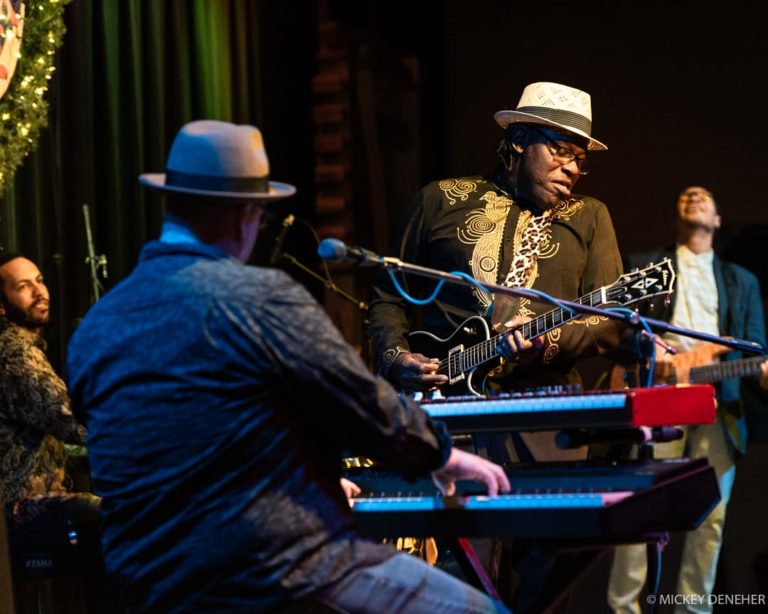
Joe Louis Walker, Bruce Katz, Giles Robson
Mickey Deneher:You are recording now, correct?
Joe Louis Walker: My album. We are about three quarters finished. A double album.
Joe’s upcoming album is chock full of his friends who he’s has played with over the years. The list includes: Juma Saltan, Mitch Ryder, Jesse Johnson (The Time), John Sebastian, Dion DiMucci, Ray Walker (one of the last living Jordanaires), David Bromberg, Carla Cook (Sam Cook’s daughter), Bobby Will, Charlie Harper (UK Subs,) Waddy Wachtel, Keb’ Mo’, and Jorma Kaukonen.
MD:I saw one of your recording credits is as a primary artist on William Shatner’s “Shatner’s Claus: The Christmas Album”
JLW: Yeah. We are getting ready to make a blues album next year. Going to beam us up baby. For me it’s sort of a double-edged thing. Because it’s amazing that now the blues are so popular, that literally, Captain Kirk, he done run out of universe, but he’s into blues music, and who’s he talking to? Joe Louis! I’m trying to give him a little bit of insight cause he’s very serious.
I just tell anybody that asks me; this is not about the notes. It’s not about the vintage guitar. It’s not about the tour bus. It’s not about the $5,000 Armani suits, with the $500 shades at the Royal Albert Hall. It’s not any of that. It isn’t. This here, comes out of suffering and what it is, its the social studies in survival and how to deal with adverse circumstances that are state sponsored and you have to deal with it. That’s what the blues came out of.
Catch this legendary bluesman and his band at The Egg in Albany on March 13th with The Robert Cray Band; March 21st at City Vineyard, in NYC; and March 22nd at Live at the Falcon, in Marlboro N.Y.
Lenny Bradford, Joe Louis Walker, Bruce Bears, Dorian Randolph
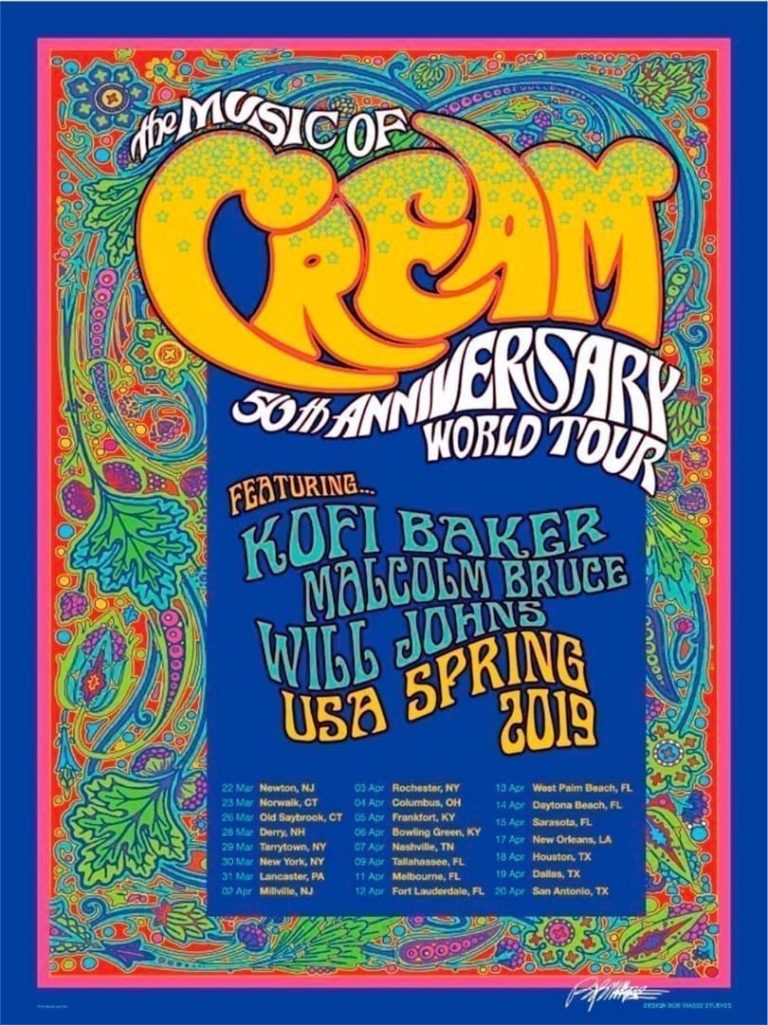
The pedigree of hallowed ‘60s trio Cream– Ginger Baker’s son Kofi Baker, Jack Bruce’s son Malcolm Bruce and Eric Clapton’s nephew Will Johns – return to the United States this spring for a new leg of The Music of Cream – 50th Anniversary World Tour. The outing celebrates the extraordinary music and legacy their family members created on the heels of the 50th anniversary since the original lineup’s farewell U.S. tour of 1968.Kicking off March 22nd in Newton, NJ, the 23-date spring tour will travel throughout the East Coast and south stopping in such places as New York City (March 20th at Sony Hall), Lancaster, Rochester, Columbus, Nashville, Fort Lauderdale, Sarasota, New Orleans, Houston and Dallas before wrapping April 20th in San Antonio.
First launched in 2017 to rave reviews in Australia and New Zealand, The Music of Cream performed over 40 shows in 2018 across North America and the United Kingdom. Throughout the extensive multi-media show, Kofi Baker (drums), Malcolm Bruce (bass, vocals) and Will Johns (guitar, vocals) perform songs such as “Sunshine of Your Love,” “Crossroads,” “Spoonful” and “White Room” and tell personal stories, while footage of their fathers and mentors is shown on the big screen.
Now, Baker says, “I feel more positive that we played the music the way Cream did; we were able to stretch out and improvise and the audience was right there with us. I really enjoyed playing with Will and Malcolm as we share a bond over this music that our fathers created. And meeting the fans after the shows and hearing their thoughts really validated and inspired me to keep playing this music.”
Bruce adds, “The uniqueness of the approach to Cream’s music means that I learn and grow every night we play. There is always something new to be discovered in the music: tempo, feel, groove, notes, dynamics, inflection. It is truly wonderful to be able to improvise onstage.”
“The audiences seemed to appreciate, and enjoy, that we were not just copying and actually putting our own slant on things,” notes Johns.
During its heartbreakingly short lifespan, Cream was an explosive musical cocktail that provided the super-group blueprint for others to follow. The group’s third album, Wheels of Fire (1968), was the world’s first platinum-selling double album, and collectively they sold more than 15 million copies of their albums worldwide. Not surprisingly, Rolling Stone ranked the Rock and Roll Hall of Fame group (inducted in 1993) as 67th in their ‘100 Greatest Artists of All Time’ list.Apart from an equally brief reunion in 2005 of seven shows at London’s Royal Albert Hall and New York’s Madison Square Garden, Cream retained an almost mythological status in the music world, right up until the passing of Jack Bruce in 2014. This, for many fans, marked the end of an era and an acceptance that there would never really be another opportunity to celebrate the group’s legacy. That is, until The Music of Cream – 50th Anniversary World Tour emerged.
Click here for or more information on The Music of Cream – 50th Anniversary World Tour.