Author: Michael Hallisey

  • Historic Albany nightclub Rain-Bo Room, frequented by Sinatra, Calloway and Ellington, to reopen

    Inside the expansive back room in the northwest corner of the old Kenmore Hotel hangs a drab, grey curtain concealing the last piece of history tied to the space.

    The curtain protects a mural called “The Court of Cleopatra,” painted on the wall above a modest stage on which Frank Sinatra, Tommy Dorsey, Cab Calloway and Duke Ellington played. It’s a depiction of the Queen of Egypt, whose beauty was unparalleled and whose intelligence matched that of the powerful men she seduced, most notably Julius Caesar and Mark Antony. It’s placement high upon the wall implied that this was the room in which the masters of the universe was expected to frolic.
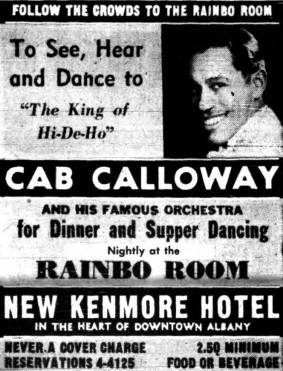
    Rain-Bo Room
    1948 Cab Calloway Rainbo Room via Albany Group

    The space is now in the midst of a multi-million dollar renovation project that’s breathing new life to the North Pearl eyesore. Modern day Dapper Dons in hardhats expose the promise of a bright future, and at the same time enhance the ghosts of the hotel’s storied past.

    When William Kennedy wrote about the Rain-Bo Room in “O’Albany,” he was still able to observe a piano on that stage. He imagined someone playing “Happy Days and Lonely Nights,” a tune Ruth Etting made popular in 1928, and a reported favorite of the Kenmore’s most famous resident, Jack “Legs” Diamond.

    Diamond’s name was never mentioned during the press conference called by Redburn Development to announce the Rain-Bo Room’s intended rebranding as the Kenmore Ballroom. Nor would it be expected. He was a New York City mobster, whose charges included burglary, kidnapping and bootlegging. Nonetheless, he was a celebrity.
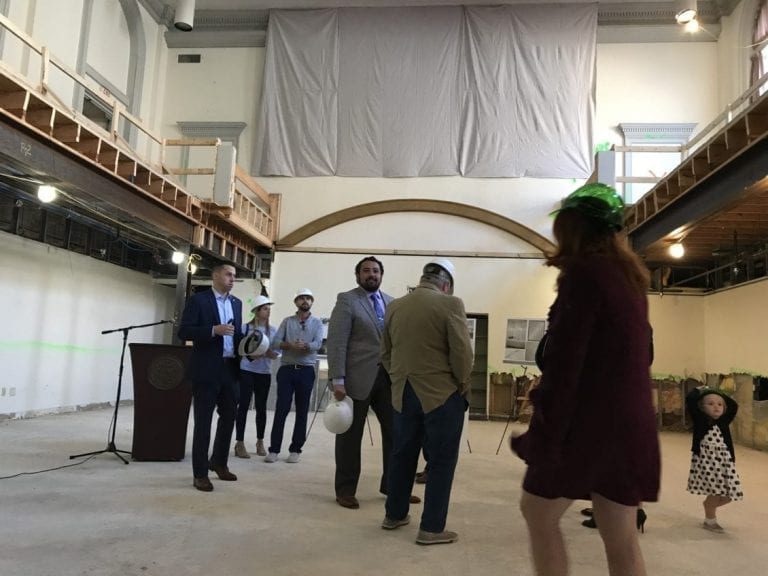
    Rain-Bo Room

    Diamond’s vocation aside, his choice of haunts reveals that the Rain-Bo Room was Albany’s top nightclub during the Roaring Twenties. Stars of the Big Band area would flock up the Hudson River to play there, especially lured by the prospect of broadcasting their live performances on the radio.

    “The Kenmore Ballroom is the heart of this building at the heart of this development,” said Jeffrey Buell, principal of Redburn Development. “We want to fill the space with life, life that spills out into the surrounding streets and supports all of the Downtown.”

    Katie O’Malley Maloney and her husband Nate Maloney will manage The Kenmore Ballroom. O’Malley Maloney has her own long history with the City of Albany. She served as the 50th Anniversary Tulip Queen and worked for the City of Albany planning events and fundraising under former mayor.

    Rain-Bo Room

    Jerry Jennings. She also owns and runs Katie O’ Weddings and Events, an event planning firm celebrating its 10th anniversary later this year. Nate brings over 20 years of corporate and not-for-profit marketing, communications, and event experience to their first venture together. Katie will oversee the day-to-day operations along with Casey Benson, Vice President of Operations for the organization.

    “We are thrilled to be back in Albany and to be a part of the revitalization of Downtown” said O’Malley Maloney. “The Rain-Bo Room was once a vibrant centerpiece of Albany culture and society. We are excited to return the vibrancy of this historic space as the Kenmore Ballroom.”

    The Kenmore Ballroom will accommodate up to 300 people for a seated function. The ornate double staircase, demolished when the building was turned into offices, will be rebuilt as the centerpiece of the space. It will also have a separate bar lounge and rooftop deck. For Elizabeth Young Jojo, she focused on the opulence of the room’s past while choosing all of its fixtures and accents.
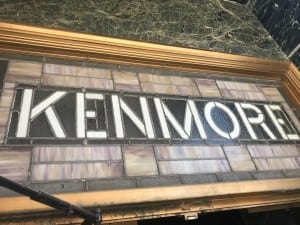
    Rain-Bo Room

    “We chose an Art Nouveau inspiration,” said Young Jojo, vice president at Redburn Developments. “That, mixed with some super, super modern elements, as well.” The Art Nouveau style was popular during the turn of the last century, a look characterised by curves and asymmetric shapes to provide the illusion of movement. The juxtaposition of elements, Young Jojo said, “I think will be very fresh, that there is no other space like that in the Capital Region.”

    “Projects like the revitalization of The Kenmore and its ballroom are transforming downtown Albany,” said Albany Mayor Kathy Sheehan. “Thank you to Redburn for their commitment to Downtown, and to Katie O’Malley Maloney and Nate Maloney for believing in Albany and investing in Albany’s newest neighborhood.”

    The Kenmore Building rehab project is part of a nine-building, $82 million neighborhood revitalization that will bring 350 apartments and 11 commercial spaces to a three-block radius. The first phase of the multi-building project, The Knick at 16 Sheridan, will welcome new tenants this week. The Kenmore is expected to be open by October 2020.

    This article was originally published by The Spot 518

  • Creating a playlist is an intimate act of appreciation for music and people

    There is a subtle science behind making a good mixtape, and I’m not talking about a musician’s collection of work captured on a flimsy metal strip of magnetized particles of rust. Mixtapes were once ubiquitous to the teenaged way of life. If you survived puberty, it was because you made a mixtape. If Charles Shultz was a kid of the 80s, Linus would have had a Walkman. No doubt. So how does one go about creating a playist?

    So, yes. Ask a kid of the 80s the importance of a good mixtape and you’ll start an hour’s conversation on his or her collection, or best yet, shared insight on the process involved on how to compose an intimate audio experience.

    It takes more than compiling a group of songs. The fictional Rob Gordon warned us of this. It’s a delicate thing. There are a lot of rules. What rules may apply depends on what your intentions may be for the final product. Is this tape for your own consumption, or are you going to be sharing this masterpiece with someone else? If the latter, then who is your audience and what is your message?

    Yeah. There are a lot of questions you need to ask yourself. But, perhaps the best way to understand the complexities behind a good mixtape is to speak to people who mix music professionally.

    Kim Neaton knows this all too well.

    “I’ve made playlists for everything from a baby shower to a six-hour cider festival,” said Neaton. Not to mention, she spent four years programming radio shows at WEQX. “I’ve made playlists for all sorts of occasions and love the topic of making the right playlist depending on what type of event or crowd.”

    Auditory chaos

    Neaton stands between the bar and the shuffleboards at Franklin Alley Social Club with a beer in hand. The arcade was an off-the-wall idea conceptualized by Frank and Heidi Sicari, owners of Takk House. The front door is in a Troy alleyway. It’s the basement of the old Knights of Columbus from nearly a century ago; a “retro boutique gathering space.” The bar features craft beers and there’s a few classic coin-operated games in the back.

    It’s a Thursday night and Neaton is there to takeover the jukebox. It’s an event the Sicaris throw on occasion, allowing a guest to come in and arrange the night’s music. She downplays her responsibility. “We picked a music theme for the night, made a four-hour playlist … plug in and it plays. No real DJ skills required.”

    WEQX has been the local authority on alternative music. Its radio signal has washed over the Capital District for more than 30 years. In four of those years, Neaton grew the reputation of throwing an occasional Beastie Boys track onto a show. Before leaving two years ago to join Guthrie/Bell Productions, she was one part of the station’s triumvirate who decided which bands received airtime and which bands did not.

    The conversation within Neaton’s circle of friends stops as one song transitions to another. As Neaton said, she’s not chained to a booth. The music is playing straight off a digital playlist she pieced together on Spotify. A four-hour playlist on the popular streaming service can be haplessly curated within minutes, but not the order.

    Neaton puts careful thought into what song follows another. Once, she said, a friend asked her to compile a list for a gathering. Neaton couldn’t attend, but gifted her friend a link to the playlist. The following day, she asked how it all worked out. She was met with a hesitant okay. Neaton asked if she had kept to the order. Her friend had not. Instead, she had hit shuffle.

    “It’s about understanding the vibe of the audience,” said Neaton. When her friend strayed from her order of songs, she tossed away the segue from one song to another; it introduced an auditory chaos.

    Sounds are important

    Music is the manipulation of sound. Listen to Adrian Lewis, John Drabik or Chris Arndt play guitar, and you’re fascinated by the dancing of chords. Stripped down, it’s sound produced by vibrating strings. Since the first instrument was created, time has nurtured an appreciation of such sounds orchestrated into composition.

    “I’ve learned this from teaching music production and engineering — I’m trying to teach them ear training,” said Josh Mirsky. On top of fronting Mirk, he owns Foster House Studios and teaches Hip Hop Academy. “We work tirelessly on ear training.

    For me, that’s one of the most important skills to have when they leave: to be able to hear what’s happening in the song.”

    Mirsky has a critical ear for sound. He has produced for Jay-Z. He’s also worked for major record labels and licensed tracks for national television networks, including NBC, VH1 and ESPN.

    “I’ll hear something and I’ll get so flabbergasted,” Mirsky said. The producer is able to pinpoint when the marriage of sounds fail. In the studio, the bridgework to a song is laid out into separate tracks. Open GarageBand on a Mac. Each instrument has a unique track. When mixing sounds, he’s listening for how each track complements the others. “Sounds are the most important thing… I spend an hour per sound.

    “Either I know the sound I’m going to —because I’ve used it and it’s a favorite of mine — and I know the depth that it’s going to add to the piece, or if I don’t know the sound, but hearing the sound in my head and finding one that sounds similar and manipulate that. It might take me an hour to find that sound.”

    The Vibe

    Moonshine Records earned meteoric popularity with the emergence of the rave scene in the mid to late 90s. The Los Angeles-based record label owned a stable of popular DJs that included DJ Keoki, Ferry Corsten and Carol Cox. Paul Oakenfold, twice-voted as DJ Magazine’s Best DJ in the World, had his first release in the U.S. under the Moonshine label. In 1997, Moonshine ran its first electronic-music tour through the United States. In each of its four tours, Denver was a stop.

    Tim Pittz left the Capital District and stumbled into Colorado’s drum and bass scene. He was spinning records as DJ Canon. It was the height of rave’s popularity, and Denver was the right place to be. But, there was a lot of competition.

    “A hundred DJs will have the same f–king records,” said Pittz. “But those are usually the anthems and bangers that get played to death. I would scour record shops looking for something different.”

    Europe drove the market. Oakenfold, Tiësto, Corsten, Armin Van Burren were all household names by 2000; all of them developed their names in Europe. Pittz landed a connection that supplied him promotional tunes weeks before the official release stateside.

    “So when everyone else was playing record xyz, I had moved on to something else,” he said.

    Pittz ran with a crew that consisted of stage names like Fury, Ecco and MC Dino. At their height, they shared the stage with De La Soul, and played the Moonshine Over America Tour when it rolled through Denver in 2000. They played in front of several thousand ravers going “bonkers” insider the Denver Colosseum. He’s now retired and living with his wife in Philadelphia.

    Preparing for your audience is key to recognizing the vibe of the room. Each venue was unique. Your time slot, and who you were playing before or afterwards, offered a particular responsibility to how the night was to flow.

    “DJ Hype, for instance — I know he’s going to be blowing the speakers out of the room and killing the dance floor with people losing their minds,” said Pittz, “so I viewed it as my job to get heads bobbing by laying the groundwork for that.” That involved playing groovy, catchy tunes, he said. His MC helped engage the crowd. Avoiding the popular anthems was important in order for his crew to stand out, he said. He helped the MC by feeding into his flow with the right tunes. “You just know when something is going to kill, but you can’t just go straight for that,” he said.

    “It’s a build-up.”

    Understand the vibe.

    Sounds are important.

    It’s a build up.

    Think about all of this when you next compose a playlist.

  • Hearing Aide: Jocelyn & Chris Arndt ‘The Fun in the Fight’

    Jocelyn and Chris broke into Billboard’s Top 40 in the Adult Album Alternative chart with “Red Stops Traffic,” the third single off their 2017 release, “Go.” The album as a whole was Jocelyn and Chris’ most successful release. It peaked at No. 2 on Relix’s Jamband Top 30, and stayed there for three straight months. Perhaps what’s most notable fact about the album is it was produced while Chris was still attending Harvard.

    The Jocelyn and Chris team chase radio play. It involves networking, sending tapes, exchanging phone calls and logging miles between more than 120 radio stations that fall under the AAA format. When “Outta My Head” debuted with Parade Magazine last November, David Bourgeois, the band’s manager at Bridge Road Entertainment, said it caught the attention of different radio stations. And, that’s exactly the point they’re trying to make.

    The Fun in the Fight, promises to be a venture that will take the band into new territory. It’s debut track “Outta My Head” starts off with Jocelyn singing over Chris’ bluesy guitar riffs, but it then turns into something different. It swiftly progresses into a layered, contemporary production; it’s uptempo and hook-focused. It is the most commercial-leaning song the two have yet to produce. And, that’s just the beginning. Other songs within the 11-track album suggest Jocelyn and Chris could take aim at alternative radio in addition to the AAA and jam-band genres they are accustom to playing.

    The album’s opening track sets the table for Jocelyn and Chris’ styling of a new generation of classic rock, featuring Danny Louis of Govt’ Mule. “Witness” is a love letter to all artists that have influenced the sister-brother duo since they were young children. A powerful guitar riff leaves bread crumbs in a lyrical homage to Ozzy Osbourne, Prince, Pink Floyd and more.

    Any given live, Jocelyn and Chris, performance is defined by both power and energy. “Kill in the Cure” may best capture that. It’s a controlled burn, with emotional vocals from Jocelyn and metronomic guitar playing from Chris. It’s an appropriate segue to “Outta My Head,” which within itself, beautifully progresses from Jocelyn’s lyrics to a craftily layered track worthy of its debut status.

    Chris plays a mean blues guitar and it stands out on a track that also features Beau Sasser on the Hammond Organ. The two are paired well on this darkly powerful, midtempo groove.

    “Don’t Hang Up” is a stop-and-listen track. Dark lyrics reveal one side of an intimate phone conversation from someone desperate and contrite. Jocelyn’s voice is front and center in a ballad that lingers on through the next track. A stark contrast to “Problematic,” which follows with a pure rock riff.

    Featuring Vulpeck’s Cory Wong on lead guitar and Louis again, this time on the Hammond, “Be That as it May” is an all-out jam. It starts slow and busts out into a stomping, danceable track. “Original” is yet another track that’s going to get you up and moving.

    “Things I’ll Never Know” is a retro ballad that, again, reveals the roots to Jocelyn and Chris’ influences. More organ in the back, allowing Jocelyn to take the listener to church on this love song.

    The album ends on two fun tracks, “The Western” and “Weatherman.” “The Western” is a story, as one would imagine, with pistols and a climactic duel, complete with a trumpet that will place you into the middle of a spaghetti western. The flute playing in “The Weatherman” accentuates yet another retro track that harkens back to the wistful ballads of Linda Ronstadt and Dan Fogelberg that dominated radio play in the 70s.

    Jocelyn and Chris Arndt have shown versatility, and The Fun in the Fight showcases an effort that should help push the band out in front of different audiences. It’s a road map of where the two have been over the past several years and it shows where they plan on going from there. Should you be one of those who has not yet picked up on this duo, pick this up.

    This article was originally published by The Spot 518, is property of Spotlight Newspapers in Albany, N.Y., and appears as a special to NYSMusic. TheSpot518 and NYSMusic work in partnership to provide readers with in-depth coverage on the local music scene in the Capital District and New York state, respectively. For more, visit TheSpot518.com

  • A reunion in Waterford’s Chrome Food and Spirits will welcome the memories of Saratoga Winners this Saturday

    It was 10 years ago this month that Saratoga Winners, one of the Capital District’s favorite live music venues, burned down in an early morning fire. This Saturday, a reunion is to be held to remember it and the people who made it special at Chrome Food and Spirits.

    From the outside, Saratoga Winners wasn’t much to look at. It was a two-story roadhouse nestled between the Mohawk River and the Town of Colonie Landfill. There was no pretense surrounding the place, other than having Saratoga in its name, which was technically across the river. Nonetheless, in the years before it closed its doors in 2006, it hosted an A-list of musical acts that rivaled the more polished and refined Saratoga Performing Arts Center.

    And, that’s where the comparisons end.

    “I went to a ‘hardcore’ show there at the very end when they weren’t even selling alcohol anymore,” said Ali Hibbs, former Spotlight News and Metroland reporter. “The lead singer in the last band broke his ACL on stage and no one even knew he was hurt for a moment because he was already screaming!” Someone then realized the situation; the singer’s mother. Hibbs said she stopped the show and called for an ambulance, “but the kid refused to let them take him until he finished his set.”

    From the inside, Winners was structured like a barn. Vaulted ceiling, and an exposed wooden frame, including pillars and support beams, reminded one radio personality of a “wagon wheel.” With an open floor layout, patrons had a good view of the band regardless of where they stood.

    David Byrne, the Ramones, Melissa Etheridge, Ben Folds, the Black Crowes, Wilco and Paul Westerberg were just a few of the names of established stars and up-and-coming artists who drew crowds through the doors.

    “It changed personality considerably act to act,” said Ivan Rodat, a former reporter for Metroland. A stereotypical rock venue that wasn’t pigeon-holed into an exclusive genre. He recalled seeing R.E.M. frontman Michael Stipe in attendance once as Fugazi performed on stage. “Great, weird place.”

    Towards the end of its lifespan, Winners became a home for punk and heavy metal music.

    Jason Keller was an on-air personality for 103.5/103.9 FM The Edge. He’d take over the Albany airwaves to play classic rock and alternative music once Howard Stern was done with his syndicated broadcasts. He recalled hosting several shows at Saratoga Winners on behalf of that radio station.

    The on-air host remembered Winners looking like a wooden “wagon wheel.” Despite that observation, it didn’t stop bands from using pyrotechnics onstage. Keller remembered feeling the heat of a “jet engine” ignited from the stage, as he stood across the room next to the soundboard.

    “This can’t be safe,” he said, with an uneasy chuckle. Regardless, no one was hurt.

    Keller is now Commercial Production and Station Imaging Director at 102.7 WEQX. You can still hear him on the air, too.

    Fire

    In the early morning of April 30, 2009, firefighters responded to a call at Saratoga Winners. By the time they arrived, it was engulfed in flames. The original call came in shortly after 3 a.m. The Cresent Bridge was closed for about seven hours as eight fire departments battled the blaze.

    At the time of the fire, Saratoga Winners had been closed for three years. Ownership had changed hands and a new owner reportedly showed interest in returning the venue to its former glory. Authorities later determined that the fire was caused by arson. Just over a month later, the owner was indicted for arson, insurance fraud and reckless endangerment.

    Reunion

    Holly Stah’s memories of Saratoga Winners are more vivid than others. She worked there for eight years. First in the office, then behind the bar. It holds a special place in her heart. It’s where she met her husband, Scott.

    “You could see the bands. You could dance if you wanted to,” said Stah. “All of our friends were there.”

    A big music fan, Stah has collected pictures of herself standing next to Alice Cooper and Billy Sheehan, among others. She likes hard rock enough to recognize characteristics from just the band name, alone. For example, rock bands with an acronym as a name play especially loud. That was proven one night while such a band performed a sound check. Stah was standing near the stage. As the bass player started, she heard a sound from across the room.

    https://www.youtube.com/watch?v=EscxBucHIwQ

    “Glasses were falling off my trays and shattering on the floor,” she said. “I couldn’t get down to the bar fast enough to stop them from falling off and shattering on the floor.

    She later shared her observation of bands with acronyms to the owner. One day, the owner thanked her for the advice by sharing a decision he made. He turned down a request to have “D.I.O.” perform.

    It wasn’t an acronym. The owner was referring to Ronnie James Dio and the band he formed after leaving Black Sabbath in 1982, producing rock anthems like “Holy Diver” and “Rainbow in the Dark.”

    Stah was not happy.

    “I thought I was going to cry,” she said, with a laugh.

    Stah has spent the past year organizing a reunion for people to remember Saratoga Winners and the music that once played there. Saratoga Winners Reunion #3: The Final Chapter will feature music from Untaymed, Divine Right, Maxx Thrust, Bone Box and Enertia at Chrome Food and Spirits on Saturday, April 6, at 4 p.m.

    The lineup includes bands that had played Saratoga Winners, Stah said. It will capture the spirit of the old place. Something she said she is looking forward to.

    “I’m going to see people I haven’t seen in a very long time.”

    This article was originally published by The Spot 518, is property of Spotlight Newspapers in Albany, N.Y., and appears as a special to NYSMusic. TheSpot518 and NYSMusic work in partnership to provide readers with in-depth coverage on the local music scene in the Capital District and New York state, respectively. For more, visit TheSpot518.com

  • Katie Louise Unleashes Debut EP

    Capital District pop artist, Katie Louise, is releasing her first EP, celebrating with a no-holds-barred show at Jupiter Hall. Louise, 21, will release Unleash today, Friday, March 15.

    The seven-song EP will show its feathers later that night. The show will start at 7:30 p.m. and feature other local artists like Justin Charles, Nick Rossi and the Broken View. Tickets range from $15 to $20 and can be purchased at ticketfly.com. Jupiter Hall is located at 1 Crossgates Mall Road, inside Lucky Strike Social Club.

    For Louise, this is an album of baggage. It’s also an album of redemption, empowerment and validation. The young star started as a classically trained pianist; she was on the fast-track to professional stardom at just 14 years old.

    “I always had this talent for piano and in a lot of ways, I was just pushed into following that skill until the end,” she said. “I had written ‘Imprisoned in Paradise’ and realized I had the ability to write music. However, when I wrote ‘Broken,’ I realized this was something I really needed to pursue.”

    Katie Louise faced some adversity from those around her, particularly from those who were in the classical music circuit. As she transitioned into pop, she had to dig down to find the empowerment to keep going.

    “This EP is so incredibly vulnerable and real for me because I really open myself up in my songwriting,” she said. “I’ve always been blessed to be able to open up relatively easy, but I’ve been through a lot of pain in my childhood and this not only helped me express it, but helped me let some of it go.”

    Fans can expect a mixture of sounds. The two singles she has already released, “Imprisoned in Paradise” and “You Can’t Talk To A Woman Like That,” are drastically different — “Paradise” is more of a ballad with dreamy accompaniment, where Woman has a kick in its step. Louise said each song will be markedly different from the one before it, but they all complete the bigger picture and help answer the question of who she is — in all of her facets. All songs are written organically, with Louise finding inspiration in things she says or what she sees around her.

    She hasn’t completely abandoned her roots. Louise is excited about the piano solo on “Unleash,” the namesake of the EP.

    “It’s like I’ve blended my two biggest passions now and am able to draw from what inspires me in both,” she explained. “I’m confident that I can do this. I’m nervous, excited, stressed and overwhelmed.”

    This article was originally published by The Spot 518, is property of Spotlight Newspapers in Albany, N.Y., and appears as a special to NYSMusic. TheSpot518 and NYSMusic work in partnership to provide readers with in-depth coverage on the local music scene in the Capital District and New York state, respectively. For more, visit TheSpot518.com.

Built in Breakdance