Tag: behind the gear

  • Behind the Gear: Ryan “ShwizZ” Liatsis

    Ryan “ShwizZ” Liatsis is the guitarist and frontman of the power rock trio ShwizZ. A well-respected group in the scene, ShwizZ is a 3 member group who are incredible at their respective instruments, and perform a wide range of progressive rock music. Ryan uses a fairly unique rig compared to other players on the scene, using a digital modeling pedalboard rather than analog pedals, and utilizing a MIDI-trigger board to play chords for added textures during his songs. Check out ShwizZ’s performance from Disc Jam this past June, footage courtesy of mkDevo.

    Ryan Liatsis
    Photo Benny Rodriguez

    Guitar: Music Man EVH Wolfgang Special
    Amp Head: Mesa/Boogie Express 5:50 Plus Cab: Mesa/Boogie Widebody 1×12 Pedalboard HeadRush Pedalboard w/ Boss Expression Pedal Keith McMillan Instruments SoftStep 2
    Keyboard Korg Krome Music Workstation w/ sustain pedal

    Jared Lindquist: Why do you put your amp head under your cabinet?

    Ryan Liatsis: This just made the most logical sense when I got the amp, though I do like to think of it as my signature move! I like when the speaker is as close to ear level as possible so you can hear what is actually being captured by the mic and therefore EQ better for the stage. That and for my particular amp (Mesa Express 5:50) the head was heavier than the cab, so it just felt right to put the heavier piece on the bottom.

    Ryan Liatsis

    JL: When did you make the switch to the modeling pedalboard?

    RL: Very recently! It’s been about 2 months with the modeler and I’m a big fan. I’m currently using the Headrush FX pedalboard. I am completely happy with the tone of the overdrives and distortions as that is extremely important to me. The switch over to the modeler has just made life easy on stage with being able to switch patches with one button and digital storage. Having a gate on the input and EQ section on the master output is extremely helpful too. The best method I’ve found is to get rid of all the speaker cabinet models on your patches. I just use the FX and occasionally the amp head models right in to the front of my amp. I haven’t tried it using the xlr outs to a PA speaker, though I imagine that’s where the speaker cabs would come in handy. This past year has seen a huge leap with amp modeler technology and I wouldn’t be surprised to see more and more pro players using them.

    Ryan Liatsis

    JL: Did you model the effects after your analog pedals?

    RL: I tried as best as I could, though I wasn’t exactly going for that. I think that every piece of gear just has its own flavor and you should put that to use. So instead of trying to recreate my boutique analog pedals, I decided to just see if I could get tones I like and was comfortable with out of the Headrush. Which, much to my surprise, I did! It seems about every 2-3 years I decide I want to change my tone to better fit my needs. I’m sure some new product will catch my eye a few years from now and I’ll adapt to what it has to offer. It’s a lifelong quest and I don’t think there’s an end, just a journey of different sounds and tones. Tone has a lot to do with creating your signature, but more importantly it’s your fingers and note choices. And as I mentioned I’m just a big fan of having different tones for different songs. The good thing about this current amp modeler I’m using is it has an fx loop, so I can insert any of my analog pedals in to the chain of each patch if I really wanted to.

    JL: What are some of your favorite pedal combinations?

    RL: Well, I am all about mixing overdrives and distortions…and now amp models. I use delay, but not much unless the song calls for it. I barely use modulation like phaser and chorus and also rarely use reverb unless for some ethereal washy effects. On my analog board I had 6 different overdrives, just for different flavors. I found I was getting bored of just having 2 overdrive sounds. One of my favorite combos is the Vox Trike Fuzz and the T-Rex Tone Bug. Putting the Fuzz first gives it quite a quality. You can hear what I mean on the guitar solo of the ShwizZ track “Hog Thai.”

    JL: What’s going through your mind when you’re deciding which effects to use?

    RL: Well, the options are limitless with effects these days. So just like with writing, deciding on a tone is really about what sparks your emotion and hits your ear in that special way. But to give you a theoretical answer, a big part of my decision is the type of tune we’re playing. If it’s agreed we’re going for a certain vibe or sound, I’ll cater to that style. Such as if we say this part of the tune should be like a 70’s disco feel, I’ll probably be using some phaser with a clean Fender-ish type sound. Overall, I don’t go crazy on the effects, I find the simpler the better most of the time.

    Ryan Liatsis

    JL: Who are some of your inspirations as a player?

    RL: Too many to name! So I’m going to go with my top 5. Frank Zappa – need I say more? Chick Corea – I was introduced to Chick’s music at a young age and it inspired me to learn jazz and fusion. Specifically, the later electric band stuff always blew me away. He was always one of those music god’s to me who could just play whatever line came in to his head at that moment with no hesitation. Sill on a quest for that level like the rest of us. Frank Gambale – My drummer buddy introduced me to Gambale when I was about 20 and my mouth hit the floor. How can somebody get away with playing bebop lines that fast with sweep picking and overdrive!! Steve Khan – I studied with Steve for 2 years. He’s probably one of the most underrated and unknown guitarists on the planet and he’s played with all the greats and been on tons of studio recordings. His chordal work puts most to shame which struck something in me. I love the chordal movement aspect of guitar and keyboard and it’s something I don’t see enough of unfortunately in today’s music. Slash – Yes it’s true, I was obsessed with Slash from age 16-18! I just wanted to be him, the playing, the image, he was the whole package. I transcribed a lot of his solos when I was younger, my favorite of all time being the ending solo on Paradise City, complete shreddage!

    JL: Who are some of your favorite contemporaries on the scene?

    RL: Kung Fu is my all time favorite of our scene, if you can call the rest of us contemporaries because they basically blow everyone out of the water! Dopapod, Mungion, The Southern Belle’s and The Fritz. My ears always tend to get caught by those bands who have their own unique style. There’s so many bands out there, great bands even, but some bands just have their own sound and you know it’s them playing instantly, which is the most important thing to me.

    JL: You’re one of the only guitarists I’ve seen that uses a MIDI-trigger board to play chord samples live, what inspired you to start doing that?

    RL: Well, necessity really. A power trio can be a thing of beauty. BUT, I’m very much in to chordal structure and movement and I always thought drums, bass, guitar and keys was the perfect instrumentation for my tastes. The thing about ShwizZ is that I play loud and sometimes very heavily distorted guitar sounds, so playing chord melody doesn’t quite give the effect desired. After our keys player and second guitarist left I said…well just how the hell am I gonna do this?! I didn’t want to play to a click or with backing tracks, so I thought, what if I can just do what some organ players and even bass players do with their feet using pedals, except polyphonic. It took a bit of cash and a lot of experimentation with different pedals and pieces of gear until I came across a handy dandy app that could do it all and be controlled by a simple trigger pedal that connected with a USB cable. I would simply record each chord I needed for that particular part or song and could save each song file as their own entity. It adds a little more switching of sounds between songs but it’s worth it to have the phantom 4th member laying down that bed of chords. Below is a link to a video I made that goes in to a bit more depth on how the system works.
  • Behind the Gear: Chris Duffy

    Chris Duffy is the bassist of Denver-based band the Magic Beans. Chris is one of the most well-respected bassists on the scene, as well as one of my favorites. If you listen to the Beans’ recent album, Casino Cabaret, you’ll hear Duffy’s bass prowess exemplified in songs such as “Inventor”, “Casino Cabaret”, “Mr. Scientist”, and my personal favorite, “Hanky Panky”. He knows how to keep a groove going! Check out some more of Chris’ playing in this Beans set from their Fox Theatre show last March.

    Bass

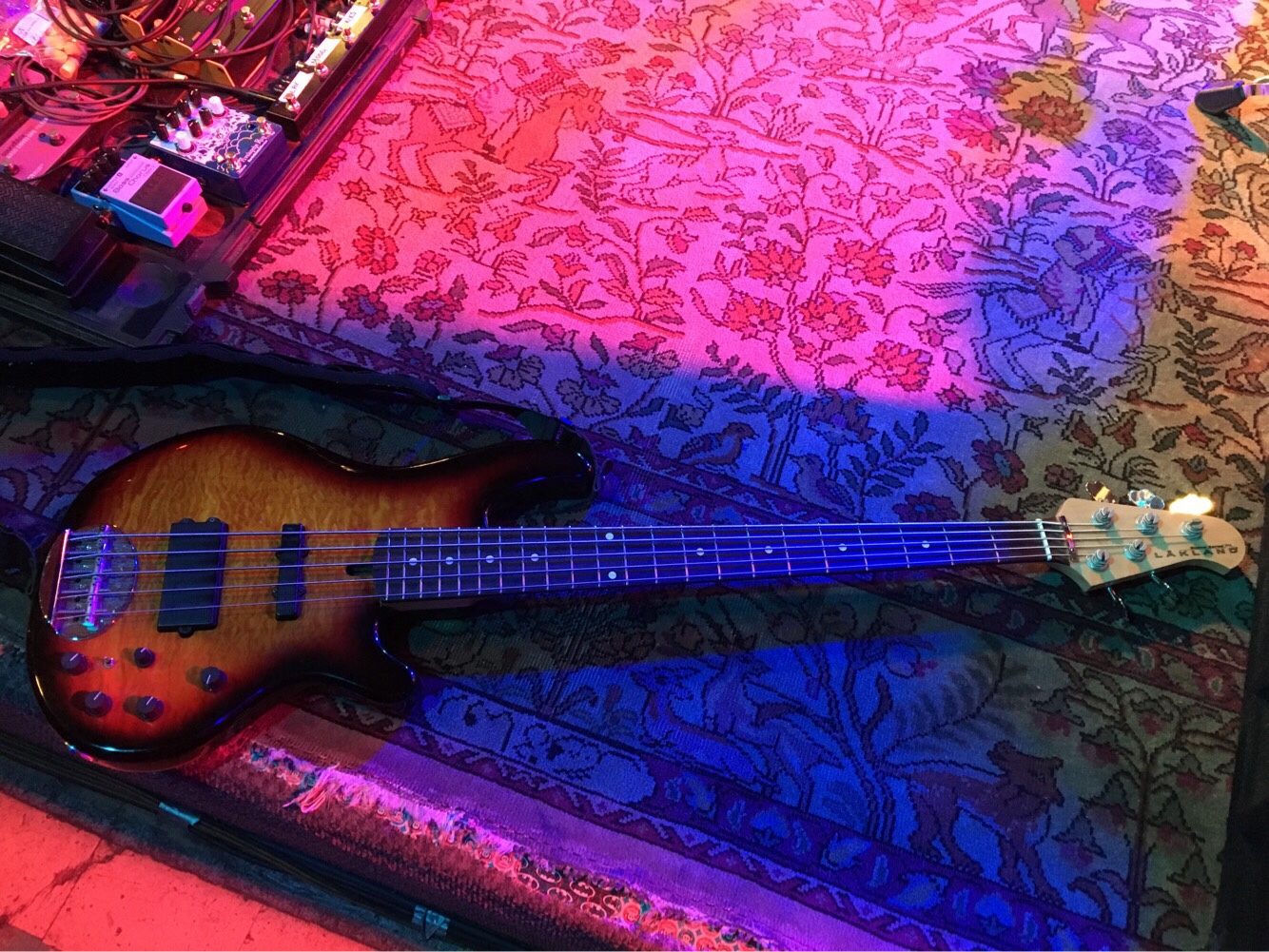
    Lakland 55-02 Deluxe
    Chris Duffy

    Amp

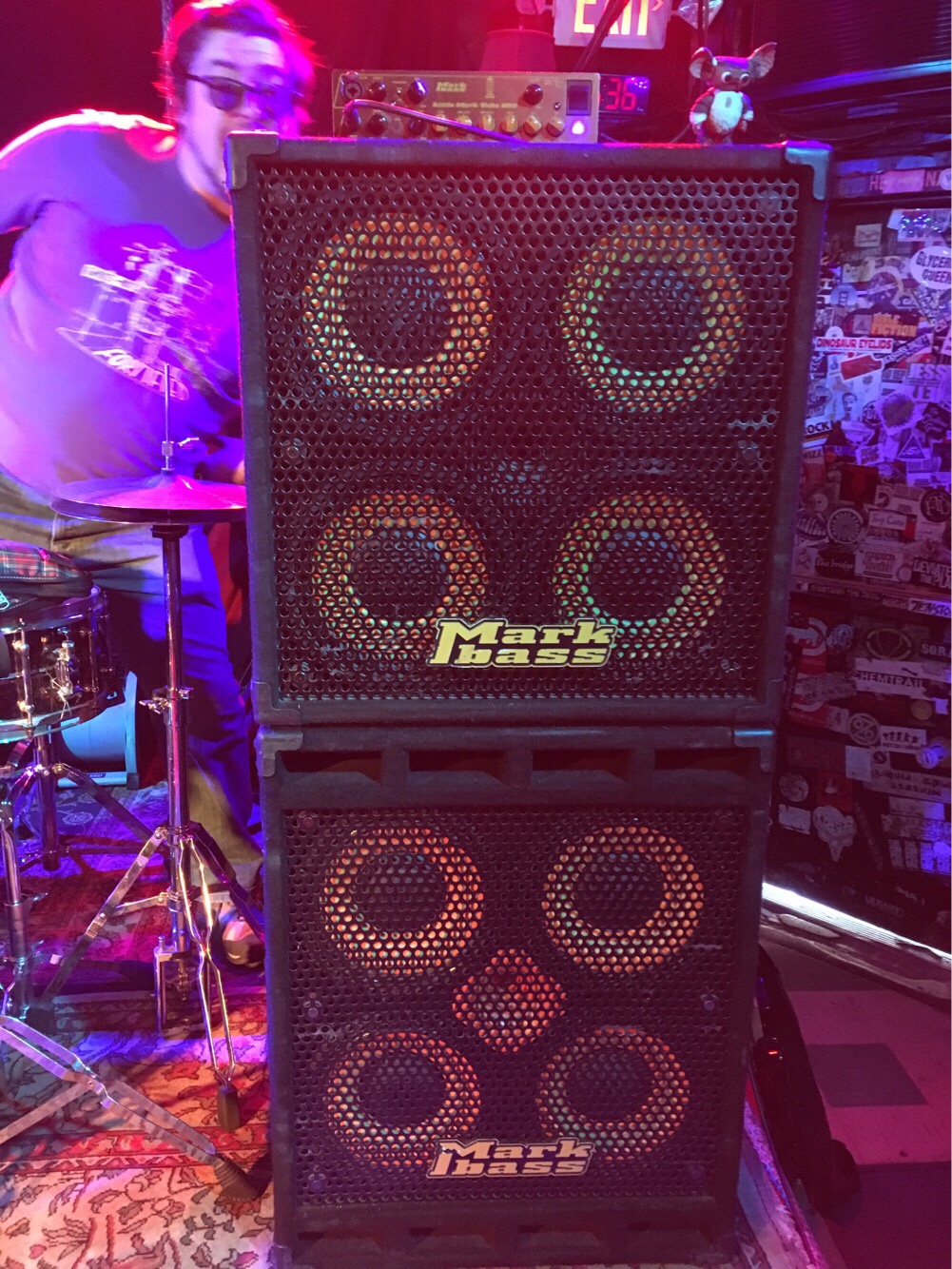
    Markbass Little Mark Tube 800 w/ Markbass Standard 104HF Front Ported Cabinet & 104RF Rear Ported Cabinet
    Chris Duffy

    Pedalboard

    Signal Chain: One Control Iguana Tail Loop MKII 5-channel Loop Switcher

    Loop 1: Boss OC-3 Octave

    Loop 2: Markbass Supersynth

    Loop 3: Source Audio Soundblox Bass Envelope Filter

    Loop 4: Moogerfooger MF-101 Lowpass Filter (w/ Moog EP-3 for Cutoff Frequency)

    Loop 5: Boss CEB-3 Bass Chorus > Earthquaker Devices Avalanche Run reverb/delayChris Duffy

    Interview

    Photo credit to Conor McMahon photography

    Behind the Gear: Did you take any inspiration from some of your favorite artists when you were building your current board? Who are some of your inspirations as a bass player?

    Chris Duffy: As far as bass players go, Dan Kurtz of The New Deal totally changed my approach to playing bass through pedals, specifically in a livetronica/dance setting. He is the master. When I saw his foot riding expression pedals for an entire show, some crucial things clicked. My use of a sub-octave/ distorted tone through the Moogerfoooger Low-Pass Filter is directly inspired by Dan. No one manipulates their live bass tone so freely on this scene. Except, ya know, Squarepusher (laughs). THAT dude is a mad scientist. As far as I can tell, his current pedal board is some obscene number of expression pedals controlling a few rack-mounted effects processors.

    If you or anyone reading knows the details on Squarepusher’s rig, please let me know, it’s fascinating. Or Dan Kurtz’s, for that matter. What a bunch of hyenas. I’ve only been interested in Squarepusher’s rig since seeing Shobaleader One videos a year or two ago, but Dan Kurtz has been influencing me since I was 16. Growing up listening to and emulating Flea means I’ll always have some envelope filters in my rig. The Source Audio is nice because it can save 6 settings, which I’m always experimenting with. It replaced my Pigtronix EP-1 Envelope Phaser, which I got after working a Turkuaz wedding and talking with Taylor Shell. I really need to fix that pedal, it’s the tits. I wish it was smaller!

    BTG: What is the one pedal on your board you couldn’t live without?

    CD: Definitely the Moogerfooger MF-101 Low-Pass Filter. I use that pedal on literally every jam the Beans go into. I probably over use it, but whatever. It gets me fired up, and that’s important in a jam band, since the flow of energy between the artists and the crowd is so fluid and tangible. If you’re having fun, they’re having fun, and vice-versa. I want to add more expression pedals for it. That’s the great thing about Moogerfoogers, you can control almost every knob on the thing with a designated expression pedal. In a perfect world I’d have four or five on my board, but that takes up so much room. Right now I only have the one controlling the filter cutoff frequency. In the future though… I’ll be Squarepusher!

    BTG: What are some of your favorite pedal combinations to play with?

    CD: Octave through envelope filter sounds are always fun. I’ve been loving the Markbass Synth through the MF-101. Throw some delay on that and suddenly I’m an EDM producer. Speaking of delay, I’m working on a sustained lead tone for taking melodic solos higher on the neck. Some sort of compression/distortion pedal that I have yet to find, through the MF-101, into the Avalanche Run, maybe some chorus. The Avalanche Run is a perfect delay/reverb for bass. That tone knob keeps things from getting too muddy. God I love that pedal.

    BTG: Do you remember the first time you were exposed to the use of effects pedals?

    CD: Flea’s tone on the “Around the World” intro led me to buy my first pedal, a Boss overdrive. Then I got into jam bands, Kurtz, Brownie, Ryan Stasik, Mike Gordon; I started copying everything those guys were doing. As I said, The New Deal changed everything.

    BTG: What drove you to pick a Lakland to use as your main bass?

    CD: Ryan Stasik of Umphrey’s McGee. It’s a Skyline 55-02 Deluxe that I bought new in 2006 without even trying one, just because I loved Stasik so much. I’m lucky that they sound so punchy and play perfectly, or else I would have been f***ed! Laklands are the truth. But don’t be like teenage Duff. Play before you buy!

    BTG: Who are some of your favorite contemporaries on the scene currently?

    CD: Man, there are so many great players out there. On the Denver scene, Tim Philpott has got to be my favorite. Everything he plays is so in the pocket and seems well thought out, yet he stays creative and interesting. Another killin’ Denver homie is Tucker McClung, who is simply fearless and slaps like a mothertucker. On the bigger picture, Richard Bona really gets my blood pumping when I hear him. His Jaco-like pocket 16ths are so bouncy and energetic, it makes me run and pick up my bass and start running syncopated afro-beat rhythms to a click. His playing with the Joe Zawinul syndicate makes me want to do laps around the house. Who else, Thundercat of course. I listen to a lot of techno and house DJ sets, lots of the Boiler Room videos get me going, especially people like Solumun and other folks on the Diynamic label. On the jam scene, there’s just so much talent. It’s like with every note you can hear people sorting through all the amazing stuff they see on the internet, and we’re all just mushing it into some ever-developing Mother-Groove. I guess thats what music is now, right?

  • Behind the Gear: Joe Davis 12/30/17

    Behind the Gear, a new website from Jared Lindquist, covers the fine details of the gear that helps to create a musician’s sound. Each week, NYS Music will bring you Jared’s latest in depth coverage of various musician’s gear.

    Joe Davis is the guitarist of Albany-based band Formula 5. Joe is one of the most precise players on the scene, shredding with a tone so wonderful that you can’t help but smile. He brings the heat every time he takes a solo, and can settle into any groove the band throws at him. Check out his playing on Formula 5’s recent live release from November 24th.

    Guitar

    2012 Gibson SG ’61 Reissue

    Joe’s SG has some serious meaning to him, saying, “It was gifted to me by my Father and has accrued some serious road rashes, including having its headstock snapped off after a show in Canadaigua, NY. It was repaired by Dan Neafsey who built Mihali’s (Twiddle) guitars and speaker cabinets amongst other things in his rig and Zdenek’s (Twiddle).”

    Amp/Cabinet

    Amp: Traynor YBA-1 Bass Master (ca. ’72-75)
    Cab: Fuchs 2×12 w/ Jensen Jets (Debadged)

    Joe runs a pretty impressive head and cab, saying, “My amp setup hasn’t changed much over the last few years. I use a Traynor YBA-1 Bass Master head, which based on the serial number I can date to roughly 1972-75. It’s an old amp and it’s using the original tubes that were in it when it was gifted to James (bassist of Formula 5) from a friend’s dad. Not sure on the model but they are old and sound GOOOD! The head actually needed to have the original ungrounded power cable removed and replaced with a grounded one after it got wrapped around a tube during a show at Mojo’s in Jamestown, NY. Ryan Nogle, gear wizard and former drummer of AQ fixed it for us and we had a good time trying to get the head out of the enclosure chasis. Let’s just say the things a tank and they don’t make em like they use to. My Cabinet ironically is also owned by James Woods and was formerly owned by Andrew Chamberlaine the original guitarist of Mister F and Timbre Coup. Andrew hooked it up with the road case too. That cabinet is a huge part of my tone, loaded up with two Jensen Jet speakers rated for 100 watts each. The thing can SCREAM whilst being buttery smooth.”

    Pedalboard

    Quick note from Joe, “Missing from my chain currently is my Fulltone Deja Vibe, which is on the mend, and my Electro Harmonix Switchblade + A/B Switch that switched between just my amp and the Motion Sound Pro 3 Rotary Speaker.”

    Signal Chain

    Dunlop 535Q Wah > Digitech Whammy II > Ibanez CP-835 Compressor II > Ibanez TS-9 (no mod) > J Rocket Audio Archer Ikon > Xotic Effects EP Booster > Pigtronix Echolution 2 Deluxe (with Preset Controllor) > Mad Professor Silver Spring Reverb
    img_1539

    He says that a huge part of his tone is the vintage gear he uses, especially his Ibanez CP-835, “The Ibanez Compressor I received as a gift from my sister, Shannon, for Christmas the year I joined Formula 5. Being a huge Trey fan my entire life, I was searching for a set and forget, always on, comp that would smooth out my clean tone and give a lil more transparency to my fully saturated TS-9 tone whilst adding sustain. Another thing I was looking for was a comp that was very quiet during operation. Most comps I tried had a lot of noise and hiss when engaged. A lot of that is to do with requiring 9V power; this old beast, which dates to roughly 1981 and is an original model, runs on an 18 V 1/8 inch power supply and is eerily quiet, even with the sustain rolled to 5. I don’t use it to squash as my sustain knob rests at 9 o’clock, but I use it to boost the signal from my guitar to my amp just a tad to really brighten the attack. That pedal is never off and is a huge staple of my tone.”

Built in Breakdance