Author: Rob Creenan

  • The Mockstrosity Tour Crashes into Buffalo

    I like to think anyone can appreciate a joke band with a solid gimmick. Just as long as it doesn’t go over people’s heads, anyone should get it under the right circumstances. That’s what drew me to Buffalo’s Tralf Music Hall on the March 23 to see the Mockstrosity tour, a collection of three such joke bands with substantial cult followings taking their gimmicks nationwide.

    Hell, the show posters show an evil Ronald McDonald, a black-clad mariachi member, and stupid sexy Ned Flanders tearing up buildings Godzilla-style. They are well aware of their jokes and embrace it wholeheartedly.

    Oh I had questions as to how these bands decided to tour together in the first place. But I left my sense of reality at the door, choosing to believe the story Mac Sabbath singer Ronald Osborne told the audience during their set. Evidently, Mac Sabbath was tired of playing with other “Drive-Thru Metal” bands, like Twisted Sizzler and Bauhaus of Pancakes, writer of the hit song “Taco Bela Lugosi’s Dead,” and organized an “international” tour with bands of different metal genres.

    The first act, Okilly Dokilly, the world’s only “Nedal” band, came on stage rather unceremoniously. Amidst the covered props for the other acts, the five members, with their green sweaters, khakis, and Ned Flanders mustaches, gave the audience their first sense of leaving reasonable music taste outside. The singer, “Head Ned,” greeted the audience with a “Howdilly Doodilly neighboreenos!” in his best Ned Flanders voice before starting off with “They Warned Me (that the devil would be attractive).”

    Their entire setlist was like a rundown of the most quotable Ned Flander’s phrases. Songs like “Godspeed Little Doodle,” “You’re a Jerk,” and the time Ned Flanders was the devil and tricked Homer into eating a donut to steal his soul. Since the whole joke is centered on how a metalcore band writes songs about such an innocent character, it’s all the more amusing how Head Ned alternates between screaming the lyrics and resuming his impression in between songs. This goes to the extreme as he goes on a monologue about how left-handed people are at war with society in general (like spiral notebooks and pants). He would also occasionally wrestle with the keyboardist on stage, when the keyboard wasn’t being thrown around of course.

    Okilly Dokilly ended their show with arguably the most iconic Flander’s quote of them all, “Nothing at All.” Head Ned even revealed himself to be wearing a ski suit underneath his other outfit, to which he just had to say, “Feels like I’m wearing nothing at all.” With one last “Nedal” hoorah, including a bit of the Offspring’s “Gone Away,” Okilly Dokilly left the stage as unceremoniously as they came on.

    The second crazy act on, Metalachi, was lead on stage with a hype man, claiming they’d convert all the Metalachi virgins in the crowd tonight. With a setup that included bra-covered microphones and outfits like any 80’s metal band would wear, the five-piece band, from Juarez, Mexico by way of Los Angeles, launched right away with “Symphony of Destruction” and “Ace of Spades.” Between songs, there would be plenty of banter between the singer, Veca de la Rockha, and the trumpeter, El Cucuy, joking about being so close to the Canadian border and finding a girl to get a green card.

    The range of their covers was all over the place. The beginning had them singing the likes of Dio, Def Leppard, and Guns N Roses, before moving onto Sublime and Journey, where the big guitar player, Nacho Picante, sang “Open Arms,” to an audience member decked out in skull facepaint. Then the violinist, “Queen” Kyla Vera,” performed an instrumental medley containing the likes of Metallica, Zeppelin, and Iron Maiden before moving onto more Metallica, AC/DC, and ending with “Raining Blood.”

    So, yes: a mariachi band playing metal covers. They sound as if a Mexican restaurant house band decided to have a more twisted version of Day of the Dead. But oh man, did I have a smile on my face for every bit of metal I did recognize.

    The final act, the one most people in the audience wore shirts of, the one that had roadies dressed as fast food employees, and had props of evil looking Ronald McDonalds and a burger drum kit, Mac Sabbath took the stage to audio that sounded like it was talking about the evil clown sightings in North Carolina. As their curtain fell, playing their “War Pigs” parody “More Ribs,” Ronald Osborne came out wearing a straightjacket, eventually freeing himself of it as the song went on. As the song ended, as Ronald proclaimed Mac Sabbath are the forefathers of “Drive-Thru Metal,” the audience chanted out “Drive-Thru Metal” (because Buffalonians can’t pass up a chance to chant ‘Let’s Go Buffalo’).

    After performing “Sweet Beef,” Ronald explained the already mentioned reasons for the tour. He joked about partying with Metalachi down in Mexico and how they retired their t-shirt cannon out of respect for Maude Flanders. They later made a reference to “White Wine Spritzer” and Okilly Dokilly’s crazy keyboard player later on, wondering if he could come back on. For some reason, after performing “Lord of the Swirl,” which featured Ronald pulling a giant straw out of his pants and drinking beer, he made a Blue Velvet reference (Pabst Blue Ribbon?) before a lip synced interlude of Roy Orbison’s “In Dreams” where even Ronald acknowledged, “That was weird.”

    In the spaces between the songs, Ronald essentially did stand-up comedy all revolving around bad food and restaurant puns, though he pretty much had to carry the show since Slayer McCheese and Grimalice couldn’t talk due to their costumes, and The Catburgler just doesn’t talk, he just made rimshots at the bad punchlines. I’m pretty sure at one point, he was just reciting the “The Duck Song,” (the one that goes “Got any grapes?”)

    In all fairness, Mac Sabbath themselves do pretty solid Sabbath covers, capturing the various kinds of metal genres they spawned back in the 70’s. But when “Children of the Grave” becomes “Chicken of the Slaves,” complete with Ronald downing some chicken nuggets and slapping together metal spatulas, it very much becomes it’s own unique thing. The same goes for closers “Frying Pan” and “Pair-of-buns,” complete with Ronald eating the head off a fake bat.

    I’m probably not looking hard enough as to when bands like these go out on nationwide tours, since I’m a fan of similarly comedic acts like Weird Al and Ninja Sex Party. I can legitimately see how someone came up with these bizarre ideas, both with and without the use of illicit substances. And I can see why each of them has legitimate cult followings. The three bands do well enough on their own, but playing all together in one night play off each other well. Okilly Dokilly brings the modern reference weirdness, Metalachi brings out the ethnic party atmosphere, and Mac Sabbath brings the bizarre politics/classic rock vibes. Certainly something to enjoy and laugh with for an evening.
  • Hearing Aide: Morricone Youth ‘Mad Max’

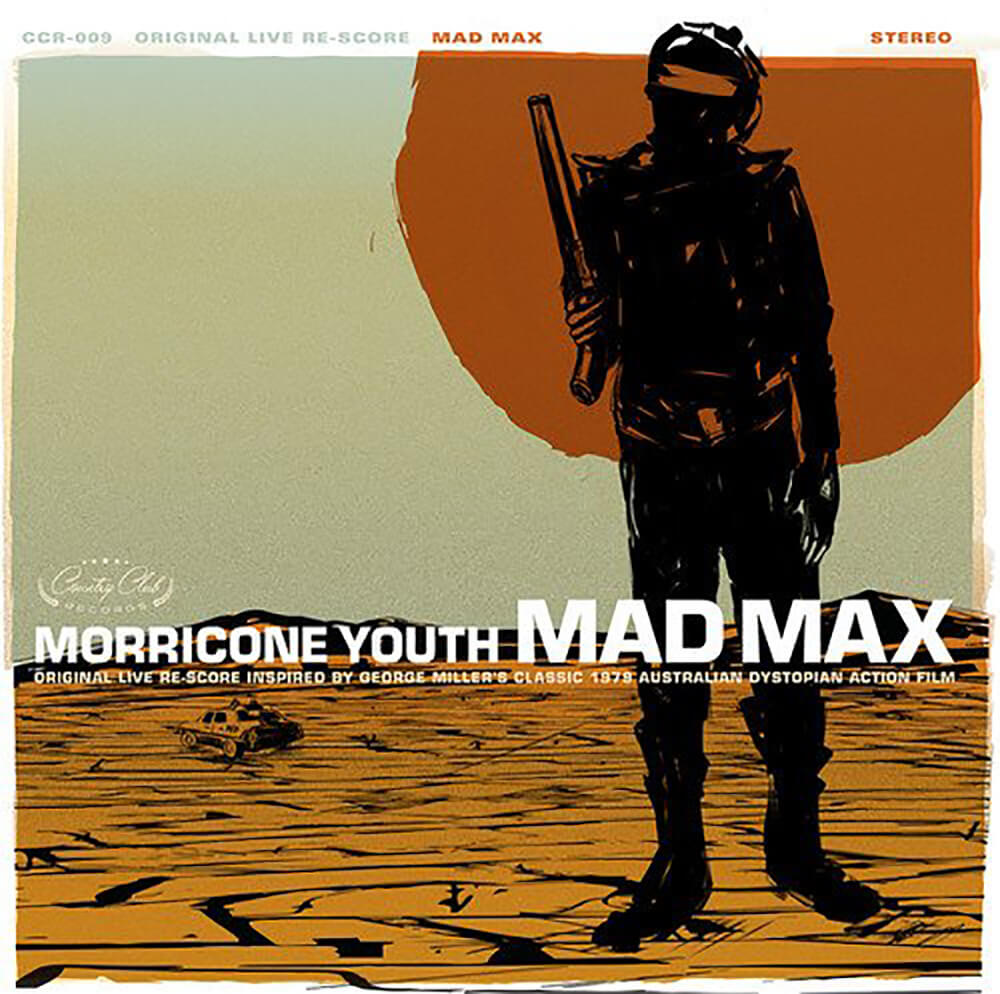
    Morricone Youth is an odd music collective no matter which way you look at them. Formed in Brooklyn and having been performing together since 1999, the group focuses mainly on writing soundtracks for already existing silent and midnight movies. A total of 15 have been done so far, includeing Eraserhead, The Battleship Potemkin, Enter the Dragon, Foxy Brown, the original Nosferatu, Fantastic Planet, The Lodger: A Story of the London Fog, Night of the Living Dead, and the work I’ll be reviewing here, the original 1979 Mad Max.
    How Morricone Youth’s shows usually work is the movie the soundtrack’s for will play, without sound of course, as the band plays their music over it instead. The only image I could find of the band playing live, one in granulated black and white, had the members in the frame wearing Michael Myers type masks. Now, aside from playing live, Morricone Youth is recording all the soundtracks they’ve composed so far, with Mad Max being their latest release.

    The first thing you need to get out of your mind, and I reiterate, is no, this is not a direct recreation of the original Mad Max score. This is their own interpretation based on their varying styles. I myself have only seen this film once, so my knowledge of events the music is supposed to correspond to is limited.

    The opening number, “Halls of Justice,” begins with a somber violin with electronic bleeps and blorps, along with distorted vocals where the only lines I could make out for sure had to do with the Interceptor, Max’s car. So when it flows into “Mad Goose,” after another synth buildup, the chase from the beginning of the movie is in full swing, complimented with surf guitar and clanking keyboards. You certainly feel like you’ve been taken along for a ride.

    Much like a soundtrack should do, it weaves in and out with your emotions. “Clunes Town,” “Jessie,” and “Johnny the Boy” are supposed to the down points, where the audience is meant to catch their breath and catch up with the side characters, like Max’s wife and child. There are also bits of cheesy saxophone and trumpet in there to make this feel authentically from the late 70’s, early 80’s (though not as cheesy as in “Beyond Thunderdome”). Meanwhile, tracks like “Revenge of the MFP,” “Nightrider,” and “Toecutter,” are downright villain songs. Which makes sense since they’re named after the various villains in the movie, with loud blaring instruments and melodies filled with tragedy, mayhem, and the urge to fight the nearest person to you.

    When the last song, “Bad Max (End Credits)” finally comes around, with a general melancholy sound from all the instruments, you feel as worn out as Max at this point, where he finally gets his revenge and leaves civilization behind for the outback. You feel just as worn out as Max at this point, longing for peace. If this album taught me anything, it’s that I should really re-watch the Mad Max movies. I remember enjoying all of them and I haven’t gone back to them since I saw Fury Road in theaters. Then I can determine for myself if this music actually does fit the parts they’re supposed to.

    Key Tracks: Mad Goose, Nightrider, Bad Max (End Credits)

  • Hearing Aide: Ned Luberecki “Take Five”

    I’ll openly admit I don’t know that much about bluegrass music, other than the fact there’s more emphasis on the banjo than other kinds of folk music. And my experience hearing the genre is limited to going to places trying to replicate an authentic Americana theme. So given the chance to review a bluegrass album, especially from someone considered one of the modern masters, Ned Luberecki is as close as a superstar the bluegrass scene currently has right now.

    ned lubereckiAlong with playing for an extensive number of bands, like Becky Buller Band, Chris Jones and the Night Drivers, the Rarely Herd, Paul Adkins and the Borderline Band, and the duo Nedski & Mojo, he also hosts two shows on the SiriusXM Bluegrass Junction channel, Derailed and More Banjo Sunday. But if there’s anything I got out of listening to his newest album Take Five, it’s that bluegrass isn’t limited to just songs about living in Appalachia and you can actually have a sense of humor playing it.
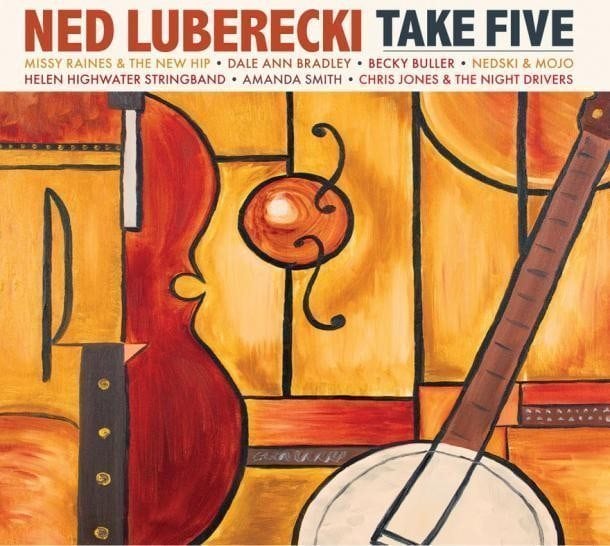
    Even the album art itself leads me to believe Luberecki is in on whatever joke he’s playing. It’s very much the same 50’s modern style Dave Brubeck’s Time Out album cover is based on, but with an upright bass and banjo painted in the image. Not something you’d expect to see when preparing to listen to folk music, but I suppose trying to invigorate something new into a genre is good.

    The first half of the album contains all the bluegrass you’d expect, and about topics people with a limited knowledge of the genre like myself can predict would appear. “Higher Ground,” (not the Stevie Wonder song) featuring Dale Ann Bradley on vocals, is about living in Kentucky, finding what your heart really wants, and proclaiming, “My mountain stands alone.” “We’ll Put out the Fire,” featuring Amanda Smith, is about finding the perfect man and “Fiddlin’ Dan,” is about a fiddle player who has the skills to charm even the fiercest of woodland creatures. Along with the other instrumentals placed in there, most notably “Adams County Breakdown,” “Night Rider,” and “B-Flat Medley,” Ned Luberecki has plenty of room to show off his quick plucking and interplay with the violin in the background, creating a proper atmosphere for some country revue action.

    In the middle of the album, we get around to the part that separates this from typical bluegrass music, jazz covers! There’s the Dave Brubeck class for which this album is named after, the bossa nova standard, “The Girl from Ipanema,” and the Thelonious Monk song, “Blue Monk.” Luberecki’s banjo is still front and center here, but the background is completely different from the standard bluegrass on the rest of the album. There are jazz drums, blues guitar, upright bass, and organ bleeps happening, while the banjo playing is slowed down considerably to draw out every little musical line. Especially on “Blue Monk,” which features prominent blues guitar, Luberecki is certainly confident in his genre blending, with bluegrass, jazz, and easy listening all coming together.

    The next two songs, more rather medleys, return to the standard bluegrass of so much of the album. “The Kitchen Squirrel medley”, and a medley of two Buck Owens songs, “Before You Go” and “Let the World Keep Turning.” It’s on the Buck Owens medley we finally get to hear male vocals befitting of the Buck Owens country tradition.

    To top the album off, and going back to his humorous nature, Luberecki plays a cover version of the original Star Trek theme song, complete with the opening “Space, the final frontier,” monologue in a southern drawl, with a hint of William Shatner in there. And so, the album ends with as much as what preceded it. With forceful interplay between banjo and violin. Bluegrass, on it’s own, is a fun genre of folk music to get into, but with the humor and other genre infusions Ned Luberecki brings here, it wouldn’t surprise at all if he made a few more fans along the way.

    Key Tracks: Higher Ground, Adams County Breakdown, Take Five

  • The Griswolds Rock Out at The Waiting Room

    Friday, March 3:  the first Sunday of Lent. In Buffalo, that normally means every restaurant has their take on fish fries out and people are trying to better themselves through personal sacrifice. However, those attending The Waiting Room that evening found themselves in a very party-friendly environment. One that resulted in a lot of spilled beer on the floor. But given that the band was from Australia, a country known for their heavy drinking, it seemed only fitting. And it also seemed fitting that the band, The Griswolds, named for the Vacation film series family often driven to their limits, was the main event.

    The Griswolds hail from Sydney, Australia and were on tour behind their new album, High Times for Low Lives. The lineup, made of Christopher Whitehall on lead vocals and guitar, Daniel Duque-Perez on keyboards and guitar, Tim John on bass and Lachlan West on drums, claim to be inspired by the likes of 2000’s indie bands Vampire Weekend, MGMT, and Of Montreal along with Kanye West and the Beach Boys.

    Whitehall definitely gives off the impression of an Australian man, with a scruffy head of long hair along with a somewhat trimmed beard. His thick accent when he spoke to the crowd was the common kind of slurred speech people often expect to hear from Australians. That sort of made his open attempts of getting the audience to party all the more amusing. His guitar sported the phrase “Love Trumps Hate” in a slightly more pleasant looking matter than if Tom Morello would’ve done it.

    The music itself does bear the influences of the band on its sleeves. The walk-on music for the band was the same “In High Places” sample by Mike Oldfield, used in Kanye West’s “Dark Fantasy” before going into “Role Models.” The various tricks performed were often found in prominent 2000’s acts, like the weird synth vocals in “16 Years,” the psychedelic sounding keyboards of “Right on Track” and high-pitched chorus line of “Be Impressive.”

    At one point, Whitehall asked if anyone in the audience had a birthday, and a few did raise their hands. He then told the crowd it was the drummer’s birthday and replied, “This is the best birthday ever” in a similarly thick accent. After a round of “Happy Birthday,” the band delved into their own song titled “Birthday,” one that played much slower and less joyous, but went in deeper. Compared to the much more upbeat, “If You Wanna Stay,” which probably got the most party-like reception the band wanted, The Griswolds really run a gauntlet of various tastes.

    After ending with “Down and Out,” complete with Whitehall doing a guitar solo with the guitar strapped to his back, and a plainly obvious attempt at an encore, they played the very Vampire Weekend-esque “Beware the Dog,” another song where the drummer got into the hard rhythms. In a rather surprising move, Whitehall, after asking the audience if they wanted one more, invited one of the opening acts, Dreamers, onto the stage. The now 8-person band on stage, in one last bit of fun-giving, played the ever-classic “Hey Ya!” Whitehall and Dreamers singer Nick Wold traded verses and lines in the chorus, trying to channel whatever parts of Andre 3000 they could muster.

    The Griswold’s music was plenty entertaining enough, with their odd mix of new wave, electronics, and funk rhythms. But at the same time, they didn’t make too much of an impression of me beyond that. I was interested in seeing this band because of the question, what would a band named The Griswolds sound like? And now that I have, I can say I’ve heard plenty of other bands trying the same thing. It’s not anything original, but it’s not anything to completely discount either.

  • GZA Runs through Wu-Tang Classics at the Waiting Room

    On Saturday, February 25, the bizarre weeklong heatwave in Buffalo finally came to an end as snow blustered across the city. And at the Waiting Room, numerous patrons were wearing Wu-Tang Clan shirts, GZA hats, and one wearing a New York Rangers style jersey, but with Wu-Tang images instead. The smell of weed permeated the air, and the audience on the bottom floor stage was packed from the front stage to where the merchandise stand would normally be. Wu-Tang was certainly representing this evening. And the crowd was here for one of it’s prime members: GZA the Genius.

    GZA Waiting RoomBorn Gary Grice from Brooklyn, New York, the GZA is the cousin of Wu-Tang mastermind RZA. He’s the oldest member of the 9-piece rap group and the only MC who released an album before the Wu-Tang Clan formed. He’s often regarded as having one of the most extensive vocabularies of any MC, which I suppose comes naturally with being in a group with as far ranging rhyme styles as the Wu-Tang Clan. It must come from trying to keep up with everyone else.

    GZA wasn’t touring behind a new release. His last solo work was 2008’s Pro Tools, and the last Wu-Tang project was the infamous Once Upon a Time in Shaolin. The Genius decided to take the mostly Wu-Tang clad audience on a trip down memory lane, spitting out some of his best-known rhymes from his 90’s glory period.

    The majority of the first set of song/excerpts were from the acclaimed Liquid Swords, the album that established where, even if he was solo, GZA was one of the most lyrically adept members of the clan. From the standard hip-hop braggado of “Duel of the Iron Mic,” and “Shadowboxin’,” to the more street-conscious “Gold,” “I Got Ya Back,” and “Living in the World Today,” it’s impressive how GZA can still manage such precise, dense lyrics from albums made 2 decades ago, even as the backing tracks cut out to let the audience chant along some of the iconic lines.

    Something else that was prominent throughout the performance was how GZA, in his effort to appeal to the massive Wu-Tang fans there, would rap some of the other MC’s lines, occasionally some songs he had no part in. The DJ said a few times during the set this show was dedicated to the deceased Ol’ Dirty Bastard. And as a proper tribute goes, the audience was hectic as the piano line of “Shimmy Shimmy Ya,” started playing, with them shouting how they “like it raaaaaw.” The same was for when songs from the Wu-Tang’s debut Enter the Wu-Tang (36 Chambers) was playing. Aside from “Clan in Da Front,” essentially a GZA solo track, he went through other MC’s verses on “Protect Ya Neck,” “Wu-Tang Clan Ain’t Nuthin ta F’ Wit,” and “C.R.E.A.M.” (dolla dolla bils y’all!)

    During a break in-between songs, GZA asked the crowd where we got the name Buffalo from anyway, out of curiosity. Mainly because he goes through towns with Native American names, of which Buffalo is one such place. GZA then went on a bit where he asked if there were any Trump supporters here (there were none), followed by if there were anti-Trump people there, where the whole crowd responded. He then gave off a “we’re not with you,” before saying how “we’re gonna make America great again our way.”

    GZA waiting roomGZA even jumped into the crowd to do a rendition of “Crash Your Crew,” surrounded by eager fans taking cell phone pics and videos.  Some bodyguards came out from backstage in case any fans got a bit too crazy. He also casually signed autographs in the middle of his set, sometimes while still in the middle of rapping. That showed the level of cool and experience GZA gave off.

    The show ended with a seemingly freestyle bit incorporating “Triumph,” “Shame on a Nigga,” and “Wu-Tang Clan Ain’t Nuthin ta F’ Wit,” ending an hour-long set keeping the Wu faithful plenty satisfied. And no doubt if any other of the Wu’s killer bees ever come into town again, the same situation will play itself out again.

  • Hearing Aide: Left Hand Shake ‘8-Track Mind’

    Left Hand Shake 8-Track MindOne day, I was given the task of reviewing this album, a debut, no less, from a band I had no idea what to expect from. All I got was a set of audio files from the album 8-Track Mind, and a brief description of Left Hand Shake’s members, David Decker and Blaze Sepowski, and the previous projects they’ve been involved with, featuring names like Bang Zoom!, Picture This, and Bottle of the Dog. Initially, I thought this would just be something I could sit through and move on.

    Even the album cover itself led me to think anything could be inside. It’s of a suit with an old speaker where the head should be with an 8-track of the album loaded inside. Upon further research, I saw it was named album of the year by WVCR, the radio station for Siena College. Okay, I thought. College-age people like this. I finally got around to listening to the album, which started off with the various synth noises of “F.S.B.” until 45 seconds in when the slow drumbeat and guitars finally kicked in. And from there, I was hooked.

    The album comes across as a breath of fresh air because it delves into a particular genre I don’t think gets enough credit: dream pop. There are definitely artists nowadays influenced by this particular underground scene, M83 comes to mind, but it’s rare to see an act fully embrace the mindset. The mid-tempos that put listeners in a state of bliss. The sweeping, soaring guitar lines. The echo-y vocals less concerned with singing clear lyrics and more with being another texture of the song.

    In terms of extent of what Left Hand Shake is willing to do, it’s on the second song, “Being There (Django).” Along with the ethereal 80’s dream pop guitar work happening, there are also hints of violin and a mandolin underneath. Of it’s eight and a half minute runtime, the last five are purely instrumental. And it’s not only more guitar work that gets to shine, there are harmonica, saxophone, and trumpet solos dispersed in that time. And oddly enough, though it sometimes feels it goes on for too long, it all works in making the dreamy atmosphere stick.

    There are also songs that tone down the dream atmosphere considerably. “Right Hand Shake” reminds me of “She Bangs the Drums,” by the Stone Roses, with the similar guitar tones and echo-y vocal work. “Fly” is pretty much a condensed version of the longer songs, but notably more down to earth.

    In terms of shortcomings, I’d say Decker and Sepowski get a bit too experimental with their instrumentation. The songs that are 7 to 8 minutes long have a good chunk made up of solos that serve only to continue the state of euphoria. “People Like,” starts off sounding like a dated 90’s industrial act before it really gets going. “Fabreeze” has a muted trumpet solo while “Path Less Taken” essentially ends with a violin solo taking up the last third. The lyrics, when you can make them out, at times come across like they’re trying too hard. Lines like “Life is a garden, I’m sowing all the seeds, when something starts to grow, it comes out as weeds” (“Fly”). And “People like you, people like me, we can change the world” (“People Like”) Then again, lyrics were never the emphasis of this genre.

    So, if you’re a fan of the works of The Cocteau Twins, Slowdive, and Lush, give Left Hand Shake and 8-Track Mind a chance. We should look forward to whatever efforts these guys have planned in the future, if they continue this direction or move on to something else.

    Key Tracks: Being There (Django), Because/Second Hand Shake, Fly, Iced & Alone

    Listen to Left Hand Shake 8-Track Mind below.

  • Tokyo Police Club Play to a Packed Waiting Room

    It’s one thing if a band from your immediate area becomes a sensation in any regard. But if any band from a major regional city, like Toronto, start off their latest American tour in a city right across the border, you better imagine fans will come in droves to see them. That’s why on January 19, Toronto indie darlings Tokyo Police Club played in front of a nearly-full crowd at Buffalo’s Waiting Room. And the crowd came from near and far to see the Canadian lads.

    Tokyo Police Club, made up of David Monks (bass/lead vocals), Josh Hook (guitar), Graham Wright (keyboards/guitar), and Greg Alsop (drums) have been big names in the U.S./Canadian border indie scene for a while now. In the past 10 years, they’ve performed at festivals including Coachella, Lollapalooza, Glastonbury, Reading and Leeds, and Bonnaroo. They’ve toured with the likes of Weezer, and Foster the People and released four LP’s and three (or four if you’re picky) EP’s. Buffalo was the first stop on their tour promoting their new EP, with stops in Washington DC, Cambridge, MA, Montreal, and Peterborough, Ontario coming up.

    Monks had immediate control over getting the crowd, wearing a black button-down shirt that gave off a look oddly reminding me of Billy Corgan. Maybe it was intentional, since their lastest, two-part EP is called Mellon Collie and the Infinite Radness. Either way, the crowd at the front reached their hands inches from Monks’ face as he reached the edge of the stage with his bass. Wright, doing double duty on backing guitar and keyboards, was by far the most enthusiastic performer of the act, bobbing around as he churned out various synth riffs and was by far the more energetic guitar player, even if his riffs mostly came in when Hook had a solo.

    The audience was more than willing to clap along when Monks urged them too, or on their own. There were also instances of a pineapple being passed around and held up by audience members, along with one attempt at crowd surfing that didn’t get too far. Musically, people recognized each song that started playing, like the distinct opening synth riffs of “Bambi” and “PCH.” They chanted along with the chorus lines of “Favorite Color” and “My House.” They waved their arms side-to-side during the slow intro of “Breakneck Speed.” And they managed to keep up with the multi-part “Argentina.”

    The band closed out their initial set by playing their first EP, A Lesson in Crime, in it’s entirely to celebrate its 10th anniversary. With each song hardly breaking the two and a half minute mark, they were notably more unrefined, more raw. The opening track, “Cheer It On,” harkens back to the time bands like The Strokes and Interpol were the toast of the indie community. “Shoulders & Arms” has a streak of noise-like guitar they would hardly come back to, while “Citizens of Tomorrow,” even with it’s hints of dance-punk, would harken to what the band would eventually turn into.

    By the time the band finished playing “La Ferrassie,” the final song from A Lesson in Crime, and bid their audience goodnight before coming out for an encore, the place had been completely enamored by whatever plans the band had up their sleeve. If the crowds at their upcoming shows are anything as responsive as the one in Buffalo, then Tokyo Police Club should expect a good time up ahead.

  • Hearing Aide: Dave Fields ‘Unleashed’

    This coming Valentine’s Day, New York City-based blues guitar player Dave Fields will release his seventh studio album, Unleashed. In a career that spans writing jingles for the likes of IBM and Publishers Clearing House, working with legendary British bluesman John Mayall, and getting inducted into the NY Blues Hall of Fame in 2012, Fields is definitely making the most of his musical talents. And with an album title like Unleashed, he’s certainly building up some kind of anticipation. And I must say, Unleashed is a fitting title.

    The album opens with “Anticipating You,” an instrumental jam more on the jazz side of things. It also starts what’s a regular occurrence on the album. Though he bills himself as a blues player, Fields goes on long shredding passages like he’s an 80’s hair metal guitarist.

    If you want an idea about what kind of lyricist Fields is, look no further than “Child of the World.” The song is about having to deal with all the bad things currently happening in the world, like terrorists and people who have extremist thinking. And Fields says he’s on a “love crusade” to try and right these wrongs. It’s the kind of lyrics you’d hear from a 1960’s artist, but trying to specifically address modern day topics in that exact way sounds odd.

    The blues aspects really come out on songs like “My Mama’s got the Blues” and “The Boy Wants to Play,” the former sounding like it comes straight from Memphis and the latter having backing singers and more of a soul/gospel feel, even if it is about a boy wanting sex. Meanwhile, the two-parter “Jagged Line” probably gives the best example of Field’s attempt to blend these varying styles together. The rock guitar, backing organ sounds, and blues lyrics about growing up with a hard life, gives any passive listener a good idea of where modern blues music is heading or what it’s trying to be.

    Starting at “Better Be Good,” another song about trying to love one another in the face of terrorism and corrupt governments, the album suddenly transitions to a live set at a NYC blues club. From there, he makes his Jimi Hendrix influences bright as day with a faithful cover of “Hey Joe” and his own rendition of the Star-Spangled Banner. It wasn’t a note-for-note recreation of the Hendrix version (I don’t think that’s possible), but he does make some impressive runs that leave any fan of shredding pleased.

    The two songs that end the album couldn’t be further from the rest of the album. “New York City Nights” is the only real ballad here, with Fields switching to acoustic guitar and backed by synth strings. Meanwhile, “Les Hoedown” is easily the fastest song here. An instrumental featuring very fast guitar plucking that sounds like Jeff Beck doing rockabilly, with the drum fills and bass managing to keep up.

    I have no doubt an audience for this music exists, for those who like frequenting establishments who play blues, roots, or Americana music. And if you do appreciate shredding and fretting guitar playing, Fields is worth a listen.

    Key Tracks: Jagged Line (Pts. 1 & 2), The Boy Wants to Play, Pocket Full of Dust (live)

    [embedyt] http://www.youtube.com/watch?v=fd3zvlvoLuo[/embedyt]

  • The Machine New Year’s Eve show in Niagara Falls

    Judging how well a tribute band does is a weird task to ask someone to do. For one thing, they’re not playing any original music. And the audience is there only to hear someone else’s music, mainly of a band or artist long since dead or disbanded. Sometimes you get an act that should be better off playing in a hotel bar. But others, you could swear you genuinely got the original. On New Year’s Eve at the Rapids Theatre, the people of Niagara Falls got their fill of one such band, Pink Floyd, in the form of The Machine.

    The Machine bills itself as America’s longest-existing Pink Floyd tribute band. Made up of Joe Pascarell on guitar, Ryan Ball on bass, Scott Chasolen on keyboards, and Tahrah Cohen on drums, they’ve been performing the Floyd’s music since 1988 and are regarded as one of the first and best tribute bands. It’s hard to come across a cover band with live DVD’s of shows in Amsterdam and performing with a symphony orchestra, but such is the demand for Pink Floyd music that sizable droves will show up like it’s one of the band member’s solo tours.

    The Machine started off right away with the first five songs from The Wall. From the first riffs of “In The Flesh” through the audience chanting along with “Another Brick in the Wall,” the audience got immediately hooked, living for every recognizable music line or lyrics, even coming from a ballad off the Atom Heart Mother album. The band certainly appeared to be having the time of their lives with songs you could tell were their favorites. Chasolen was living for every different keyboard effect used on “Welcome to the Machine,” along with the saxophone solo on “Money” played on keyboards too.

    There was a break between sets for the audience to refill their drinks and to watch the ball drop on two screens beside the stage. The second set, fittingly enough, began with “Time,” the clocks chiming at the beginning drawing immediate applause, while later on, the vocal interplay between Pascarell and Ball sounded just like it came from the Dark Side of the Moon album.

    The Machine wasn’t afraid to shy away from the longer Floyd songs either. They ended the first set with “Pigs (Three Different Ones)” from the Animals album, which Pascarell certainly got very involved in once the talkbox solo came in. They also performed the first half of “Shine On you Crazy Diamond,” complete with the long synth and guitar intro with visuals of a child playing and laser lights.

    I’m sure if I saw Pink Floyd back in their heyday, or one of the Roger Waters or David Gilmour solo tours, this would be quite similar to what I’d get from those. Certainly the kind where the long instrumental passages and medleys are best enjoyed with the assistance of some substance in your system. And considering this is as close to hearing a genuine Pink Floyd show I’ll ever come to, I was pleased with the authenticity. There were no flying pigs, but I can take that.

Built in Breakdance