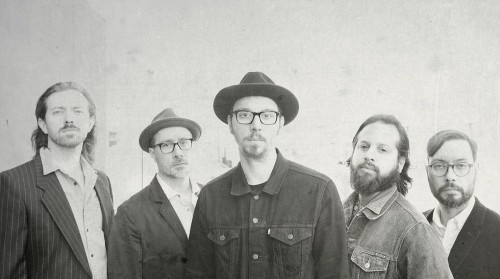
Hollis Brown markets itself as an American rock band which, lately, is the best way to describe groups that lean towards the origins of rock and roll — a little bit of blues, a little bit of soul and a splash of funk.
Listen to Hollis Brown’s latest single, “Run Right To You,” off its October release Velvet Elk, and you’ll hear nothing that resembles the fabricated sound of Top 40 radio, or anything that would remind you of their home. The band takes its name from Bob Dylan’s “Ballad of Hollis Brown,” which opens with “He lived on the outside of town.” Vocalist Mike Montali said the homage pays respect to what he perceives to be the song’s message of redemption and rebirth. He and band co-founder Jonathan Bonilla call Queens home. Along with drummer Andrew Zehnal, from Cleveland, keyboardist Adam Bock, from St. Louis, and bass player Brian Courage, from Long Island, they play a sound that’s more in place at a roadhouse in rural America than your coffeehouse in neighboring Brooklyn.
“We somehow fit in though,” said Montali, who admits the roots-edge sound of Hollis Brown clashes against any dance scene perceived to come out of Manhattan or Long Island. “New York, historically, has had a lot of great bands come out from all different styles and great songwriting. So eclectic, that it’s hard to really define.’
“In particular with the New York scene, and the press, we’re outsiders for sure, in a way,” he said. The perception, however, is only reality to those expecting a band with “a couple of iPads and some synth.”
“We do really well in New York,” said Montali. “It’s home, and it’s been good to us.”
Since forming in 2009, Hollis Brown has attached its name to Lou Reed, Bo Diddley and the Counting Crows. Its 2013 debut album Ride On The Train, garnered song and video premieres from Rolling Stone, Paste and American Songwriter, along with placement in several movie trailers and an online ad campaign for Abercrombie & Fitch. Following a Reed tribute concert in New York City, Alive Naturalsound asked the band to record a tribute to the Velvet Underground’s Loaded as a limited-edition vinyl release for Record Store Day 2014. Hollis Brown Gets Loaded took on a life of its own, with airplay on influential radio stations, resulting in a full CD and digital release.
Locals who didn’t catch Hollis Brown’s music through the above likely caught on when the band tagged along with Counting Crows and Citizen Cope when the three played the Saratoga Performing Arts Center in the summer of 2015. Still relative no-names, the band that sounds nothing like New Amsterdam garnered the admiration of Crows’ frontman Adam Duritz. Duritz, who updates Twitter more often than President Trump, constantly expressed praise towards Montali and his crew.
“I think that’s pretty rare for a guy with his level of success,” said Montali of Duritz. “He’s a fan first. He always has been, more than a musician, himself. He loves music and he loves the process of seeing bands starting out in their hometowns to become national acts. … We’re fortunate that we got on his radar and made good friends with him.”
Flash forward to 2017, Hollis Brown will tour across the country with stops at Mountain Jam, Karoondinha Festival and more. “Steady Ground” is a featured-exclusive on Amazon’s playlist Amazon Acoustics. The band’s vinyl EP, Cluster of Pearls, was chosen as one of the 300 select releases throughout the world for Record Store Day last year. “Cluster of Pearls” followed the 2015 release 3 Shots, which featured Diddley’s collaboration “Rain Dance,” and the duet “Highway 1” with acclaimed alt-country songstress Nikki Lane.
This article was originally published by The Spot 518. is property of Spotlight Newspapers in Albany, N.Y., and appears as a special to NYS Music. TheSpot518 and NYS Music work in partnership to provide readers with in-depth coverage on the local music scene in the Capital District and New York state, respectively. For more, visit TheSpot518.com.
Holly Taormina rushes into the quaint side room set behind the bar at The Orchard Tavern where her bandmates are waiting to order lunch.
“Words cannot describe how much I hate driving a car,” she exclaims through clinched teeth, as she takes her seat. The Holly to Holly & Evan can be as tempestuous as the energy she exhibits on stage. Especially if she’s caught behind someone driving too slowly. “I have no tolerance or patience for people who don’t know how to put their foot on the gas pedal.”
Between raising a family, logging in 40-plus hours at the U.S. Postal Service Honors Pete Seeger with New StampU.S. Postal Service where she works, and the precious little time spent with the band, Taormina is a woman with places to go and too much in her way. It’s a feeling shared by the rest of the band. There are obstacles standing in the way, and they’re itching to move past. A local radio station continues to play a single the band released a few years ago. It’s the only one they have. Despite having enough songs to cut a CD, finding the money and time to get together to record is a challenge in itself — something to which all bands juggling day jobs can relate.
“It’s one of those things we want to get to,” said Evan Conway. “It’s tough to get everybody together to get this thing out. It’s been like that for a while.” As with most bands, musicians juggle their time between the day jobs that pay the bills, and the nightlife that satiates their dreams to play music. No one is living off music alone. Except, maybe, Josh Greenberg, the band’s sax player. He’s a retired music teacher.
“Josh plays with, I don’t know how many different bands, a good number of them. That goes into figuring out when we can play. But, Bob [Morris, the band’s drummer] also plays in a number of different bands. Holly has a job that she works six days a week, [with] overnights…”
Around the table, there is a sense of family. Greenberg helps Taormina’s daughter out with picking from the tavern’s menu. Once the food arrives, everyone gives Morris a hard time for stealing a chicken finger from Taormina’s son. The band’s been together for more than five years. In the case of Morris and Conway, they’ve played together since the two were in high school more than a decade ago. So, when everyone mentions Taormina’s demanding job schedule, it’s all out of respect. On top of her obligations as a mother of two and her pursuit of a supervisor’s position at the post office, she continues to write songs. Some of which, Greenberg describes as “hip-hop” in origin. A description she greets with a smile, though she jokes, her songs sound like that because she’s angry.
“I think the insane work schedule that Holly works has created this situation over the past year, where we play fewer performances, but we knock ‘em dead,” said Greenberg. “I think there is something that is just beginning to change. With Holly being the songwriter, and with Holly and Evan being the music arrangers. I think the music is brilliant. It’s meaningful, it’s original and it absolutely deserves to get out there.”
Holly and Evan is a self-described “blues based Alt Rock” band that’s “tinged with jazz and soul.” The band’s Facebook page lists off Skip James and Robert Johnson among its influences, old-school blues performers with no earthly ties to the Capital District. Johnson died in Mississippi in 1938 at the age of 27. His life story was the inspiration behind the 1986 Ralph Macchio film “Crossroads.” Legend says he sold his soul to the devil. A gifted guitar player, he was inducted into the Rock and Roll Hall of Fame in 1986. Conway, too, is a gifted guitar player. His father, Ed, said he has the unnatural ability to pick up a song by ear and play it. As a kid, he’d play before gatherings at the Hibernian Hall. His first taste at playing in front of a crowd.
“I think this band is poised to have a product and a presence, there’s no doubt about it,” said Greenberg. “I think the live performances have just come alive. I think Holly’s performances are phenomenal. I think all of us are performing at a very high level. We know the material. We’ve been playing together for a number of years, so it’s very intuitive. And, we just absolutely have a great time playing.”
The band works without the aid of a manager to book gigs or maintain social media channels. Some of those duties fall on Evan’s mother, Kathy. Nonetheless, it’s Evan’s responsibility to update Facebook. He admits, months can go by between posts. Despite the relative quiet internet chatter, the band has gained a larger audience. Gigs outside the Tri-City area have been more frequent, including a near regular appearance at The Red Lion Inn in Stockbridge, Mass. The inn, that dates back before the American Revolution, has hosted Leonard Cohen and James Taylor.
Taormina believes it’s the band’s penchant for original work, instead of a “jukebox full of covers,” the audience appreciates most. She believes musicians are artists, and should obligate themselves to not just the instrument they play, but to apply thought towards stage presence.
“That’s what really bothers me about music nowadays,” said Taormina. “I mean, I look at The Beatles, and Led Zeppelin and Jimi Hendrix, and I look at them as artwork. The way they dressed and the way they performed. Nowadays it’s just plastic. Not to put anybody down. It’s just not visually stimulating. It doesn’t do anything for me visually or mentally. The clothes, you know? Fashion and music, it all goes together. Nobody is grasping that now.”
[A scornful stare.] “It’s like watching a play. Like a high school play,” said Taormina. “Not to put her down. It’s great for her, but I miss the seriousness of it. I took my kids to see 21 Pilots at the Times Union [Center]. They were unbelievable. One of the best shows I’ve ever seen. I’ve seen a lot of shows. … Two people on stage. The set was all art. He did a backflip off the drum platform. They lifted the drum platform, and he played the drums on top of the audience. The coolest thing I’ve ever seen. There’s a band that is innovative, and thinking, and trying to get people to think. That’s important. We can do it on a small-scale. I mean, it’s as simple as thinking about what I’m going to wear before I walk on the stage. It’s how I’m going to do my hair.”
This weekend Holly and Evan play the main stage at Albany’s Tulip Fest. That, too, shows another evolution to the band’s growing popularity. It will be the band’s second time at the annual Mother’s Day festival. Its first appearance was relegated to the local stage.
“We’re getting to that point,” said Greenberg. “So, I think that somebody’s got to come along and produce it. Somebody’s got to come in and take care of that business. Promotion. Promotion. Promotion. It would have to be somebody who is willing to invest a lot….”
“Someone willing to work with four cranky people,” said Evan.
As Greenberg said, there appears to be a light at the end of the tunnel. Things are beginning to open up for a band juggling daytime obligations with nighttime dreams. Short of making a deal with the devil, Evan said there’s always a need to strive towards the big picture.
“You have to have the big picture goal,” said Evan. “You have to have that picture where you’re sitting on the beach in Tahiti in the middle of winter. To say, I can afford anything I want. You’ve got that dream.”
“I don’t even care about that,” said Taormina. “I just want my Grammy.”
This article was originally published by The Spot 518. is property of Spotlight Newspapers in Albany, N.Y., and appears as a special to NYS Music. TheSpot518 and NYS Music work in partnership to provide readers with in-depth coverage on the local music scene in the Capital District and New York state, respectively. For more, visit TheSpot518.com.
Josh Carter has been traveling the world so much that he dreams of being on the road. “My girlfriend said to me the other day that I was sleep talking, and I was saying something about being in Singapore,” said Carter. “I’ve never been to Singapore.”
Give Carter and Sarah Barthel — better known as fast-rising alternative electronic pop group Phantogram — enough time and they may yet reach Singapore.
The duo from Greenwich recently wrapped up five months of constant touring in support of its new album, “Three,” with a series of East Coast club shows, including a sold-out show Saturday, January 14 at Upstate Concert Hall in Clifton Park.
“I used to go to Hatebreed shows at Northern Lights (what Upstate Concert Hall used to be called,)” said Carter in a phone interview from Los Angeles, where he now lives. “I was really into hardcore back then.”
There is a harder edge to Phantogram’s songs than when Carter and Barthel started out as Charlie Everywhere in 2007. The breathy vocals and electronic soundscapes featured in early songs such as “Mouthful of Diamonds” and “When I’m Small” have been replaced with big beats and in-your-face vocals, as found in more recent hits as “Black Out Days,” “Fall in Love” and “You Don’t Get Me High Anymore.”
Carter said the change to a more aggressive sound was fueled in part by audience reaction to the band’s shows early in their career.
“I can’t cite a specific moment, but I remember people saying to us, ‘I love the music, but I can’t understand any of your lyrics because they were so buried in the mix,’” said Carter. “So, I think it’s a combination of playing live shows and gaining confidence.”
Carter also said collaborating with other artists helped Phantogram grow. A guest appearance on Big Boi’s 2012 solo album Vicious Lies and Dangerous Rumors led to a full-blown side project with the Outkast rapper called Big Grams that led to an EP in 2015. Phantogram also appeared on The Flaming Lips’ tribute album to The Beatles’ Sgt. Pepper’s Lonely Hearts Club Band — 2014’s With a Little Help from My Fwends — where Carter and Barthel tackled “She’s Leaving Home.”
“It’s been so much fun. It’s also been a learning experience,” said Carter. “Collaborating and playing music with others is always a good thing because you learn so much.”
Having the chance to work with Big Boi on Big Grams has been a dream for Phantogram, said Carter. “We were heavily influenced by Outkast. In fact, Sarah and I call ourselves Aquemini (a title of a 1998 Outkast album) because Sarah is an Aquarius, and I am a Gemini,” said Carter. “We loved Outkast because it seemed like the sky was the limit for them. They could do something like a gangsta rap on one song, and then they’d have this cheerlead-y pop song like ‘Hey Ya.’”
Phantogram’s own discography maps out the direction the band has been heading. Eyelid Movies in 2010 — their first release for indie label Barsuk Records — was an expansion of its self-released EP from the previous year, which included “Mouthful of Diamonds.” In 2011, they released the EP Nightlife, which saw the beginning of the band’s transition from shoegazing electronic music to more sample-heavy hooks, as found on “Don’t Move.”
A couple of years later, Phantogram moved to Republic Records — a division of Universal Music Group that features artists such as Ariana Grande, Nicki Minaj and Drake, among others. The group’s first album for Republic, 2014’s Voices, brought their music to a more mainstream audience around the world. They started making regular appearances on such shows as “The Tonight Show with Jimmy Fallon,” “Jimmy Kimmel Live” and “The Late Show with David Letterman.”
Three marked another transition for Phantogram. The band exclusively worked with an outside producer for the first time, as Ricky Reed took the controls on the album. Outside songwriters including the-Dream and Tricky Stewart also collaborated on the album.
Reviewers had mixed feelings about Three, but Carter said the album is part of Phantogram’s continued growth.
“We’re not David Bowie. We’re not as brilliant as he,” said Carter. “But if we can have that one moment like David Bowie had with ‘The Thin White Duke’ and ‘Ziggy Stardust,’ that would be awesome.”
And as it edges closer to mainstream success, Phantogram is proving that a Capital District band can have an international following.
“I’m proud and happy to represent our home area,” said Carter. “It’s a testament that you don’t have to be from New York City or Los Angeles or Austin or San Francisco to be successful.”
This article was originally published by The Spot 518. is property of Spotlight Newspapers in Albany, N.Y., and appears as a special to NYS Music. TheSpot518 and NYS Music work in partnership to provide readers with in-depth coverage on the local music scene in the Capital District and New York state, respectively. For more, visit TheSpot518.com.
Roots of Creation is known to sing of its love for the “603.”
That’s the area code for New Hampshire, of which the reggae-jam fusion band calls home. Its 2012 video “Summertime in the 603” (a homage to Sublime’s 1995 “Summertime”) remains a colorful sight for those recently wishing winter away. Just a day after returning from the warmth of sunny Costa Rica, Brett Wilson continues to defend his love for the “Live Free or Die” state. This, after snowstorm Stella dumped more than 20 inches of the white stuff across the region.
“Well, a lot of us here like to ski and snowboard and stuff,” said Wilson, in a phone interview from his home. He admits to feeling out of place with the heat and sun of the coastal vacation spot, from which he just left. With his “pale skin,” he said he found himself retreating more often to the evening hours to avoid being burned. “I like having all the seasons. Costa Rica was great. It was nice and warm, but man. I was not built for 100 degrees, everyday.”
The popularity of a band that envelopes the offbeat rhythms and staccato chords of reggae initially seems just as out of place in New England as Wilson is in the Caribbean sun. But, that’s not the case. Wilson explained he was introduced to the Jamaican music through his mother at an early age. She would provide him with mixtapes of the popular bands that, too, called New England home. When she took him to a reggae fest to hear the music live, he was hooked.
Flash forward 20 years later, Roots of Creation is a Billboard chart topping band. The band’s latest release “Livin Free” debuted on the Billboard Reggae Chart last April. The success follows a cultivated reputation of making each live show a unique gem for the audience’s experience. Wilson recalls Phish and The Grateful Dead, two of some of his favorite bands whose fans often trade recordings of individual shows throughout the years, each with a different line-up of songs, possessing its own unique experience. Today, it’s not uncommon for those who follow Roots of Creation to do the same thing.
“We never really saw any of those bands play the same shows once,” said Wilson. “That was cool, because it built kind of a culture around the band. People wanted to follow them around, collect set lists and tape the shows. Also, the bands never got tired of it. So, we definitely adopted that kind of mentality.”
Whether on the festival circuit, performing at jam favorites like Gathering of The Vibes, Wakarusa, Camp Bisco and Closer to the Sun, or sharing the stage at sold out shows with some of their diverse influences including Slightly Stoopid, The Wailers, Fishbone, and Michael Franti, Roots of Creation has been recognized as a Top 20 artist on the Relix/Jamband radio chart as a festival staple.
Roots of Creation’s fan base played a substantial role with last year’s release of “Livin Free.” The CD, and subsequent three-CD set, was released from the band’s own label, Bombshelter Records, and distributed by ILS/Caroline/Universal Music Group. The record was funded with a crowdsourcing initiative through PledgeMusic.
“We could not have done this without everyone who was a part of our PledgeMusic campaign, those who purchased the album, our fans who come out to the shows, and our team behind the scenes,” said Wilson. “It was a really huge team effort. The RoC family is just amazing, and we thank everyone for their support.”
“Livin Free” features guest performances by Melvin Seals (Jerry Garcia Band), Marshall “Ras MG” Goodman (Sublime, Long Beach Dub Allstars), the Rubblebucket horn section, Billy Kottage (Reel Big Fish), Bill Carbone (Zach Deputy, Max Creek), Grammy-nominated Pato Banton (Sting, UB40), and Mighty Mystic.
This article was originally published by The Spot 518.
After having been a staple in Albany’s comedy entertainment scene for the previous 35 years, Tommy Nicchi picked up his Comedy Works brand in 2016 and moved it up to Saratoga Springs. As he recalled the move last week during a press conference to announce the new partnership between the Comedy Works in Cohoes Music Hall, Nicchi said, “We would only come back for the right reason. And, this building is the right reason.”
Less than a year after it was announced Cohoes Music Hall was making its return as a viable entertainment hub under the Palace Performing Arts Center Inc., the storied music hall continues to build partnerships that will ensure its lights will remain on.
Palace Executive Director Holly Brown announced the partnership, Thursday, March 2, along with three scheduled acts to start later this month.
“Comedy Works will bring a regular series of comedians to a ‘Comedy Works at the Cohoes Music Hall’ series,” said Brown.
Nick DiPaolo kicks off the series Saturday, March 25. The next act featuresformer WWE wrestler, and Glens Falls native, “Hacksaw” Jim Duggan on Saturday, April 22. And, on Saturday, May 13, Gilbert Gottfried will take to the Cohoes stage.
Nicchi said he sent photos of the music hall to management firms before making calls out to comedians. The aesthetics of the venue, and its relative close proximity to New York City — where many such acts call home — made for an easy sell.
“We made three phone calls out, and got these three acts,” said Nicchi.
The Comedy Works comes back to the greater Capital District with stiff competition. In 2015, the Funny Bone Comedy Club established business in Crossgates Mall. It, too, brings a steady stream of regional and national acts to its stage. However, the partnership between the Palace, Albany’s Park Playhouse, the Comedy Works and Cohoes Music Hall, promises both a constant and eclectic stream of entertainment.
The Comedy Works is no stranger to bringing national names to the Capital District. Aziz Ansari famously flew into Albany and immediately took to the Comedy Works stage on what was the anchor leg of a eight-hour marathon stretch of performances in August of 2015.
Brown said she hopes to see at least one live comedy event at the Cohoes Music Hall each month through the new partnership.
Cohoes Mayor Shawn Morse expressed his gratitude for the positive affect Albany’s performing arts group has had on his city.
“The Palace Theatre has certainly exceeded our expectations,” said Morse, who added that more than 7,000 patrons have visited the revitalized hall since the partnership was announced last September. “And, [it] has become our economic engine that drives success to our downtown.”
This article was originally published by The Spot 518. is property of Spotlight Newspapers in Albany, N.Y., and appears as a special to NYS Music. TheSpot518 and NYS Music work in partnership to provide readers with in-depth coverage on the local music scene in the Capital District and New York state, respectively. For more, visit TheSpot518.com.
Less than a week after the opening of the Albany Capital Center, ownership of the city’s most storied stage changed hands — the first big step required for the upgrades it needs to expand.
The Albany Common Council approved the sale of the Palace Theatre to the Palace Performing Arts Center, Inc., the not-for-profit organization which operates it on Monday, March 6. The transition, from a municipally owned venue to privately owned, will secure additional funds for a $65 million expansion and renovation project.
The Palace’s expansion project is billed as a means of revitalizing its surrounding neighborhood. Once completed, its proposed to enhance traffic to area restaurants and provide a bridge to downtown’s entertainment district from the city’s burgeoning Warehouse District. PPAC estimates there will be an “on-going indirect” annual impact of $10 million on local businesses.
“The Palace Performing Arts Center is clearly an important driver of the local economy as proven through the theatre’s exceptional growth under the leadership of Holly Brown and her partners at Park Playhouse and Albany Symphony,” Albany Mayor Kathy Sheehan said in January, when PPAC announced it had secured a labor agreement for the expansion project. “The exciting project will certainly spur additional downtown development, and create an even more dynamic venue for arts and entertainment in the heart of downtown Albany.”
According to PPAC, the Palace has doubled the number of featured events at the 86-year old theatre in the past five years, from 77 events in 2009-10 to 170 in 2015-16. The Palace is also home of the Park Playhouse, which uses the building space for offices and classes for the community.
Palace Executive Director Holly Brown and PPAC Chairman Alan Goldberg said they anticipate the proposed expansion to occur in different phases. The first of which will include restoration and expansion of the theatre’s stage and backstage areas, and creation of classroom and rehearsal space. Additional elements of the project includes a new 600-seat theatre, expanded lobby and box offices, a video post-production studio, the addition of a loading dock and rehearsal space.
In preparation for the expansion, the Palace has spent more than $750,000 to purchase properties along North Pearl Street, and to fund appraisals and various studies to investigate further steps.
The renovation plans rival those implemented by Schenectady’s Proctors Theatre over the years. Proctors Theatre has about 2600 seats to the Palace’s approximate 2800. The city sold the theatre for $750,000, the aggregate value to be paid over the next 30 years. The city first purchased the property for $90,000 shortly after its doors closed in September 1969. Over the theatre’s eight decades of operations, it has features iconic figures of both the arts and pop culture. Bob Hope, The Who, Bruce Springsteen, The Rolling Stones and Jerry Seinfeld have all taken to the Palace’s stage. The Palace is also the home of the Grammy Award winning Albany Symphony Orchestra.
The sale of the theatre did receive some opposition from members of the Albany Common Council, who expressed concern the city was not receiving a fair price. Though the PPAC reportedly presented its purchase proposal based on two, separate assessments, Councilmember Frank Commisso, Jr. took to social media hours before the 12-3 vote last Monday.
“As Mayor Sheehan and her allies on the Albany Common Council are preparing to give away the Palace Theater [sic.], an inconvenient data point is presented,” stated Commisso, attaching an Albany Business Review article reporting the sale of $497,000 sale of the 13,500-square foot eba Dance Theatre on Albany’s Lark Street and Hudson Avenue. Late last week, Commisso announced he will run for Albany Mayor.
This article was originally published by The Spot 518.
The interview was wrapping up just a few minutes before her show was to start. Was there anything you’d like to add that my questions didn’t touch upon?, I asked. “We didn’t even talk about my sobriety,” said Erin Harkes.
The local musician and, as of four years ago, comedian is never shy about the subject of alcoholism. Her sobriety has been covered in newspaper features. It’s a part of her comedy skit.
I didn’t want to ask, because I didn’t want readers to think it defined you.
“It’s very much a part of me,” said Harkes. “I would not be who I am without my sobriety.”
According to the National Council of Alcoholism and Drug Dependence, Inc., roughly one in twelve people in the United States suffer from alcohol or substance abuse. Harkes has been sober for six years. Those participating in Alcoholics Anonymous carry a token depicting the length of their respective sobriety. A reminder. A last extension of a helping hand before one walks into a bar.
Harkes spends her life in bars. According to last year’s schedule, she worked 274 shows; on a 365-day calendar, that’s three-quarters of her days. The musical comedienne quit her day job about four years ago. “It’s a hard thing to do when you’re surrounded by …,” she said, gesturing behind her: a bar that stretched the length of the room, lights bouncing off bottles of liquor and the shiny metal of beer taps. In a career that often obligates her to perform in front of her former vice, she expressed pride in her ability to maintain the course.
But, Harkes said she understands not to be overconfident. She’s her own manager, and her own accountant. “No one does me better than me,” said said. She’s her own boss in a line of work that requires a thick skin impervious to crowds unreceptive to her jokes, indifferent to her songs, or the occasional heckler. It’s also needed when she listens to her body, feels a familiar urge, and packs up her equipment. She said it doesn’t happen often, but it boils down to a short conversation between herself and the venue owner: the owner either understands or she doesn’t play there again. Her attitude is not out of contempt. In the end, she said, she has to take care of herself.
Despite her propensity for travel — again, 274 shows last year — Harkes has attempted to be more selective with her shows. When she first quit her job, she said she would take every opportunity presented her way. Last year, she attempted to taper off the number of shows by selecting quality over quantity. It was a means to prevent herself from burnout. There’s also the balance between her music career, and her comedy one.
“If I wasn’t doing music full time, I’d probably be doing a lot more comedy,” said Harkes. Her reputation is strongest with music, so it pays more. “It’s like you couldn’t take an unpaid work day to go do whatever your hobby is. So, it’s really hard for me to take comedy shows. They have to be really worth it. … I have to sit down and seriously look at it. Is it really worth it? Is it a good investment? Sometimes the return, you don’t make any money at all doing comedy. So, I just work really hard on the other end to supplement it.”
So, you’re a double threat like a Bo Jackson?
“[Laughs.] Do you really have to make a sports reference to a musician?” she asks.
Adam Sandler?
“I prefer Bo Jackson.”
Truth be told, she holds on to early comparisons to former Fleetwood Mac lead singer, Stevie Nicks. Harkes’ soulful lyrics, her music delivery and, perhaps, her light-hued locks, has had people comparing her another double-threat. (Nicks has long been known as a dancer during live performances, and is recognized for her contributions to fashion, as well.)
“The first music I remember listening to was Fleetwood Mac,” said Harkes. “I loved the harmonies. I loved everything about it. … I was born in 1977. Clearly these albums were before my time. I’d just like to state that [for the record],” she said, as she laughs some more.
Jackson — again with the sports reference — was a rare gem of an athlete who excelled at two professional sports. He would often be asked as to which he prefered, and obscurely referred to one as a hobby over the other. Harkes said she loves both music and comedy — and doesn’t want to choose.
“I love music,” she said. “It provides for me. I feel very blessed. I mean, I work really hard and it just blows my mind that I’m able to do it [for a living]. The comedy is way harder. I don’t know if it’s because it’s still new to me still. The excitement is so fresh. I get nervous, and I enjoy that.”
“They each have their pros and cons,” Harkes said. “I wouldn’t say I love them equally. I love them much differently.” With music, she said, she sits down and dives into the music. No interaction with the crowd is needed. However, she describes comedy as sometimes “terrifying,” because she’s not able to hide behind anything. The interaction between performer and audience is vital to the quality of a show. “It’s like every few seconds, someone’s standing on your chest.”
“With the comedy, you need the audience and you need the attention,” said Harkes. “It seems like I’m putting myself in a precarious situation, because I’m already an attention-starved individual.”
It’s January, and Harkes has her schedule planned out for the entire year. She’s the regular host of the all-female comedy show “Chicks Are Funny” at the Funny Bone in Crossgates, in addition to the hundreds of shows to which she travels. There is no time to reflect on her progression, but she said she sets goals with each coming year; one of which was performing last year at Carolines on Broadway in New York City.
“I don’t ever like to tell people my goals,” said Harkes, “and I’m the only one who knows if I fail them.” But, just as she did when she quit her day job, she’s taking the opportunities that come to her. Only this time, the opportunities are getting much better. Before she was able to establish goals for 2017, she was already accepted to perform at the Boston Comedy Festival. And on television, she was asked to appear for the third season of Hulu’s “Laughs TV.”
“The things I didn’t expect, the things I didn’t anticipate I would get, I got them,” said Harkes. “I don’t know. Sometimes it’s throwing so many things up onto the wall and seeing what sticks.”
Sean Rowe is no stranger to walking a different path, but he needed help with his latest venture — walking away from his record label and seeking a crowdfunding campaign to produce his next record.
You can call Sean Rowe a “madman” for his recent, unorthodox approach to his music career, but he is a man with a plan.
The popular blues singer opted not to resign with his record label, chose to crowdfund his latest project, and got the guts to do it by doing something a little off the wall.
“This all started when there was a giant fork in the road for me in terms of where I was going to go career-wise,” said Rowe. “I had fulfilled my contract with Anti Records… And, I had to figure out where I was going to go next.”
For the better part of the last decade, Rowe has made a living off his music. It’s the path he’s chosen to walk since he discovered Otis Redding when he was 17. Not your typical Troy teenager coming of age in the early ‘90s. Instead of Bell Biv Devoe, Guns ‘n’ Roses or Pearl Jam, he spent his money on John Lee Hooker and music out of the Mississippi Delta. Obscure stuff you wouldn’t find playing on FLY 92. He speaks of his love for Laura Lee, a gospel R&B artist out of the ‘60s whose sound he describes by comparing her to the icons of Gladys Knight and Aretha Franklin. “That’s all I wanted to listen to,” said Rowe. “I was pretty strict. I emulated all these people that I love. It taught me how to play guitar. It taught me how to sing.” And, for the 10 years that followed high school, Rowe spent his nights cutting his teeth at the local bars and venues that allowed him to strum his guitar and bellow out that signature baritone singing voice.
Rowe has five albums to his name, the last three under Anti Records, the same label under which Merle Haggard and Tom Waits are signed under. The terms of Rowe’s contract were met after the 2014 release of Madman. Though he describes the experience with the Los Angeles-based label as “great,” Rowe said he needed to push out into the unknown. So, he decided not to resign, and opted instead to go “rogue.”
“A part of this was realizing that if I wanted to do the best record I could do — I’ve already been comfortable with the last record. I already did that stuff — I want to do something that’s going to throw me out into the abyss,” said Rowe. “Something that is going to challenge me. So, that’s why I did all this.”
Last July, Rowe launched a crowdfunding campaign with Kickstarter to collect enough money that would allow him to produce his next album. The concept is not necessarily new. In fact, the trend of artists seeking financial help from fans prompted a 2013 Louie Herr article at digitaltrends.com, suggesting bands target modest amounts instead of the $1.2 million raised by musician Amanda Palmer in 2012. Rowe’s $43,000 target would fall under Herr’s modest range. Nonetheless, Rowe said he felt like that was a lot to ask. “We launched this thing, fully realizing that it was a lot to ask.” said Rowe. “We needed to raise $43,000 in one month. And, we were asking our fans to do that.”
Rowe’s plan kicked into motion around the 2014 release of Madman, the third and final record under the terms of his contract with Anti Records. Rowe started a side project; a nationwide tour that involved the musician playing to many of his fans from inside their own living rooms.
“Just to try something different, you know?” said Rowe. “And, quite honestly, I also had to make money between tours. It was a combination of needing to work and wanting to do something different that led me to this house show idea, where I started playing in people’s living rooms — fans of mine, who wanted me to come to their house and play.”
The tour built momentum and became a success in more ways than one. Rowe was able to support himself financially, but the intimacy of playing to his fans from within their homes created a dynamic that felt “very natural” to him. He described the typical show as being no larger than a handful of people, sitting on sofas. But, something about the shared experience drew an epiphany. He could walk away from the conventional path of producing albums through record labels.
“From that audience, so many other things came, including this idea, said Rowe. “That was a big factor in starting this whole Kickstarter thing. I don’t think it is something we could have done before we did the house show thing.”
In two weeks, contributors from as far out as Dublin, Ireland contributed enough to match the $43,000 goal. And, by month’s end, the funding effort reached $53,000.
“That was very, very telling to me, that I’m on the right path,” said Rowe.
Plotted on that path was the plan to record tracks at Sam Phillips Studio, the same studio built by famed Sun Records producer Sam Phillips, in Memphis, Tenn. Phillips is credited with discovering Johnny Cash, Jerry Lee Lewis, Carl Perkins and Elvis Presley, many consider Phillips to be the Father of Rock and Roll. While building up Sun Records, it’s said Phillips was building his dream studios around the corner. For the kid fascinated by the sound of recording artists before his time, the environment could not be more perfect.
“It’s like walking into 1960,” said Rowe. “Nothing has changed in terms of the aesthetic of that room. I had all these dreams around this recording that I really wanted to accomplish.” Another part of that dream included working with Grammy Award-winning engineer, Matt Ross-Spang, too. And, the end product provides a thousand vinyl records and another thousand CDs. The record is planned for release by the end of March.
For Rowe, 2016 has been a humbling experience; from seeing fans help support his upcoming album, to hearing an older track of his play along with the closing scenes of Ben Affleck’s feature film The Accountant. There’s a sense of affirmation that the “madman” isn’t so crazy, after all.
“It’s a lot to ask of people, and it is validation,” said Rowe. “When you see the people willing to pay quite a large sum of money into something they really believe in, it’s not like telling somebody after a show, ‘hey, that was a great show.’ … When someone is willing to pay $1,000 just for the idea of this album, that’s not even made yet, [who] believes in you that much… . For that to happen, that’s a tattoo. That’s a lifelong commitment that someone makes for you.”
Sean Rowe on “To Leave Something Behind,” featured in Ben Affleck’s The Accountant.
“I wrote that about six years ago, and where I wrote it was in London, actually. I was walking through a park out there while in the middle of a tour. And, when you’re overseas and you’re touring out there, and you have family back home in the states, the proximity effect is very palpable. Your communication is off. You can’t just connect, like you can. Over there, it’s always been a challenge to maintain that connection with family.
It came to me at that time. I was already having feelings of disconnectedness — the not-knowing of how it was going to be with my son being born, because he was still in the womb at the time. I was having all these feelings and emotions popping up. You know, how I wanted to be as a father and what it was going to be like to bring a child up in these times. And, that was six years ago. It’s even more relevant to me now then it was back then.
Speaking from a father’s perspective, but also from a holistic perspective, how to fit into this world view that seems to be opposed to a lot of the things I hold to be sacred. And, trying to find a place in there, where you can have balance. That was just an ongoing theme for a lot of my songs, really.”
This article was originally published by The Spot 518, is property of Spotlight Newspapers in Albany, N.Y., and appears as a special to NYS Music. TheSpot518 and NYS Music work in partnership to provide readers with in-depth coverage on the local music scene in the Capital District and New York state, respectively. For more, visit TheSpot518.com.



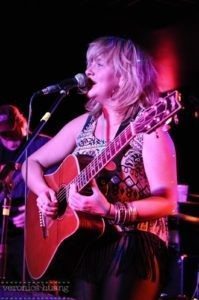 But, Harkes said she understands not to be overconfident. She’s her own manager, and her own accountant. “No one does me better than me,” said said. She’s her own boss in a line of work that requires a thick skin impervious to crowds unreceptive to her jokes, indifferent to her songs, or the occasional heckler. It’s also needed when she listens to her body, feels a familiar urge, and packs up her equipment. She said it doesn’t happen often, but it boils down to a short conversation between herself and the venue owner: the owner either understands or she doesn’t play there again. Her attitude is not out of contempt. In the end, she said, she has to take care of herself.