Tag: stubhub

  • New York AG Announces Settlement With Ticket Brokers Worth $2.76 Million

    As NYS Music reported in January, New York State Attorney General Eric Schneiderman released a report putting the concert ticketing industry on blast. That report found that at least 54 percent of tickets for the biggest shows were being set aside for privileged pre-sale or industry insiders. The report also found ticketing agencies using bots to purchase tickets to be resold at much higher prices on resale sites.

    Last week, the AG’s office announced a settlement has been reached with six ticket brokering companies as a result of this report. This week, Schniederman pressured the major players, including StubHub, Ticketmaster and VividSeats, to level the playing field for the general public looking for tickets to big-ticket shows.
    AG Shneiderman
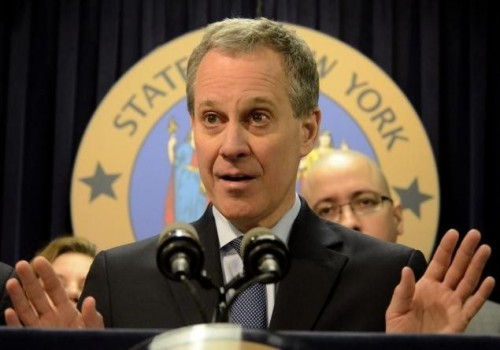
    New York Attorney General Eric Schneiderman

    New York law requires ticket re-sellers to be licensed in the state and prohibits them from using bots to buy tickets for resale.  The six firms found to be in violation of state law that are settling with the state on this issue are TicketToad.com, Flying Falco Entertainment of California (doing business as Avery Tickets), Charm City Entertainment, All Events Utah (all out of state) and two New York-based brokers, Just in Time Tickets and A2Z Tix. All but Charm City were found to have used bots in purchasing tickets.

    The settlement among the four brokers has thus far totaled $2.76 million. Charm City skated with a $100,000 settlement, while Flying Falco coughed up the largest settlement at $1,125,000.

    In a statement, Schneiderman said:

    Ticketing is a fixed game. The industry’s tactics prevent New Yorkers from getting tickets at affordable prices, or even getting them at all. Now we are calling on the major industry players to take steps to address these issue.

    According to the Daily News, ticket brokers are willing to work with the attorney general. StubHub has issued a response: “We are in receipt of the letter and are currently reviewing the AG’s request.”

    In his press release, Schneiderman laid the gauntlet:

    Our office has zero tolerance for ticket resellers that use illegal bots to scoop up large numbers of tickets for popular events before consumers can obtain them, and then resell those tickets to those very same consumers at a large markup.  New Yorkers deserve a fairer ticket marketplace.  Our office will continue to enforce New York’s ticket laws by investigating ticket brokers who are breaking our laws, and making them pay for their illegal acts.

    Schneiderman is making the effort and succeeding thus far. It only serves the music industry as a whole for ticket brokers to follow suit. True fans have been getting shut out of tickets for their favorite shows for too long and government is finally catching up with the technology that has kept these fans from those tickets.

    Fans can support face-value ticket re-sale by using websites like cashortrade.org.
  • MSG Execs Caught in Ticket Scalping Scandal

    Several MSG employees have been terminated following an investigation that revealed scalping – taking tickets to events and reselling them for profit.

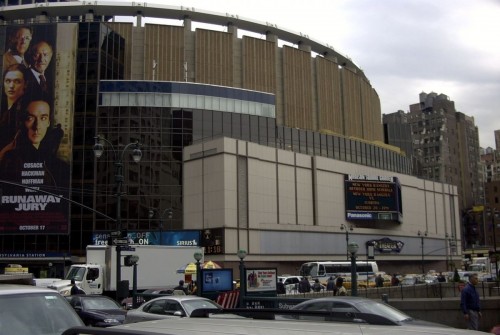
    Madisonsquaregarden

    According to the New York Post, about a half dozen sales executives were caught reselling tickets to Knicks games on the after-market ticket site StubHub. The internal investigation uncovered a scheme where the employees would buy the lowest priced tickets, often those the teams would reserve for group sales, and sell them at a higher price online. The purchase of tickets by MSG employees is restricted by company policy. Employees must have written permission to purchase tickets. However, because the sales team has direct access to the tickets, their process is different.

    This is not the first time MSG employees have been caught in a ticket scalping scam. In 1996, then-CEO Checketts terminated five ticket office employees for reselling tickets following a six-month investigation.

    PIX11 also reported that the New York Attorney General’s office has accused MSG sales executives and a senior executive of illegally assisting ticket brokers with acquiring tickets for popular events to sell at huge profits. The Attorney General has said that oftentimes the tickets are given to the online ticket brokers before they’re even made available for public purchase.

    This comes around the time the Attorney General released a report from a three-year investigation into the concert ticketing industry, as we previously reported.

    Thankfully, websites like cashortrade.org are building a community of people who are only willing to buy and sell tickets at face value, bucking the trend of screwing fans out of money to see their favorite musicians perform.

  • New York Attorney General Issues Scathing Report on Concert Ticketing Industry

    Many of us have been there. Ticketmaster queued up, ready to click “buy tickets” as soon as sales begin. You’re sure you’re going to get quality seats for the show; after all, you clicked on that “buy” button the second the clock struck 10. Alas, you discover you’re in the nosebleeds once the purchase is complete.

    New York Attorney General Ticketing IndustryHow does this happen so regularly to concert goers? New York State Attorney General Eric Shneiderman had the same question, and his office conducted a three-year investigation into the ticketing industry and Thursday issued a report on the findings.

    The report details results of his office’s investigation into online ticketing and the practices of third-party ticket resale sites such as StubHub and TicketsNow.

    The 44-page report cited numerous complaints the AG’s office has fielded concerning “price gouging,” “scalping,” “outrageous fees” and “immediate sell outs.” One consumer quoted in the report stated, “The average fan has no chance to buy tickets at face value…this is a disgrace.”

    The AG confirmed this concerned consumer’s remarks, finding:

    The majority of tickets for the most popular concerts are not reserved
    for the general public at least in the first instance. Rather, before a member of the public can buy
    a single ticket for a major entertainment event, over half of the available tickets are either put on
    “hold” and reserved for a variety of industry insiders including the venues, artists or promoters,
    or are reserved for “pre-sale” events and made available to non-public groups, such as those
    who carry particular credit cards.

    The figure below illustrates New York-area shows between 2012-2013 for which tickets were held from general sale for pre-sale insiders. An “insider” can be classified as a holder of a sponsoring credit card, a member of a fan club, members of social media sites or shopping sites. The consumer who is not a member of any of the above mentioned groups is immediately at a disadvantage once tickets are officially on sale to the general public.

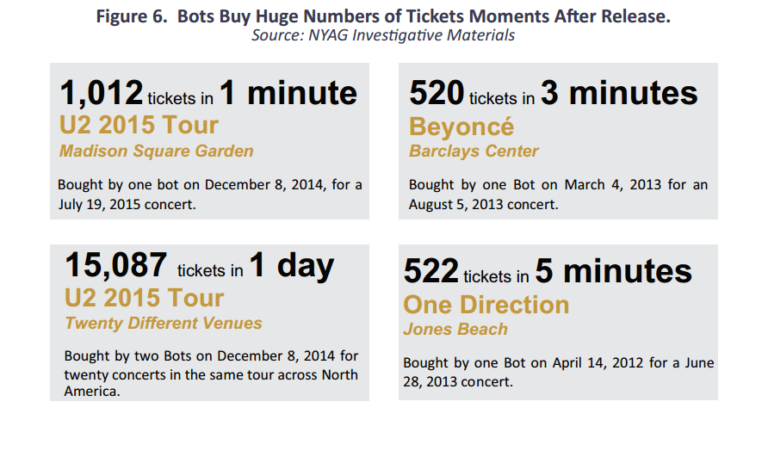
    In addition to tickets being held in advance of an on-sale date, brokers use bot software to purchase hundreds of tickets at a time using a four-step process. In December of 2014, ticket sales for a June U2 show at Madison Square Garden saw one broker, using ticket bot software, purchase 1,102 tickets within the first minute of sale. The report defines a ticket bot as:

    Software that automates ticket-buying on platforms such as ticketmaster.com. Automation lets the Bot (1) perform each transaction at lightning speed, and (2) perform hundreds or thousands of transactions simultaneously. As a result, in the first moments after tickets to a top show go on sale, Bots crowd out human purchasers and can snap up most of the good seats.

    Bot programs allow brokers access to hundreds of tickets which are then immediately placed for sale on third-party sites. Frustrated consumers still wishing to attend a concert or sporting event are then left with only the ticket resellers as an option to buy, and at a markup anywhere from 15 percent to 118 percent of face value.

    As illustrated in the figure above, brokers using bot programs are able circumvent any prevention methods instituted by ticket sellers such as Ticketmaster and Live Nation.

    Several startups, such as Cash or Trade, are becoming more popular among savvy ticket buyers. Cash or Trade touts itself as the “World’s first social ticketing platform.” There, members have the ability to sell tickets at face value or in trade among themselves [Cash or Trade is a partner of NYS Music].

    While bots and pre-sale events comprised the majority of the AG’s report, one complaint that has been fielded repeatedly for years is that of “convenience” or “handling” fees on the part of the ticket agency. One complaint stated, “I purchased a 30 dollar ticket to see A View From A Bridge. During the transaction I saw that a ten dollar fee would be added for handling. Handling what? I am using my own printer to print my own ticket!”

    Ticketmaster often takes blame for many of the added charges, but the report states that some of the blame can also be given to the venues as well.

    In its final recommendation, the report calls for the state legislature to conduct hearings challenging the key players to level the field for everyday fans to be able to get their hands on tickets to even the most high-profile events. The call for ticket resale platforms to comply with the law, greater transparency in regards to allocations and limits, and addressing what the AG termed the “Bot Epidemic” are steps the state legislature needs to take. “A longer-term solution must include improvements in Bot detection and prevention methods. While the industry works on long-term technological solutions, steps can be taken to reduce Bot use in the near term,” the report states.

    In the meantime, keep your mouse finger at the ready for the next big show you hope to attend.