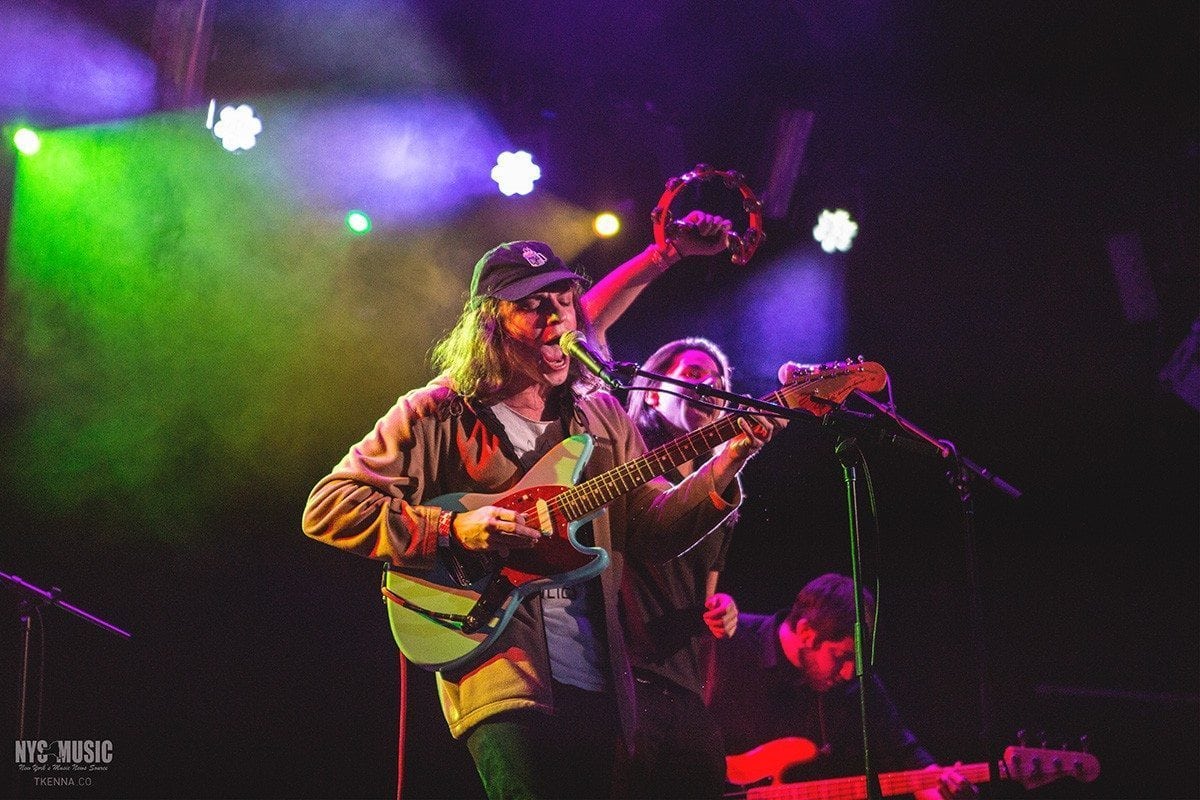
Zuli took the stage at Le Poisson Rouge on Monday, January 25th, for their first Manhattan show of the year. The New York City based four-piece played a set involving strong three-part vocal harmonies, a complex instrumental cover and striking dynamic changes. I got the sense that the whole thing was admirably unlabored, despite the highly detailed musical composition, as the band moved between songs with a casual ease. Some thoroughly speedy guitar work, courtesy of frontman Zuli (Ryan Camenzuli), was underpinned by the nord electro keyboard and the bass, which made the songs followable, fun and accessible.
Zuli arrived just in time for their 9.30 slot, having played another set – in another borough, no less – just beforehand. A pretty intense schedule didn’t impede the joyous musical moves that were on display throughout their performance. A large room like LPR, when not-quite-full with the mixed crowd of a Monday night – fans, friends of the other bands, NYU juniors catching up after their Christmas breaks – can create an awkward vibe for some live bands. If Zuli sensed this difficulty at all, they tackled it with jesting stage banter, the settling of a beef about their favorite restaurant (it might, after all, be CJ’s), and a set full of rhythmic surprises emerging like bold rabbits pulled from sonorous hats. I sense that Zuli are not quite at their peak, yet: they’re probably building up momentum for the spring, when they’ll hit SXSW and the West coast. In the meantime, Zuli have a busy March lined up with shows DC, Charlotte, New Orleans and Phoenix.
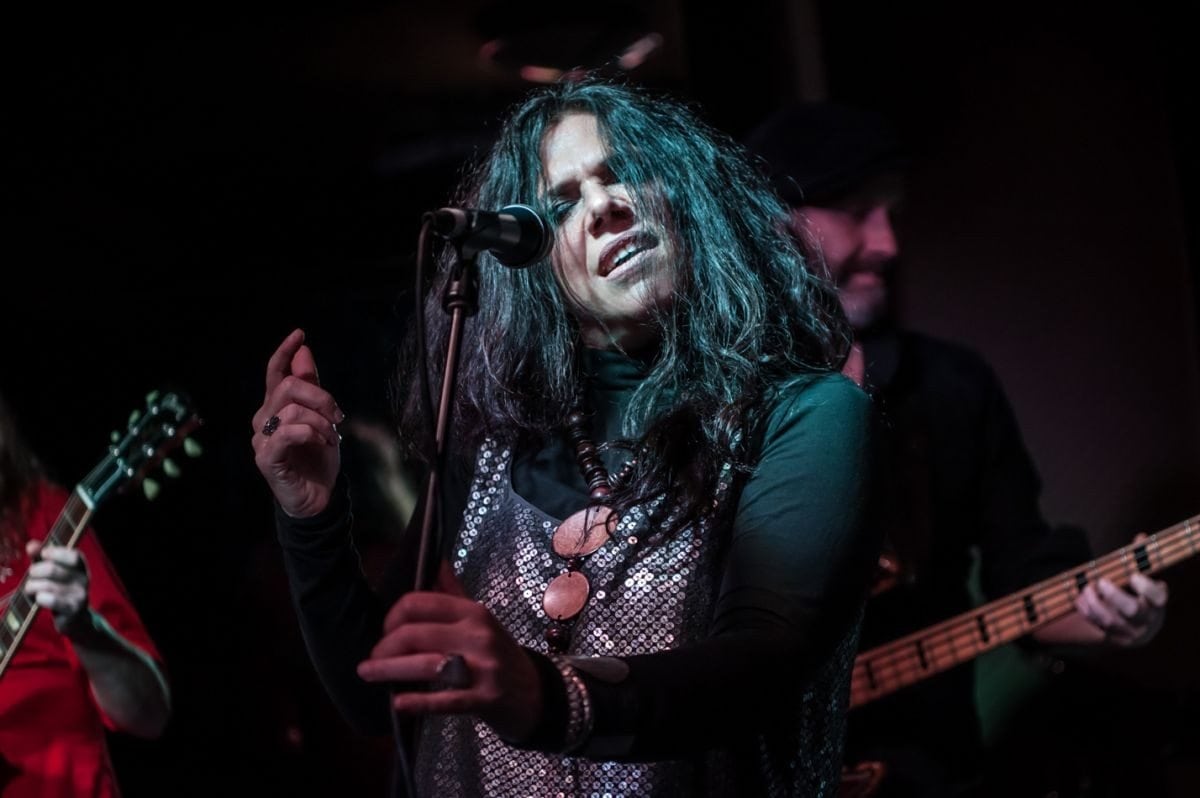
New York Blues Hall of Fame singer and Brooklyn resident Sari Schorr is gaining a lot of momentum as a solo artist. After being a member of Joe Louis Walker’s band in 2013 and then Popa Chubby’s band in 2014, Schorr met legendary producer Mike Vernon in 2015, who upon hearing Schorr’s original work came out of retirement to produce her debut solo album coming out later this year.
Schorr will be performing at the Lead Belly Festival taking place on February 4 at the fabled Carnegie Hall in New York City, where she will be joining Buddy Guy, Eric Burdon, and many others to pay tribute to renowned New York folk-blues musician Lead Belly. Her other New York performances include shows at The Falcon in Marlboro on February 7, Turing Point in Piermont on February 12, and The Cutting Room in New York City on February 17. NYS Music spoke with Schorr on topics ranging from working with Mike Vernon to performing at Carnegie Hall.
Nicholas Cho: Before singing the blues, I heard you first started in opera. Is that correct?
Sari Schorr: Yeah I was studying with a Julliard opera teacher. That was really the best thing that I ever did because it allowed me to learn how to use my voice properly, which is why now I can put a lot of demands on my voice now, and I don’t have a problem with my voice at all. I’ve been really lucky.
NC: When did you switch to the blues?
SS: I was doing a lot of jazz singing, and I wanted to make an album for a friend of mine who had a successful label here in New York. He had come to one of my shows and said, “Honey, you’re a blues singer. Why are you fighting this?” And I was, “Because I love the subtlety of jazz and the nuance.” It was kind of like a self-awareness thing—realizing that my voice was just so well-suited for blues and it was really the vehicle to use my voice to its full potential.
I had always loved the music from my early influences of Ella Fitzgerald and Billie Holiday and Sarah Vaughan. When I went back to discover who were their influences, I discovered Bessie Smith and Ma Rainey and Big Mama Thornton. What I loved about the music that they were singing was that it was very honest, and it was this genre that would allow such honest communication between performer and audience. I loved this dialogue that the blues allowed.
NC: What was it like having Mike Vernon as your producer for your debut album?
SS: He’s a legendary producer—a pioneer—and he is the truest form of an artist I’ve ever worked with. He is so generous with his talent and with his energy. Working with him is perfect. I’m doing the next album with him and the one after that. We’ve already agreed to do two albums together.
We adore each other—he’s family to me. He brings out the best in everybody he works with. The musicians loved being with him in the studio. He’s got boundless energy and enthusiasm, and he has a vision so clear in his head on how to make the best possible album in keeping line with what the artist wants.
NC: How far into the recording process are you for your debut album?
SS: Well we just finished mixing, I would say, 80% of the album. There are two new songs on the record that we just added, so those will be getting mixed in the next couple of weeks.
NC: How did you get involved with the Lead Belly Festival?
SS: There is a terrific guy from Norway who is the manager of one of the venues I work at, and he talked me up to one of the producers of the show. That producer happened to be at the venue with an artist, and this manager, who is always promoting me in any way he can, told the producer, “There’s this singer, Sari Schorr—you’ve got to see her,” and that was the introduction.
The thing is, is that this venue is one that usually takes me two hours to get to from Brooklyn, and there were many times where I was exhausted coming back from overseas and jet-lagged, and I still went out there consistently, and that’s how it happened.
NC: What influence did Lead Belly have on you?
SS: Lead Belly was a phenomenal storyteller, and learning how to tell stories through music and use a lot of symbolism and imagery—that’s the influence Lead Belly had on my songwriting—this incredible honesty and simplicity in the lyrics that’s really deceiving. He’s speaking a lot under the surface of the lyrics.
NC: What is it like for you to be performing at Carnegie Hall?
SS: It’s an honor because it’s such a historic venue. It’s an honor because of the other artists that are going to be performing—Buddy Guy who I met when I did a co-bill with Joe Louis Walker and him up in Canada, and then with Eric Burdon and Walter Trout, who is going to be on my album. It’s really an honor to be a part of history in this way, and also being able to honor such an important man who contributed so much to blues music.
Many of us have been there. Ticketmaster queued up, ready to click “buy tickets” as soon as sales begin. You’re sure you’re going to get quality seats for the show; after all, you clicked on that “buy” button the second the clock struck 10. Alas, you discover you’re in the nosebleeds once the purchase is complete.
How does this happen so regularly to concert goers? New York State Attorney General Eric Shneiderman had the same question, and his office conducted a three-year investigation into the ticketing industry and Thursday issued a report on the findings.
The report details results of his office’s investigation into online ticketing and the practices of third-party ticket resale sites such as StubHub and TicketsNow.
The 44-page report cited numerous complaints the AG’s office has fielded concerning “price gouging,” “scalping,” “outrageous fees” and “immediate sell outs.” One consumer quoted in the report stated, “The average fan has no chance to buy tickets at face value…this is a disgrace.”
The AG confirmed this concerned consumer’s remarks, finding:
The majority of tickets for the most popular concerts are not reserved for the general public at least in the first instance. Rather, before a member of the public can buy a single ticket for a major entertainment event, over half of the available tickets are either put on “hold” and reserved for a variety of industry insiders including the venues, artists or promoters, or are reserved for “pre-sale” events and made available to non-public groups, such as those who carry particular credit cards.
The figure below illustrates New York-area shows between 2012-2013 for which tickets were held from general sale for pre-sale insiders. An “insider” can be classified as a holder of a sponsoring credit card, a member of a fan club, members of social media sites or shopping sites. The consumer who is not a member of any of the above mentioned groups is immediately at a disadvantage once tickets are officially on sale to the general public.
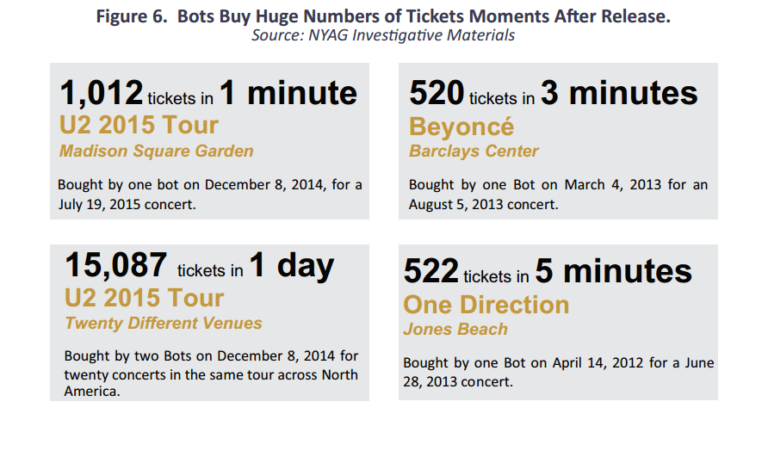
In addition to tickets being held in advance of an on-sale date, brokers use bot software to purchase hundreds of tickets at a time using a four-step process. In December of 2014, ticket sales for a June U2 show at Madison Square Garden saw one broker, using ticket bot software, purchase 1,102 tickets within the first minute of sale. The report defines a ticket bot as:
Software that automates ticket-buying on platforms such as ticketmaster.com. Automation lets the Bot (1) perform each transaction at lightning speed, and (2) perform hundreds or thousands of transactions simultaneously. As a result, in the first moments after tickets to a top show go on sale, Bots crowd out human purchasers and can snap up most of the good seats.
Bot programs allow brokers access to hundreds of tickets which are then immediately placed for sale on third-party sites. Frustrated consumers still wishing to attend a concert or sporting event are then left with only the ticket resellers as an option to buy, and at a markup anywhere from 15 percent to 118 percent of face value.
As illustrated in the figure above, brokers using bot programs are able circumvent any prevention methods instituted by ticket sellers such as Ticketmaster and Live Nation.
Several startups, such as Cash or Trade, are becoming more popular among savvy ticket buyers. Cash or Trade touts itself as the “World’s first social ticketing platform.” There, members have the ability to sell tickets at face value or in trade among themselves [Cash or Trade is a partner of NYS Music].
While bots and pre-sale events comprised the majority of the AG’s report, one complaint that has been fielded repeatedly for years is that of “convenience” or “handling” fees on the part of the ticket agency. One complaint stated, “I purchased a 30 dollar ticket to see A View From A Bridge. During the transaction I saw that a ten dollar fee would be added for handling. Handling what? I am using my own printer to print my own ticket!”
Ticketmaster often takes blame for many of the added charges, but the report states that some of the blame can also be given to the venues as well.
In its final recommendation, the report calls for the state legislature to conduct hearings challenging the key players to level the field for everyday fans to be able to get their hands on tickets to even the most high-profile events. The call for ticket resale platforms to comply with the law, greater transparency in regards to allocations and limits, and addressing what the AG termed the “Bot Epidemic” are steps the state legislature needs to take. “A longer-term solution must include improvements in Bot detection and prevention methods. While the industry works on long-term technological solutions, steps can be taken to reduce Bot use in the near term,” the report states.
In the meantime, keep your mouse finger at the ready for the next big show you hope to attend.
The Twittersphere was abuzz this week when Georgia rapper B.o.B — Bobby Ray Simmons — posted a series of tweets dissing the Earth’s roundness theory. But have no fear, the media’s favorite celebrity scientist Neil deGrasse Tyson rushed to the rescue.
B.o.B’s self-proclaimed photographic evidence (posted below) in support of the Flat-Earth Conspiracy went viral, causing the New York City-based astrophysicist to fire back with point-blank scientific facts. B.o.B shot off more opinionated tweets, saying things like “the horizon is always eye level” and “once you go flat you never go back.” Tyson’s response? “Duude — to be clear: Being five centuries regressed in your reasoning doesn’t mean we all can’t still like your music.” The spat escalated quickly to a full-on rap battle.
On Monday night, B.o.B released “Flatline” on SoundCloud (now removed), and by Tuesday, Tyson had posted his rebuttal — a track titled “Flat to Fact” that was written and recorded by his nephew, Steve Tyson, and labeled B.o.B’s line of thinking as ignorant and mentally enslaving.
The Twitter fight was trending on news outlets across the country and highlighted on shows like “The Nightly Show with Larry Wilmore,” in which Tyson himself made an appearance and did a little freestyling before he literally dropped the mic. Here’s a sample:
Listen B.o.B, once and for all. The Earth looks flat because, one, you’re not far enough away, at your size. Two, your size isn’t large enough relative to Earth to notice any curvature at all. It’s a fundamental fact of calculus and non-Euclidean geometry—small sections of large curved surfaces will always look flat to little creatures that crawl upon it.”
Tyson continued by acknowledging the rapper’s freedom to think the world is flat, but deemed this “strain” of thinking for a public influencer as “the beginning of the end of our informed democracy.” And he left B.o.B with one last knowledge bomb:
Quoting my man Isaac Newton, ‘If I have seen farther than others, it’s by standing on the shoulders of giants.’ So that’s right B.o.B, when you stand on the shoulders of those who came before, you might just see far enough to realize the Earth isn’t fucking flat.”
While we love a good rap feud, it’s safe to say that Tyson will thankfully be sticking to his day job as the head of the world-renowned Hayden Planetarium. Case closed.
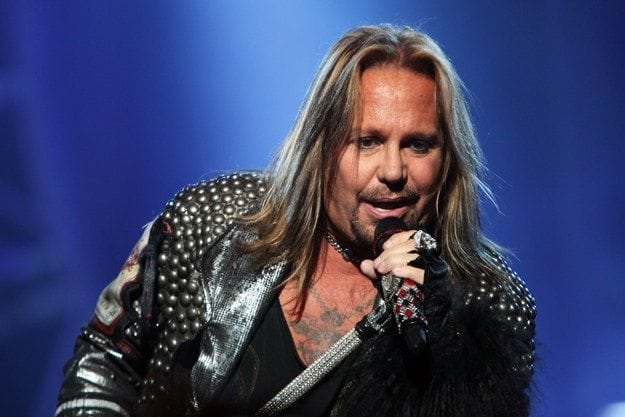
This week, TMZ broke the news that Motley Crue’s Vince Neil is starring in the next season of NBC’s “The Celebrity Apprentice.” With Motley recently hanging the gloves, Neil, who is no stranger to reality TV, is returning to the screen.
On “The Celebrity Apprentice,” the stars that compete on the show partake in business tasks and assignments to raise money for their charity of their choice. No word on what charity Neil will raise money for. This season, Arnold Schwarzenegger has replaced Trump. Filming is expected to start in New York City in March with the show debuting this September on NBC.
In other post-Motley Crue news, guitarist Mick Mars is recording a solo album with former Motley Crue vocalist John Corabi, and Nikki Sixx is expected to tour with Sixx A.M. in 2016.
Brooklyn-based electronica duo Break Science will put on back-to-back hometown shows this week at Brooklyn Bowl.
Break Science is the project of Adam Deitch (drums) and Borahm Lee (keys). The duo fuses its hip-hop roots with dub and funk influences and a smattering of electronic styles to create a fusion music that rumbles and moves bodies. Both collaborators have extensive experience playing in other bands (Lettuce, Pretty Lights Live Band, Lee “Scratch” Perry, Matisyahu), and Deitch has produced the likes of 50 Cent, Redman and Talib Kweli.
In the past few months, Break Science have released the acclaimed single “Force of Nature” ft. Paperwhite and have toured the US. They’re set to appear at the Gem & Jam Festival in Tuscon, AZ, in February. In the midst of this activity, these Brooklyn Bowl gigs will showcase Dietch and Lee playing in two different live band configurations.
Thursday, January 28, will feature Break Science performing in conjunction with Manic Focus, the musical project of likeminded Chicago-based artist John “JmaC” McCarten. The High & Mighty Brass Band Horns and CX will round out the band. Artifakts and Brasstracks will open.
Friday, January 29, will feature the Break Science Live Band comprised of The Shady Horns, Adam “Shmmeans” Smirnoff and Jesus Coomes of Lettuce, Rahzel, CX and Bajah. Marvel Years and Dreamers Delight will open. Doors open at 6 PM and music starts at 8 PM both evenings.
On Thursday, January 21, 2016 Umphrey’s McGee took the stage for their first night of a three night run at Beacon Theatre. 18 years to the day of their first performance ever, they brought the heat immediately.
Opening with “Gooneville,” track that had it’s debut in March 2015, Umphrey’s quickly segued into a the mathematical serenade of fan favorite, “Plunger.” Although it was only the second song of the first set, it felt as is everyone in the theatre was firing on all cylinders, fans included. “Plunger” took an ambient turn and segued into “40’s Theme” which had guitarist/vocalist Jake Cinniger telling the crowd to pick up some “New York City 40s.” “In the Black” and “Roulette” allowed Umphrey’s to display their prowess in transitioning from regaling vocal harmonies with backing chords to heavy, precision playing across all instruments. The band followed up with “Kimble,” which was fitting for a theatre as the song feels like it’s pulled from the soundtrack of a play or musical. “Attachments” was up next showing guitarist/vocalist Brendan Bayliss’ vocal ability on full display. Closing out first set was an almost relentless rendition of “Rocker Pt. 2” which had fans going nuts and throwing up the Umphrey’s rock hands ( mm/) all over the theatre.
Second set opened with “All In Time” which traversed an almost ethereal musical landscape at points. A very special “Booth Love” featured teases and full on lyrics from the recently deceased Glen Frey’s “You Belong to the City.” Umphrey’s surgical musicianship was in full view mid-second set with “Bridgeless” into “Remind Me,” a few “Xxplosive” (Dr. Dre) teases during “Tribute to Spinal Shaft” and a full on auditory assault with a segue back into “Bridgeless” to close out the second set.
The highlight of the night was most definitely the encore. In homage to the late, great, David Bowie, Umphrey’s encored with excellent covers of “Space Oddity” and “Fame.” The band funked it up for their rendition of “Fame” which just seemed to fit them perfectly. Here’s to hoping we see more of it in the future!
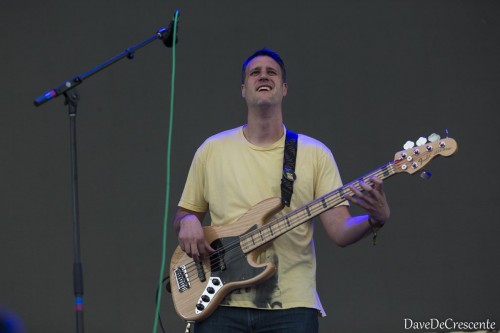
Dino Dimitrouleas, bassist from The Werks, announced he will take a hiatus from the band and will not join them for their upcoming tour.
Dino The Werks
The Werks, whose former keyboardist Norman Dimitrouleas recently passed away, will head out on tour this week with a change to their lineup. Bassist — and older brother of Norman — Dino Dimitrouleas will be temporarily replaced by Jake “Baby Hands” Goldberg. Through a message posted to The Werks’ Facebook page, the elder Dimitrouleas announced that he will be taking a hiatus from the band.
I hope to return after this tour but at this junction in my life I am taking things one day at a time.
I want to thank Jake for keeping the show on the road as well as thank my family, friends, band mates and fans for being so supportive during this difficult period in my life. I also want to encourage all of our fans to support The Werks in my absence as this is a very difficult time for them as well.
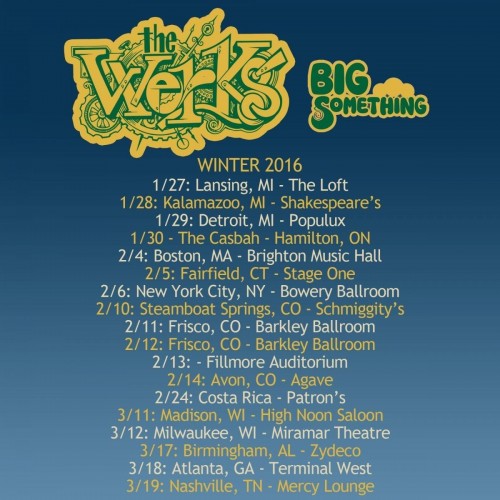
The Werks tour will take them through parts of the Midwest, the Northeast and Colorado, ending in the South. Their one New York date is Feb. 6 at the Bowery Ballroom in New York City. Other Northeast dates include Feb. 4 at Brighton Music Hall in Boston and Feb. 5 at Stage One in Fairfield, Connecticut.
There’s something to be said about bands that continue to perform to throngs of devoted fans who turn out no matter the venue or date. When Assembly of Dust, Strangefolk and God Street Wine perform individually, their well-honed crowds come out in support, even though some shows are less frequent these days. But bringing together these three bands that defined the ’90s jam scene is no small feat, yet a two-night run in Portchester, NY, at the Capitol Theatre and in Boston, MA, at the Paradise Rock Club, led to packed houses, marathon jams and plenty of dancing each night with Assembly of Strange Wine.
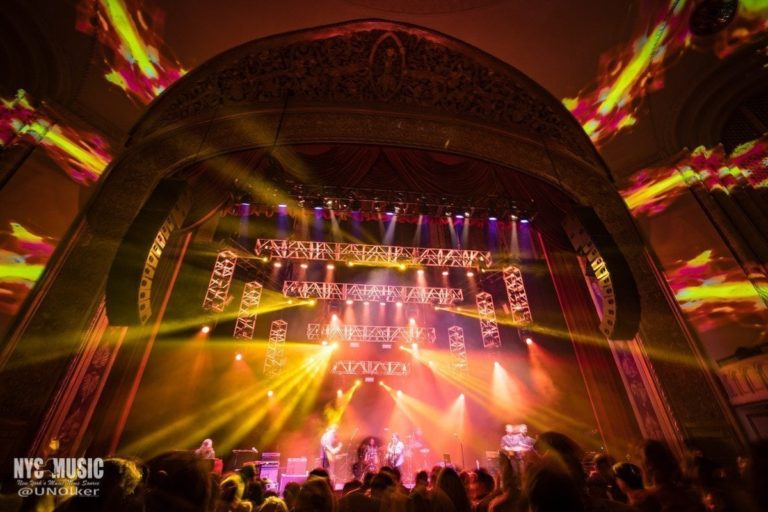
At the Cap, Assembly of Dust started the night with a short set that featured Scott Metzger on guitar, filling in for Adam Terrell who was on assignment in Mexico. The first big jam of the night opened up in “Revelry,” giving Metzger a chance to flex his ax for the crowd. “Whistle Clock” and “All in Time” brought out Jon, Luke and Erik from Strangefolk to join Assembly of Dust for the first of many superjams this weekend, while “Filter” swapped in God Street Wine for the members of Strangefolk and continued the loosely planned, well-executed jam session.
Assembly of Dust setlist: Bootlegger’s Advice, Man with a Plan, Revelry, Honest Hour, Whistle Clock$, All in Time$, Filter^, Head on Straight*
$with Strangefolk ^with God Street Wine *Reid solo
The bands were warmed up and the audience dialed in for Strangefolk, the second act to take to the stage. Opening with “Rather go Fishin,” I felt a light nod to those who opted to head to Mexico for Riviera Maya, but there was no other place I’d rather be than seeing Strangefolk perform this evening. Jason Crosby shone on “In Deep” and added just the right touch of fiddle on “Goin’ Down the Road Feeling Bad.” All of God Street Wine joined Strangefolk for “Sometimes” and “Westerley,” two songs patiently shared among the nine musicians. From the audience it seemed that taking the stage with friends you’ve played music with for nearly a quarter-century amid a focused and receptive audience has to be nearly utopian in terms of live performance.
Strangefolk setlist: Rather go Fishin’, Udderly Addled, Furnace, In Deep, Goin Down the Road Feelin’ Bad*, Roads*, Sometimes^, Westerley^, Songbeard*
*with Assembly of Dust ^with God Street Wine (entire set with Jason Crosby on keys/fiddle)
God Street Wine took the stage last and made their presence known with “Life on Mars?” in tribute to the late David Bowie. A clean segue into “Molly” kept the energy high and the crowd danced well into the set. An extended “Goodnight Gretchen” > “Goodbye Oklahoma” were just getting things started, but it was during “Borderline” when the line between stage and audience blurred, as the energy spilled over with raucous approval (see video below). There was a chemistry onstage during GSW’s set that built off the sit-ins during the previous sets. Whether the bands had practiced together or planned anything in advance was unimportant; onstage everything meshed together well with only the few hiccups that come with having nine musicians onstage at the same time. A “Golden Years” encore paid tribute to Bowie once again (this was a recurring theme of the weekend to come). Night one was in the books and the bar was raised even higher for the sold-out show at Paradise.
God Street Wine setlist: Life on Mars? > Molly, Bring Back the News > Goodnight Gretchen > Goodbye Oklahoma, Hellfire > Wall, Borderline*, A Good Dream, Sweet Little Angel, Cheap Utah Blues > Ballroom > 6:15 Encore: Oh Wonderful One, Golden Years
*with Strangefolk
The Paradise Rock Club in Boston is, in stark comparison to the Capitol Theatre, a small music club that holds about half as many people. As the crowd filed into the small room, there was an air of excitement that could be felt from each attendee for the second of what would be two very special nights of music. The room hadn’t quite filled up by the time Assembly of Dust took the stage only 15 minutes after the ticket time. They immediately got the crowd moving when they opened with “Paul Henry.” The lineup featured the noteworthy additions of Scott Metzger on guitar and Jason Crosby on keyboards and organ. As they pushed through the set, they showed that this would not be a simple three-band show; it was truly an Assembly of Strange Wine. As AoD finished their set with “Harrower” and with eight musicians onstage, the audience knew the night was just beginning.
Assembly of Dust setlist: Paul Henry, All That I Am Now, Cluttered, Lost & Amazed, Whatever, Ophelia, Telling Sue, Harrower
After a brief set break, God Street Wine took the stage with “Epilog.” After moving through a few of their tunes, Crosby came back onstage and joined them on fiddle for “Chop.” Reid Genauer and Jon Trafton then came out for a handful of songs, including the newly penned “Oh Wonderful One” and Genauer on vocals for “Get on the Train,” into which he infused Strangefolk’s “Rachel” in the middle. GSW moved through the remainder of their set, which included crowd-pleaser “Imogene” and ended with “Into the Sea.” As they left the stage, the now completely packed room was waiting with bated breath for the third act.
God Street Wine setlist: Epilog, Light My Candles > Stranger > Chop#, Oh Wonderful One*, Driving West*, Get On The Train* -> Rachel* -> Get On The Train*, Lighthouse > Imogene, Waiting For The Tide, Into The Sea
#with Jason on fiddle * with Reid and Jon (entire set with Dave Diamond on percussion and Jason on keys except Chop and Lighthouse)
Another short breather allowed the audience to cool down and relax before Strangefolks’s night-ending set. Opening with “Valhalla,” they sent a message that they meant business. They saw a rotating cast of musicians throughout their set, and for “Mama,” there were 10 musicians onstage, including four percussionists, to which Genauer commented, “There will be a lot of notes.” Their energetic set ended with “Burned Down.” As they came back out for the encore, those in the crowd who had heard the GSW cover of “Life on Mars?” from the previous night wondered if there would be another tribute to David Bowie. Sure enough, the notes for “Space Oddity” were played, and as the band moved from that to Strangefolk’s “Speculator,” the entire crowd was repeating “Can you hear me, Major Tom?” along with the band. The encore came to a finale with more repeating of those lyrics at the end. Walking back out to the cold streets of Boston was quite welcome after leaving the heat from the small room and the incredible music.
Strangefolk setlist: Valhalla, Poland, So Well, Diary, Stout Hearted Man, Mama, Take it Easy > Memory of a Free Festival, Burned Down
This is not a review of the 2015 New Year’s Eve run but rather a fan’s retrospect on seeing Phish 21 times at Madison Square Garden since 1995. – ed.
Twenty years ago, on December 31, 1995, I descended upon New York City for my first Phish New Year’s Eve show at Madison Square Garden. I was 18, new to the city and accompanied by my two 16-year-old best friends. Our tickets were floor; row X to be exact. Soon after the show began, my two friends retreated to for the security of the well-lit hallways leaving me by myself with nothing but their shoes as reassurance that they would eventually return.
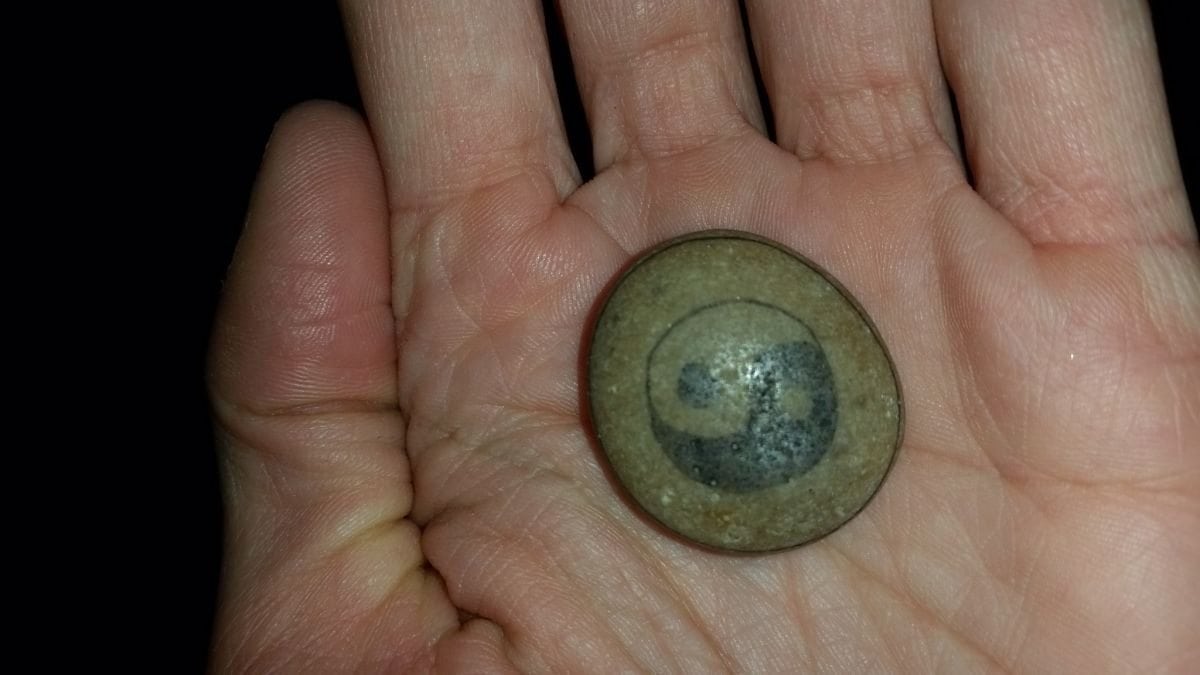
After deducing that I was alone, scared and a little bit lost, the two men situated beside me took me under their wing. One of them was old enough to be my grandfather. He gave me a smooth stone adorned with a yin yang to hold in my palm and bought me ice cream. That night, as Phish’s Time Factory counted down the minutes to midnight, I remember looking up into the stands from the floor and thinking everyone looked like ants. I tried putting the fact that I did not know where I was staying on Long Island or how to use public transportation in the back of my head and surrender to the flow.
I left that show that night unsure of what exactly I had just witnessed, filled with feelings I could not put into words. One thing that was for certain, I would never quite be able to see live music the same ever again.
Fast forward 20 years. Just as I had from 2010 to 2014, I hopped on a train down to New York City with Phish on December 29, 2015 for my 18th through 21st Phish shows at Madison Square Garden.
It was night 2 and the excitement for the New Year’s Eve stunt was building as I snuck away before set 3 to fill some water bottles for my crew and I. I was standing at the drinking fountain filling three empty Dasani water bottles when a security guard walking through the halls stopped in his tracks and gave me the dirtiest look, quipping incredulously, “Three?! Really three?! You’ve really got to be that greedy?”
First, I tried to put myself in his shoes … maybe he felt I was somehow taking money from his pocket by not purchasing three new bottled waters from the venue. Then, I found myself wanting to explain how much I hate purchasing bottled water, especially when there was no recycling in the venue. I wanted to stop and make him understand that these bottles of water were not just for me, but for my friends. I was able to eek out a meek apology, for what I wasn’t sure. As I made my way back to my section, I realized I was spinning my wheels for no reason. The security guard simply “doesn’t get it.” And how lucky are we that we do?
The lights dimmed and a laser beam visual-effect gave way to what some have called a teepee or a cone. I immediately perceived it as an hourglass, the sands of time slowly dripping from the upper bulb to the lower bulb where the band was situated. As an ambient jam out of “No Men in No Man’s Land” escorted us into a new year, I looked around the Garden, reflecting on the sharp contrast between how at home I felt amidst 20,000 strangers at that moment to how alone and scared I had felt twenty years ago in this same spot. Instead of ants, this time I looked around the Garden and saw individual faces of friends, waves of people I’ve met through the years. We are, after all, just one Phish show away from being friends.
Ironically we got a “Carini” in the final set, and as kitschy as “Backwards Down the Number Line”is, it played right into my mindset. Maneuvering through “Cavern,” I couldn’t help but feel the time was growing nearer and my mission was clearer than ever. The lyrics “Whatever you do, take care of your shoes” hit me hard. I looked at my girlfriend with tears in my eyes and we both smiled knowingly at one another. This wasn’t about our shoes. We are the lizards, destined for no man’s land if we don’t do something to change our future.
As we made our way out of the show, someone tried to take a balloon out onto the streets of New York City. As they gently prodding the orange ball around the snaking stairwell, I realized the balloon was not much different than quest to find meaning in the shows and to carry a message home that lasts after the music ends. As I laid my head on my pillow in the wee-morning hours on January 1 and removed the faded glow stick from my wrist, I began a text message to myself, letting the thoughts flow, still unsure what form they would take.
Everyone knows there’s got to be one slow night in a four-night run. For some that was night 3. For me, night 3 took on a poignant tone, shining light on another example of just how connected we are to the band and they are to us. I had read in a Facebook group that the ashes of Gayla Samuels, a phan whose light was snubbed out by cancer in 2015, had been tossed onto the stage on New Year’s Eve. I couldn’t help but draw some correlations to the band’s song choice on night 3 from “Stealing Time from the Faulty Plan” and “Heavy Things”to “Down with Disease” and “Dirt” and think of a young life ended much too soon. Maybe it was just me, but during “Farmhouse,” it seemed to me Trey put a bit more emphasis on the line “every man returns to dust.”
Night 4 was a bang-up, drag-down rock-n-roll show that shook the Garden to the rafters. At the close of set 2, with a “Harry Hood“and “You Enjoy Myself” behind us and a “Tweezer Reprise” on the table, what could they possibly encore with? If there was any doubt that I needed to try and make sense of this crazy show of life we’ve been on for the past 30 years, it was immediately washed from my brain when the first notes of “The Lizards” rang out. In my 20 years of following Phish, I had no intention of writing a review ever, fearful I didn’t know enough about stats or the band or the music to have anything relevant to share, certain whatever I might say would be met with criticism and negativity. Then, I finally got the message loud and clear.
We are no longer children blindly following a band searching for their footing. We are a functionally dysfunctional family of teachers, engineers, entrepreneurs, accountants, writers, artists, lovers, friends and acquaintances. We are inspired by the music to create art, pins, posters, t-shirts, merchandise, and we support each other by purchasing it. We are an economic powerhouse that can fill hotels in New York City, coordinate trips to Mexico and Europe, all in the name of our band. We generated at least $720,000 in local and state tax revenues during the three-day Magnaball concert, according to Watkins Glen International racetrack.
The real question is how do we represent ourselves and our band the other 300 plus days of the year when we aren’t on tour? How do we harness that energy that keeps us coming back year after year to venue after venue and channel it into doing something to have a positive impact on our communities and our world? If we are willing to do things like wait in six hour re-release lines or have our entire campsite destroyed in storms at Deer Creek, only to come back for more, then what else are we capable of?
Together as a fan base, we have help each other score tickets, bring down the hammer on scalpers, fund Mariachi bands, sky writers and fellow phan’s medical bills. What would happen if we carried that message and energy beyond the shows and into our everyday lives? Perhaps it’s just as simple as picking up a few glow sticks or used balloons after a show or buying a new or young fan an ice cream cone at a show. Maybe that means volunteering at a nursing home, gathering donations for our local food pantry or participating in a fundraiser to help the homeless?
There are plenty of opportunities to give back which we as a fan base have staunchly supported. Founded in 1999, the Mimi Fishman Auction has worked closely with bands like Phish, The String Cheese Incident, Yonder Mountain String Band, moe. and Umphrey’s McGee to provide high quality sought-after items for online auctions which have raised approximately $350,000 for The American Glaucoma Society, among others, and launched The Mimi Fishman Adventure Camp at the Delta Gamma Center for Children with Visual Impairments. Phish’s WaterWheel Foundation has raised over $1 million dollars for more than 425 groups, primarily benefiting women and children and the environment with a focus on clean water and land conservation, as well as food banks, urban gardening and more.
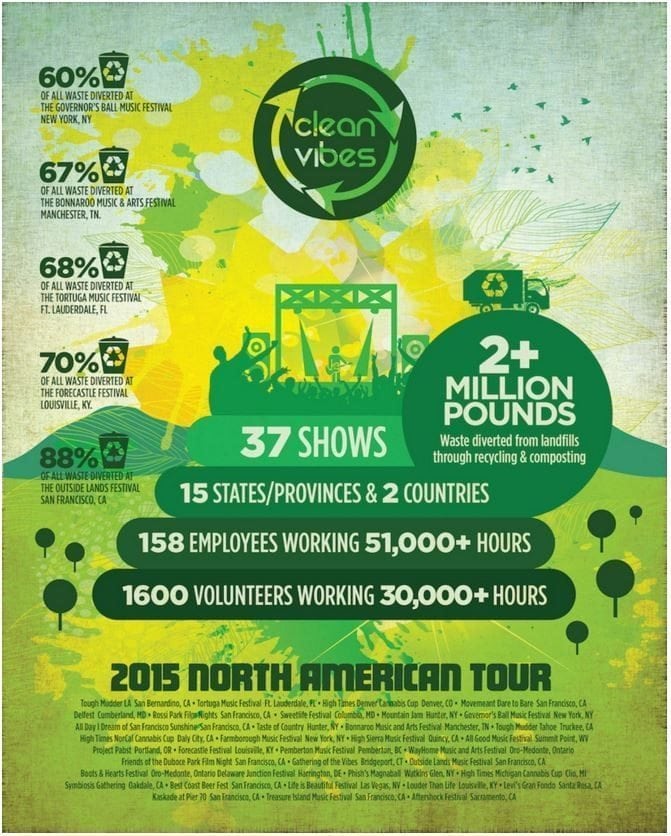
Surrender to the Flow (Phish) Yoga has raised more than $10,000 for Street Yoga and The Mockingbird Foundation, an entirely volunteer run, non-profit organization founded by Phish fans which has raised over $843,000 to support music education for children, providing 261 grants in 45 states since 1996. And in 2015, over 1,600 volunteers logged over 30,000 hours diverting over 2 million pounds of waste from landfills through recycling and composting at 37 concerts through Clean Vibes.
Graphic provided by Clean Vibes, January 2015.
We have the potential to be a force for social change. We can make a difference by deciding to vote with our money and our voices, by being more aware of our economic footprint and purposeful with how we spend our spare time so we can raise our children in a world we can be proud of. We are living in times of uncertainty, but each show gives us a glimmer of hope for a brighter future. Over the past 30 years, we have covered many miles, lost our possessions, lost our inhibitions and our minds. But together we’ve also found so much more.
What remains long after the show is over is the human connection; the companions we take along on our ride, singing, laughing or crying, brought to our knees by the pure beauty and unadulterated madness of it all. Suddenly, all those nonsensical lyrics, they’re beginning to make a heck of a lot of sense. Your trip is short, so make it count. If we have to be stuck in this tube, why not be stupendous? If nothing comes down, then we’re forced to swim up. We’ve got one life to live and our worst days are gone.
After all these years of following Phish, nothing has changed, but everything is different. If Phish can make a comeback, keep redefining themselves and pushing the envelope decade after decade, why can’t we?
 Zuli arrived just in time for their 9.30 slot, having played another set – in another borough, no less – just beforehand. A pretty intense schedule didn’t impede the joyous musical moves that were on display throughout their performance. A large room like LPR, when not-quite-full with the mixed crowd of a Monday night – fans, friends of the other bands, NYU juniors catching up after their Christmas breaks – can create an awkward vibe for some live bands. If Zuli sensed this difficulty at all, they tackled it with jesting stage banter, the settling of a beef about their favorite restaurant (it might, after all, be CJ’s), and a set full of rhythmic surprises emerging like bold rabbits pulled from sonorous hats. I sense that Zuli are not quite at their peak, yet: they’re probably building up momentum for the spring, when they’ll hit SXSW and the West coast. In the meantime, Zuli have a busy March lined up with shows DC, Charlotte, New Orleans and Phoenix.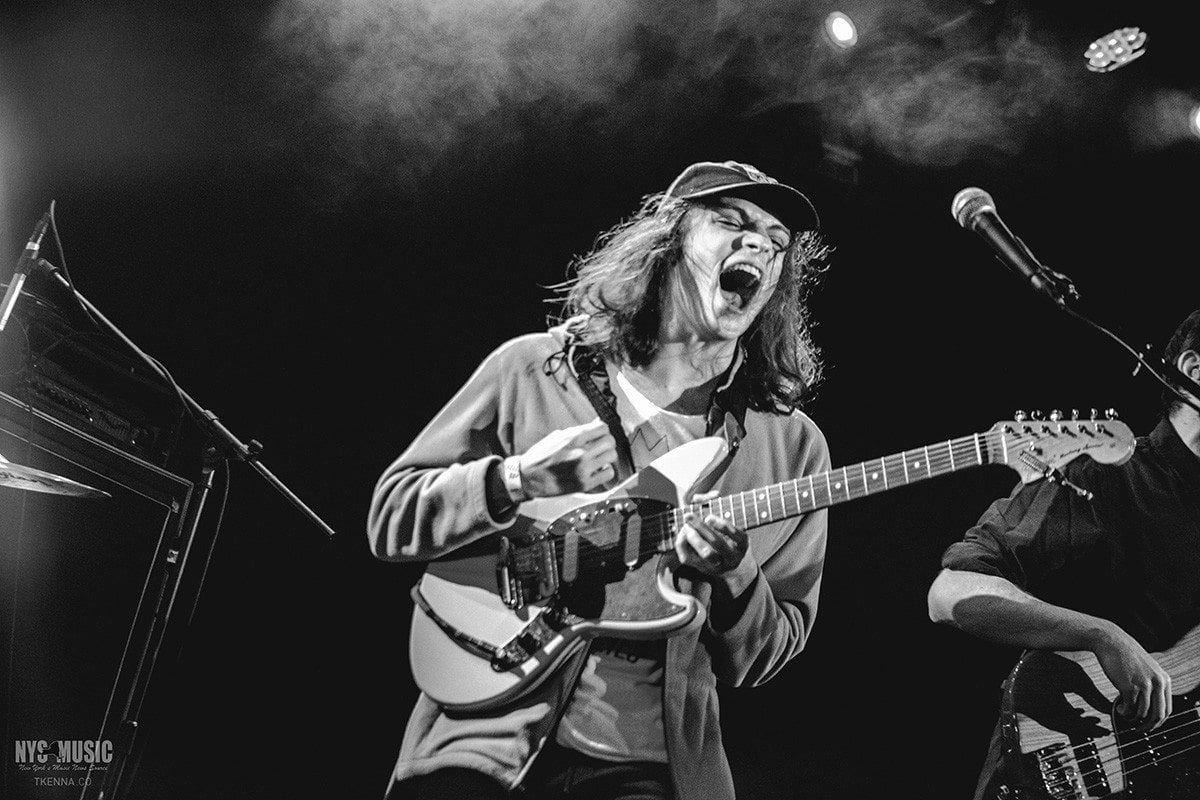
 Schorr will be performing at the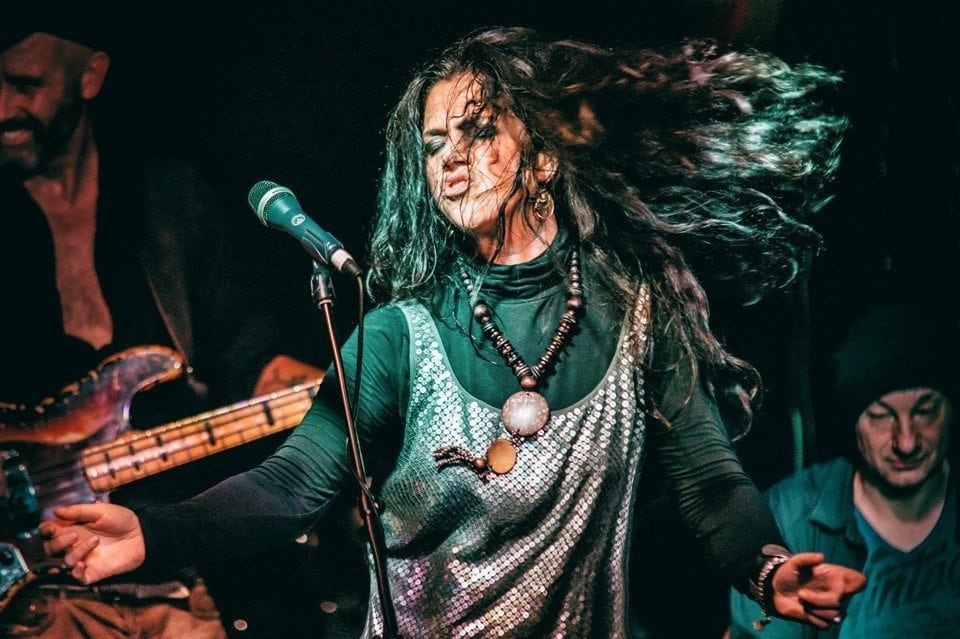
 NC: What influence did Lead Belly have on you?
 How does this happen so regularly to concert goers? New York State Attorney General Eric Shneiderman had the same question, and his office conducted a three-year investigation into the ticketing industry and Thursday issued a
 On “The Celebrity Apprentice,” the stars that compete on the show partake in business tasks and assignments to raise money for their charity of their choice. No word on what charity Neil will raise money for. This season, Arnold Schwarzenegger has replaced Trump. Filming is expected to start in New York City in March with the show debuting this September on NBC.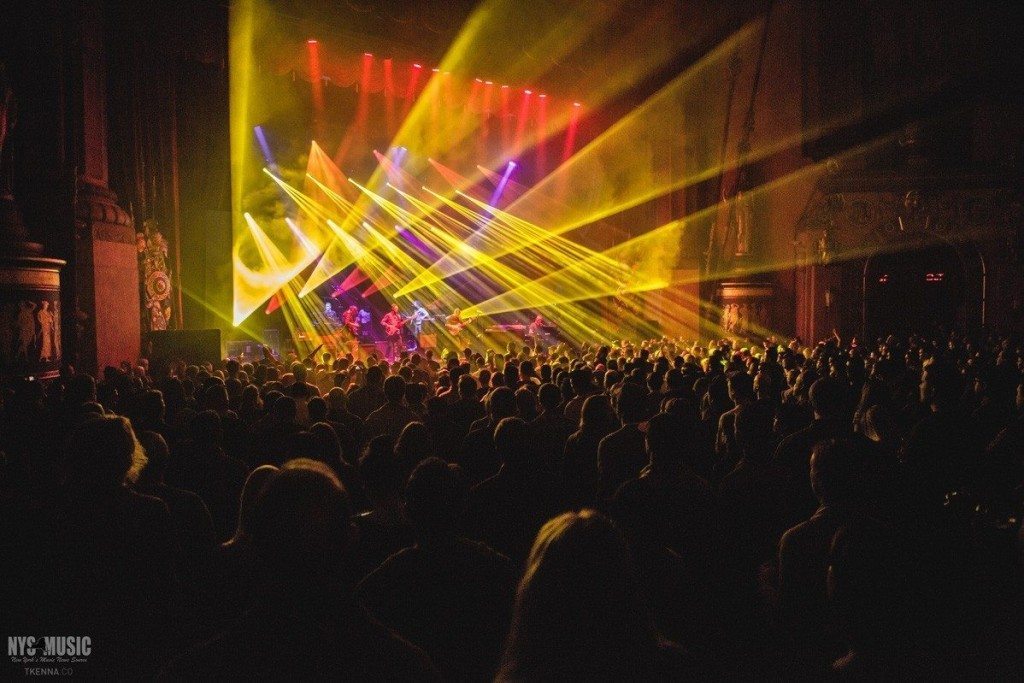
 At the Cap, Assembly of Dust started the night with a short set that featured Scott Metzger on guitar, filling in for Adam Terrell who was on assignment in Mexico. The first big jam of the night opened up in “Revelry,” giving Metzger a chance to flex his ax for the crowd. “Whistle Clock” and “All in Time” brought out Jon, Luke and Erik from Strangefolk to join Assembly of Dust for the first of many superjams this weekend, while “Filter” swapped in God Street Wine for the members of Strangefolk and continued the loosely planned, well-executed jam session.
 I left that show that night unsure of what exactly I had just witnessed, filled with feelings I could not put into words. One thing that was for certain, I would never quite be able to see live music the same ever again.
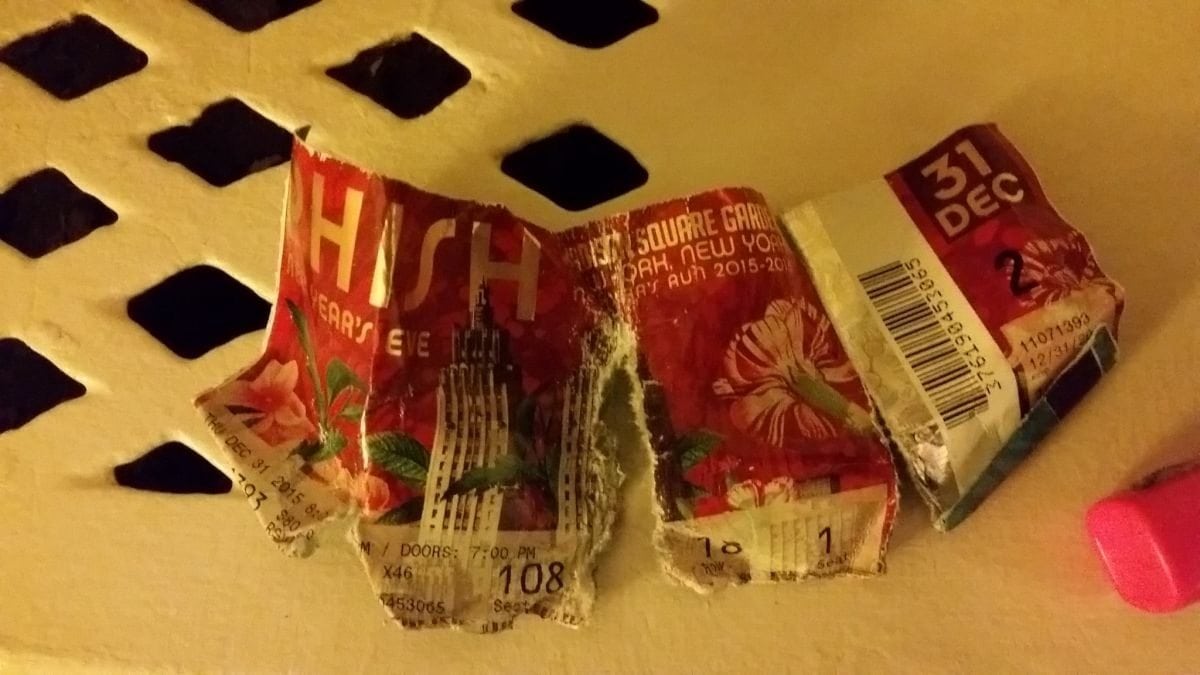 As we made our way out of the show, someone tried to take a balloon out onto the streets of New York City. As they gently prodding the orange ball around the snaking stairwell, I realized the balloon was not much different than quest to find meaning in the shows and to carry a message home that lasts after the music ends. As I laid my head on my pillow in the wee-morning hours on January 1 and removed the faded glow stick from my wrist, I began a text message to myself, letting the thoughts flow, still unsure what form they would take.
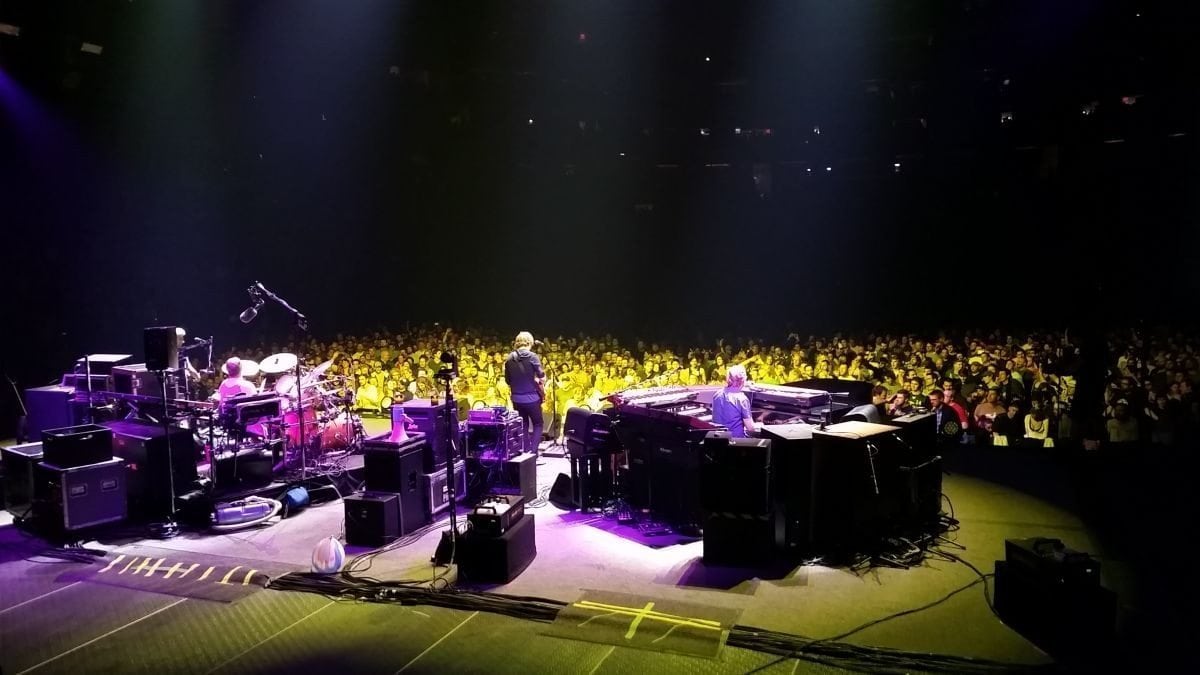 We are no longer children blindly following a band searching for their footing. We are a functionally dysfunctional family of teachers, engineers, entrepreneurs, accountants, writers, artists, lovers, friends and acquaintances. We are inspired by the music to create art, pins, posters, t-shirts, merchandise, and we support each other by purchasing it. We are an economic powerhouse that can fill hotels in New York City, coordinate trips to Mexico and Europe, all in the name of our band. We generated at least $720,000 in local and state tax revenues during the three-day Magnaball concert, according to Watkins Glen International racetrack.
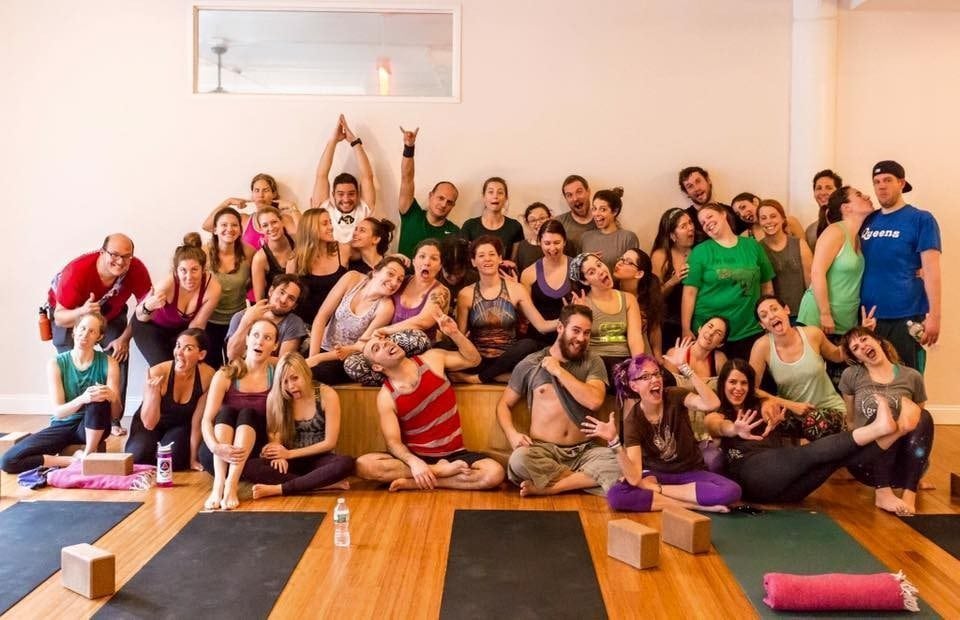 Surrender to the Flow (Phish) Yoga has raised more than $10,000 for Street Yoga and The Mockingbird Foundation, an entirely volunteer run, non-profit organization founded by Phish fans which has raised over $843,000 to support music education for children, providing 261 grants in 45 states since 1996. And in 2015, over 1,600 volunteers logged over 30,000 hours diverting over 2 million pounds of waste from landfills through recycling and composting at 37 concerts through Clean Vibes.