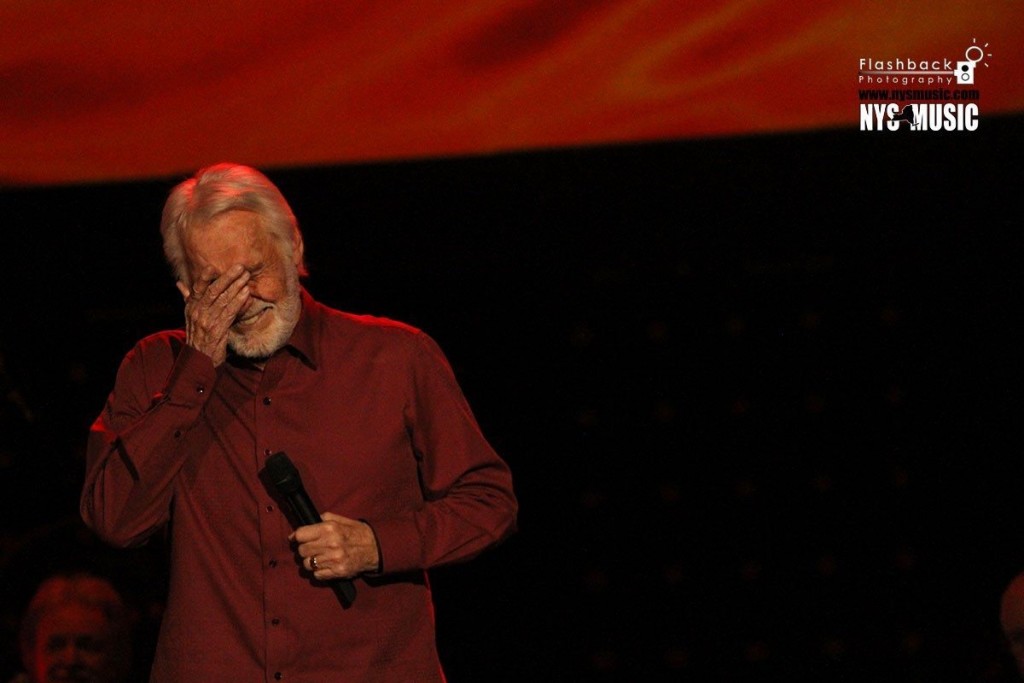
It was bittersweet to say the least as Kenny Rogers took to the stage at The Turning Stone Casino December 20, 2016 for his final holiday show here in Central New York. Welcomed by a sold out crowd, Kenny Rogers made his entrance to his tried and true hit “Ruby” where he encourages the audience to participate at the chorus, however they always seem to miss their cues. You would think after all the these years, the audience would get the words right and sing on cue, however it was not meant to be this final show as well.
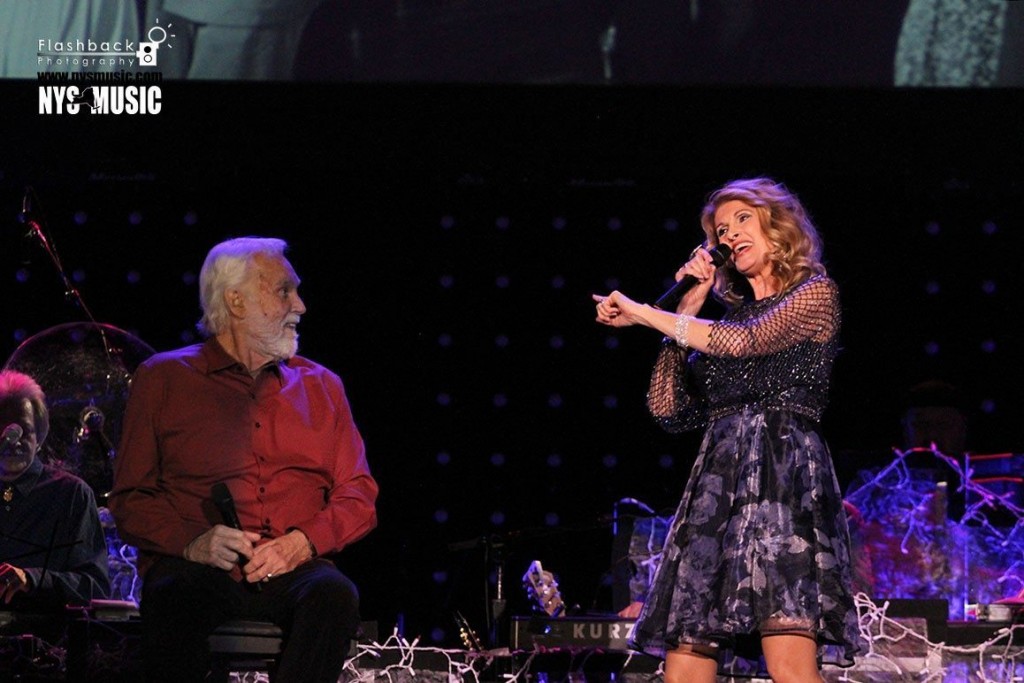
For this final performance he was once again joined by the lovely Linda Davis. Linda has joined Kenny for his Christmas shows for a few years now, and they are the perfect pairing on stage as they sing both carols, their hits, and covers of some of the greats.
Kenny’s wit and sincerity comes through as he talks with his audience. Joking around about his recent knee surgery, he wonders how his doctor can claim this is “age appropriate” when he runs into Mick Jagger at Glastonbury who is jumping all around on stage. Maybe he states, “it’s age appropriate for Americans.” Well that thought quickly went to the wayside when he returned home and immediately ran into Willie Nelson. His ability to laugh at himself, and put his audience at ease is one thing we will miss most about Kenny Rogers.
Then there’s the music. Kenny Rogers was one of the first to cross over and make his mark on both the country charts and pop charts with songs such as “The Gambler,” “Islands in the Stream,” and “Lady” to name a few. Then there were the well known collaborations. His best known friend and collaborator is the legendary Dolly Parton, their chemistry and love and admiration is one fans will never forget. He also has sung with Dottie West and Ronnie Milsap, and who can forget his part in “We Are The World.” This multi talented performer has sung doo-wap, pop, country, and even dabbled on screen for years. He has entertained us for years and loved by all.
A little known fact about Kenny Rogers, and one I was able to talk to him about recently, is his love and passion for photography. He is an amazing photographer capturing remarkable stills of several artists such as Elizabeth Taylor, Michael Jackson, and so many others, and his landscapes will take your breath away. Something he took up while on the road, he wanted to do something worthwhile in his down time so he took up capturing the amazing places he was visiting and performing. In the works we will soon be able to see his newest book of landscapes, some of which he’s taken while on tour and others while on vacations with his wife and twin sons.
This show was a definite celebration of music, of fans, and a thank you to all those who have supported Rogers over the years in his career both on stage and screen. We will certainly miss him, and thank him for all he’s given to us over the years. It is now time for this cowboy to ride off into the sunset and spend some quality time with his wife and children. It’s now time to ‘fold em.’
Setlist: Ruby, Don’t Take Your Love to Town (Johnny Darrell cover), Video Walkin’ My Baby Back Home, (Broadway Syncopators cover), PlaIt’s Only a Paper Moon, (Harold Arlen cover), Through the Years / You Decorated My Life / She Believes in Me, Something’s Burning, Just Dropped In (To See What Condition My Condition Was In) (Mickey Newbury cover), Love Lifted Me, But You Know I Love You (Kenny Rogers & The First Edition), It’s The Most Andy Williams song), Let It Snow! Let It Snow! Let It Snow! (Vaughn Monroe cover), Baby It’s Cold Outside (Frank Loesser cover), I’ll Be Home for Christmas (Bing Crosby cover), O Holy Night (Adolphe Adam cover), Go Tell It on the Mountain (John Wesley Work cover), Joy of The Lord, Mary Did you Know, The Light, Lucille, Coward of the County, Love Will Turn You Around, We’ve Got Tonight (Bob Seger cover), The Gambler (Don Schlitz cover), Lady, Islands in the Stream (Bee Gees cover), You Can’t Make Old Friends, and Blaze of Glory
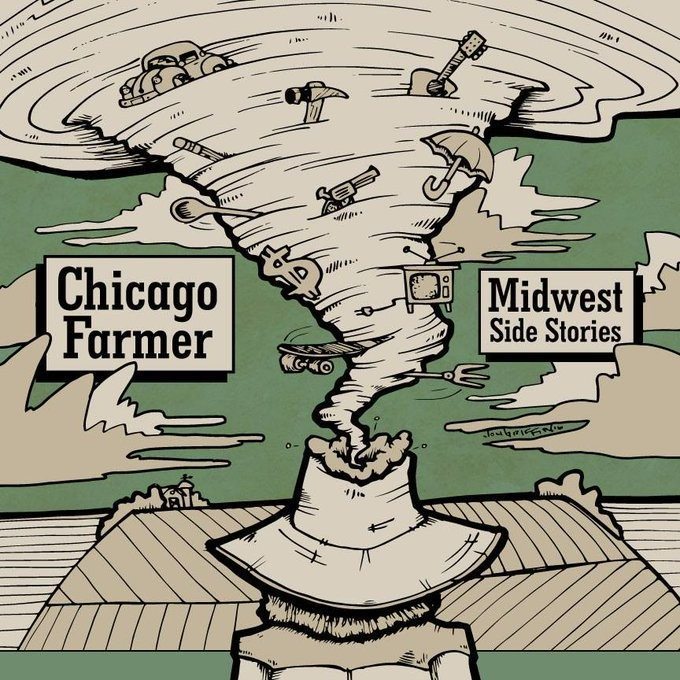
Chicago Farmer recently released his seventh studio album, Midwest Side Stories, which debuted on September 30, 2016 on his Chicago Farmer record label. It’s the follow-up to 2013’s Backenforth, IL. Chicago Farmer is the nom de plume of Illinois-based folk artist Cody Diekhoff, who has spent the last decade barnstorming bars and theatres across his native Midwest, traveling far and wide, through dim towns and bright cities alike, to perform for a growing legion of appreciative fans. Diekhoff was born in tiny Delevan, IL, has spent significant time in Chicago, and currently calls Bloomington, IL home. It’s these localities, which are largely defined by the sordid power dynamics surrounding them, that make up the backdrop for his blue-collar ballads.
Distilled to its essence, Midwest Side Stories is a concept album, one centered around the workingclass struggles of the people of Tazewell County, Illinois. The concept, while in league with Sufjan Stevens’ Illinois, is less sprawling, more localized, and reads sort of like Sherwood Anderson’s short-story collection Winesburg, Ohio, yet its themes are more aligned with those of another famous Illinoisian, the poet and folk singer, Carl Sandburg.
The opening track, “Umbrella,” a seemingly autobiographical take on the life of a folksinger with a rainy day plight and a ticket to ride, acts as an overture, setting the stage for the strugglers that Chicago Farmer will routinely call into the limelight over the course of the album. The track takes its name from a simile built into the first verse, which provides an inside look at the inspiration behind the songs, while also detailing the apparent relationship between the folksinger and his subject. The first-person narrator sings:
I went searching for some kind of meaning
Like words looking for a page
Came up empty and full of worry
That nothing could cover the pain
And these songs and stories
Began unfolding like an umbrella in the rain.
I want to write you a sad, sad song
That I hope will make you smile
And we could pass it along
We’re only here for a little while.
The track also sets in motion the album’s most resonant message: that storytelling is important, and that it’s equally important how one goes about it. Here, Chicago Farmer delivers a well-constructed acoustic guitar tune that’s tinged with electric honky-tonk guitar fills, and hinges on his shaky and crisp, rich as honey vocal performance, complete with emotional tension, brief yodeling, and a crafted message. And while there’s some slick lines in “Umbrella,” such as “we’ve been trying to find our way through the darkness of our minds,” we also see the traces of Chicago Farmer’s major weakness as a songwriter, that there’s a disturbing lack of particularity, personality, and local detail in these folk tales, while there’s an abundance of flat lines and forced rhymes that advance the story by length alone.
One song in and I’m totally going for Chicago Farmer’s voice, as it’s reminiscent of Ryan Adams during the Cardinals era, while the song itself sounds more like something from Kentuckian Stoll Vaughan’s catalogue, but I’m definitely not sold on the lyrics.
When the second song, “The Revolving Door,” hits, it’s high drama from the jump. Shrill, Neil Young inspired harmonica tears through the song like a factory whistle, while the ominous bass and drums lugs a gurney of carnage out of what seems a folk music netherland, some gruesome place from which the Byrds’ “Lover of the Bayou” once emerged, and from whence Chicago Farmer’s authoritarian boss figure comes, wielding a trembling falsetto warble like a razor, his voice haunted with the spirit of Will Oldham and bent on corporate enforcement.
After the first verse, the song breaks suddenly into a bewitched surf-hued anthem that takes up the point of view of a worker caught in this exchange, who’s prideful in repeating “I’m a worker / Not a number,” yet fully aware that the boss dictates he always get “back in line.” Finally, the song increases in tempo and intensity, building up to the climactic moment, in which the blazing harmonica returns, as does the voice of the boss figure, who informs the worker, “saddened to tell you, sir / you don’t work here anymore / pack your things and your feelings / and head on towards the door.” And while the title seems to allude to “revolving door” politics, the song is essentially about the binary bind of incorporated power and its grip on a vulnerable labor force.
Two songs in and Chicago Farmer has me captivated by his voice, impressed by the careful structures inherent in his songwriting, and excited about the range so far displayed.
The next three songs, “Rocco and Susie,” “Skateboard Song,” and “Two Sides of the Story” provide the album’s most on-the-nose references to Tazewell County. “Rocco and Susie” is a stripped down, bluegrass-tinted ballad featuring acoustic guitar, tambourine, and backing vocals. There’s a slow setup as the song unfolds. The couple described, at first, “seem like your typical neighbors / [whose] children were somewhat behaved,” but, ultimately, the family succumbs to the sordid afflictions facing Tazewell County: the stock market crash, factory job loss fallout, crystal meth addiction and production, police intervention, and the dissolution of their family. While Rocco and Susie at least have names to which one can connect, they serve merely as stock pieces, with all evidence of their personalities and the sweat of their struggle erased, in what reads as basically a reductive critique of a changing economy, from which the only thesis adduced from the ordeal is simply that one should “stick to smoking grass and drinking beer.”
“Skateboard Song” gives another passing glance at some of the participants in the local goings-on in Tazewell County, this time from the view of a first person skater riding through town; however, the characters involved in the story are warped by the lighthearted, uptempo, musical-theater style satire Chicago Farmer employs in critiquing smalltown social ills and the misguided laws meant to curb them. Every authority in town, from the signs to the cops to the judge, has only this to say, “skateboarding is bad,” which is always followed with why don’t you “take up guns” or “do some harder drugs,” or some other such miscreant behavior, and only a pop-punkish jingle by which to convey it. While the idea of making a powerful metaphor out of the skateboard has great promise, the execution is tepid, and listeners are left with a less than revolutionary assault on the powers that be.
“Two Sides of the Story” is a John Prine-esque portrait of the small town heartbreak and struggle that seems to typify the experience Chicago Farmer presents to his audience. It’s another stripped down acoustic guitar tune, with piano and harmonica accompaniment, and featuring Chicago Farmer’s twangy vocals. From his point of view, middle America is a place divided exponentially in twos, where the politicians are feckless liars and misinformation abounds, where the media is a gluttonous machine and working-class reality its fodder, where living’s dying and dying living.
And here Chicago Farmer uses his highly developed sense of songcraft to portray a growing chasm dividing Americans along intangible lines. In the chorus, he sings “there’s two sides to every story, there’s two sides of every town / the side of town that tells the story and the side where the story went down,” which calls attention to the gap between product and producer that outlines the larger conflict at stake. He adds depth to this stance throughout the song, stringing together artful, impactful lyrics that diagnose the worsening situation while adding some political punch. Take for example this stanza that highlights the gulf between the words and actions of politicians:
There was a lawmaker whose laws never made any sense
So he started making promises on both sides of the fence
Double-crossed his fingers every other time he smiled
Shook hands across the country, couldn’t reach across the aisle.
Whereas, Chicago Farmer’s other story songs do well to elicit many concerning issues, they mostly fall in short driving home a moral lesson, however, “Two Sides of the Story” succeeds in convincing the audience that storytelling is important and that it’s even more important to “get your story straight.”
Halfway through and Midwest Side Stories has proven Chicago Farmer’s obvious talents, namely songcraft and singing, but, in comparison with one another, the songs are quite uneven. In fact, “Two Sides of the Story” marks the high point of Midwest Side Stories, but it also marks the point at which the album takes a turn for the worst.
“New Used Car” is an easy listening diddy with an attractive pedal steel part, but the trite subject matter and blithe singing give it the taste of Diet Springsteen in a can, while the feathery lyrics secure this tune’s place as the Americana version of those riding-around-town-in-a-pickup-truck revelries celebrated on pop country radio.
The next tune, “9PM to 5,” is a straightforward country-tinged rock song in the manner of Los Lobos, which describes the life of a graveyard shift worker, but nothing ever develops regarding his situation and it’s difficult to know what Chicago Farmer is trying to invoke here.
An uptempo fiddle-number follows with the Carter Family styled singalong “Farm and Factory,” which details the working backgrounds of the narrator’s family. Chicago Farmer’s aim here seems directed once more at a changing economy, one that used to provide satisfactory jobs for Midwesterners, either on farms or in factories, but has since rendered these institutions defunct, leaving the people in search of opportunity. He sings “thank God for the farm and the factories / thank the devil for the factory farm.” In retelling this brief, mostly detail-less history, however, it appears that Chicago Farmer’s concern is not truly complex economic despair and worn down, hardworking individuals who need a voice lifted on their behalf, but something more aligned with joining his voice in a nostalgic rank and file of troubadours singing work songs.
The album’s penultimate song, “Homework,” continues in making rather obvious social observations, partly in reference to environmental destruction and denial, while placing the blame on a wide, vague swath of the citizenry, for which a cloudily aware, altruistic, and populist “we” becomes “the kid who does everyone else’s homework,” which precludes his half-hearted rallying cry, “we have a chance if we can enhance the number of us who’ll stand.”
Midwest Side Stories concludes with a cover of John Hartford’s “I’m Still Here.” The approach to the song is reminiscent of Houser-era Widespread Panic, with whetted guitar leads, a solo section, a marching drumbeat, and savory vocals. It’s also refreshing to hear lyrics matching the high-stakes political matter at which the originals often obscure or only gesture toward, rather than point at, and it goes a long way in fleshing out the album’s narrator and vision to hear Chicago Farmer howling:
My cigarettes are gone and so’s my money
So are all my nerves and all my teeth
My hair’s falling out, I’m looking funny
My friends are either dead or on relief.
When the last note ceases and the dust settles over Midwest Side Stories, what’s left is a readily accessible and highly entertaining volume of country-fried ballads in the Americana tradition, and while the songwriting is polished and the playing refined, the final product lands somewhere shy of the ambitious summit it sets for itself in the early going. Listeners get merely a glimpse of the broke-and-busted life and times of the folks of Tazewell County, Illinois, as the gritty detail and sludgy realism is mostly omitted, and the characters who appear in these weary tales are not granted the shape of their struggles or the use of their authentic voices, as Chicago Farmer flattens them to fit the contours of his traditional songwriting and the bent of his buttery vocals.
Cole Swindell brought his Down Home Tour to the sold out House of Blues in Boston December 10 for what promised to be an exciting night of up and coming country talent. Swindell, who is no stranger to selling out the nation’s largest House of Blues, was also able to do so the last time he played the venue. This time he brought along Cole Taylor and Travis Denning as his tour support.
First to take the stage was Travis Denning. The Georgia-native has been working to make a name for himself since his move to Nashville less than two years ago. In that time, he has worked both as an artist and a song writer to create a career for himself in music, a dream he has fostered since he was young. Denning did a great job catching the crowd’s interest with his own songs, including “Red, White, and Blue,” which he introduced by speaking not only about those over seas fighting for the country but also all of the people who protect the nation here at home, like police, EMT’s and firefighters. This truly seemed to resonate strongly with the sold out crowd. He carried on into the sing along portion of his set, where he played a song that he penned, “Everyone We Know Does,” which was recorded by Chase Rice. The crowd’s energy peaked during this song as everyone was happily able to sing along word for word. He closed out his set with “Southern Rock,” a song that he explained was very important to him as southern rock is what he grew up on and what inspired his love for music and guitar.
Cole Taylor was up next and he kicked things off with a fan favorite, “Drop Top,” off his self titled EP, which immediately had the crowd off their feet and singing along. Taylor took the stage with an energy and command of the crowd that one would have expected from a seasoned performer. He demonstrated a great deal of potential when he kept the energy in the room alive during songs the crowd was not necessarily as familiar with as they’d been with “Droptop.”
A noteworthy song from Taylor’s set was one off of his self titled EP called Boom. The catchy, up tempo song captivated those who knew it already as well as those who were hearing it for the first time. The highlight of his set came when he played a song that he penned for Luke Bryan and Karen Fairchild. The popular “Home Alone Tonight” had the entire crowd singing along word for word. He carried the energy from that song into his closing song, “Cold Beer,” which has been gaining popularity recently. Taylor did a wonderful job amping up the crowd for Cole Swindell and showed a great deal of potential for his career going forward.
Swindell took the stage with a great deal of energy and command of the stage with “Hope You Get Lonely Tonight,” the second single from his self titled full length release that went platinum and helped create the loyal fan base Swindell has today. He continued on with “Wildlife,” a song from Swindell’s Down Home Series which was released Fall of 2016 and “Brought to you By Beer,” from his self titled release. Other noteworthy songs that Swindell played from his self-titled release included “Chillin’ It” and “The Back Roads and the Back Row.” “Chillin’ It” was the single that helped catapult Swindell onto the map with country radio as it garnered a #1 spot on the US Hot country chart and a #2 slot on Country Airplay, in addition to going RIAA platinum. Its extreme popularity was certainly recognizable among the sold out crowd who all seemed to be singing along verbatim with Swindell.
Swindell took a few minutes before a performance of “Flatliner” to introduce it as a song he was very excited to have created with the help of Dierks Bentley and even more excited to get to play next spring when he tours in support of Bentley, a tour which should bring much success to both artists. From there he went into a string of songs he penned for some of the most popular artists in country right now, including “Get Me Some of That,” which was recorded by Thomas Rhett and “Roller Coaster,” which was recorded by Luke Bryan. Swindell also took some time to reflect on the origins of his musical journey. Prior to having his own successful career as a country artist, he sold merchandise for Luke Bryan, so later penning a song for Bryan was a career milestone for him.
Another noteworthy moment of the set came with the last two fan-favorite songs Swindell played: “No Can Left Behind” from his latest full length release You Should be Here and “Ain’t Worth the Whiskey” from his self-titled release. Swindell returned to play two of his own songs, “You Should be Here,” the somber yet catchy lead single and title track from his recent release, and “Let Me See Ya Girl,” the last single from his self titled release. His rendition of “Let Me See Ya Girl” was a treat for fans as it was intertwined with a cover of the ever popular “Closer” which was recorded by the Chainsmokers and Halsey.
With the Down Home Tour winding down fans should be looking forward to the next run of tours for these three talented young men. Each took the stage with great energy and charisma and demonstrated why they are making a name for themselves within the genre as writers and musicians.
After a two year hiatus, moe.down is a go for 2017. Last year the band announced that, for the second consecutive year, moe.down would not take place but have never outright dismissed the fact that it would return. Today’s announcement puts the conjecture to rest. moe.down is returning to its original location, Snow Ridge in Turin, NY June 30 – July 2.
The July date marks a departure from previous moe.downs, which traditionally took place over Labor Day weekend, a weekend, as any upstater knows, that can bring weather ranging from excessive heat to cold rain, sometimes over the course of one day. The July date should make for a more pleasant weekend experience for fans.
Past moe.downs have seen the band perform six sets throughout the weekend as well as sets with side projects such as Al and the Transamericans, Ha Ha the Moose and Floodwood. The festival is known for attracting artists typically not seen at jamband festivals. Past performers have included Violent Femmes, They Might Be Giants, Cracker/Camper Van Beethoven and Meat Puppets.
Early bird tickets, VIP and RV passes for moe.down 16 go on sale Friday, Dec. 16 at noon ET. Three-day general admission tickets are $130 in the early bird allotment. For more information, visit moe.’s website.
Singer/songwriter Mike Powell has no shortage of inspiration for writing music. Raised in the foothills of the Adirondack Mountains, he taught himself guitar at the age of 13, boasting a catalog of 20 or so songs by the age of 15. Powell went on to become one of the most decorated college lacrosse players in history for Syracuse University, declining an offer to play in the pros straight out of college, opting instead to follow his passion for music and songwriting to the stage.
With the reverent simplicity of his soulful voice, an ax, and a harmonica, he delivers nine heartfelt, timeless songs on his fourth album, Tied to the Rail. Eliciting influences from Bob Dylan and John Prine, Mike Powell has been described as a “polite rebel; a truly unique and inspiring American voice,” by The Boston Globe. Powell has also released Blue Eyes and Hand Me Downs, Replevin, and the 2014 Syracuse Area Music Award-nominated Kapow.
Powell eventually did play lacrosse professionally – for the Baltimore Bayhawks in 2005 and the Boston Cannons in 2007. Two years later, he was back on stage, touring alongside Sarah Lee, the granddaughter of Woody Guthrie. A woodworker, Powell nearly lost his ring finger on his playing hand while moving a stack of logs in 2014. With a varied past such as his, it comes as no surprise that Powell is such a great storyteller!
The album kicks off with the folk/southern rock hybrid “Empire,” a track that showcases the power of what one can accomplish with the simplicity of an acoustic guitar and Powell’s smokey yet earnest voice. It’s a taste of what’s to come – a no-frills album showcasing powerful lyrics by a seasoned vocalist.
The second track, “Bibles and Bourbon,” features a signature steel guitar and is a short but sweet busker song, good for helping you get out of your own head.
His lyrics – like these from “Mary Anne” – are pieces of Americana.
When the water cost money and the drugs seem cheap
When all your dreams stay lost in your sleep
And you can feel a break down coming soon
When your head gets dizzy from the rattle and the spin
And the sadness seems to burn on your skin
And every night you’re left yelling at the moon
Conjuring up images of dusty railroad tracks and bible thumping preachers, “Tied to the Rail” combines folk, soul and a bit of country to create a sound that is sure to give you the feels. Inspired by the birth of his daughter in 2016, Powell is back on the road promoting his third album.
You can catch Powell on the road Tuesday, December 13 at the Light Club Lamp Shop in Burlington, Vermont, at Ray Brothers BBQ in Bouckville, New York on Friday, December 23 and at the Brae Loch Inn in Cazenovia on Friday, December 30.
In January, he returns to the studio with his Black River Band to record a new record set to release in March. He resumes his tour in early 2017 with over a dozen upstate New York appearances already scheduled, many of which Powell will be joined by Black River Band featuring John Hanus on guitar, Shane Kelson on keys, Joe Bell on bass and Dom Scicchitano on drums, with intimate solo shows when appropriate.
Visit Mike Powell on Facebook or his website for more dates or to pick up a copy of Tied to the Rail.
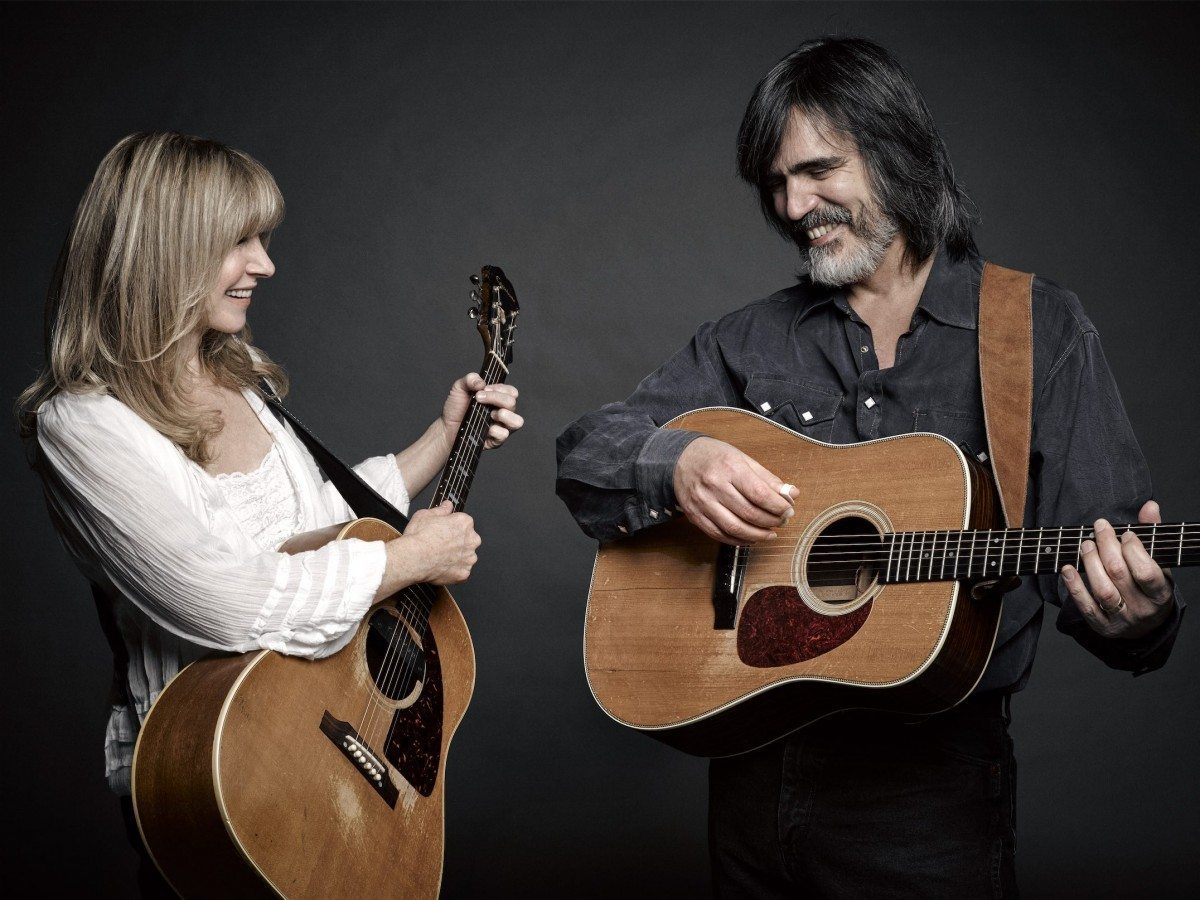
Lovers of classic country and American roots music would have loved to see Larry Campbell and Teresa Williams perform at the intimate FTC venue, Stage One in Fairfield CT. But people not involved in that culture may not have found show as much fun. It was a very, very laid back and low energy energy night, but that seemed to be just the right mood for the almost full house that attended, who gave the duo several standing ovations.
They played for about two hours and featured many tracks from their new self titled album and first collaboration together as well as a number of covers and originals from Campbell. Their voices did sync up perfectly and most of the instrumental side of the performance was intriguing, but listeners didn’t go there to be blown away by guitar solos and complex riffing and movements. They came to reminisce and dream about a country lifestyle while being stuck in Fairfield County, Connecticut, the least “country” place for miles.
The only notable downfall was the uncomfortable moments in between songs. The two were cute together but they were a bit awkward on stage with Williams lying low in conversation and a seemingly nervous Campbell stumbling over his words a little bit. The crowd didn’t seem bothered by his lack of fluency and found it to be more charming than anything else.
Many of their songs were of a slow tempo and about love and heartbreak, like “Midnight Highway” and “Running Wild” by The Louvin Brothers, and they soon gained some momentum with a few more from their album, “Surrender to Love” and “Bad Luck Charm.” And although the audience loved every song, there was a noticeable difference in the lack of applause after several ballad songs in a row. It seemed that Larry Campbell and Teresa Williams read the Stage One room and ended the night strong and upbeat with their encore that left the audience on their feet once again.
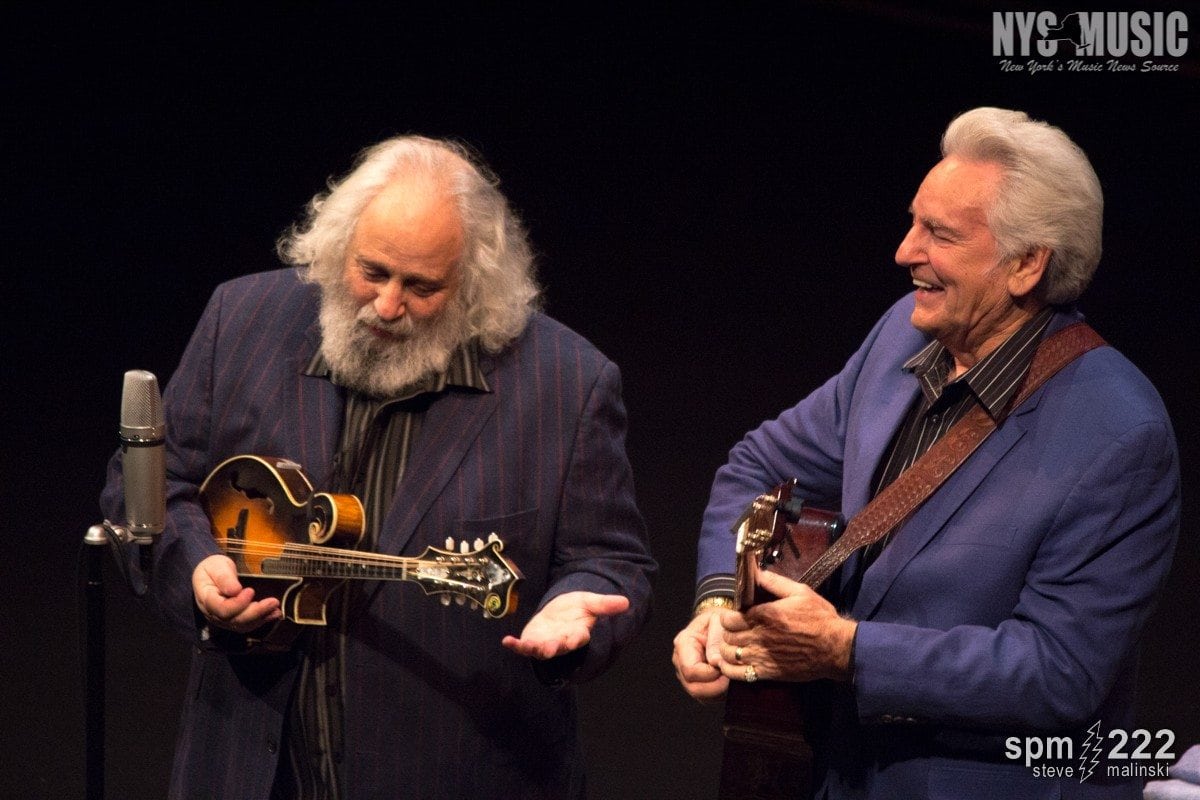
A standing ovation welcomed Del McCoury and David Grisman to the stage shortly after 8pm on December 10. The duo best known as Del & Dawg began their 50th anniversary show on the same RPI campus with “Feast Here Tonight,” a tune by the Monroe Brothers that nodded to Bill Monroe’s connection to both Grisman and McCoury and the genre of which they are elder statesmen. Using only one microphone, the crisp sound made it seem as though you were standing next to them. Even the applause sounded remarkable.
The Capital Region of New York is fortunate to have some of the best sounding venues in the country, where the audience and artist can mutually appreciate immaculate acoustics. The Experimental Media and Performing Arts Center (EMPAC) on the campus of Rensselaer Polytechnic Institute in Troy joins The Egg, Troy Music Hall and Picotte Recital Hall as premiere venues with impeccable sound which aids in bringing an exceptional variety of music to the Capital Region.
The pair took turns introducing the other. Grisman said it was “Great to be back in Troy with this young man,” while McCoury presented his counterpart as “The founder of Dawg music.” The reflection of their instruments bounced off the walls of the spacious room as they swayed and stepped back and forth to the microphone. “East Virginia Blues,” a humorous song of longing sung by both the Carter Family and Stanley Brothers felt like stepping into 1940s Appalachia. “Toy Heart,” a Bill Monroe original, elicited banter from Del and David who gave a free history lesson on the original Blue Grass Boys who first performed in 1946. A former Blue Grass boy himself, Del started out playing banjo, but Monroe got him to switch to acoustic and start singing, much to our delight 50 years later.
Some banjo humor preceded the instrumental “G-Run Blues,” followed Ralph Stanley’s “Man of Constant Sorrow,” as did “Tennessee Waltz,” considered by Grisman to be “a piece of musical substance” and also the state song of Tennessee that preceded the current title holder, “Rocky Top,” somewhat to Grisman’s dismay. To end the first set, the two performed “The Country Boy Rock n Roll,” a song that was seen at the time as a push back to Elvis Presley and Jerry Lee Lewis.
Del and Dawg returned to the stage, discussing the circumstances of their first show in 1966. A 4-piece needed a guitar player, and Del McCoury drove up to play with Grisman, the late Winny Winston on banjo and his brother Jerry McCoury on bass. Jerry then joined the pair on stage, followed by Chris Warner on banjo, collectively referring to themselves as The Bluegrass Survivors. “I Wonder Where You Are Tonight,” a Hank Snow song dating to the 1940s, began the set, followed by Del singing lead on “Dark Hollow,” one of the most familiar tunes of the night. Jerry McCoury sang lead on “Send me Your Address From Heaven,” with a voice akin to Del’s, pun intended.
Prior to “We can’t be Darlins Anymore,” Grisman pointed out the duality of bluegrass music, describing lyrics as focusing on “them tragic things of life – unrequited love, death, incarceration, suicide” and the melodies as “very uplifting, the antidote to the lyrics.” Grisman’s summation of bluegrass: “If you don’t listen to the words, it’s very uplifting.”
Dawg humor was on display with “I’m my own Grandpa,” as was Del’s ‘High and Lonesome sound’ on “The Prisoner’s Song,” followed by a somber and beautiful “White Dove.” Del gave thanks to the crowd, saying “We enjoyed having a reunion,” and wrapping up the night with Jimmy Martin’s “Hit Parade of Love” and an encore of “Lonesome Road.”
The history of the music performed this evening exceeded the 50 years the two have performed together. Music dating back to the 1920’s provided a century of bluegrass from which to cull a celebratory performance for this pair of musicians whose influence and knowledge runs deep through the veins of bluegrass music.
Setlist:
Set 1: Feast Here Tonight, Shackles & Chains, East Virginia Blues, G-Run Blues, Toy Heart, Man of Constant Sorrow, Tennessee Waltz, Snow Dove, Del & Dawg, Country Boy Rock n Roll
Set 2: I Wonder Where You are Tonight, Send Me Your Address From Heaven, Dark Hollow, Shenandoah Breakdown, We Can’t be Darlins Anymore, He’s His Own Grandpa, The Prisoner’s Song, Fanny Hill, Walk the Dog, The White Dove, Hit Parade of Love
Encore: Lonesome Road
Special thanks to Guthrie/Bell Productions for bringing an historic show to EMPAC, and Del and David, and their wives Jean and Tracy for chatting with fans at the merch table after the show.
The roots of bluegrass travel from Appalachia through Kentucky in the 1940s, but the origin of one of the most famous duos in bluegrass history is found in New York. On Saturday, December 10, Del McCoury and David Grisman, better known as Del and Dawg will reunite to celebrate 50 years of music. They’ll do so on the campus of Rensselaer Polytechnic Institute, just as they did that first time back in 1966. Del and David will be joined on this very special evening at EMPAC by Jerry McCoury and Chris Warner.
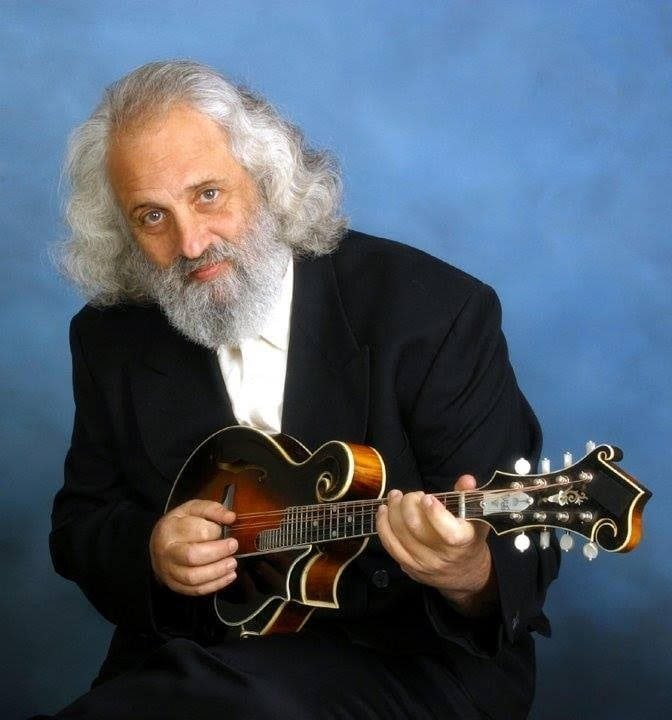
Mandolinist David ‘Dawg’ Grisman, a nickname coined by Jerry Garcia, has combined bluegrass and jazz throughout a career of acoustic prowess. Grisman studied English at NYU and lived in Greenwich Village where the folk scene proliferated in the early 1960s. David learned to play mandolin in a style befitting the father of bluegrass music, Bill Monroe. One of Monroe’s Bluegrass Boys, McCoury switched from banjo to guitar, making the pairing with Grisman have a deeper connection in the music.
Grisman spoke to NYS Music from his Northern California home, discussing the origins of Del and Dawg, bluegrass today and the influence of Jerry Garcia on his mandolin playing.
Pete Mason: The performance at RPI on December 10th is the 50th anniversary of your first show with Del. How does it feel to bring your history together full circle? Any memories of that show?
David Grisman: It feels just great to have maintained such a fruitful musical and personal relationship for this long. I still remember the excitement and energy of that first gig together, which was captured on tape and released in part on my album, Early Dawg. I was offered the princely sum of $200 to put a bluegrass band together and was able to obtain the services of Del and his bass-playing brother Jerry, with whom I played in Red Allen’s band. My good friend and banjo whiz, the late Winnie Winston, completed that first ensemble. Later that year (1966) at the 2nd Bluegrass Festival in Fincastle, Virginia, Del asked me to play a set with him. That band included Chris Warner on banjo. Del and I have invited Jerry McCoury and Chris Warner to join us for the second half of this show for a special Bluegrass 50th year reunion set. We’re calling the band The Bluegrass Survivors! We’ll also be playing the next night at the Birchmere in Alexandria, Va.
PM: How was bluegrass received in the mid-1960s in New York?
DG: Bluegrass was always exciting for New York audiences, then and now. Of course, now there’s a wider audience. But it always was very special for me, particularly when people like Ralph Rinzler, Mike Seeger, John Cohen and Israel G. Young started promoting concerts with bands like Bill Monroe and his Bluegrass Boys and the Stanley Brothers.
PM: What are some of the highlights of the last 50 years of playing music with Del?
DG: Playing with Del is always special, but one highlight was the tour we did in 1989 as the David Grisman Bluegrass Experience where Del and his band (featuring his sons Ronnie and Rob and two fiddle players) joined me for a two-week tour to promote my LP, Home is Where the Heart Is. Another high point was producing the Mandolin Extravaganza project with Ronnie McCoury, which featured eight bluegrass mandolin masters in various combinations, all backed by Del’s masterful rhythm guitar.
PM: What is the first instance where you knew there was a musical chemistry between you?
DG: I reckon it was the first note we ever played — long ago.
PM: How did playing with Jerry Garcia influence your mandolin playing?
DG: Playing with Jerry opened me up to exploring a lot of possibilities that existed within our many common musical sensibilities. We had both drunk from the same musical well for many years and playing together later in our careers was a great musical and personal experience for me.
PM: You have seen 50 years of bluegrass music, from the beginning of the familiar genre. How have you observed its evolution?
DG: Well to be perfectly honest, I wasn’t there at the beginning which Del & I both agree occurred when Earl Scruggs joined Bill Monroe’s band in 1946 (which already included Lester Flatt and Chubby Wise). I didn’t discover bluegrass music until 1960, but fortunately the original architects of the music were still in their prime and playing. I did get to play with many of them, including Bill Monroe, Earl Scruggs, Ralph Stanley, Red Smiley, Mac Wiseman and Red Allen, who gave me my first “hard-core” bluegrass job. I’m currently working on a project with one of my heroes, the great mandolin master, Jesse McReynolds. Bluegrass has of course “evolved”, taking on many influences that Bill Monroe probably wouldn’t have approved of. In a way it’s become diluted and in my opinion, commercialized by the music business, as have many other genres. I still like the more traditional bands like Del’s. Having said that, I think there are many young musicians who are playing incredible music these days, from Chris Thile and the Punch Brothers to Sierra Hull. I just wouldn’t call it bluegrass. That’s why I called my own music Dawg because I don’t feel it is bluegrass as defined by the creators of that genre.
PM: What is it like to have not only a stage relationship with Del, but to also have sons Monroe Grisman and Ronnie McCoury born a month apart?
DG: Our children are a great source of inspiration. Monroe Grisman is a wonderful musician and singer, but was always in the rock world. He now plays in a very popular band in Marin County, California — Petty Theft. My daughter Gillian (head of production for George Lucas’ Edutopia project) is also musical and even played a gig with John Sebastian’s jug band on washboard bass! My son Samson is a great bass player who currently plays with Lee Ann Womack and the Bryan Sutton Band, as well as my own Bluegrass Experience. My stepson, John R., has been developing into a fine mandolinist and my wife Tracy has subbed for Sam on bass and also plays guitar and fiddle. Of course Del’s sons Ronnie and Rob are fantastic award winning bluegrass musicians and will certainly carry on the McCoury legacy. I know that Del and I are both proud dads and we’ve talked about doing a father & son project someday.
Tickets for Saturday’s Del and Dawg show are available through EMPAC.
Watch Del and Dawg from Oriental Theater in Denver below.
Last Friday, December 2 was an absolute treat for everyone that went to The Warehouse in Fairfield, Connecticut. The night was even a pleasant surprise for renowned dobro player Jerry Douglas, saying he was “shocked people wanted to sit through an hour and a half of dobro music.” His hour and a half spread over two hours after the crowd begged for more and gave him a standing ovation at the end of his performance. No more than 100 people were in attendance which made for a very intimate show, intimate enough that he came out after his set and met almost everyone that showed up.
He played some of his own highly improvised original songs, told hysterical stories, talked with the audience mid-show, joking about how there’s some parts of his songs that he wish he never wrote, and completely opened up to everyone there about his personal life. He shared stories from how his late and most beloved dog inspired him to not walk off stage if he thinks there will be an encore, to how he wrote a song in spite of Maurice Sendak, because his famous book Where the Wild Things Are scared his children when he read it as a goodnight story. “I’m going to write a song about it, get rich and get back at Maurice Sendak at the same time. Neither of those things happened.” And that’s how his song “Wild Rumpus” came to be.
To get a sense of why this was a huge surprise to see such a small turn out, one must do some homework and will appreciate the amount of time and dedication Douglas has clocked in since his start in the 1970’s. He’s worked with a plethora of world renowned artists from Ray Charles to Eric Clapton, Paul Simon to Dolly Parton and countless more, while still writing his own music and performing alongside Alison Krauss and Union Station. He has won numerous Grammy’s, many of which were awarded to his work with Union Station and some for his original recordings. He’s a Country Music Hall of Fame member, won three CMA Musician of the Year awards and a copious amount of International Bluegrass Music Association awards over the past three decades. Simply put, he’s damned good, and so was his performance last Friday.
He played for two hours and had every soul in the house engaged for every minute he was on stage, partly because of his raw talent, but mostly because almost every song had a story behind it. He started with a short introduction and immediately everyone felt a connection with him. He opened with “A New Day,” a soft and sultry song with a perfect balance of country twang, moving to a cover of “Foggy Mountain Rock,” a recording Douglas said was made in order to compete with Elvis who had at the time was the center of attention in the music world and was, “ruining it for everybody.” This time, his fingers started flying across the frets and still managed to keep a steady melody. It blew the audience away.
He continued on through the night performing his original song “Peaceful Return” which was unsurprisingly peaceful, simple and serene, and onto a cover of “Hey Joe” by Hendrix and many more covers from musicians he’s worked with and ones he hasn’t. Each one was special because of the attachment Douglas had to it and knowing the backstory of each song he played made it so much more meaningful to the audience, encapturing them in a way that was never thought to be possible.
He played about 12 songs total, and every one had a unique sound, which is an incredible feat using just one instrument. An assortment of loop and effects pedals contributed to that accomplishment, but an untrained eye would pay no mind to it and would be simply blown away by his talent and charm.
It’s fair to assume Douglas does not have a lot of down time, so it’s undetermined when he will be touring again, but he is definitely someone to keep an eye on. His plethora of recordings are available on Spotify as well as iTunes and is worth investing some time into.
Mr. K Phillips opened up for Rob Thomas and the Counting Crows at SPAC in Saratoga Springs, so naturally, we had to speak with this young up-and-coming ranch-raised Texan about his passion for story-telling.
Listen to interview: https://www.youtube.com/watch?v=ve-EK4DeG9M
Listen to the abridged feature/interview
Recess with Spinelli: How’s the trip going, any highlight so far?
K. Phillips: Everything is a highlight. This is a highlight; we’re in Saratoga Springs there’s 24,000 seats in this venue. It’s like I died and went to heaven, I’m just glad to be here.
RWS: It sounds like this tour is largly outdoor amphitheatres?
KP: Yes. I loved it. It’s a little harder for us because the band rehearsed so much and and we’re so good at playing a club setting but nothing can prepare you for playing on a gigantic stage; it’s made out of aluminum and the sound shoots everywhere and it bounces off the back of the hill and comes back to you and it was very challenging, first to learn how to hear each other to play on the stage. I’ve been touring the United States for about seven years but that’s usually in front of you know, 15 people a night.
RWS: When that transition initially happened, from going from playing in front of 15 people to playing in front of thousands or 20,000 what was your initial mindset change?
KP: It’s actually actually easier because when there’s 5000 people watching you who haven’t seen you seen you, some of them are listening and so maybe like 2500 people are actually watching you attentively. It’s actually easier because you feel like you’re doing something. Sometimes when you play for 15 people, 2 of those people are listening. We’ve been ready to do this but nothing can prepare you for it.
RWS: The way we heard about you was through interviewing Adam Duritz of Counting Crows; Adam spoke very fondly of you and told us to check you out, How long have you actually known Mr. Duritz.
KP: In 2012…he sponsors a blog that finds new music and he listens to all of it. He doesn’t have to do that but he still does. I mean, I think that’s what makes him great, is that he loves music and he’s always filling the well. It was so funny when we started to play and he used to come to my shows and it would be 12 people, but then 1 of the 12 people would be Adam Duritz. It was almost embarressing, you know like “you like me, but I don’t have any fans yet.” I mean he’s like one of the greatest writers of our time and one of the greatest literate writers. it’s a very special thing for me. And Rob too, I didn’t know Rob before this tour; they’re 2 of the nicest guys I’ve ever met and they don’t have to be, they’re super successful, they watch every show of mine and then they going to put on a show on the kill and after that we hang out; it’s amazing. I never want it to end
RWS: Have you noticed any doors open or any opportunities come your way because of this?
KP: D’Angelico, the great New York guitar company gave me a guitar. They sent me to their showroom and I just pick out a guitar to play for this tour and that was so nice. Being somebody that they think is worthy of an endorsement, that’s kind of neat to me. Right before this tour I had a guitar in pawn which I lost because I couldn’t afford get out of pawn. And then D’Angelico gives me this way better guitar than I had in pawn. It’s just funny how your life changes so quickly when people help you
RWS: Now with Mr. Duritz, I believe that you’ve done some work with him in the past, I think I saw that he covered “Kat’s Song” and I think I heard that he worked with you on the new albums?
KP: Yeah, he let us record some stuff at his house, so one of the new songs on this was recorded at his house and actually, a guitar that we used, we found out later was the guitar from the “Mr. Jones” video, which is funny. I was like “this guitar sounds so Counting Crows. So we recorded at his house and he sang on it and he added this four-part harmony like it was nothing. A few years ago I was watching the Counting Crows. We were at the Bowery Electric and the Crows were playing a cigartette show and my friend Nekia was playing a song with them and he’s like “Dude, you gotta video tape me doin’ this song” and I’m like “Man I gotta go, I have my own show” and he said “This is gonna blow your mind.” They go into this song and I’m like “That’s funny, I have a song that sounds alot like that.” and then Adam Duritz sings “I took that young thing to dinner,” which is my line to a song I wrote called “Kat’s Song” and I realize at that moment that they’re not doing a song that sounds like my song, they’re doing my song. I started weeping, it was like a lifetime achievement award. The Counting Crows have too many good songs.
RWS: As a songwriter, would you say you have a certain duty or responsibility either to yourself or to the listener to write an honest song?
KP: My duty is to connect people and to write things which connect the song with the listener, and the only way you can do that is to have an honest narrator. When you do that, it doesn’t matter what the story is, it’s going to connect, it’s gonna help people through whatever the situation is.
RWS: How do you know whether or not you are being honest?
KP: I know because, there’s a poem by Robert Graves, which I always go back to. It’s actually what our LLC is named after. It’s called “Love without Hope” and in four lines, Robert Graves tells the story of this bird catcher in industrial England, he spends his day in this park, everyday his job is to put larks in his hat, take them to a baker, baker gives him a piece of bread, maybe a piece of coal and that night he goes with food in his stomache and he doesn’t go cold; that’s all he has to do, just grab the birds before it gets dark. On this particular day, he’s leaving the park, he’s got his birds and he sees this beautiful white carriage drawn by two white horses and inside is this beautiful squire’s daughter and here, this lowly birdcatcher, sees this girl and he looks at her and shee looks at him and he tips his cap; the birds fly out, the larks fly to the heavens and she watches them go to the heavens and he’s made this impression on this girl he’d never have a chance with. Now he goes home and he’s cold and he’s hungry, but he’s made an impression on this girl. I’ve never been a birdcatcher, bu I know from that story, I can relate and I think about that story all the time and if I wonder if my narrator is being honest, I just compare it to that, “Love without Hope.”
RWS: Was it a relief when you were finally able to put your thoughts on paper in a cohesive manor that could be understood?
KP: Yeah, but I can’t do that every time. After each song you write after every record you write, you’re just starting over. You’d think that you would get better, but the only thing that gets better is your expectations, I’ve definitely gotten better at finishing songs, I’ve gotten better at writing with people. This last record was writted to be a breakup record. That was fun for me to go like “How does this fit in?” or “There’s a song called 18 year old girls,” an 18 year old girl who like looks like a grown-up but she’s totally not. It’s funny the idea of this character who’s come out of a relationship and he’s gonna bring this 18 year old girl around to his friends and they’ll be like “What are you doing, dude?” So I am looking for more perspective than I am looking for the next what I can’t have. What gets me off about songwriting is finding different angles and funny scenarios.”
Recess with Spinelli can be heard every Wednesday 8pm-10pm EDT on WSPN in Saratoga Springs, NY on 91.1FM and on Hoxton FM in London, England every Wednesday 11pm-1am GMT 6pm-8pm EDT
 Chicago Farmer recently released his seventh studio album, Midwest Side Stories, which debuted on September 30, 2016 on his Chicago Farmer record label. It’s the follow-up to 2013’s Backenforth, IL. Chicago Farmer is the nom de plume of Illinois-based folk artist Cody Diekhoff, who has spent the last decade barnstorming bars and theatres across his native Midwest, traveling far and wide, through dim towns and bright cities alike, to perform for a growing legion of appreciative fans. Diekhoff was born in tiny Delevan, IL, has spent significant time in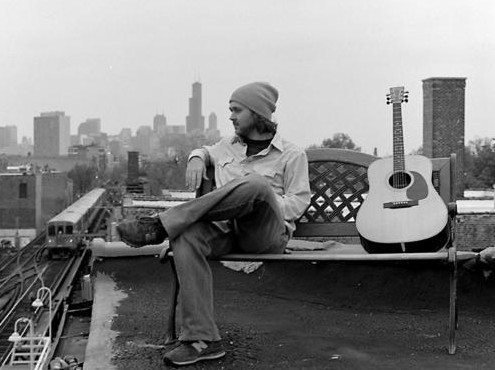
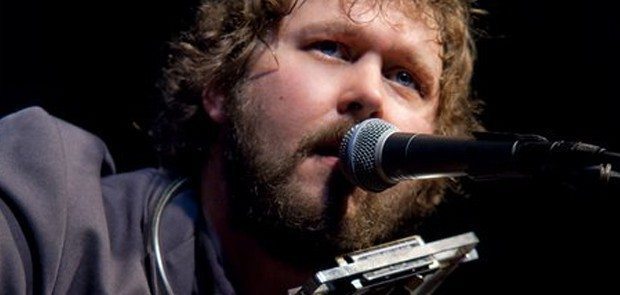

 The Capital Region of New York is fortunate to have some of the best sounding venues in the country, where the audience and artist can mutually appreciate immaculate acoustics. The Experimental Media and Performing Arts Center