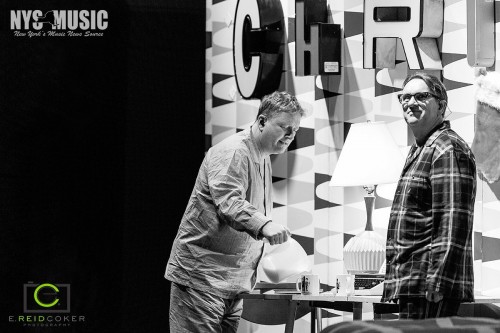
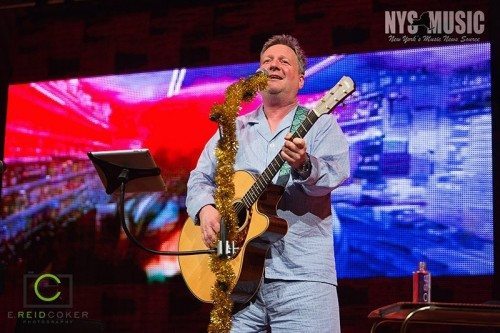
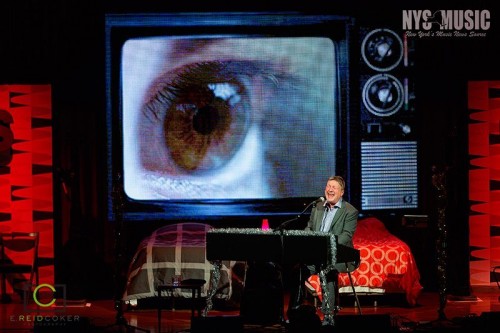
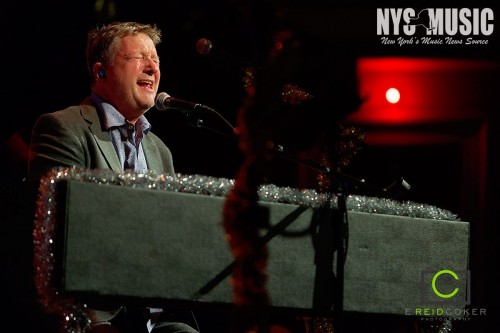
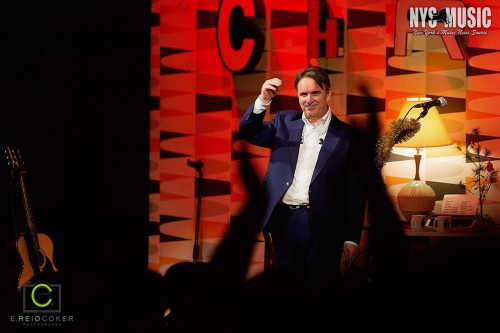
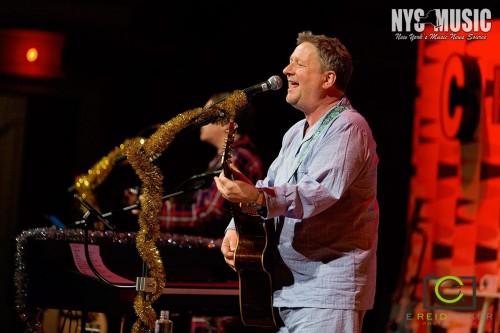
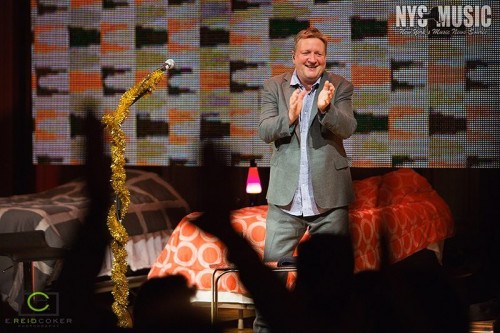
Glenn Tilbrook and Chris Difford, the masterminded songwriters behind the new wave rock band, Squeeze, rolled out of two makeshift beds in pajamas and instantly pulled in the Troy Savings Bank Music Hall crowd on December 16, as part of the “At Odds Couple” tour. The duo proceeded to rip through two hours of classics mixed in with a few new tunes and works from each singer’s solo careers.
After a brief visit to a set up kitchen table to have a beverage, the dynamic duo kicked off the first set with “Take Me I’m Yours” from their 1978 self-titled release “Squeeze.” Tilbrook briefly exited the stage afterward, to change out of his wrinkled jammies while Difford tackled “Cool For Cats,” one of only two occasions in Squeeze’s grand career where Difford provided lead vocals. Exit Difford, enter Tilbrook for “Black Coffee In Bed,” the only release from 1982’s “Sweets From a Stranger” to chart. The classic tune also featured Elvis Costello and Paul Young on vocal backups. The two ventured back together onstage for six more songs before Difford getting the opportunity to play three solo songs: “Fit As A Fiddle,” “Wrecked” followed by Tilbrook backing on “Cowboys Are My Weakness” providing one of the night’s more memorable moments. “Cowboys,” a tune said to be written for and soon rejected by K.D. Lang, was perfectly accompanied by a video montage of homo-erotic, silly string ejaculate spraying toy cowboys.
The second set featured three solo performances from Tilbrook including “Still,” a beautiful track from his time with The Fluffers and off the release Pandemonium Ensues in 2009. Beside the obvious highlighted classic tracks like “Annie Get Your Gun” and “Tempted, ” the duo lit up the hall with a brand new track, “Cradle To The Grave” from the band’s 2015 album of the same title. “Cradle” featured an official video on the big screen behind the musicians synced perfectly with Difford and Tilbrook. There was an obvious passion in Tilbrook’s voice during “Cradle” that proves the duo still has what it takes to write a catchy, melody driven pop-rock song. It’s hard to believe that the work on the “Cradle” album features a new batch of songwriting that we have not seen since 1998. The night was finished off with the 1978 single, “Goodbye Girl.” A fitting tune for two stellar songwriters who were saying goodbye the Music Hall crowd but will not soon be forgotten.
Setlist: Take Me I’m Yours, Cool For Cats (Difford only), Black Coffee in Bed (Tilbrook only), Nirvana, Electric Trains, Some Fantastic Place, Beautiful Game, Love’s Crashing Waves, Slap and Tickle, Fit As A Fiddle (Difford solo), Wrecked (Difford solo), Cowboys Are My Weakness (Difford solo), Up The Junction. Second set: Still (Tilbrook solo), Ice Cream (Tilbrook solo), The Elephant Ride (Tilbrook solo), Annie Get Your Gun, Truth, Happy Days, Cradle To The Grave, Pulling Mussels, Is That Love, Tempted, Another Nail In My Heart, If I Didn’t Love You, Goodbye Girl.
Nothing compares to experiencing live music. But when it comes to packing up and leaving the world behind to immerse in a weekend of musical debauchery with a community of like-minded souls, well, that’s the stuff that dreams are made of for music festival fans.
From one-band to multi-artist events and crowd sizes from 2,000 to 50,000, New York State hosts a bevy of festivals annually in some of the most beautiful settings imaginable, and let’s face it, our state knows how to throw a proper fest, as it is ingrained in New York’s rich musical history having put on one of the biggest rock festivals of all time, Woodstock. Here we’ve rounded up our favorites from NYS Music 2015, so sit back, relax and relive some of the festival magic that happened throughout the Empire State this year, because we all know what it’s like to experience those post-fest blues.
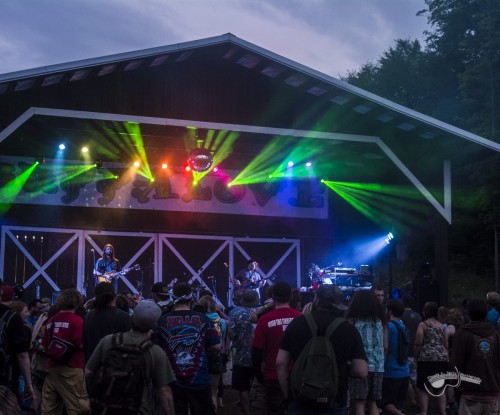
The third installment of Buffalove Music Festival saw a venue change from Cole Farm, Panama, NY, to North Fork Music Park, Warsaw, NY, with the new location offering four stages, a private beach, disc golf and wooded-area camping, and a record attendance that doubled previous years. With an impressive lineup including Kung Fu, Pink Talking Fish, Funktional Flow, Particle, Formula 5, Mister F, Space Junk, Dopapod, Aqueous and Aquapod, the three-day June 2015 festival created to celebrate Western New York’s emerging music scene was one for the books, according to Jen Foster and Thomas Sgroi:
Buffalove came through. Co-founder of Buffalive Productions and Founder of Buffalove Cody Conway clearly had one goal in mind: keep the energy as high as possible. Every single band had heads turning and jaws on the ground. There was never a lull, never a band that just played to fill space. Every minute was dance-worthy. If you missed out this year, we can highly recommend you don’t make that mistake next year. Without any problems or unruly attendees, this festival made its mark at North Fork Music Park in Warsaw, NY. The amount of talent coming out of Upstate New York is only paving the road for more incredible shows. Buffalove, you certainly were lovely.”
Another summer fest that saw a venue change was the fifth annual Disc Jam Music Festival, which moved from Massachusetts to New York State—and promoters recently announced that the event will return to Gardner’s Farm in Stephentown for its sixth year in June. Throughout four days of music, camping, disc golf and Flow Tribe, festivalgoers experienced live performances from more than 50 acts, including Lettuce, Electron, Dopapod, Aqueous, Brightside, Kung Fu, Consider the Source, Cabinet, Soule Monde, Roots of Creation, Formula 5, The Hornitz, Soul Rebel Project, Broccoli Samurai, Krewe de Groove and Relative Souls. According to Dave DeCrescente, the festival’s last day culminated with a “healthy dose of guest sit-ins” with jamband Twiddle, noting that:
One of the highlights of the set was the massive guest sit in with DJ Honeycomb, James Woods, and Joe Davis from Formula 5, Scott Hannay of Mister F and Todd Stoops for the ultimate mega jam on “Apples.” The Disc Jam Flow Tribe was out in full force with fire spinners and hooping entertainers that were almost as mesmerizing as the music. The weekend ended just as it started, with mind blowing music and a close knit community who continue to make the Disc Jam Festival special. Tony Scavone and crew did a suburb job of organizing the 5th annual Disc Jam with a new location but still the same friendly, loving festival experience that keeps fans coming back each year.”
While Catskill Chill is speculated to make a move to Lake George in 2016, the festival’s last waltz at bucolic Camp Minglewood in Hancock, NY, this September was a success, selling 5,000 tickets, according to Chill promoter Dave Marzollo. Headlined by moe. who kicked off their fall tour at the festival and including other bands like Lotus, Zappa Plays Zappa, Lettuce, Twiddle, Turkuaz, Dopakuaz plays Studio 54 and The Motet, the sixth annual installment of Catskill Chill featured on-site cabin rentals, daily yoga, live art, a farmer’s market, craft and food vendors, a communal bonfire nightly and an open mic. The three-day event was packed with guest sit-ins and collaborations like Dopapod and Turkuaz joining forces to play as Dopakuaz, which Chill organizer Josh Cohen noted is the type of community mindset that sets this festival apart from others its size or larger by creating an environment where rising bands can experiment and grow in a unique setting:
Point is that when comparing us to larger festivals, we’re at this cool stage attendance-wise where in many band’s cases we have the best ‘music’ out there in our prime slots. I love tons of bands who’ve been around since the ’90s or earlier but there’s nothing like seeing musicians in their youthful stages, when creativity is just exploding and you can feel it dripping off the stage as opposed to later-in-their career bands who are playing mostly songs they first wrote and fell in love with decades earlier.”
It’s no surprise that Magnaball takes the cake for this category. During late August more than 30,000 phans invaded Watkins Glen International race track for Phish Festival 10. And while the three-day event took place at the site of their 2011 Superball IX festival, this time around the setup featured many upgrades, including local and regional food vendors, the five-course restaurant Festival Ate, MagnaWater Program, speciality Phish-themed cocktails and coveted craft beer from Lawson’s Finest Liquids and Hill Farmstead. (And let’s not forget to mention the interactive Glurt Institute, Drive-In movie theater, JEMP Record Store and cornhole tournament.) The Vermont quartet majorly delivered throughout the weekend’s eight sets busting out rare tunes like “Mock Song” and jamming out typical breather ballads such as “Prince Caspian” to uncharted territory, but perhaps one of the highlights was the Saturday festival tradition of performing a late-night set, which according to Pete Mason raised expectations for future secret sets:
Magnaball’s foray into the history of Phish’s special festival sets was the Drive-In Jam and it raised the bar while putting forth a performance on par with the ‘Storage Jam,’ if not exceeded this established upper echelon of improvisation. On a 183-foot movie screen, a wide array of visual treats combined with a progressively growing ambient jam that eclipsed the Lemonwheel by a longshot and morphed into a full on jam for 50 minutes. The Drive-In Set raised the bar for surprise performances and gave fans a treat after the music on the main stage ended an hour prior.”
If you aren’t from the Capital Region of New York, there’s a good chance you’re missing out on a little gem called Let’s Be Leonard, a five piece rock, jazz, fusion from Saratoga Springs. Hell, even if you live in Albany there’s a chance they’ve slipped under your radar as they’ve only officially formed in March 2015. This was the case for me, although I’m not sure how this happened given their surge in popularity in the spa city and rapidly growing fan base. They have even played Albany street fests Pearlpalooza and Lark Fest.
Regardless of my own lack of exposure, I recently wised up and sat down to listen to their debut album, Cow, just released on November 29. The album is really quite enjoyable, with a few mellow and romantic tunes sprinkled among a largely high energy and up-beat selection of original songs.
According to guitarist Karl Bertrand, he and Matt Griffin, also on guitar, met saxophonist Connor Dunn at Schenectady County Community College just last year. They added drummer Paul Guay and bassist Chris Cronin in March to complete their ensemble. While the album provides a chance for all members to shine to different degrees, it is Dunn whose impressive and smooth notes serve as the lead in most songs.
The strongest tracks on the album include “Rocky Road,” and “Kindergarten Blues,” which, not surprisingly, blend rock and blues. “Young Sprite” is blues heavy with velvet smooth layers of jazz. Listeners are sure to find themselves wrapped up in the groove with a good head bob – the universal body language for “I’m digging this!” The young band has gone beyond having just potential, they sound like the real thing.
Another sign of Let’s Be Leonard’s sudden, yet warranted, rise in popularity is their inclusion on upcoming bills with other local and better known favorites. They’re scheduled to open for Mister F on December 26, and for Wild Adriatic on New Year’s Eve. Both shows are at Grizzly’s Bar and Kitchen, just over the border in Stratton, Vermont. They’re also opening for Lucid at the Putnam Den on January 1. But for the hard evidence, check them out on their own turf at Café Lena in Saratoga Springs on December 22. Based on both rumors and, now, my own listening experience, I would bet it will be one of many packed shows to come.
Check out their Facebook page for information, music, photos and more
Erin Clary: What or who inspires your music? Karl Bertrand: We definitely draw influences from the Grateful Dead and Dave Matthews Band in terms of song form and arrangement, we also are influenced a good deal by use of jazz harmony from a variety of artists.
EC: What is the ultimate goal of “Let’s Be Leonard?” KB: To throw a killer show on the Moon.
EC: How did LBL come to be? KB: Our three founding members, Karl Bertrand, Matt Griffin, and Connor Dunn met while studying music at Schenectady County Community College close to two years ago and we met our current bassist, Chris Cronin, and drummer, Paul Guay, through the Saratoga/Glens Falls music scene in Winter/Spring of this past year
EC: How old are you guys? KB: We range in ages 21-23
EC: Is there a theme to your debut album, Cow? KB: We’d probably have to say the theme to Cow is kind of like a day in the life of a kindergartner. A lot of the songs are generated by feelings you have at the best time in your life: childhood.
EC: Do you play all originals at your shows? KB: We do play mostly originals, we do a number of Dead covers though and a few others as well.
EC: Where does the name “Let’s Be Leonard” come from? KB: The name comes from a couple of our members having a convo about possible band names, someone said “let’s be ‘Leonard’” as in just Leonard and someone realized “Let’s Be Leonard” had a pretty little ring to it.
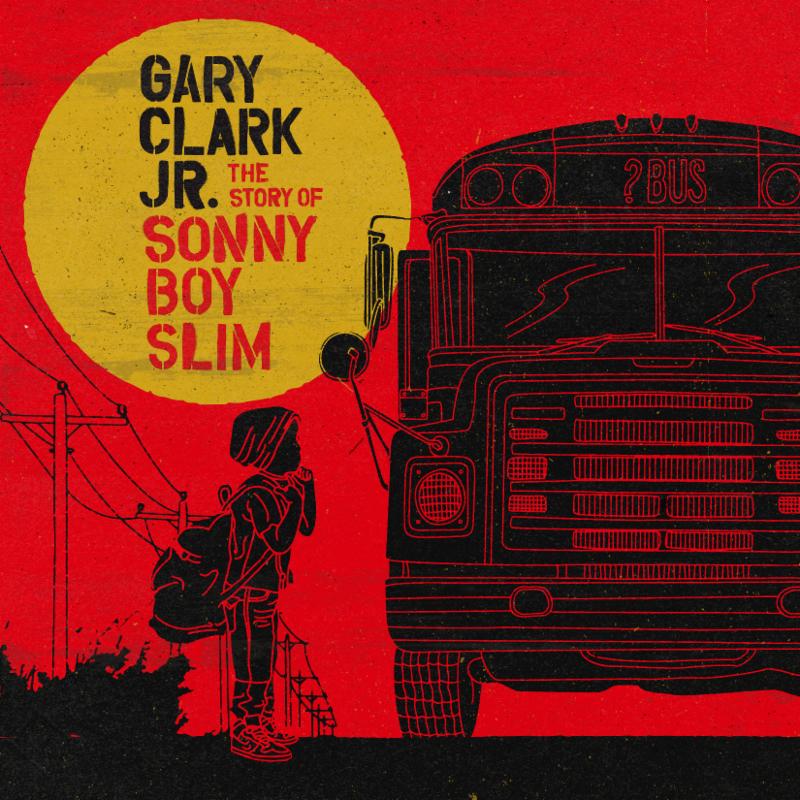
In his recently released sophomore studio album, The Story of Sonny Boy Slim, Texas blues man Gary Clark, Jr. shows the world the true extent of his versatility. With a mix of blues, funk, and soul, Clark proves, more than we’ve seen from him so far, his ability to produce a multifaceted sound.
The album’s second single, “Grinder,” prominently features screaming guitar solos wrought with a Hendrix influence. On the other hand, “Star” and “Cold Blooded” dial back on the licks and show off a funk-soul combo reminiscent of Stevie Wonder and Curtis Mayfield. Clark brings “Church” in a direction we’ve had yet to see from him: Clark, his guitar, and his harmonica combine to create a beautifully written acoustic track with just the right mix of gospel and soul.
Clark has always shown a natural ability to mix modern soul themes in with more traditional blues themes, but perfects this ability in The Story of Sonny Boy Slim. For example, “Wings” and “Can’t Sleep” contain lyrics appealing to the listener interested in a more modern “party” sound, a la John Legend, but also incorporate classic funk and blues guitar.
The Story of Sonny Boy Slim is an album that can be enjoyed by young and old due to its masterful fusion of classic blues with neo-soul. In addition to the fact that Clark produced the album, true music lovers can appreciate that he also played many of the instruments. As the album is surely his best studio work so far, fans can look forward to a very bright future for Gary Clark, Jr.
Grammy-nominated producer Dave Cobb has rounded up some of Nashville’s best and brightest country and Americana stars for an upcoming compilation album.
The 12-track record titled Southern Family features artists Chris and Morgane Stapleton, Jason Isbell, Shooter Jennings, Zac Brown, Rich Robinson (of The Black Crowes), Miranda Lambert, Anderson East, Jamey Johnson, John Paul White (formerly of The Civil Wars), Brandy Clark, Brent Cobb and Holly Williams.
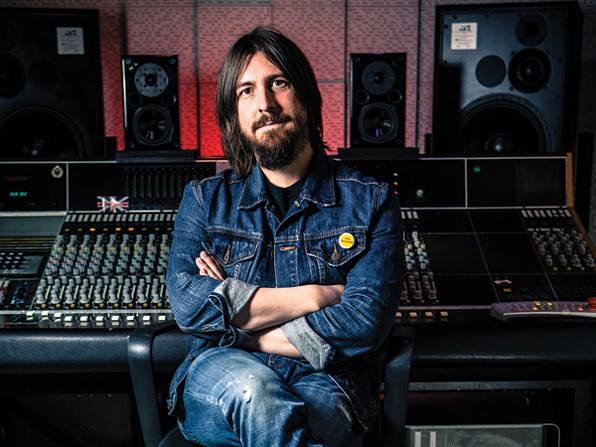
According to MusicRow, the album was inspired by 1978’s Civil War concept album White Mansions that featured notable musicians Waylon Jennings, Eric Clapton and Jessi Colter, and for this latest project, the acclaimed producer gathered “all of my friends on one record” to share a collection of stories about growing up in the South.
Dave Cobb is best known for his work on Sturgill Simpson’s Metamodern Sounds in Country Music (2015 Americana Music Awards Artist and Song of the Year), Isbell’s Southeastern (2014 Americana Music Awards Album and Artist of the Year) and Something More Than Free and Stapleton’s Traveller (2015 CMA Awards Album of the Year).Cobb has also produced records for Houndmouth, Honey Honey and Lake Street Dive. This year he is nominated for several Grammy Awards, including Producer of the Year, Traveller is up for Album of the Year and Best Country Album and SMTF for Best Americana Album.
Southern Family is expected to be released on Cobb’s own label imprint Low Country Sound/Elektra Records on March 18.
Southern Family Track List:
1. John Paul White, “Simple Song”
2. Jason Isbell, “God Is A Working Man”
3. Brent Cobb, “Down Home”
4. Miranda Lambert, “Sweet By and By”
5. Morgane Stapleton with Chris Stapleton, “You Are My Sunshine”
6. Zac Brown, “Grandma’s Garden”
7. Jamey Johnson, “Momma’s Table”
8. Anderson East, “Learning”
9. Holly Williams, “Settle Down”
10. Brandy Clark, “I Cried”
11. Shooter Jennings, “Can You Come Over”?
12. Rich Robinson (featuring The Settles Connection), “The Way Home”
Sister songwriters Alison and Zoë have assembled a handful of heartfelt folk songs for their debut Ep Home Is… The five song collection released Aug. 19, exudes a nostalgic sentimentality fit to be wrapped in brown paper and tenderly tied together with twine. Their music is less about perfecting instrumentation or inventing a new sound, instead focusing on shaping a familiarity and sharing honest, human stories to connect with listeners. The album was recorded, mixed, & mastered by Jeremy Johnson at Subcat Studios. Ryan B. Curtis cultivated the design and layout of the album cover and CD art, using a photo provided by Elisha Stasko.
Alison and Zoë’s songs act as melodic vehicles, taking the listener on a journey of relatable experience. As is often the case with traditional folk music, various elemental strands are weaved into their lyrics, rooted in the sisters’ adventures or borrowed from other folk songs gathered during their travels through Ireland and Great Britain. The album is an audible patchwork quilt of memories.
“Following That Star” showcases Alison’s rich, sturdy voice with support from Zoë’s delicate harmonizations, accompanied by simple guitar picking. Alison sings: “Our father’s mother said one day she’d get discovered/ And you know they say she sang just like me/ But she crossed to the other side and so she passed it down the line/ Now generations live vicariously through me.” The song centers on the theme of following a star, where the star could be a metaphor for a life path or the intuition to help guide someone down a particular life path. This metaphor would ring true for Alison and Zoë, whose song writing has become an intimately important foothold grounding them to their own individual yet entwined life paths.
The title track “Home Is…” begins with a straightforward guitar rhythm before both sisters chime in. They harmonize about singing together on a train, adding a meta layer to a song seeking to interpret the concept of home. Their lyrics suggest home not as a structural entity, but rather a feeling that can manifest through engaging with others, even in faraway landscapes. “This Song I Wrote” offers the notion of music as a healing mechanism. Alison and Zoë sing in unison: “I saved my marriage with this song I wrote/ I plucked the words out of my chest and I said darlin’ that’s the best I can do for you/ Then we got drunk on honesty and we fell back towards each other/ Remembering all the ways we fell in love in the first place.” The tender lyrics dance through a spectrum of emotions, intimately touching on feelings of love and heartache so accessibly that any listener can identify in some way.
Key Tracks: Following That Star, Home Is…, This Song I Wrote
When you think of music and New York City, many big names come to mind. Depending on your age and musical tastes you may think of George Gershwin or Cole Porter, Lou Reed or The Ramones, Jay-Z or Alicia Keys. For sure all those names are among the tapestry of our shared musical legacy; but any list of important musicians in New York’s history should also include Kurt Masur.
Like so many others who have shaped the ever-evolving artistic landscape of New York, Kurt Masur — pianist, conductor, and music impresario — came here from somewhere else. Born in Germany, this powerhouse in orchestral music rose from the desolate grayness of the Cold War to become a beacon of light helping to resurrect the once great New York Philharmonic to its proper place as the preeminent American music ensemble.
On September 11, 1991—a date exactly a decade later that would become synonymous with NYC— when Masur took control as Music Director, he had been guest conducting the orchestra for nearly ten years. At that time, the NYP was at a precarious point in its history. Popularity was waning and the previous directors, namely Pierre Boulez and Zubin Mehta, weren’t clicking with the fan-base or more importantly, charitable donors. Both of these Maestros were brilliant conductors, but like a great athlete that comes to the Yankees and falters under the big spotlight, they weren’t what the New York audience wanted.
Meanwhile, across Lincoln Center’s plaza, Director James Levine had Luciano Pavarotti and Placido Domingo to lure music fans to the Metropolitan Opera, and legendary dancer Mikhail Baryshnikov had led the American Ballet Theatre to huge success. With so much high-level competition so close, this faltering NY institution needed a change.
Orchestras are only as strong as its core members. To attract and retain a group of the most talented musicians on the planet, an orchestra must maintain its reputation. It was because of this uncertainty that many top-tier conductors turned down offers to replace Mehta. At the time, Masur wasn’t the first choice, wasn’t the popular choice, or the flashy choice. Over the next decade, however, with him in charge, he proved to be the best choice.
It was his hard work, dedication to rehearsal, and the orchestra’s respect for him that made him successful. But this wasn’t a foregone result. He had to overcome his player’s reluctance to change, petty infighting, and not a few unkind words from early critics. Worries that his choice of repertoire was too safe and traditional were soon overshadowed by the unparalleled quality that his orchestra brought that repertoire to life. What he lacked in showmanship he made up for in passion. Soon, this champion of the traditional classical music cannon quieted all his naysayers. Although it has been widely reported that he often clashed with the NYP Executive Director, and that ongoing feud led to his eventual dismissal (Masur admitted as much in an interview with Charlie Rose- May 21, 2002).
The eleven years spent at the helm were arguably the best years the orchestra experienced since the golden years of Leonard Bernstein (1958-1969). The orchestra traveled extensively making yearly excursions around the world, including the Philharmonic’s first trip to mainland China. Possibly the most notable performance abroad was the February 26, 2008 performance in Pyongyang with the landmark concert being broadcast internationally on CNN, and North Korean Television and Radio. This was an unprecedented cultural event between the U.S. and North Korea.
This act of diplomacy through music was not the first for Masur. As a non-communist East German living in Leipzig it took a level head, a strong reputation, and of course his musical talents to be allowed to travel abroad during this time. When tensions were at a high level during the years before the dissolution of East Germany, Masur often risked his own safety and career by defending street musicians under attack by the Stasi police. Several times he acted as mediator and calming voice when pro-democracy rallies threatened to get violent.
Despite this turmoil, Masur never forgot his ties to the place of his birth. When you lived in the same city as Bach, why would you? His career-long mastery of German masters like Beethoven, Brahms, and Bruckner made him popular among the purists and that was clearly his forte. His best recordings with the Philharmonic include these greats as well as Dvorak, Mahler and Schumann.
A sure highlight of his career was the first performance by the Philharmonic after the attacks of 9/11. What the New York Times called “His finest hour” was an emotional and poignant rendition of Brahms “German Requiem,” in honor and memory of those lost during the previous week’s disaster.
Always the teacher, Masur made a point to keep close contact with the notable music conservatories in New York. He alternated visits each year with the Manhattan School of Music and Mannes College of Music where he conducted each school’s orchestra in live performances. To be sure, these events were life changing to many students taking part. It was between rehearsals for one of these concerts that I was lucky enough to meet him myself while attending Mannes in the mid 90’s. Despite his serious countenance that was often mistaken for a strict demeanor, he was friendly and extremely generous on person-to-person level. Those of us fortunate to see that side of him, even briefly, will remember his warmth.
Besides working in New York, Mr. Masur was the principle conductor with the London Philharmonic, The Director of The National Orchestra of France, awarded membership to the Royal Academy of Music, honored with untold accolades and prizes, and performed with every major solo artist from Yo-Yo Ma to Pavarotti. He was a man of the world, but like anyone who makes it big in this town, he will be remembered forever for his time in New York City.
Kurt Masur died on December 19th, 2015 finally succumbing to Parkinson’s disease. He lived a full and musical life. Bravo Maestro, Bravo!
Dinosaur Bar-B-Que in Troy played host to a very special event this past Saturday for a band near and dear to the local music community. Nestled next to the Green Island Bridge on the riverfront, the famous barbecue joint’s back end was teeming with excitement as the Albany-based Formula 5 shuffled onstage for what would be their final performance of 2015. Perhaps more significantly, though, as the event’s poster artwork indicated, it was “Mike’s Farewell Show,” the last hoorah of keyboardist Mike McDonald with the band he helped start.
The band broke through the anticipatory bustle with the dark and searching prelude that introduced Jeff Beck’s “Freeway Jam.” The tune set the tone for the evening with a texture that was thick and blissful with melodious playing from guitarist Joe Davis. The music seamlessly morphed into the reggae-bounce and staccato hooks of “Coming Home.” Here the lyrical themes were appropriately reflective. With impressive precision in the rhythm section, the band jammed this one to an exuberant peak, McDonald banging passionately on the piano. A verse from the Talking Heads’ “Psycho Killer” was subtly dropped in the transition to Phish’s “Sand.”
Tucker Callander joined the band onstage to contribute energetic fiddle playing, helping bring “Mister Elixir” to a frenzied peak. Next up founding bassist Bill Shattuck was brought onstage, reassembling the original Formula 5 lineup. Stepping outside of time, where past and future merge into the eternal now, Shattuck led the band through the deep funk of “3 Ring Circus,” which gave way to a jam featuring F5’s new keyboardist Matt Richards. The first set ended with a poignant “Floating,” again featuring Callander’s fiddle and McDonald slicing it up on synth.
The second set opened with a twofer of guest vocals. First Brian LaPoint provided an authentic delivery of the Allman Brothers’ “Ain’t Wastin’ Time No More.” Then Bill Shattuck was summoned back to the stage, where after professing his love for and gratitude to the band, he danced and shouted his way through an uproarious version of Peter Gabriel’s “Sledgehammer.” A string of original songs was then triumphantly delivered. The rubbery but rhythmically exact style of James Woods’ bass playing supported and propelled the soaring jam on signature original “Hot Box.” Drummer Graig could be seen with eyes locked on any of his band mates, playing with nuance and finesse to bolster and compliment their contributions to the improv, or at times would play with eyes closed, engrossed in the tight aural soundscape F5 has increasingly mastered in recent years. Glittering guitar phrases from Davis scampered around in “The Clear,” and a “Little Drummer Boy” tease reminded the audience of the festive time of year despite unseasonably warm weather. The set culminated with a nod to the band’s full set of Phish covers performed at Dinosaur Bar-B-Que this past summer, this time uniting the crowd in celebration by debuting their version of “Run Like An Antelope.”
Mike’s Farewell Show was an even mix of Formula 5’s most memorable originals and heartfelt tributes to the band’s roots. Influence from Phish could be sensed in the texture and pacing of the group’s improvisations. Years of hard work were evident in the coherence of a band sounding tighter than ever. At one point departing keyboardist Mike McDonald took a moment to assure the crowd that “Formula 5 is going nowhere,” but not in that sense. Though the void at the end of the show was filled with chants of “Mike! Mike! Mike!” and McDonald will be moving on to life’s next adventure, Formula 5 demonstrated themselves to be a band with some staying power. Expect great things from this band in 2016 with keyboardist Matt Richards in the mix.
Setlist:
Set 1: Freeway Jam* -> Coming Home -> Sand# -> Coming Home, Mister Elixir+, 3 Ring Circus%, Floating+
Set 2: Ain’t Wastin’ Time No More^, Sledgehammer@, Hot Box, The Clear -> Ride -> Run Like An Antelope#
*Jeff Beck cover
# Phish cover
+ feat Tucker Callander on violin
% feat Bill Shattuck on bass/vocals & Matt Richards on keys
@ feat. Bill Shattuck on vocals
^ Allman Brothers Band cover feat. Brian LaPoint on vocals
Nashville’s All Them Witches played an hour-long set at The Bug Jar in Rochester that got started with a couple songs off their latest release, Dying Surfer Meets His Maker. Lead vocalist Charles Michael Parks, Jr. played the opening pair on the guitar, giving the band a heady two-guitar assault and leaving the low-end duties mostly to keys player Allan Van Cleave.
The band’s full force though came forth once Parks picked up his bass. His hair-raising blasts to open “The Death of Coyote Woman” powerfully proclaimed the band’s intention to beat the audience down to a pulp. Shirtless, dreadlocked, and bearded, drummer Robby Staebler pounded the music onward through its peaks and valleys. With Parks committed to the bass the rest of the set, Ben McLeod’s guitar stood stronger and Van Cleave’s work on the electric piano shone through more brightly. After a superb slide guitar solo and keys-led jam section, “Death of Coyote Woman” evcntually calmed to a standstill before rising again for a glorious finish. When the dust had settled, the song’s companion “The Marriage of Coyote Woman” rose from the ashes. Both songs appear on their 2014 release Lightning at the Door which they sampled from amply throughout the evening. “Marriage” showed off the bands blues leanings, and resulted in another quality improv session.
The heavy fuzzed-out “When God Comes Back” was a huge crowd pleaser, and played like the Devil’s rendition of “Young Man Blues.” Spoken word lyrics over a psychedelic guitar and keys accompaniment had the band channeling the Doors, but again, darker and eviler, on “Blood and Sand / Milk and Endless Waters.” The set came to a close with more bluesy rock and slide guitar on “Charles William.”
Setlist: Call Me Star, Open Passageways, Death of Coyote Woman, Marriage of Coyote Woman, Mountain, When God Comes Back, Dirt Preachers, Blood and Sand / Milk and Endless Waters, Charles William
New Madrid, out of Athens, GA, played an opening set of diverse indie-rock songs. Led by vocalist/guitarist Phil McGill, the band made the best use of their time, leaving little dead air and taking almost no time to address the audience. The music spoke plenty though. A mellow laid back rocker hinted at Mac DeMarco, a beautiful down-tempo instrumental was reminiscent of Explosions in the Sky, while an 80s style pop-rock tune saw McGill engaging in a whammy bar solo and exhibiting some freak-out dance moves. The quartet finished with a pair of major key fist-pumpers, the first featuring some inventive vocal looping while the closer played bright and bouncy.
From Athens to Nashville, it was a night of Southern rock of a different sort, on this Saturday night at the Bug Jar in Rochester, NY.
Video of two unreleased Wild Adriatic songs were released today from Otis Live. The tracks, “The One” and “Cruel Lovin,” are from Wild Adriatic’s debut performance at Otis Mountain Get Down from this past September. Performed on September 11, 2015 (also drummer Mateo Vosganian’s birthday), this video is part of Otis Live’s new series of videos, directed and edited by George Watts and produced by Watts and Quillan George.
Since Otis Live started, they have sought to create a platform for artists to gain exposure. The fall of 2015 marked the beginning of bringing this goal to life in a digital realm, with bi-weekly releases of diverse live performances from on and off the mountain. An interview with Wild Adriatic here.
Otis Mountain Get Down is an independently & cooperatively produced festival in the heart of the Adirondacks in Elizabethtown, NY. Otis is an open, intimate and affordable festival, offering an eclectic and unique mix of artists and genres. Otis Mountain encourages new and meaningful interactions with art, music, the outdoors and each other, while embracing and supporting our local communities, music and culture. The festival is held each September and was named one of the “Top 5 Lesser Known (But Incredible) festivals for artists to play” in 2015 by Sonic Bids.






 According to guitarist Karl Bertrand, he and Matt Griffin, also on guitar, met saxophonist Connor Dunn at Schenectady County Community College just last year. They added drummer Paul Guay and bassist Chris Cronin in March to complete their ensemble. While the album provides a chance for all members to shine to different degrees, it is Dunn whose impressive and smooth notes serve as the lead in most songs.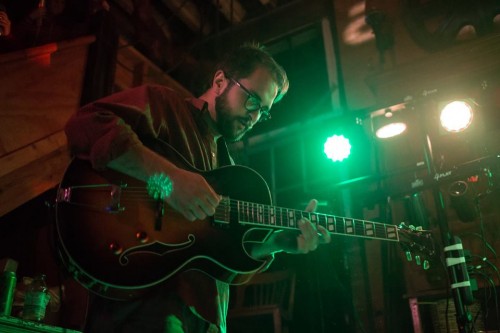
 The album’s second single, “Grinder,” prominently features screaming guitar solos wrought with a
  According to
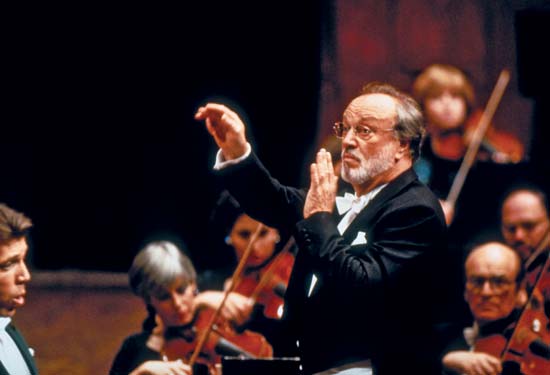 Like so many others who have shaped the ever-evolving artistic landscape of New York, Kurt Masur — pianist, conductor, and music impresario — came here from somewhere else. Born in Germany, this powerhouse in orchestral music rose from the desolate grayness of the Cold War to become a beacon of light helping to resurrect the once great New York Philharmonic to its proper place as the preeminent American music ensemble.

 The band’s full force though came forth once Parks picked up his bass. His hair-raising blasts to open “The Death of Coyote Woman” powerfully proclaimed the band’s intention to beat the audience down to a pulp. Shirtless, dreadlocked, and bearded, drummer Robby Staebler pounded the music onward through its peaks and valleys. With Parks committed to the bass the rest of the set, Ben McLeod’s guitar stood stronger and Van Cleave’s work on the electric piano shone through more brightly. After a superb slide guitar solo and keys-led jam section, “Death of Coyote Woman” evcntually calmed to a standstill before rising again for a glorious finish. When the dust had settled, the song’s companion “The Marriage of Coyote Woman” rose from the ashes. Both songs appear on their 2014 release Lightning at the Door which they sampled from amply throughout the evening. “Marriage” showed off the bands blues leanings, and resulted in another quality improv session.
 The heavy fuzzed-out “When God Comes Back” was a huge crowd pleaser, and played like the Devil’s rendition of “Young Man Blues.” Spoken word lyrics over a psychedelic guitar and keys accompaniment had the band channeling the Doors, but again, darker and eviler, on “Blood and Sand / Milk and Endless Waters.” The set came to a close with more bluesy rock and slide guitar on “Charles William.”
 New Madrid, out of Athens, GA, played an opening set of diverse indie-rock songs. Led by vocalist/guitarist Phil McGill, the band made the best use of their time, leaving little dead air and taking almost no time to address the audience. The music spoke plenty though. A mellow laid back rocker hinted at Mac DeMarco, a beautiful down-tempo instrumental was reminiscent of Explosions in the Sky, while an 80s style pop-rock tune saw McGill engaging in a whammy bar solo and exhibiting some freak-out dance moves. The quartet finished with a pair of major key fist-pumpers, the first featuring some inventive vocal looping while the closer played bright and bouncy.