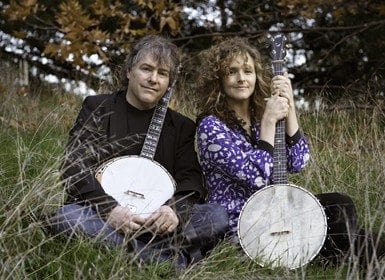
Béla Fleck and Abigail Washburn arent just virtuoso banjo players – they’re also husband and wife. Together, Fleck and Washburn employ the relatively rare 3-finger and clawhammer banjo duet to create an explosion of musical white heat. Add in Washburn’s voice and you have a night of musical magic waiting for you at Troy Savings Bank Music Hall on Friday, October 24.
These two banjoists have mastered the deceptively intricate art of the duet. Their performances embrace a diversity almost unthinkable – coming from just two banjos and one voice. Washburn’s beguiling composing, playing and singing blend with Fleck’s riveting and virtuosic musicianship to create music both unique yet familiar in texture.
Fleck is a 15-time Grammy winner who has collaborated with Chick Corea, Oumou Sangare, Zakir Hussain, Edgar Meyer, Dave Mathews, Earl Scruggs, and the Buffalo Philharmonic Orchestra for his Banjo Concert ‘The Impostor’. Washburn’s banjo has taken her far beyond the usual old-timey comfort zone, musically and geographically. An alumnus of Uncle Earl, the powerhouse all-female stringband, Abby’s adopted second homeland is China, and her music resounds with echoes of Appalachia and the tidal wave of emerging Chinese cultural influence.
Tickets for Béla Fleck and Abigail Washburn at Troy Savings Bank Music Hall are $25-42 and can be purchased at the box office or online.
Though indiscriminant from the outside, passing beyond the entry is a portal into another time. In an era during the booming peak of industrial America, Troy hustled and bustled with growth. As a result of successful patronage to Troy Savings Bank, a music hall was gifted to the public. In 1870, the Board of Trustees of the bank moved its offices to a new building, located at 30 Second St, that included a music hall on the upper floor. George Browne Post was the hired architect.
Troy Savings Bank Music Hall is an acoustic marvel with no clear reason as to why. Many have attributed the sound quality to variables like hard walls, ratio to length, width and height, stage dimensions, interior design and textures. However, it wasn’t until 1890 when an Odell concert organ was installed that the hall reached it full acoustical potential. The organ was eight years old at the time of purchase belonging to millionaire William Beldon. The organ has remained untouched since its installation with the exception of routine maintenance. According to the Troy Savings Bank website, the organ is “the nation’s largest nineteenth-century concert organ in original condition.”
Just as a nation struggled with the ups and downs of the economy over the last hundred years, so had the hall. As the twentieth century developed the advent of radio and television provided cheaper and easier means of entertainment. However, in 1979, the Troy Savings Bank Music Hall Corporation was formed as a not-for-profit organization to restore and maintain the hall. In 1989, the hall was named a National Historic Landmark. Today, The Troy Savings Bank Music Hall is operational.
The Troy Savings Bank Music Hall continues to carry on tradition. Historically, a great musician of their time rarely failed to include the hall on an American tour. World-renowned performers are booked year round from singers and songwriters to orchestras and comedians. Every artist, every performance seemingly captures the essence and glory of the halls storied past. Every wooden chair is equipped with metal bars located on the back and on the underside of the seat. Hinting to the past, the bars held top hats and the scarves. Indeed, Troy Savings Bank preserves history and magnificence.
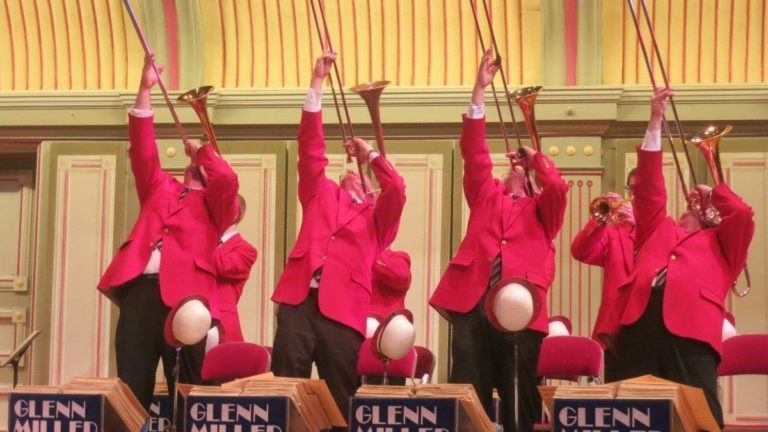
Inside one of the Capital District’s oldest music venues, the Glenn Miller Orchestra brought back the RCA Records sound of the 1930s and 40s amid the pastel pink, green and white interior of Troy Savings Bank Music Hall. While there are no original members, an observation bandleader Nick Hilscher made, eliciting a ripple of laughter from the crowd, they are workhorses, performing 48 weeks a year on tour with typically five shows each week. Honed and polished, the band was the sound of perfection in their extensive catalog of hits from the Big Band era of American music.
With conductor/singer Hilscher, who was classy and decked out in a suit, the 16-piece band played a brief “Moonlight Serenade” to open the show, establishing the most notable Glenn Miller song’s smooth jazz as the theme of the evening. “Caribbean Clipper” and “Tuxedo Junction” followed, with intermittent applause after each orchestra member’s solo. Derbys, plungers, wah-wah and solo-tone mutes were used at various times by the four trombonists – George Reinert, John Tyler, Joe Zeigenfus and Jason Bennett – altering the sound to that of big bands from the pre-World War II era. Following “Serenade in Blue” from the 1941 film Sun Valley Serenade, featured singer Natalie Angst came out to sing “String of Pearls” and “Church on Time”, a golden voice that sounded like it had lept from the movie musicals from the same era.
Glenn Miller, having enlisted in the war effort, he formed a band in the Army Air Force, from which the classic “Begin the Beguine” originated. Alternating brass and woodwinds were featured on “The White Cliffs of Dover”, particularly by Christopher Hearld and Kevin Sheehan whose clarinet was a soothing presence.
Recalling the Modernaires, a vocal group who performed with Glenn Miller in the 30s and 40s, today’s Glenn Miller Orchestra has the Moonlight Serenaders, including Natalie Angst and band members Joe Zeigenfus, Kevin Sheehan and Ian O’Beirne, along with Nick Hilscher. Singing “Chattanooga Choo Choo”, (the first ever gold record with 1.2 million sales), the audience was moved to sway and sing along with the American classic. A unique comedy/parody tune, “Conchita Marquita Lolita Pepita Rosita Juanita Lopez” from the movie Priorities on Parade, fit the Moonlight Serenaders perfectly. The first set ended with “The American Patrol”, dedicated to the veterans in the audience, who stood up at Hilscher’s request, making up roughly 10% of the men in the audience.
After a short break, the band returned to continue the night with a “Pennsylvania 6-5000”, “Pennies from Heaven” and “The Lady is a Tramp”. These three familiar numbers put the Music Hall’s incredible acoustics front and center, which have been experienced by thousands since opening in 1875. With big bands having played the room since over the past 140 years, the Glenn Miller Orchestra was well aware of the fabled legends that had preceded them. Closing with “Don’t Sit Under the Apple Tree”, “In the Mood” and a full version of “Moonlight Serenade”, as well as an encore of Eddie Durham’s “The Tiger Rag”, a speedy club jazz number, featuring piano from James Navan, the current incarnation of the Glenn Miller Orchestra brought a sound from the 20th century and reintroduced it into the American music catalog of the 21st century.
The Glenn Miller Orchestra, known for classics such as “In the Mood”, “Chattanooga Choo Choo”, “A String of Pearls”, “Moonlight Serenade”, and “Tuxedo Junction”, will bring the famed bandleader’s legendary music to to Troy Savings Bank Music Hall on Thursday, May 8th.
Although bandleader Glenn Miller disappeared over the English Channel on December 15, 1944, almost 70 years after the public first embraced the successful Glenn Miller sound, the legend and the music live on. The Miller Estate formed the present orchestra in 1956 and the band, which includes two vocalists, has been touring constantly ever since, playing an average of 300 live dates a year around the globe. It returns to the Hall after selling out its 2011 engagement here!<
 These two banjoists have mastered the deceptively intricate art of the duet. Their performances embrace a diversity almost unthinkable – coming from just two banjos and one voice. Washburn’s beguiling composing, playing and singing blend with Fleck’s riveting and virtuosic musicianship to create music both unique yet familiar in texture.