The Electric Sextet of Hot Tuna returned to The Egg, with Teresa Williams, almost seven years to the date of the last Hot Tuna performance, an acoustic duo, on Dec. 11, 2007. Hundreds of old hippies and couples with more than a touch of grey, excitedly attended the performance; some enthusiastic enough to cheer loudly for Jorma Kaukonen and knew every song and dove head first into every jam alongside the band. Donna the Buffalo opened the night with a very powerful set, garnering chatter in The Egg’s lobby, with a new fan, Susan, remarking ‘Oh they’re so much fun!’ in her first time seeing them.
With Hot Tuna taking the to stage, the audience roared with approval, seeing Jack Casady and Jorma Kaukonen and a nearly 50 year relationship playing music together. Alongside them stood Larry Campbell on guitar and fiddle, Barry Mitterhoff on mandolin and Justin Guip on drums, an all-star lineup that welcomed Teresa Williams for part of the set. The alt-country of “Mama Let me Lay it on You” featured Campbell’s fiddling, “Ode to Billy Dean” brought out Tuna’s blues origins and “Can’t Get Satisfied” had a hint of Freddie King’s “Going Down” and was far from radio play, as much of the night’s songs would be; Hot Tuna is an overlooked predecessor to the early jambands that developed in the 1970s and ’80s. Jorma took a moment to respond to the continuous cries of “JORMA!” from an audience member, saying “That’s my name, don’t wear it out.”
A progressive jam build from “Been so Long” when Campbell took to the mandolin, which led to Teresa Williams coming to the stage for the first song of the night, the enthusiastic traveling country blues of “Children of Zion” and “Wade in the Water” which was full of energy and had Williams dancing all over in a circle.
Teresa later returned for “White Rabbit” with its foreboding bass line from Casady. Feed your head? Feed your ears with this wonderful voice that was on par with Grace Slick in her heyday. Jack strutted around the stage as “Mourning Interrupted” began and when the band found that one groove in the and stated into the jam, the clear highlight of the night was at hand. There was no ADD here, and not just because they’re too old for that $#!&. A cover of “Deep Ellum Blues” featured Williams and Campbell on vocals, a tune he sang frequently when he toured with Phil Lesh & Friends’ in 2006. “Sugaree” with Teresa featured solos from everyone, resulting in the longest song of the night. To cap the night, the band played the classic “Funky #7” which delved into psychedelic rock before moving into a prog jam, with big jamming to end it, alongside Teresa’s revival-level of energy. Let’s hope it doesn’t take seven years for Hot Tuna to play The Egg or Upstate New York in the future.
Setlist: True Religion, Mama let me lay it on you, Ode to Billy Dean, Can’t Get Satisfied, Been so Long, Children of Zion, Wade in the Water, Second Chances, White Rabbit, Mourning Interrupted, Deep Elum Blues, Bar Room Crystal Ball, Sugaree
November 22 at The Egg brings The Touré-Raichel Collective to the Swyer Theater, part of the Rhythm International concert series. Featuring Malian guitar virtuoso Vieux Farka Touré and Israeli superstar pianist Idan Raichel, both of whom have developed an inspirational collaboration and artistic kinship that creates an intercultural free-form acoustic masterpiece, crossing boundaries of country, culture and tradition.
Often referred to as “The Hendrix of the Sahara”, Vieux Farka Toure is known for his speed and dexterity on the guitar, and is considered one of world music’s true stars. Idan Raichel is a keyboardist, producer and composer known around the world for his ambitious cross-cultural collaborations that changed the face of Israeli popular music. Vieux Farka Touré and Idan Raichel met by chance, in 2008 at the Berlin airport, where they expressed mutual admiration and a desire to work together. Touré’s father, the legendary Ali Farka Touré, was one of Raichel’s musical heroes and the two went to Israel and recorded The Tel Aviv Session, which found musically beautiful common ground between the artist’s cultures. This was followed by The Paris Session and international touring.
Tickets are $29.50 and are available at The Egg Box Office at the Empire State Plaza, by telephone– 518-473-1845 – or online.
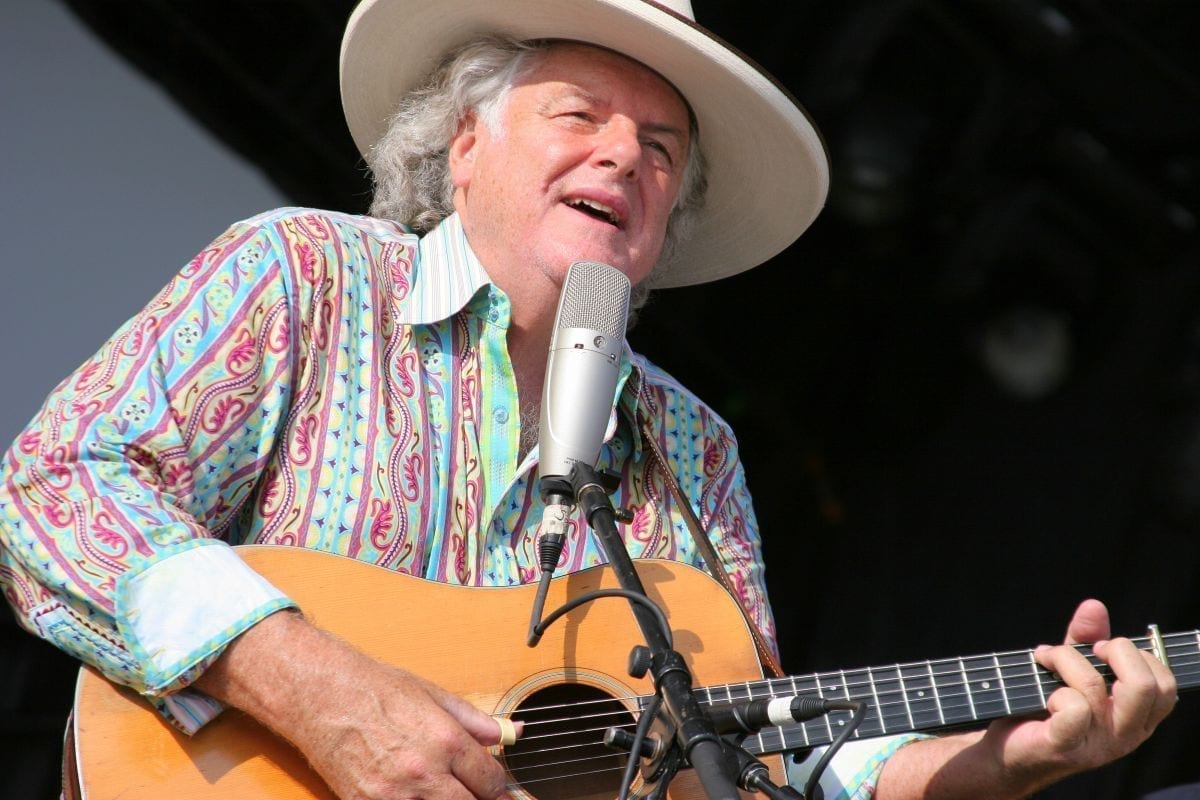
In referencing how music becomes something tangible to the world, Peter Rowan describes in a new interview how the transient process as “a strange and mysterious thing.” The words mirror his spiritual and philosophical existence on this plane. Peter Rowan has traveled near and far and with him, the adventures of playing music and the lessons of deep spiritual focus which have become interconnected within him on a cellular level. He is the commander-in-chief, the leader of contemporaries, the principle musician, the Buddhist guide and the forerunner of song compositions. He has collaborated with legends, he’s made albums with icons, he has written songs that are often covered by others and album’s that impacted musical direction.
Tabitha Clancy: Lets begin with your most recent works, of which two were released this year. Can you tell me about Dharma Blues?
Peter Rowan: I wrote that material while I was on pilgrimage to Nepal and India while doing concert dates in Japan. It was a mid-life journey. To have purgatory, paradise and hell – those are states of mind. To go on pilgrimage you actually leave behind your own world and engage in spiritual energy. Once I got to India and Nepal, my mind was open and songs started coming intensely. It was as if I was waiting my whole life to go on this journey. You surrender your baggage.
TC: When did you travel to Nepal and India?
PR: Well the first time in 1992, then I went back 1996, 2002, well, every decade. I would combine it with my Japanese dates.
TC: As musician you seem to create from the heart. How do your songs come together for you?
PR: On Dharma Blues there is a song called “Arise.” It is sort of a vow. It is the first vow someone on a spiritual path would make by sacrificing your own suffering and enlightenment for the enhancement of others. It begins by realizing all beings have been your parents. So in a way, that’s the prayers I was saying. I rehearsed different ways of playing. It’s been six years before I recorded it. I lived with those songs for a long time until I could be really comfortable with them. That’s one way of looking at it. It’s a strange and mysterious thing how any kind of music will see the light of day.
TC: What do you think about the progression of the bluegrass genre?
PR: I think it’s all great. My whole thing is I’ve been wrapped up in my own stuff. Basically I’m a songwriter whereas these other bands are about entertainment value and instrumental work. To me bluegrass has great potential for extended instrumental solos. All these bands tip their hats to Old In And The Way. I was a Bluegrass Boy; there is a self-imposed idea that I have to bring the tradition. You can draw a line and say bluegrass begins and ends at this certain traditional sound, beyond that it’s a progression of bluegrass. Right now, I don’t fit the category anymore.
TC: Can you tell me what those early years were like for you?
PR: Both my parents were musicians. My uncle Jimmy came back from World War II and brought back grass skirts and coconut bras and we all put them on and danced in living room while he played a ukulele he won in a poker game.
There was a big music scene Cambridge, MA and bluegrass was a part of it and I started playing bluegrass with different folks. Then Bill Monroe came to town and hired me to join his band.
TC: What was that like for you?
PR: Oh, it was scary! By the time I was 24, I was on the road with Bill Monroe. That is a big subject. I can tell you, when you share a mic with another, you do learn to project your voice. Ok, here’s the difference, to be really bluegrass it has to be acoustic instruments over a microphone. The point is, what I learned from Bill Monroe is projecting voice and projection of your instrument to cut the mic. And you call it “cut the mic.”
TC: You have countless collaborations and creative projects under your belt. Is there any project that stands out for you, the one album, show or musical adventure that you are proud of that you felt set you on you on your path?
PR: I’d say Old In And The Way, and the fact that I put out “In The Land of Navajo,” “Panama Red” and “Midnight Moonlight” on the same record was me finding my voice. It wasn’t that to me at that time; it was just exciting. Of course, playing with incredible greats. I’ll just give you dates and names: 1965, Bill Monroe; 1970, Jerry Garcia and Vassar Clements; all along there’s David Grisman; 1975, Flaco Jimenez. To my enjoyment, I played with these greats. In the 1980’s, Jerry Douglas and Sam Bush – you know these are contemporaries. Into the nineties, we were becoming iconic. I ended up playing with Tony Rice for twelve years. He was a huge inspiration to me.
It’s been a wonderful evolution. I have my own bluegrass band now. I started writing in the first person six years ago. I feel like I’m able to share more. I like to tell stories. I like to pass on what I know.
TC: Last year you toured with Yungchen Lhamo who is someone whose musical presentation is quite different from Western style music. Where did you meet Yungchen?
PR: Years ago I was complaining that bluegrass seems limiting. So, Charles Sawtelle (Hot Rize) gave me Yungchen’s record. I listened to it for a long time both critically and joyfully. Years went by and two years ago I played a festival and saw she was on the bill. We kind of started connecting and so I invited her out to Rocky Grass in Colorado. So, I did a traditional bluegrass set and then I had Yungchen come out. We never really solidified what we do together. She did an opening prayer and then sang several of my Dharma songs with me. It was the first time we tried it on stage and it really worked. She’s an inspiration for me. She’s so direct in her approach. She made me realize that you don’t have to shy away. If you do it, just do it!
TC: You are currently touring the Northeast. What can we expect from the show at The Egg in Albany? Are you touring solo?
PR: I’m solo, that way I can tell the stories. The challenge is bringing it down to one person and let those influences be there.
Peter Rowan will be at The Egg, Saturday, November 15. Tickets available at the box office or online.
Southside Johnny & The Asbury Jukes played a rocking two hour set at The Egg on October 18. Although the venue wasn’t sold-out, everyone who was in attendance was either dancing in the aisles or dancing in their chairs. Southside played songs spanning his whole career and even took requests from the crowd. He was in a joking mood, mentioning how Buffalo has the worst snow in the world, New Jersey will transform Ebola into lobster like creatures because of their pollution, and how it’s impossible to find your way into The Egg itself. With more than 40 years under their belt, Southside and The Jukes show no signs of slowing down anytime soon.
Set 1: Angel Eyes, Forever, This Time Baby’s Gone for Good, Walk Away Renee, Harder Than it Looks, Key to the Highway, Strange Strange Feeling, Take it Inside, Rhumba & Coke, Got Me Where She Wants, This Time It’s For Real, Without Love, Some Things Just Don’t Change, On The Beach, Talk to Me, Working Too Hard, Passion Street, Fever, Trapped Again, Havin’ A Party
Encore: Ooh Poo Pah Doo, I Don’t Want To Go Home, Hearts of Stone
It’s been eight years or so since I last saw Drive by Truckers, the Athens, Georgia rockers led by Patterson Hood, and while they stood out at my last experience seeing them, Sunday Oct. 19 at The Egg Performing Arts Center was a different case. While the band was louder than expected, the vocals kept the focus on the instruments.
Drive by Truckers play both kinds of southern rock – ballads and straight fire rockers. They flip-flopped between the two throughout the night, notably played a Franz Ferdinand-esque “Where the Devil Don’t Stay” followed by “The Opening Act” a slow number that found Hood channeling Van Morrison’s vocals. The at times feisty crowd cheered for “The Opening Act” which Hood previewed as a ‘different kind of song for a different kind of room,’ this being their first time at The Egg.
Keyboardist Jay Gonzalez shone throughout the night, a steady highlight in every way, especially on a song that could have been pulled from Tom Waits’ catalog. A honky-tonk song became story time/spoken word with Hood carrying on a ramble like Jerry Joseph or Arlo Guthrie on an extended “Alice’s Restaurant”.
The encore break resulted in four additional songs – Hood channeling Janis Joplin followed by “Bulldozers and Dirt” the song that garnered the most approval from fans and the most recognizable song of the evening. A ballad/rocker followed, then a fair amount of extended jamming ensued on the finale; each band member looping their instrument as they walked off stage, one at a time. By the time the house lights came up, a lackluster performance was the main takeaway this evening
Southern rockers Drive By Truckers will perform at The Egg Performing Arts Center on Sunday, October 19th at 7:30 PM as part of the American Roots & Branches concert series.
Drive by Truckers boast a mix of Southern pride, history, folklore, politics, and character studies and have quickly risen to become one of today foremost alternative country-rock bands. This will be their debut performance at The Egg in support of their new, critically acclaimed recording English Oceans. Read a review of Drive by Truckers’ latest album English Oceans by Garrett K. Woodward.
Tickets are $29.50 and are available at The Egg Box Office at the Empire State Plaza, by telephone – 518-473-1845 – or online.
Drive by Truckers start things off in NYC at the famous Beacon Theater on Friday, then head to the Electric Factory in Philadelphia this Saturday before making their way north to the Capital Region. For the full tour schedule, check out the bands website.
On a night celebrating 20 years of a free South Africa, The Swyer Theater at The Egg played host to a once in a lifetime show – Hugh Masakela and Vusi Mahlasela performing South African selections in an intimate setting.
To start the night, Vusi Mahlasela took the stage alone, playing “Ubuhle”, a speedy bike ride after a slow climb on a guitar that sounded like a harpsichord with a hint of sitar. Joined after by Francis Fuster (percussion), Ian Herman (drums), Bakithi Kumalo (bass, who, along with Herman and Fuster kept a consistent beat throughout the night), Mongezi Ntaka (guitar) and finally, Hugh Masakela, the audience rose up to thunderous applause and welcomed the sound of South Africa to the stage.
Ubuntu, translated as ‘humanity towards others’, was mentioned for the first time this evening, prior to the song “Meadowlands”, featuring a jazz groove, Vusi’s vocals and Hugh’s trumpet. Hugh then spoke about how much of a privilege it was to play in Albany, and thanked Albany for their role in the anti-apartheid movement, likely referencing the 1981 protests against the South African rugby football team who came to Bleeker Stadium to play against a local club. Nods and rumbles of agreement echoed through the theater, as Hugh told us that tonight we would hear songs of love, protest, tradition, and revolution
The legendary Mama Africa, Miriam Makeba, had her name invoked prior to “Thanayi”, pointing out that some form of beauty was to be found within all of us. Hugh performed in Troy, NY in the mid-90s with Makeba, a memorable experience that more than a few audience members chatted happily about in the theater lobby before and after the show. The cowbell intro to “Grazing in the Grass”, the most easily recognizable of the night’s songs, highlighted the trumpet once again as Masakela performed double-duty between the two instruments. “Weeping”, containing the melody from “Nkosi Sikelel’ iAfrika” (the South African national anthem at a time when South Africans could not sing their own anthem under apartheid), was one of the more passionate and emotional songs of the evening. The lyrics reference moving past the anger over apartheid, rather than seek revenge after years of injustice:
It doesn’t matter now / It’s over anyhow / He tells the world that it’s sleeping / But as the night came round / I heard it’s lonely sound / It wasn’t roaring, it was weeping
As Masakela said early in the evening, “Forgiveness – all men should wear it like a crown.”
The show continued with “Say Africa”, an active crowd sing-along; Johnny Clegg’s ode to Nelson Mandela, “Asimbonanga”, clearly a more emotional and life affirming song for Hugh and Vusi, followed by “When You Come Back”, which told the story of the gold trains that traveled from countries in south and central Africa to Johannesburg, bringing miners to work 16 hour days. Hugh imitated the train whistle and screech eerily well, the tone of his voice and the threatening pace of the beat conveying the passions towards the exploitation of labor.
Naturally, the final songs of the evening would be more upbeat, and with Masakela saying to the crowd “Shake your bootie for all those old geezers” (a reference to Mandela and those he was sentenced to life in prison with), the crowd rose up and danced, waved their arms and sang “Bring him back home to Soweto”. For the final ten minutes, there was nonstop music, dancing and band introductions. An encore of “Pata Pata” was prefaced with an apology from Hugh, “Sorry, but you have to stand up and boogie harder”, the band singing “Dance, dance, dance, what a party!” and sending the crowd out with broad smiles and beaming with energy.
Professing the philosophy of Ubuntu throughout the night, Mahlasela and Masekela mentioned its many elements – love, helpfulness, neutrality, variety, and the redistribution of morals, knowledge and skills – throughout their music, a common theme that tied the night, audience and band together.
Hugh Masakela and Vusi MahlaselaSetlist: Ubuhle, Meadowlands, Thanayi, Miyela Afrika, Grazing in the Grass, Weeping, Say Africa, Asimbonanaga, When You Come Back, Stimela, Bring him back home, Unomeva
On a night celebrating 20 years of a free South Africa, The Swyer Theater at The Egg played host to a once in a lifetime show – Hugh Masakela and Vusi Mahlasela performing South African selections in an intimate setting. To start the night, Vusi Mahlasela took the stage alone, playing “Ubuhle”, a speedy bike ride after a slow climb on a guitar that sounded like a harpsichord with a hint of sitar. Joined after by Francis Fuster (percussion), Ian Herman (drums), Bakithi Kumalo (bass, who, along with Herman and Fuster kept a consistent beat throughout the night), Mongezi Ntaka (guitar) and finally, Hugh Masakela, the audience rose up to thunderous applause and welcomed the sound of South Africa to the stage.
Ubuntu, translated as ‘humanity towards others’, was mentioned for the first time this evening, prior to the song “Meadowlands”, featuring a jazz groove, Vusi’s vocals and Hugh’s trumpet. Hugh then spoke about how much of a privilege it was to play in Albany, and thanked Albany for their role in the anti-apartheid movement, likely referencing the 1981 protests against the South African rugby football team who came to Bleeker Stadium to play against a local club. Nods and rumbles of agreement echoed through the theater, as Hugh told us that tonight we would hear songs of love, protest, tradition, and revolution.
The legendary Mama Africa, Miriam Makeba, had her name invoked prior to “Thanayi”, pointing out that some form of beauty was to be found within all of us. Hugh performed in Troy, NY in the mid-90s with Makeba, a memorable experience that more than a few audience members chatted happily about in the theater lobby before and after the show. The cowbell intro to “Grazing in the Grass”, the most easily recognizable of the night’s songs, highlighted the trumpet once again as Masakela performed double-duty between the two instruments. “Weeping”, containing the melody from “Nkosi Sikelel’ iAfrika” (the South African national anthem at a time when South Africans could not sing their own anthem under apartheid), was one of the more passionate and emotional songs of the evening. The lyrics reference moving past the anger over apartheid, rather than seek revenge after years of injustice:
It doesn’t matter now / It’s over anyhow / He tells the world that it’s sleeping / But as the night came round / I heard it’s lonely sound / It wasn’t roaring, it was weeping
As Masakela said early in the evening, “Forgiveness – all men should wear it like a crown.”
The show continued with “Say Africa”, an active crowd sing-along; Johnny Clegg’s ode to Nelson Mandela, “Asimbonanga”, clearly a more emotional and life affirming song for Hugh and Vusi, followed by “When You Come Back”, which told the story of the gold trains that traveled from countries in south and central Africa to Johannesburg, bringing miners to work 16 hour days. Hugh imitated the train whistle and screech eerily well, the tone of his voice and the threatening pace of the beat conveying the passions towards the exploitation of labor.
Naturally, the final songs of the evening would be more upbeat, and with Masakela saying to the crowd “Shake your bootie for all those old geezers” (a reference to Mandela and those he was sentenced to life in prison with), the crowd rose up and danced, waved their arms and sang “Bring him back home to Soweto”. For the final ten minutes, there was nonstop music, dancing and band introductions. An encore of “Pata Pata” was prefaced with an apology from Hugh, “Sorry, but you have to stand up and boogie harder”, the band singing “Dance, dance, dance, what a party!” and sending the crowd out with broad smiles and beaming with energy.
Professing the philosophy of Ubuntu throughout the night, Mahlasela and Masekela mentioned its many elements – love, helpfulness, neutrality, variety, and the redistribution of morals, knowledge and skills – throughout their music, a common theme that tied the night, audience and band together.
Hugh Masakela and Vusi Mahlasela, The Egg, Albany, NY – October 7, 2014
Setlist: Ubuhle, Meadowlands, Thanayi, Miyela Afrika, Grazing in the Grass, Weeping, Say Africa, Asimbonanaga, When You Come Back, Stimela, Bring Him Back Home, Unomeva
South African legends Hugh Masekela and Vusi Mahlasela head to Albany on October 7 as part of the Rhythm International series at The Egg. These two musicians are freedom fighters and renowned musical icons in South Africa and beyond, and this night they will celebrate the 20th anniversary of the end of apartheid with a special concert.
Hugh Masekela is a legendary jazz artist who hit the top of the pop charts in 1968 with “Grazin’in the Grass” and Vusi Mahlasela – simply known as ‘The Voice’ in South Africa – is celebrated for his distinct, poetic, and optimistic songs. Separately, they are two of the most powerful performers on the planet – and together a tour-de-force.
Tickets are $34 and are available at The Egg Box Office at the Empire State Plaza, by telephone at 518-473-1845, or online.
King Crimson is one of the most legendary bands in the prog-rock scene to ever take the stage and, they will have a reunion for a full tour for the first time since 2009.
Albany, New York’s own The Egg has the privilege to be the first stop on the tour on September 9th and 10th. The tour will roll south to New York City’s Best Buy Theater on September 18th, 19th and 20th for a special three-night run.
This has been a highly sought after show ever since Robert Fripp, the founding and only consistent member of the band, announced last September that the band would be getting back together. The line up is expected to include Fripp, Gavin Harrison, Bill Rieflin, Tony Levin, Pat Mastelotto, Mel Collins and Jakko Jakszy.
http://www.youtube.com/watch?v=aAAqAnCBNKQ
The shows in Albany go on sale on June 6th at 11AM, and at noon for each New York City show.

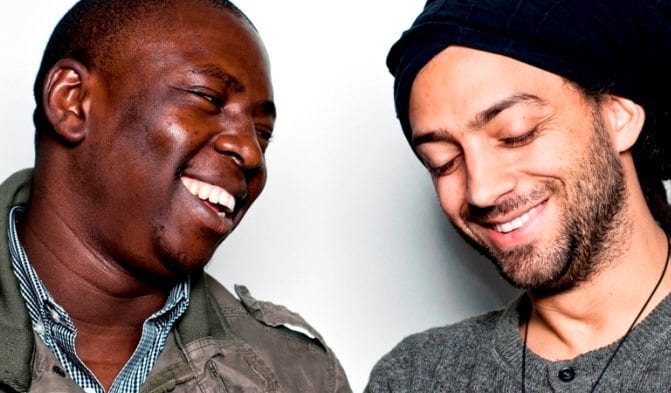 Often referred to as “The Hendrix of the Sahara”, Vieux Farka Toure is known for his speed and dexterity on the guitar, and is considered one of world music’s true stars. Idan Raichel is a keyboardist, producer and composer known around the world for his ambitious cross-cultural collaborations that changed the face of Israeli popular music. Vieux Farka Touré and Idan Raichel met by chance, in 2008 at the Berlin airport, where they expressed mutual admiration and a desire to work together. Touré’s father, the legendary Ali Farka Touré, was one of Raichel’s musical heroes and the two went to Israel and recorded The Tel Aviv Session, which found musically beautiful common ground between the artist’s cultures. This was followed by The Paris Session and international touring.
 Tabitha Clancy: Lets begin with your most recent works, of which two were released this year. Can you tell me about Dharma Blues?
 TC: What do you think about the progression of the bluegrass genre?
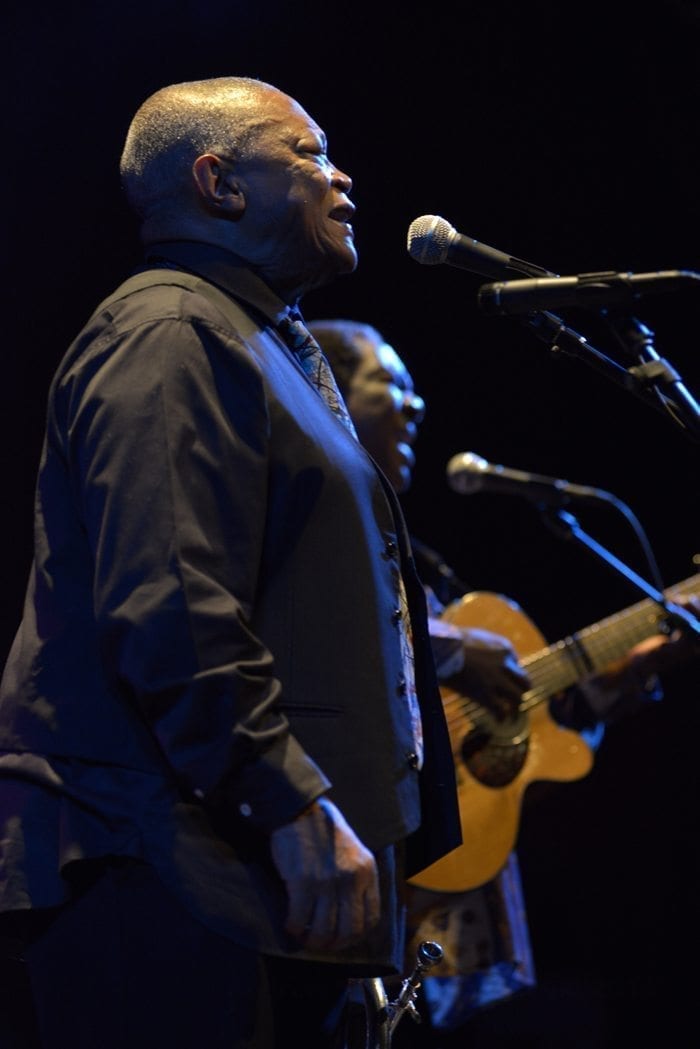 Ubuntu, translated as ‘humanity towards others’, was mentioned for the first time this evening, prior to the song “Meadowlands”, featuring a jazz groove, Vusi’s vocals and Hugh’s trumpet. Hugh then spoke about how much of a privilege it was to play in Albany, and thanked Albany for their role in the anti-apartheid movement, likely referencing the
 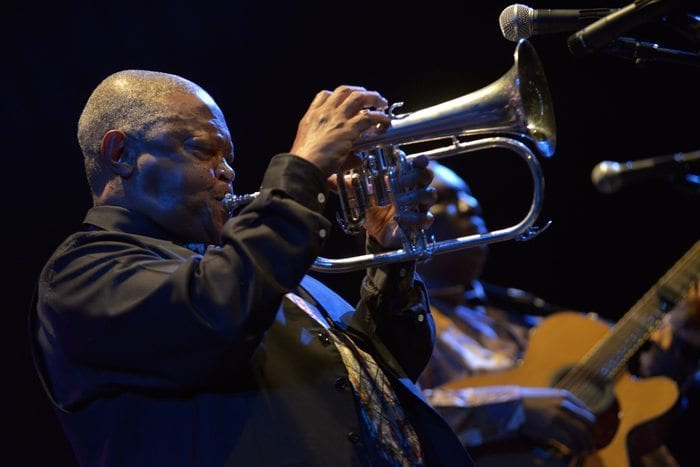 The legendary Mama Africa,
 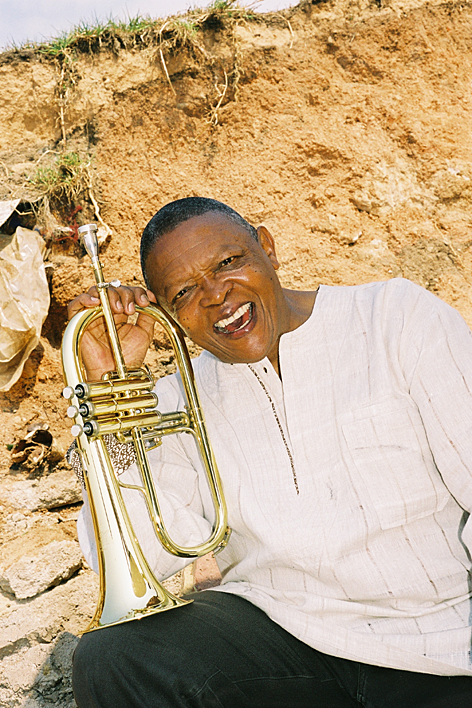 Hugh Masekela is a legendary jazz artist who hit the top of the pop charts in 1968 with “Grazin’in the Grass” and Vusi Mahlasela – simply known as ‘The Voice’ in South Africa – is celebrated for his distinct, poetic, and optimistic songs. Separately, they are two of the most powerful performers on the planet – and together a tour-de-force.