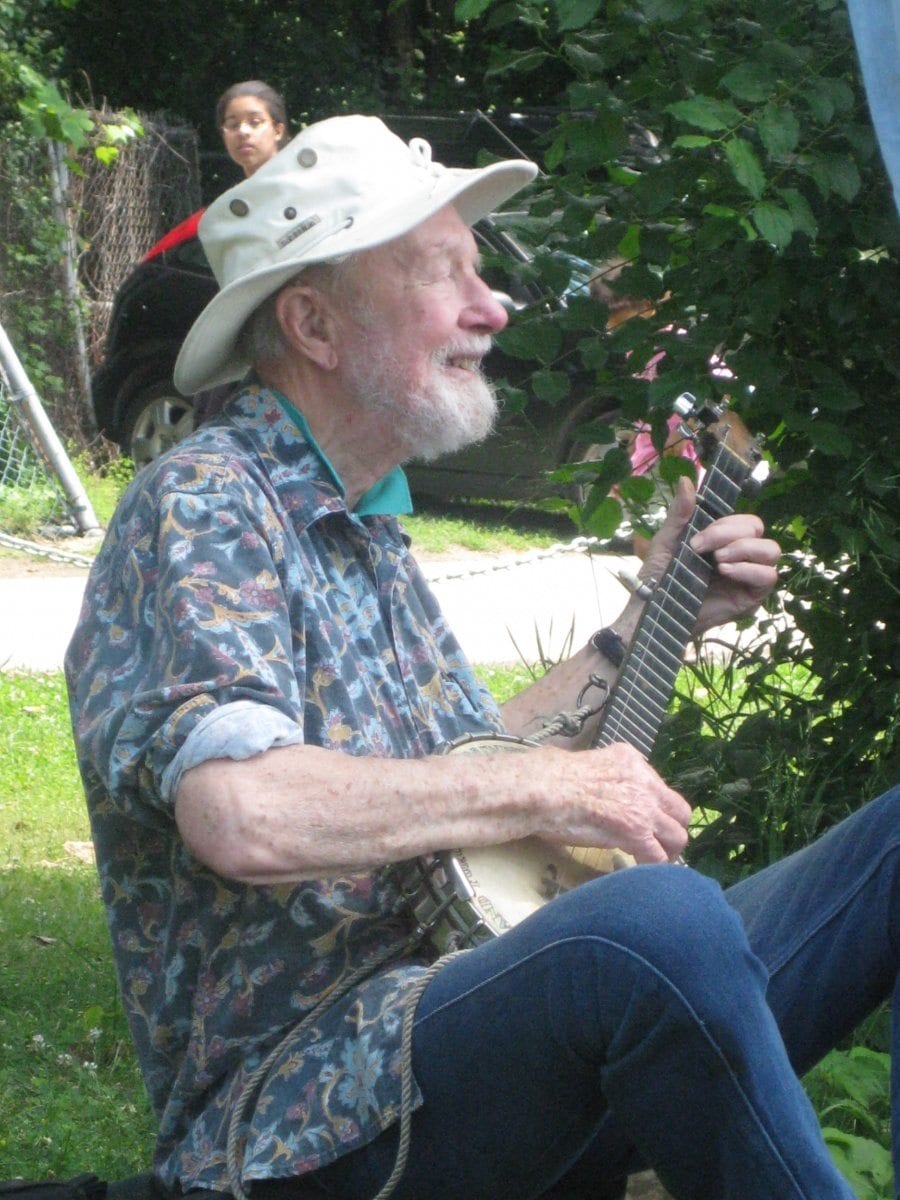
On June 14, 2009, I drove to Beacon, NY for the annual Strawberry Festival, an annual community event on the shores of the Hudson River. I attended at the suggestion of Pete Seeger, so that we might chat and conduct an interview regarding music festivals. The family event had well over 1,000 in attendance, roaming the park grounds, sampling local food, and enjoying the greatest Strawberry Shortcake you will ever have.

I arrived around 9 am, not wanting to miss Pete. He did say to talk to him before his “set” (three songs with children isn’t your typical musical set) so I didn’t sleep in on that. But there were two documentary crews there to talk to him, and they got his attention the moment he started walking from the edge of the parking lot into the park. I stood idly by, listening and admiring the then 90 year old Pete who was answering every question levied at him, for well over an hour between the two films. He played some songs, and at one point lost his balance and fell backwards off the log he was sitting on. He righted himself easily and went on with the interview, hardly shaken. This is the man who had all the windows in his car smashed in the Peekskill riots of 1949, while he was driving through a mob. Falling back on a log was nothing by comparison.
Then it was my turn. There wasn’t a queue, and he had no handlers to speak of, so I waited for my moment. I saw his grandson Tao Rodriguez-Seeger was nearby, letting his grandfather handle his own interview and affairs on his own accord. If you make it to 90 and are still this able-bodied and aware, there is no need for a publicist to say when the interview was over. Pete handled all his own publicity and look how far that got him.

When I saw an opening, I walked up to Pete and said “Pete, I’m Pete Mason, I wrote you a letter and you said to come here and talk to you about music festivals.” He looked at me, then off into the distance, closed his eyes and said ‘Oh yes. OK, well, let’s walk and talk, I have to play music soon.” And we were off, walking at a slow, but steady pace for 15 minutes while we chatted. Now, I’m 6’2″ and Pete was a tall and imposing 6’4″, and I was fumbling with my questions, partially because I was talking to Pete Seeger and partially because he was a little larger than life. He had a John Muir/Mark Twain vibe, in the sense that both are best recalled in their later, white hair years, but also for their place in a specific part of American Written History: Muir with the environment, Twain with his humor and Seeger with his music. Like them, Seeger was grounded and charismatic, with a somewhat reserved personality, and he focused on the music and history which he readily shares with others. After a couple questions, I was relaxed and it felt like a conversation with Everyone’s Grandpa.
Pete Mason: What is the first event that you recall playing music at?
Pete Seeger: I never expected to become a musician. In 1939, 70 years ago, I was asked by a friend’s aunt to sing some of my songs to her class at school for $5, an impressive sum of money. It felt like stealing but I kept looking for an honest job and kept singing though at schools and camps, and as kids got older and went to college, one of the most important jobs in my life was to go from college to college to college to college in the 1950’s, and even thought the John Birch Society and KKK tried to stop me, all they did was give me free publicity. It was the most important job I ever did because I could have kicked the bucket in 1960 and now a whole batch of younger people picked up where I left off – Bob Dylan, Carol Oates, Sandra Lee, Joni Mitchell; I don’t have to get my records played on the radio, or get jobs on the side.
PM: What do you recall from the Peekskill event in 1949?
PS: It was closed down by police and right-wing opponents in 1949. It is referred to as a “concert” but was outdoors and included several performers [Seeger and some of the Weavers, who were on the pop charts at the time]. There was no encampment as far as I know, but 20,000 people showed up for the event from all over the East Coast. I think you can consider folk music of that era analogous to pop of 20 years later.

PM: Regarding the community aspect of festivals and the atmosphere that is present when folks come to a festival, how does the festival atmosphere differ from ordinary daily life and regular gatherings, and what does it say about festivals?
PS: E.F. Schumacher wrote “Small is beautiful” and Hawken wrote “Blessed unrest”. How did the largest movement in the world come so quickly? What is this movement? It doesn’t have a name. Little things are going on, 100’s of festivals and now 1,000’s of festivals and now 10’s of 1000’s of festivals going on all throughout our country and through much of the world. I really do believe that these little things are going to save the human race. Big organizations tend to get power hungry and they can be co-opted by people with money and a million little things. Big becomes a bad thing, and the establishment doesn’t know what to do about these things. Did you ever hear of the Spirit of Beacon day?
PM: No
PS: It was the result of a race riot from years ago. More than 14,000 people showed up in a town of 10,000 – it boasts diversity and everyone takes part – Muslims from their Mosque, Indians, Jews, the whole town. Now it starts with a big parade for a few hours up and down Main Street. A few years ago, women from India took part. My father was a musicologist and he would have loved it.
PM: In the event music festivals generate crowds that are there for the scene more than the music, what can be done to revert back to the roots of music festivals?
PS: (Laughs) Well, take this stage for example. This stage here is small, you can have not so much noise, sit up right and close to the music.

PM: What do you think gives music its power to change and bring about the good in people?
PS: Nobody can say exactly. I like to say that all the arts, music, the visual arts, acting and dancing arts, cooking arts, and I believe sports, will save the human race because they can leap over barriers, religions, leap over barriers of race, politics. Rugby was one of many ways of resolving conflicts in South Africa, because both blacks and whites love rugby and whites felt they were playing their (white) game.
PM: Can you shed any light on that feeling you get when you play music, and how the feeling and music can change over time?
PS: Well, music does affect your opinions. Plato is supposed to have said “It’s very dangerous to allow the wrong kind of music into the republic.” There is an old Arabic proverb, ‘When the king puts the poet on his payroll, he cuts off the tongue of the poet’, so throughout the ages, people in power have liked to control music, they used to throw songwriters in jail throughout history, and were assassinated.
PM: What are they afraid of?
PS: Ideas which might threaten their control. Aesop only told fables which were African folk stories to the Greeks, but some of his folk stories got too close to home, and the people who ran Athens ended up by assassinating him, executing him.
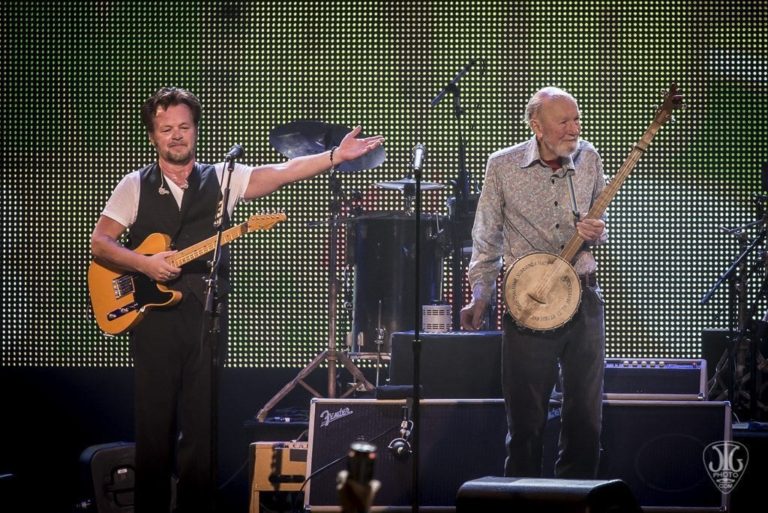
 A lifelong resident of New York, Pete Seeger learned folk music from his father, Charles Seeger, and in turn influenced musicians from Bob Dylan to Joan Baez and Bruce Springsteen to Tom Morello. His musical impact and influence is far-reaching and encompasses songs that few identify with Seeger, for other musicians made their name with his words – Dylan, The Byrds, and Peter, Paul and Mary, to name a few. Pete Seeger spent a lifetime writing and teaching music to anyone and everyone, always with a positive outlook on the future, instilling in all the hope and courage to do the right thing and stand up for one another.
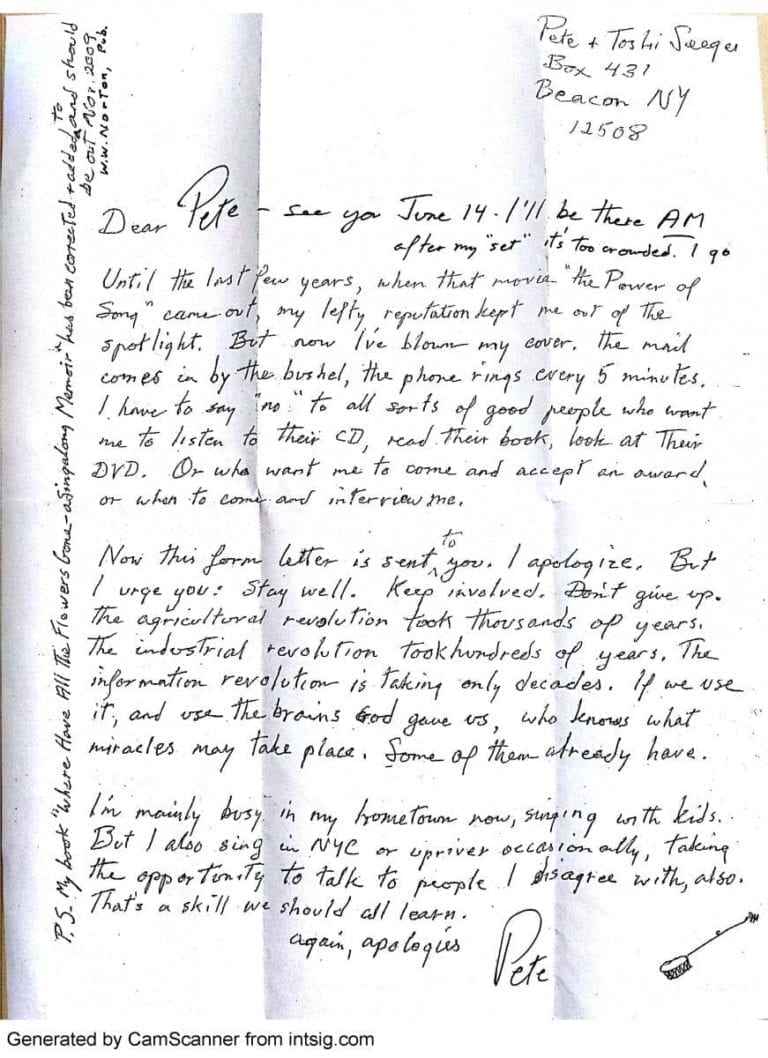
 In 2009, as I began work on a book on music festivals I made a list of musicians I wanted to seek out for their input on the oral history of festivals that were not part of historical records. I sought out Seeger, feeling he must have a trove of stories on past events and festivals that took place in the middle of the 20th Century. Upon discovering his mailing address, I wrote him the letter below.