Dolls have always been a fear of many people around the world, but a doll named Annabelle can make every person get a chill down their spine. The horror movie Annabelle was released worldwide on October 3, 2014 and is directed by John R. Leonetti. The movie is a spin off of 2013’s The Conjuring.
The movie is about a young married couple around the ’60s/’70s that is expecting a child and the husband (John) being a nice guy, buys his wife (Mia) a new creepy doll for his wife’s weird doll collection. Slight spoiler alert, so beware; early in the movie two craze cult members come into the couple’s house and tries to kill them. The male of the cult is killed by the police but the female commits suicide with the Annabelle doll in her arms; this was one scene that stuck to me. The event was foreshadowed when Mia was watching TV and Charles Manson’s court case appeared on the screen, giving the audience a heads up that some suspenseful scene was due. After the suicide, strange things started happening in the house like random fires, the doll being moved from room to room and laughter of children. Mia is the one that takes notice on all the events which quickly start driving her insane.
Going into the theater, I was expecting Annabelle to be full of blood and gore. But to my surprise, I got a mind-boggling experience. The movie was more like a thriller and had the audience on the edge of their seat the whole time. Annabelle had a perfect balance of horror and things popping out and scaring you. The movie did not need any excessive blood and gore scenes to make it a great movie. The plot did amazing on its own, but the thing that leaves people in shock is that Annabelle is based on a true story and a real doll! Annabelle is located in the Warrens Occult Museum.
For all you horror fans that do not need blood and guts to satisfy your movie cravings, I recommend this movie!
One of the most legendary musicians and intense concerts to grace an Upstate New York stage took place in the fall of 1978 at the Mid-Hudson Center in Poughkeepsie. On September 21, 1978 Frank Zappa and his band appeared on stage for an extended fun and filthy evening of multifarious musical excursions. The circulating recording is a warm well-balanced line tape available through the efforts of an enterprising taper allowed to plug his rig into the soundboard.
The resulting document captures Zappa’s 1978 big touring band featuring, Zappa, drummer Vinnie Colaiuta, Arthur Barrow on bass, Ed Mann on percussion, Tommy Mars on Keyboards, Denny Walley on second guitar, Peter Wolf on second keyboards and Ike Willis on guitar and vocals. The 3,000 seat venue in the midst of the Hudson valley would bear witness to a diverse, virtuosic and musically offensive performance that is still reflected on and talked about by locals and hardcore Zappa fans alike.
The existing tape cuts in with the show already in progress midway through ‘The Deathless Horsie”. The ambient instrumental jam offers a moody warm up for the band as well as an opportunity for Zappa to introduce the band and greet the assembled crowd. Breathlessly the band enters a song that ‘doesn’t rock at all,’ “Dancin Fool”. The percussive ‘disco’ flavored track warms the crowd with an addictive groove and intense show opening breakdowns.
Stage favorite “Easy Meat” from Zappa’s Tinsletown Rebellion follows and spreads a horny groove down in which Zappa slips in a lubricated and penetrating solo display. Segueing deftly into “Honey Don’t You Want a Man like Me” things get sufficiently strange while riding the quirky edge of progressive arrangement.Continuing to move forward into the show without respite, “Keep It Greasy’ continues the musical innuendo containing a kinetic and slick groove orchestrated by Zappa’s numerous compadres.
Sufficiently warmed up, the sets first cool down period comes with the sideways soul and religious condemnation of ‘The Meek Shall Inherit Nothing’. Group vocals, slide guitar and honky-tonk piano support the sarcastic glimpse of religious zealots.
This featured set not only spotlights Zappa’s diverse musical arrangements but his increasingly ‘shocking’ and unabashed lyrical content. The collaboration of venue, era, set list and band, make this bootleg capture a must for any Zappa fan that was unaware of the recordings existence. “City of Tiny Lites” highlights some of the most aggressive soloing of the evening unfortunately cutting out before its conclusion and cutting in midway into the following “Pound for Pound”. Zappa unleashes shaded and dark soloing that eventually dissipates into a sweet guitar and keyboard dual melody quote that rolls together like a sticky bun in “City”. While the following instrumental, “A Pound For A Brown” expresses a jazzy sensibility and a thick spacey synth breakdown, showcasing the groups many improvisational talents.
Next comes one of Zappa’s most well-known tracks, “Bobby Brown” a single release in Europe, but not as well-known in the States due to the edgy sexual content. The main character of the song struggles with their sexual identity, played out through the lyrical playfulness of Zappa. A fantastic and humorous version of the melodically solid track is featured on this recording, a high point of the set. “Conehead” as well a highlight of this early segment of the concert emerges from “Bobby Brown” with a pointed and funky groove. Zappa takes a phased and patient solo break that contains some of his finest playing of the evening thus far. Crisp sustains and lightning fast riffing highlight the central part of this jam. When “Conehead” fades into dynamic rhythmic support, Zappa then introduces “something weird” taking a unique trip with the twofer of “Mo’s Vacation” and “Black Page #2”.
The rare “Mo’s Vacation” flies the friendly skies with syncopated bells, jumpy percussion and variegated statements that amazingly the band required no musical notation to play. The instrumental segues into “Black Page #2” another complicated and stratified musical arrangement that lends witness to the masterful musical mind of Frank Zappa at work. This particular movement embarrasses Zappa’s contemporaries due to its illustrating multiple and diverse levels of melodic expression and mastery of instruments. The song rises and falls over rocky waves of inspiration, jaw dropping in its crisp execution.
As “Black Page #2” fades into darkness Zappa begins a rap about the ‘preposterousness of rock and roll’ and asks the crowd if ‘they feel it’ also. Zappa then takes some body shots at Peter Frampton and mentions how a panty-sniffing Wagner composed some of his works. The slow and sure “I Have Been in You” begins and is beautifully sung/spoken in Zappa’s greatest dry, one-eyed wink, vocal attack. ‘I Have Been In You’ is a classic Zappa segment and one continuous laugh and highlight commentary on the state of rock and roll reality.
“Flakes” drops out of the sky suddenly, keeping its promises through a plethora of funky and complex riffs. The song pulses through multiple changes and commentaries on those certain people who cannot hold up their end of the deal. A solid version of “Magic Finger’s” rubs all the right spots while emerging from “Flakes” in a series of cascading licks while building the set to a ticklish peak.
As if the preceding display of music was not enough Zappa and band construct a medley of the “Yellow Snow” suite, containing the opening four tracks from Zappa’s 1974 Apostrophe LP. The crowd’s pleasure can be felt on the recording as the band pops into the shoulder swiveling “Don’t Eat the Yellow Snow”. The suite continues with carnival blues of “Nanook Rubs It,” “St. Alfonzo’s Pancake Breakfast,” “Father Oblivion” and “Rollo”. The aforementioned narrative is musically challenging, complex, shockingly funny and another piece in the long line of highlights from this performance.
Zappa introduces the players as “Rolo” ends, concluding the main part of the set in animated fashion. The crowd pleads for more, their enthusiasm apparent on the recording. Zappa states that this will not be your typical encore and tells everyone to sit down for another ‘tiny show’.
Zappa then digs into his “Mothers of Invention” catalog for an expansive rendition of “Little House I Used to Live In” from 1971’s Burnt Weenie Sandwich. A moody version, with room left for all band members to receive a spotlight segment. This is not your typical encore, but a mind expanding and twisted compositional display.
The show puffs out its chest for the next series of songs that not only pay witness to Zappa’s extreme abilities and guitar prowess but conclude the show in an awe-inspiring fashion. The aggressive pulse of “Tell Me You Love Me” “Yo Mama” and “Black Napkins” allow the Zappa orchestra to let it go. “Yo Mama” is the showcase for Zappa to deconstruct and build again the songs internal workings through his fretboard. The air gets thick, the music tense and Zappa’s guitar work dense as the arrangement allows for ample exploration. Guitar aficionado’s alert, the central core of “Yo Mama” is a clinic, an organic and tangible aural event.
The encore and performance concludes with ‘Black Napkins’ originally from Zappa’s 1976 record Zoot Allures. Similar to the preceding ‘Yo Mama’ this track allows Zappa to disseminate his guitar work in another context. The smoldering R and B groove ignites with Zappa’s round quivering notes, leaving only metallic shadow remains on the constructed musical bed. A series of punctuated ‘thank you’s’, and the show is over.
Zappa’s 1978 visit to Poughkeepsie, NY left an indelible mark on Zappa’s touring history, fans, and collectors as well the community at large. A muscular performance and collection of songs that through the foresight of tapers and of Zappa’s crew is now immortalized for future fans and musicians to enjoy.
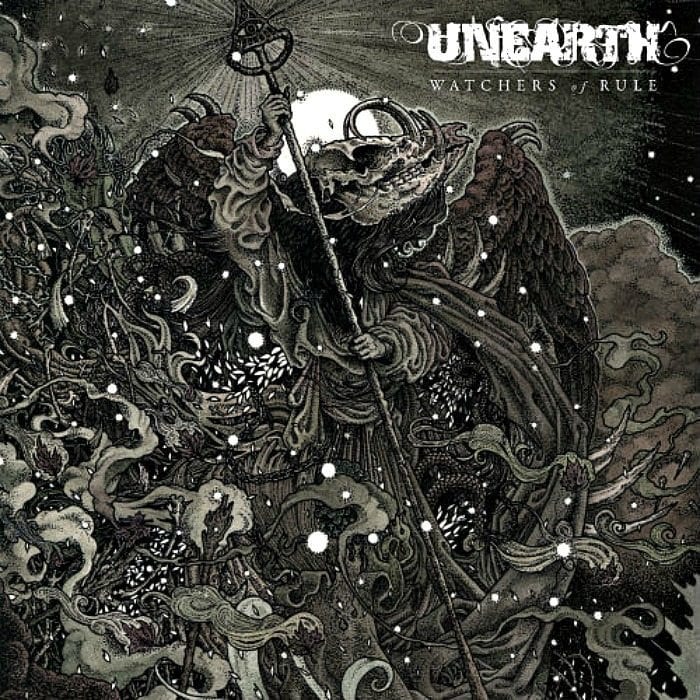
Unearth has remained present in the metal landscape for over fifteen years. This has everything to do with their work ethic, constant touring, and producing quality albums for that entire time. Their newest record, Watchers of Rule, is another incredible heavy masterpiece from this band that has consistently kept metalcore music heavy as ever.
The forty-second intro works as a bridge, dragging the listener to the top of the mountain to prepare them for the first single from the album, “The Swarm”. This track launches itself from high above the already lofty expectations from such a talented band. Incredible double guitar attacks revel in their technical prowess, but never get lost; the beautiful chaos bleeds seamlessly into crushing breakdowns with unwavering double bass drum beats. Metal at it’s best keeps the listener entertained, and Unearth does that to perfection on this record.
There are also more straightforward genre songs. “Lifetime in Ruins” is a great example of a well-worn groove with an unshakeable rhythm section, but it delivers exactly what it sets out to achieve. The nice thing about a record like this, is that you go into it believing you will get a specific type of heavy metal, and Unearth never deviates from that plan. They sing about the oncoming assault of Hell with dragons and demons laying waste to kings and their kingdoms, heavy with metaphors on life and personal experience. Their music reflects those sentiments as well, never falling away from the metalcore ethos they have carved out throughout their career. This record is a culmination of everything they have achieved thus far, and where they plan to go.
With Mark Lewis at the helm, producing and engineering this project, it has the polished feel of a well crafted record. He has worked with DevilDriver, Whitechapel, Deicide and many more, most recently producing Cannibal Corpse’s new record, A Skeletal Domain. (check out our review of that record here.) The vocals, done by up to three other members with Trevor Phipps taking lead, sit perfectly in the middle of the audio onslaught. Heavy music of this calibre is so vital in the metal scene because poorly produced metal albums lose so much of what was put into them. This record shines through and gives the listener a true representation of everything that happens between the five musicians. It will be interesting to see these songs performed live as the band prepares to embark on their next tour.
Tour starts October 13.
“Guards of Contagion” is a track that allows the whole band to bring all their tricks to the table, with unstoppable guitars blending into a heavy, sludge-riddled low-end, and vocals that eat at your core. The title track is the bookend to a record that doesn’t pull punches, and remains true to its core from the first song to the last. Just when you think you are sufficiently destroyed by all this record has to offer, “Watchers of Rule” brings everything even higher.
“They aim to save the world” the song explains, and Unearth just might achieve that with such a generous offering of brutally infectious metal. The intense precision permeates each song, but many tracks are rooted in heavy groove metal, making it impossible to keep still while listening. This record should come with a disclaimer: Listen at your own risk, for your body will not be able to stop moving. You will sing along, you will bang your head, and if you listen to this in your car, you will speed.
Key tracks: The Swarm, Guards of Contagion, Burial Lines, Never Cease
Watchers of Rule will be available from eOne Music on Oct. 27. You can pre-order the album and special merchandise here.
If you’re in the Upstate area and looking to catch these guys live, the band will be playing a show at Montage Music Hall in Rochester on Friday, Oct. 17. Opening the night will be Darkest Hour, Carnifex, Origin, I, The Breather, Black Crown Initiate, and local support from Order of the Dead. Tickets can be purchased here for $22 and the show starts at 7pm.
Buddy Black and The Ghost Umbrellas have returned with their latest release, The Story on The Road to Waterloo (A Vampire Love Story in Three Acts). The new release speaks volumes of abstract mysteriousness and musical maturity for the blossoming band from Toronto. The lyrics are delivered with an outpouring surge of emotion as Buddy Black’s voice serves as the perfect vessel to do the music justice. Peeling away at the many layers of Black’s lyrics will take the listener down a rugged and untraveled road, meandering through many twists and turns of darkness. The music compliments Black’s vision well and at times morphs into its own unique form of basic, acoustic folk forming sounds that could be skyrocketed into a punk rock feel at any given moment. The range of this band is impressive and the energy encapsulated in the studio will truly translate to the live atmosphere.
This album marks the first official release for the band in over a year. The chemistry between Black and long time friend and multi-instrumentalist Dayne Polny is remarkable. Polny has not only found a well-rounded niche in the Ghost Umbrellas but he’s also been involved in nearly every one of Buddy Black’s numerous backing bands and side-projects.
The story opens with the self titled track “The Story on the Road to Waterloo”, the simplicity behind the music and the gruff lyrics could easily be a carousing soundtrack to sailors who’ve finally returned home to land after years at sea. “Emily” provides a splash of optimism as the message behind the music is generally upbeat and while the song is inspired by love there’s still a glimpse of darkness behind the passion.
“You Need To Know” serves as the perfect bridge for the story as this is one of their most well composed numbers. The acoustic guitar is anchored by a slide guitar painting a message over the heartbeat drumming section. There’s nothing more satisfying than when an artist successfully blends two genres together. Most often this sort of accomplishment is done without rhyme or reason, or on accident. Buddy Black and The Ghost Umbrellas have managed to fuse a heavy punk/indie foundation with elements of folk and acoustic guitar inspired ballads. “You Need To Know” is complete with a soft acoustic interlude before the rest of the band comes back in with authority. The chilling backing vocals also help lift the song to monumental peaks of raw emotion.
As the album continues to progress the music becomes more electric driven and heavy. “Renfield Would Approve” and “Fuck You and Goodbye” flow nicely into one another and while they’re both under three minutes each both songs pack a punch and are packed full of energy and emotion. While the volume may go to 11, none of this is a distraction from Black’s astonishing vocals or melodic compositions. There’s a lot of substance behind the music as Black’s voice is every bit unique and powerful. The album closes with “Can the Circle Be Unbroken?” another full band sing-a-long that’s catchy music still leaves listeners pondering alternate meanings embedded in the lyrics.
Currently the band is touring extensively through Canada as well as finding time to write and rehearse new material. The band is also preparing for a live release later this year. Until then, fans can catch them on the road as Buddy Black and the Ghost Umbrellas are a genuine force to be reckoned with. Successfully fusing two sacred genres, the band is breaking through into new ground that very few artists even dare to explore.
Key Tracks: You Need To Know, Emily, The Story on the Road to Waterloo
Worker, the new album from Jacob Fred Jazz Odyssey and the twenty-sixth in the band’s twentieth year features a return to a trio lineup that explores new material in the band’s original format. Guitarist Chris Combs reflects on the revised lineup, saying “Much of the first large-level success the band saw was as a trio, and for the 20th anniversary of the band, we worked up a set of older material to celebrate that anniversary – a lot of which was from that trio era.” On Worker, many tracks have one sub-layer keeping a beat – and to keep things fresh, it’s not always talented drummer Josh Raymer – that the other instruments build off of, giving a base-level for listeners to jump in at, rather than being overwhelmed by the not-for-amateurs deconstructed jazz that plays over the top of this layer.
Founding member Brian Haas shares that the music on Worker, “It’s influenced by jazz, but it’s not jazz”, a fitting description as identifying this album as jazz would be like nailing jello to a wall and expecting it to stick.
Opening with “New Bird”, video game blips appear inside a floating frame, a gentle easing into the album. “Appropriation Song” could serve as the soundtrack to a Contra video game, where as the song progresses you can picture a shift into the jungle, meeting the level boss and the hero dying in a hail of 8-bit bullets. “Betamax”, a highlight of the album, features a slow uphill climb with some underlying funk, followed by “Hey Hey NSA”, with an appropriately creepy intro that is at first trancey then gets weird.
Big Gigantic meets Marco Benevento in “Say Nothing”, a flair of acid jazz where the trio shines brightest, locked in step. “Bounce” could double as a horror-film score amid Combs’ superb guitar work. “Let Yourself Out” brings things down a notch with placid jazz for the first half of the song, then as Haas slowly turns things up on synth for a redirection of the composition, a curveball sends things into ludicrous speed, only brought back to earth by “Mesa”, a wind chimes interlude. “Better Living Through Competitive Spirituality” uniquely features a Schoenhut toy piano that takes center stage while Haas’ synth keeps a steady melody over Josh Raymer’s drumming.
JFJO has quite a gem with Worker, an accessible jazz-influenced album from the reformed trio. Just don’t call it a jazz album.
KeyTracks: Betamax, Say Nothing, Bounce
Upcoming shows in the Northeast include Nov. 13 at The Lily Pad in Cambridge, MA – tickets/info, Nov. 14 at The Zinc Bar in NYC (w/Jamie Saft’s New Zion Trio) – tickets/info, and Nov. 15 at Radio Bean in Burlington, VT – tickets/info.
Music lovers from all walks of life packed Woodstock’s Bearsville Theater on Saturday, October 4 for the inaugural Woodstock Jazz Festival. The evening began with a highly entertaining piano set from GRAMMY nominee Uri Caine, which featured two sets including John Medeski on the organ; and concluded with an inspired cover of Bob Marley’s “No Woman No Cry” sang by Jack DeJohnette. The music rolled along for more than four hours and the man who dreamed up the festival, drummer Ben Perowsky, dedicated the festival to local legend Sonny Rollins.
Uri Caine
Uri Caine went on stage at 7:30PM and folks rushed to take their seats or claim standing room. Even the separate bar area was overflowing and, despite a chilly night outside, the cavernous, barn-like theater was warm with bodies packed tight. There were multiple drum sets, an organ and various other instruments on stage but the attention was focused on Caine seated behind a black baby grand piano. Caine’s vaunted resume includes a stint as the LA Chamber Orchestra composer in residence, more than two dozen recorded albums, and the aforementioned GRAMMY nomination for “The Othello Syndrome”; His modernization of Verdi’s Otello. While Caine paid homage to the classics Saturday night, a playful side twinkled through during his Bearsville set. Looking cool and tranquil behind the piano, it sounded like his left hand produced a number for a king’s chamber while the right played something more fitting for a Mississippi riverboat. His unique style had the audience tapping along on their legs or nodding emphatically. Caine’s enthusiasm was evident when he spoke between songs. He played until 8:30PM sharp and drew a huge standing ovation from the crowd.
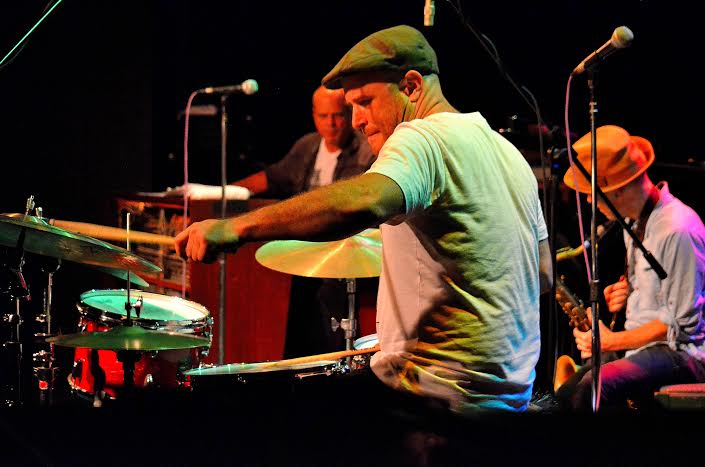
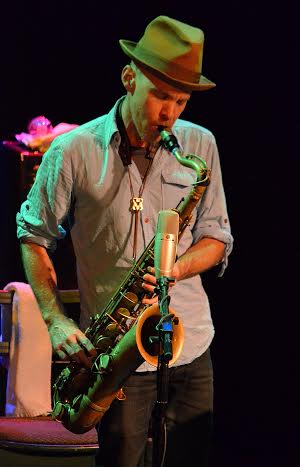
After a short break, RedCred had their chance to show off. Consisting of tenor saxophonist/clarinetist Chris Speed, drummer Ben Perowsky, and organs/keys player John Medeski, the trio only took one brief break in the middle of a continuous hour-long set. At moments, the three played harmoniously with each other. Then, they would unceremoniously diverge down their own paths. Medeski oozed out thick, eerie notes while Perowsky utilized every surface of his kit— clicking on the snare rim, clinking a cymbal’s edge and blasting out rudiments on the high hat—and Speed belted out sensual sax licks. Just before they lost you in a dense jazzy jungle, they made eye contact and pulled it all back together seamlessly.
Perowsky on the drums with Medeski (L) and Speed (R) in background.Chris Speed
Perowsky, a NYC native whose talent and exuberance rivaled each other onstage, deserves all the acclaim he received for being the event organizer. Medeski, whose genius is instantly evident in his thoughtful eyes, wowed everyone with his organ-izing. The set concluded with a Weather Report favorite, “Face On The Barroom Floor” which allowed Speed to showcase his ability and versatility, beginning with a clarinet solo and concluding on the tenor saxophone.
Everyone was eager for the last act. Each seat was claimed and extras were brought in; those standing shuffled on tip-toes for a better look at the stage as Jack DeJohnette, John Scofield, and Larry Grenadier joined John Medeski. Inspired by the musicians’ lofty presences, a ubiquitous awe fell over the room before an impromptu shush-off lightened the mood—someone in the crowd “shhh’ed” the audience, then another “shh” followed and another, until it sounded more like a bunch of leaky inflatables filled the theater than jazz aficionados.
After a good laugh, DeJohnette, who has played with the likes of Miles Davis, Pat Metheny, Herbie Hancock and many others, led the show from behind his drum set as the group covered music made famous by Davis, John Coltrane, and Frank Sinatra. DeJohnette conveys emotion through the drums as well as anyone and does not lack in speed or creativity. He played complex fills and kept obscure time while playing “Inspired By Tony Williams”. He teased the crowd, slowly building up the solo before finally letting loose to everyone’s delight.
Throughout the set, Medeski mouthed each note as he alternated banging on his backless organ and the baby grand while his foot, dancing along frantically, seemed in danger of flying off its leg. Scofield, meanwhile, rocked his guitar into acquiescence, drawing emotional lines from it. During “I Fall In Love Too Easily” he decided it was shredding time. The band followed Scofield’s lead as he kicked in the wah pedal and belted out slick runs, launching them into the heaviest jam of the night.
Bassist Larry Grenadier attacked his upright, plucking its strings fervently and deftly. With DeJohnette backing him on the drums, Grenadier busted out a mind-boggling solo in the middle of “Promise.” The only time his hand strayed from bass strings was to push his glasses back onto his nose, but even that action seemed part of his time-keeping. Medeski and Scofield smiled on admiringly before joining back in to fill the theater with a full, rich sound. The whole set was electric and reached a climax when they concluded with DeJohnette singing “No Woman No Cry”. While the majority of the night was dedicated to instrumentals, the audience was ecstatic to hear the Bob Marley cover and nearly everyone sang along.
The inaugural Woodstock Jazz Festival proved to be a huge success. Woodstock’s Bearsville Theater provided a comfortable and intimate setting and the musicians did the rest, playing late into Saturday night. The event was run smoothly and one can imagine the night’s honoree, Sonny Rollins, would be proud to know so many people enjoyed an evening of jazz together in his honor.
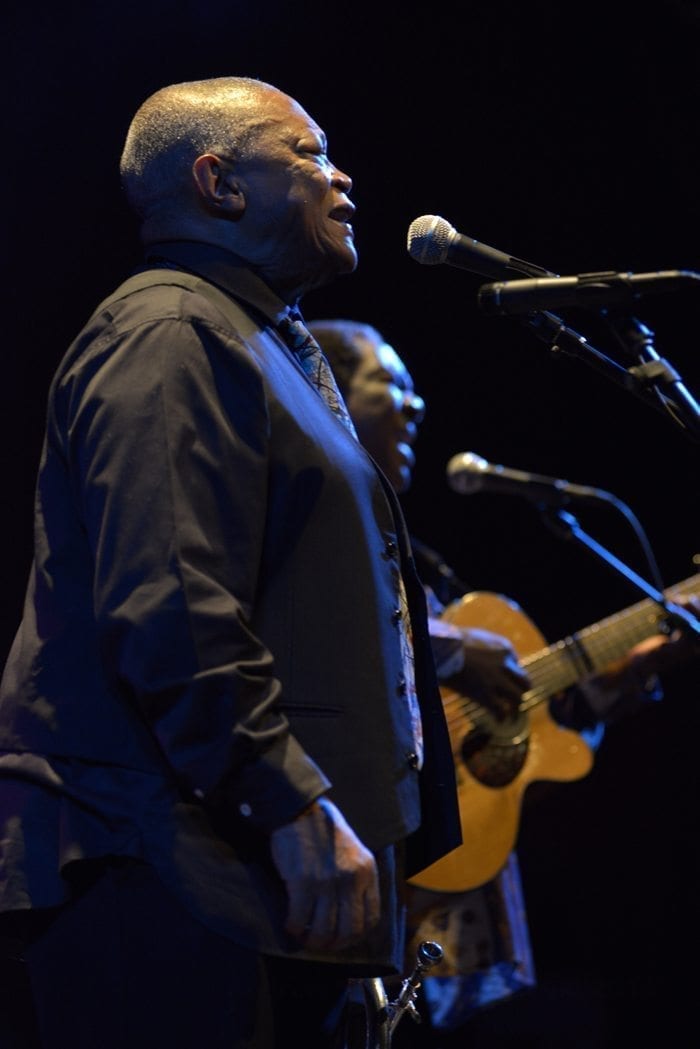
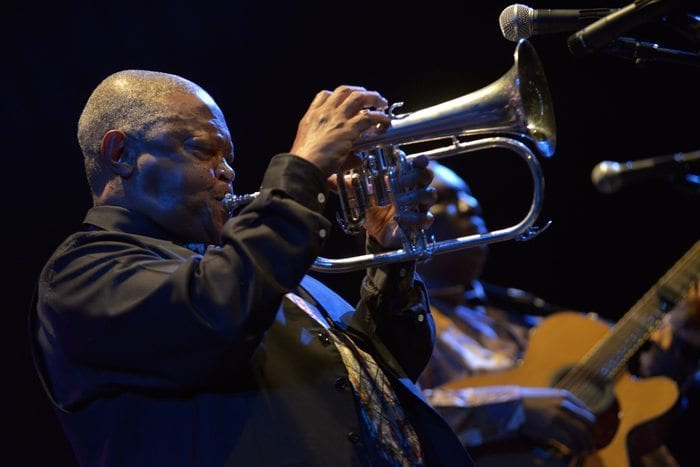
On a night celebrating 20 years of a free South Africa, The Swyer Theater at The Egg played host to a once in a lifetime show – Hugh Masakela and Vusi Mahlasela performing South African selections in an intimate setting. To start the night, Vusi Mahlasela took the stage alone, playing “Ubuhle”, a speedy bike ride after a slow climb on a guitar that sounded like a harpsichord with a hint of sitar. Joined after by Francis Fuster (percussion), Ian Herman (drums), Bakithi Kumalo (bass, who, along with Herman and Fuster kept a consistent beat throughout the night), Mongezi Ntaka (guitar) and finally, Hugh Masakela, the audience rose up to thunderous applause and welcomed the sound of South Africa to the stage.
Ubuntu, translated as ‘humanity towards others’, was mentioned for the first time this evening, prior to the song “Meadowlands”, featuring a jazz groove, Vusi’s vocals and Hugh’s trumpet. Hugh then spoke about how much of a privilege it was to play in Albany, and thanked Albany for their role in the anti-apartheid movement, likely referencing the 1981 protests against the South African rugby football team who came to Bleeker Stadium to play against a local club. Nods and rumbles of agreement echoed through the theater, as Hugh told us that tonight we would hear songs of love, protest, tradition, and revolution.
The legendary Mama Africa, Miriam Makeba, had her name invoked prior to “Thanayi”, pointing out that some form of beauty was to be found within all of us. Hugh performed in Troy, NY in the mid-90s with Makeba, a memorable experience that more than a few audience members chatted happily about in the theater lobby before and after the show. The cowbell intro to “Grazing in the Grass”, the most easily recognizable of the night’s songs, highlighted the trumpet once again as Masakela performed double-duty between the two instruments. “Weeping”, containing the melody from “Nkosi Sikelel’ iAfrika” (the South African national anthem at a time when South Africans could not sing their own anthem under apartheid), was one of the more passionate and emotional songs of the evening. The lyrics reference moving past the anger over apartheid, rather than seek revenge after years of injustice:
It doesn’t matter now / It’s over anyhow / He tells the world that it’s sleeping / But as the night came round / I heard it’s lonely sound / It wasn’t roaring, it was weeping
As Masakela said early in the evening, “Forgiveness – all men should wear it like a crown.”
The show continued with “Say Africa”, an active crowd sing-along; Johnny Clegg’s ode to Nelson Mandela, “Asimbonanga”, clearly a more emotional and life affirming song for Hugh and Vusi, followed by “When You Come Back”, which told the story of the gold trains that traveled from countries in south and central Africa to Johannesburg, bringing miners to work 16 hour days. Hugh imitated the train whistle and screech eerily well, the tone of his voice and the threatening pace of the beat conveying the passions towards the exploitation of labor.
Naturally, the final songs of the evening would be more upbeat, and with Masakela saying to the crowd “Shake your bootie for all those old geezers” (a reference to Mandela and those he was sentenced to life in prison with), the crowd rose up and danced, waved their arms and sang “Bring him back home to Soweto”. For the final ten minutes, there was nonstop music, dancing and band introductions. An encore of “Pata Pata” was prefaced with an apology from Hugh, “Sorry, but you have to stand up and boogie harder”, the band singing “Dance, dance, dance, what a party!” and sending the crowd out with broad smiles and beaming with energy.
Professing the philosophy of Ubuntu throughout the night, Mahlasela and Masekela mentioned its many elements – love, helpfulness, neutrality, variety, and the redistribution of morals, knowledge and skills – throughout their music, a common theme that tied the night, audience and band together.
Hugh Masakela and Vusi Mahlasela, The Egg, Albany, NY – October 7, 2014
Setlist: Ubuhle, Meadowlands, Thanayi, Miyela Afrika, Grazing in the Grass, Weeping, Say Africa, Asimbonanaga, When You Come Back, Stimela, Bring Him Back Home, Unomeva
On a night celebrating 20 years of a free South Africa, The Swyer Theater at The Egg played host to a once in a lifetime show – Hugh Masakela and Vusi Mahlasela performing South African selections in an intimate setting.
To start the night, Vusi Mahlasela took the stage alone, playing “Ubuhle”, a speedy bike ride after a slow climb on a guitar that sounded like a harpsichord with a hint of sitar. Joined after by Francis Fuster (percussion), Ian Herman (drums), Bakithi Kumalo (bass, who, along with Herman and Fuster kept a consistent beat throughout the night), Mongezi Ntaka (guitar) and finally, Hugh Masakela, the audience rose up to thunderous applause and welcomed the sound of South Africa to the stage.
Ubuntu, translated as ‘humanity towards others’, was mentioned for the first time this evening, prior to the song “Meadowlands”, featuring a jazz groove, Vusi’s vocals and Hugh’s trumpet. Hugh then spoke about how much of a privilege it was to play in Albany, and thanked Albany for their role in the anti-apartheid movement, likely referencing the 1981 protests against the South African rugby football team who came to Bleeker Stadium to play against a local club. Nods and rumbles of agreement echoed through the theater, as Hugh told us that tonight we would hear songs of love, protest, tradition, and revolution
The legendary Mama Africa, Miriam Makeba, had her name invoked prior to “Thanayi”, pointing out that some form of beauty was to be found within all of us. Hugh performed in Troy, NY in the mid-90s with Makeba, a memorable experience that more than a few audience members chatted happily about in the theater lobby before and after the show. The cowbell intro to “Grazing in the Grass”, the most easily recognizable of the night’s songs, highlighted the trumpet once again as Masakela performed double-duty between the two instruments. “Weeping”, containing the melody from “Nkosi Sikelel’ iAfrika” (the South African national anthem at a time when South Africans could not sing their own anthem under apartheid), was one of the more passionate and emotional songs of the evening. The lyrics reference moving past the anger over apartheid, rather than seek revenge after years of injustice:
It doesn’t matter now / It’s over anyhow / He tells the world that it’s sleeping / But as the night came round / I heard it’s lonely sound / It wasn’t roaring, it was weeping
As Masakela said early in the evening, “Forgiveness – all men should wear it like a crown.”
The show continued with “Say Africa”, an active crowd sing-along; Johnny Clegg’s ode to Nelson Mandela, “Asimbonanga”, clearly a more emotional and life affirming song for Hugh and Vusi, followed by “When You Come Back”, which told the story of the gold trains that traveled from countries in south and central Africa to Johannesburg, bringing miners to work 16 hour days. Hugh imitated the train whistle and screech eerily well, the tone of his voice and the threatening pace of the beat conveying the passions towards the exploitation of labor.
Naturally, the final songs of the evening would be more upbeat, and with Masakela saying to the crowd “Shake your bootie for all those old geezers” (a reference to Mandela and those he was sentenced to life in prison with), the crowd rose up and danced, waved their arms and sang “Bring him back home to Soweto”. For the final ten minutes, there was nonstop music, dancing and band introductions. An encore of “Pata Pata” was prefaced with an apology from Hugh, “Sorry, but you have to stand up and boogie harder”, the band singing “Dance, dance, dance, what a party!” and sending the crowd out with broad smiles and beaming with energy.
Professing the philosophy of Ubuntu throughout the night, Mahlasela and Masekela mentioned its many elements – love, helpfulness, neutrality, variety, and the redistribution of morals, knowledge and skills – throughout their music, a common theme that tied the night, audience and band together.
Hugh Masakela and Vusi MahlaselaSetlist: Ubuhle, Meadowlands, Thanayi, Miyela Afrika, Grazing in the Grass, Weeping, Say Africa, Asimbonanaga, When You Come Back, Stimela, Bring him back home, Unomeva
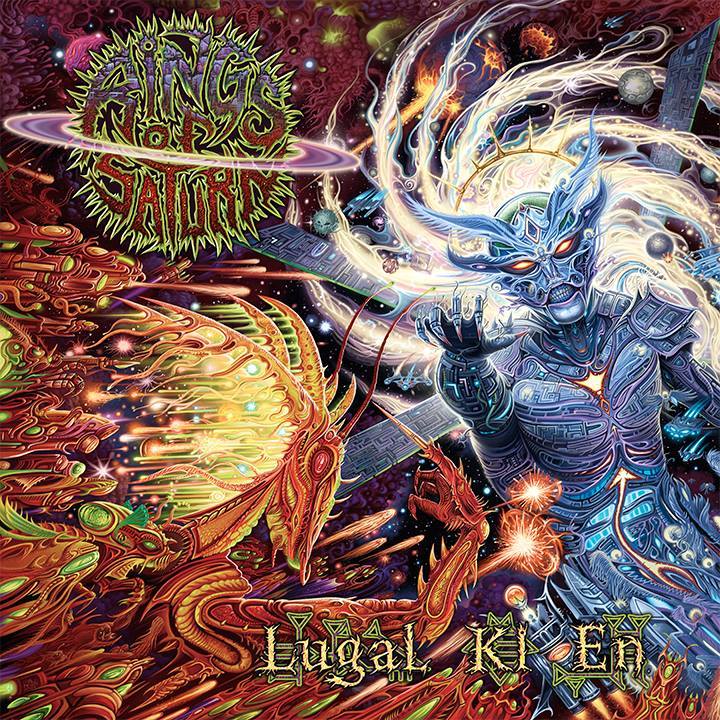
Ahead of release, California death metal band Rings of Saturn are streaming their third full length album via YouTube, Lugal Ki En. Which translates in Ancient Sumerian Cuneiform to “King of the Earthlings, Lord of the Cosmic World,” according to guitarist and founding member Lucas Mann. The album does not sound much different from their last effort, Dingr, in most cases. However, this time around, there have been multiple claims surfacing of “unrealistic editing” — that is, the band, and mostly guitarist Lucas Mann have been accused of altering their parts in the studio if they cannot be played, such as speeding up tracks, over-triggering drums, and so forth.
Whether these claims are true or not is basically pointless. The most important aspects of this album are its writing and how it sounds, not whether it can be repeated live. Overall, it is at best a fun listen, but nothing about it is truly unique. The guitar work is fast, as are the drums, and the vocals are brutal. Fans of death metal band Thy Art is Murder or Suicide Silence (the last track on Lugal En Ki is a cover of Suicide Silence’s “No Pity for a Coward”) will enjoy the rhythm while Jeff Loomis fans may enjoy the style of leads that the band pulls: extremely fast runs with no holding back. Overall, Lugal Ki En is a semi-solid effort, but it’s nothing more than a rehashing of many other deathcore albums. It’s part of the modern trend, aside from a few unique moments.
Looking at the musical aspects alone, we see an album that is composed of the same thing every other deathcore band pulls: low, cutting triplets, with the same note played over and over. Guitar leads possibly reach a level of annoying. Guitarists Lucas Mann and Joel Omans have actually gone beyond the call of duty to play as many possible notes within one measure without giving any regard to what they are actually playing.
The two exceptions to this rule are the third track, “Lalassu Xul,” which features dissonance, unique chord changes, and new ideas on the face of deathcore. Rather than swarming the listener with “breakdowns” the band has elected to write a strange song which features multiple changes, acoustic guitars, and quite the ambiance. If more songs on the album contained this level of experimentation, Lugal Ki En would be more than just a shallow idea, and certainly listenable more than just three or four times.
Also fitting this profile, we see the eleventh track, “The Heavens Have Fallen”. The instrumental features the same level of experimentation and includes heavy use of piano, samples, and keeps the listener the whole way through.
Unfortunately, these are the high points of the album. Aside from the fact that Rings of Saturn’s lineup has changed twice almost every album, if not more, the current musicians display a lack of interest in their work. Most of it is simply mediocre. For more reference, we’ll look at the vocals of the album. Vocalist Ian Bearer sounds just like many other deathcore vocalists, especially Mitch Lucker (deceased vocalist of Suicide Silence). Further, his words are unintelligible and those which can be understood, or read from a lyric booklet, are written weakly and display a general lack of character. The vocals amount to sludge and the lyrics amount to cartoon violence.
Rings of Saturn would be wise to think about keeping the same lineup for more than one album, and try putting some effort in. If Rings of Saturn were trying to make a joke, they hit the nail on the head. If not, they’ve made another mediocre album with just enough catchy riffs to slide by with a C minus. Regardless, we give this one a failing grade.
Better By Morning is the creation of Jake Brooks (vocals, guitar, bass, keys) and Johnny Gravitt (Lead and rhythm guitar), they’ve released their first EP You Say. It’s aptly titled as many listeners will have much to say after hearing this.
Joining them on this EP are Roy Stein on drums of, My Plastic Sun and Jet Black Berries and Johnny Cummings, organ on tracks 1 & 3, also a member of My Plastic Sun and Jet Black Berries, their live performances feature Bradley Paquet (bass) and Kyle Squires (drums). Stein and Cummings come to the band through Nazareth College where Brooks is a student and Stein a Professor and Director of the Music/Business program, quite the interesting combination. Stein was enlisted to help finish the EP after their previous drummer departed and the multitalented Cummings was introduced to the equation by Stein. Together they’ve created a frankly stunning first release, bolstered by the nimble ears and fingers of Cody Niver at CGI Studios in Ontario, N.Y. and Tim Lynch at The Recording Company, Albany, N.Y. Track 2 was mastered by Joe LaPorta at Sterling Sound and the balance by Cody Niver at CGI Studio. Deftly talented artists’ each, the end result is even, yet dynamic with an underlying impulse for a number 11 on the volume knob.
If you have any knowledge (and you should) of Stein and Cumming’s work in their bands My Plastic Sun and Jet Black Berries, you’ll know these are two of the most remarkably talented individuals working from the Rochester area. To have them participate and speak as highly of Brooks as they do says volumes of what is in store from Better By Morning. Like Cummings, Brooks is a multi-instrumental talent, his voice is both commanding and sensitive, its depth belies his age. The band hails from lovely Saratoga Springs, N.Y., so having surroundings that inspire are certainly falling in their favor. The strength of his musical partnership with Gravitt is clearly evident and they’ve set a high bar for themselves. The hallmark of great pop and rock are big guitars, Gravitt provides the needed licks to accentuate and power the sweet melodies. Better By Morning has implied that planning for another EP is already in the works, but that’s for later, let’s get right to their current offering.
While they’ve chosen “alternative” as the box to click genre wise, the songwriting duo of Brooks/Gravitt prove it’s much more than that with their lyrical and musical flexibility that conjures the energy of an early U2 with Coldplay intellect and diversity. The opener “Bird Won’t Fly” really lays it out there with a solid hook, soaring vocals and a driving rhythm, immediately listenable and repeatable. “Sell” has a Franz Ferdinand feel, the syncopated guitar and layered harmonies rise and fall into the breathy verses.
“Hearts” is pure melodic power-pop in spades, it hits on every cylinder from the call and respond vocal to the rich instrumentation. The mix is so even that the bass pushes the melody line while the drums pacing is bright and on top of it, swelling with the guitar and urging the emotive delivery from Brooks. Very dynamic and well-engineered. “Pages” sounds like the built-in single, the catchy guitar riff, the easily assessable lyric, it pushes, bounces and urges motion within the listener. Trademark stuff for well-hewn power-pop.
The closer, “Change Your Mind” gives Gravitt a chance to really cut it loose and get outside of the box a little. While his subtlety throughout the earlier songs is within the formula and fitting, there’s always space and frankly need, for that signature riff. I’d like to hear more of it. The restraint demonstrated by each player throughout is admirable, they obviously have the chops to run-over each other trying to grab the limelight. It shows a great deal of maturity and thoughtfulness to avoid that trap and work as a cohesive unit.
Key Tracks: Sell, Pages, Change Your Mind
I believe there is a ton of room for growth with Better By Morning, I also believe that there is another personality they take on when they play live. They’ve just announced an opportunity to see just that at Bug Jar in Rochester on November 11. Details on the show and their EP are available at their many social media and internet outlets, their website, facebook, twitter
 The movie is about a young married couple around the ’60s/’70s that is expecting a child and the husband (John) being a nice guy, buys his wife (Mia) a new creepy doll for his wife’s weird doll collection. Slight spoiler alert, so beware; early in the movie two craze cult members come into the couple’s house and tries to kill them. The male of the cult is killed by the police but the female commits suicide with the Annabelle doll in her arms; this was one scene that stuck to me. The event was foreshadowed when Mia was watching TV and Charles Manson’s court case appeared on the screen, giving the audience a heads up that some suspenseful scene was due. After the suicide, strange things started happening in the house like random fires, the doll being moved from room to room and laughter of children. Mia is the one that takes notice on all the events which quickly start driving her insane.



 Ubuntu, translated as ‘humanity towards others’, was mentioned for the first time this evening, prior to the song “Meadowlands”, featuring a jazz groove, Vusi’s vocals and Hugh’s trumpet. Hugh then spoke about how much of a privilege it was to play in Albany, and thanked Albany for their role in the anti-apartheid movement, likely referencing the
  The legendary Mama Africa,