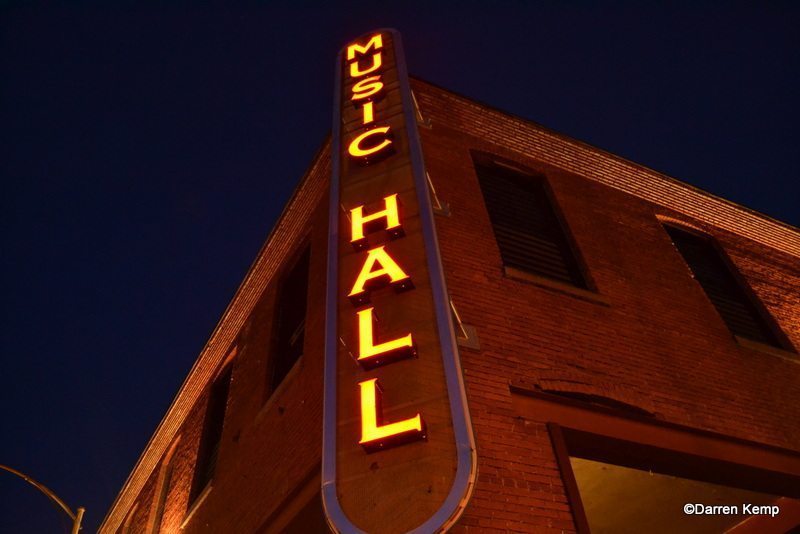
While the venue is closer to 30 years old, for the last five years the local hardcore and metal scene in the Albany area have really called Bogie’s on Ontario Street home. To say that Bogie’s has character is like saying the Pope is a little religious – from the black walls and the sticker covered bathrooms, to the fliers thrown throughout the place celebrating past and upcoming shows. Above the bar there are signed drum heads and cymbals, each to tell tales of legends and start-ups alike coming through those doors, to play for the diehards that make up Bogie’s core clientele.
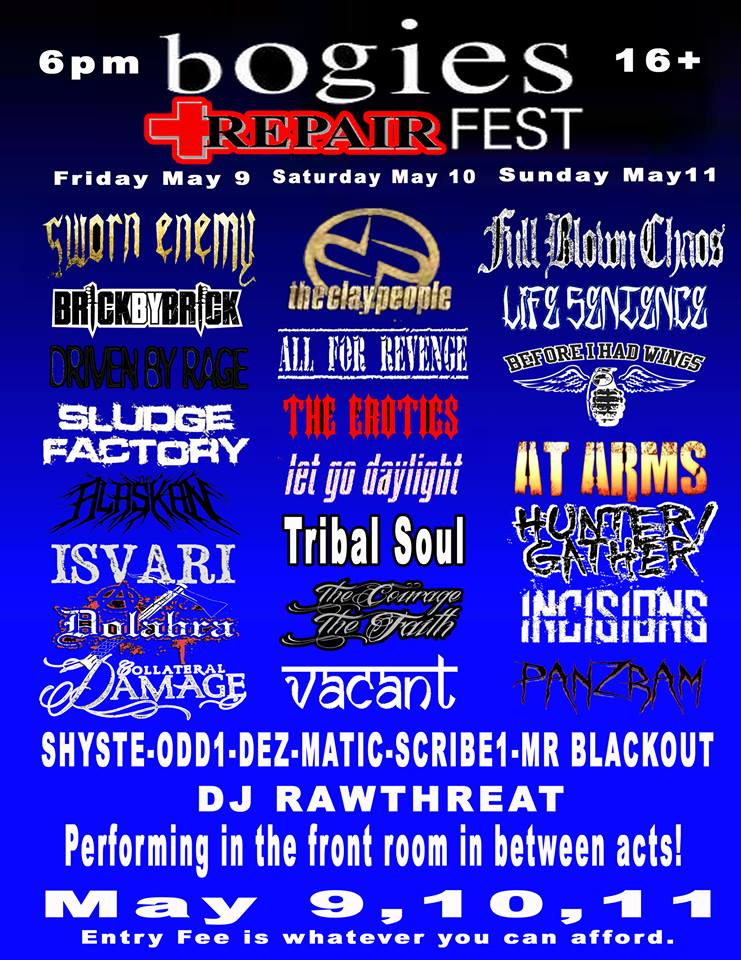
This coming weekend Bogie’s is reaching out to the community for help. The music scene is not a lucrative one and to keep the metal and hardcore scene alive, Mike Valente is asking friends, family, and fans to come support the venue. “Repair Fest” is a weekend-long show held at Bogie’s with some of the best local bands on the metal, hardcore and similar scenes.
Friday night headliners Sworn Enemy will be gracing the stage along with Valente’s own Troycore band, Brick By Brick. Saturday will be headlined by local industrial rock band, The Clay People. The music continues on Sunday with headliner, Full Blown Chaos.
 NYS Music sat down with Mike Valente before a Goatwhore show last month and asked a few questions. Here’s what Mike had to say about Bogie’s and some of the memories inside those walls.
NYS Music: How long have you run Bogie’s?
Mike Valente: Five years.
NYS Music: What have been some of the more notable bands that have played here the past five years?
Mike: Corrosion of Conformity, Tommy Tutone, Sepultura, Soulfly, Marc Rizzo, Stigmata, Black Flag, I could go on and on.
NYS Music: What’s one memory that sticks out?
Mike: Tommy Tutone (of Jenny/867-5309 fan) was blasted on something. He was wearing sunglasses, chewing gun, he had the worst bus I’ve seen and he was hyped up really good. He needed someone to sell merch, so Matt was helping him out and Tommy told him to sell signed photos for $3. $1 for Tommy, $1 for Matt. When Matt pointed out they were $3 and that only accounts for $2, Tommy ignored the question and told Matt that he should try to get a hummer from the girls. Completely wasted.
NYS Music: Repair Fest is coming up. What is it and what are some goals?
Mike: There are a ton of repairs needed here. The bar is surviving, there is enough for salaries except mine and Ralph (Mike’s partner at Bogie’s) most the time. The repair funds will go toward doors, floors, ceiling, bathrooms, coolers, etc. This place has taken a beating over the years.
NYS Music: Do you attribute the damage to the hardcore scene?
Mike: Not the hardcore or metal scene. Those guys are the most respectful, it is when we throw college parties that everything gets destroyed. Like a tornado goes through here.
NYS Music: Can you tell me about your affiliation with Black ‘n Blue out of New York City?
Mike: Freddie and Cousin Joe, they are BNB. They’ve helped a lot and have Black ‘n Blue Bowl, big names and they are only three hours away. Upstate Black ‘n Blue is completely separate but we help each other out.
NYS Music: What are some bands that played here before anyone knew who they were?
Mike: State Champs. They played the first spot of six bands. they started at the bottom but worked hard. They are getting big and they are going to be big. They deserve it.
NYS Music: Any bands out right now to look out for?
Mike: Sure. Before I Had Wings, Collateral Damage and Ego Destroys. There are others, too.
NYS Music: Is there a difference between the Albany scene and the Troy scene?
Mike: Not a difference anymore. It is the same kids, they go wherever there is a good show. Troy bands are very proud of their Troy connection though.
NYS Music: What’s the scene like now?
Mike: It is okay, all the promoters are working together. Trick Shots, Upstate Concert Hall and Bogie’s. We try not to book over top of each other. None of us are getting rich off this and we all have other jobs to pay the bills. We have to work together and we do.
So this weekend, if you have a free day, free afternoon, or even a free hour, come down to Bogie’s at 247 Ontario Street in Albany and support the local venue. If you can’t make the festival, please consider to donate online at their GoFundMe account (www.gofundme.com/6k0qjw) and check out future dates at Bogie’s including these in May: Adrenaline Mob on the 14th, Vanna on the 24th and Blacktide on the 31st.
Website: www.bogiesny.com
Facebook: www.facebook.com/pages/Bogies-NY

 PM: How are acoustics and the flow of music built into the design in a way that does not affect the overall structure of the building? How can acoustics be worked into a building without making the overall structure unappealing, or worse, unsafe?
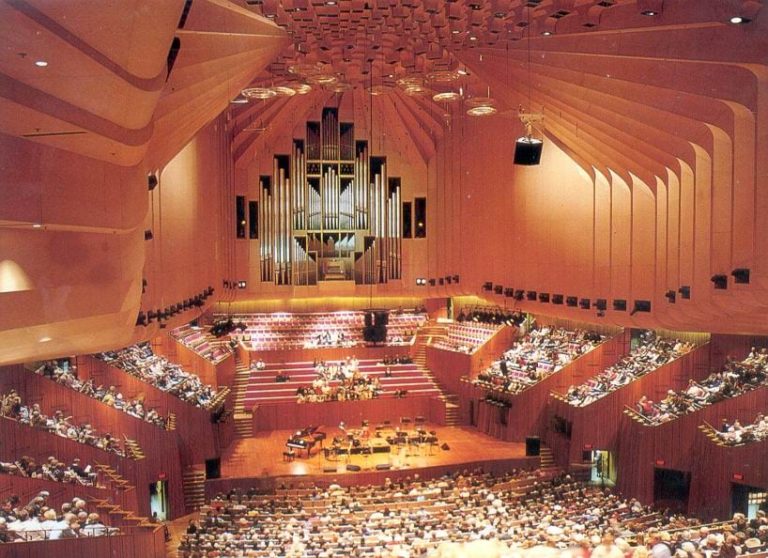
 Take for example the Sydney Opera House, where you can see from the exterior the curved shape of the interior space to move the sound, whereas with Radio City Music Hall you couldn’t even tell where within the building the main stage and theater was; both are incredible examples of acoustical masterpieces where you literally can hear a pin drop. There is even the middle ground which can be experienced in the renovated Lincoln Center in New York City. Here you cannot see the form of the music space in its purist form as in the Sydney Opera House, but in the area of the building that does house the theater the architecture changes and you can tell where it is unlike Radio City.
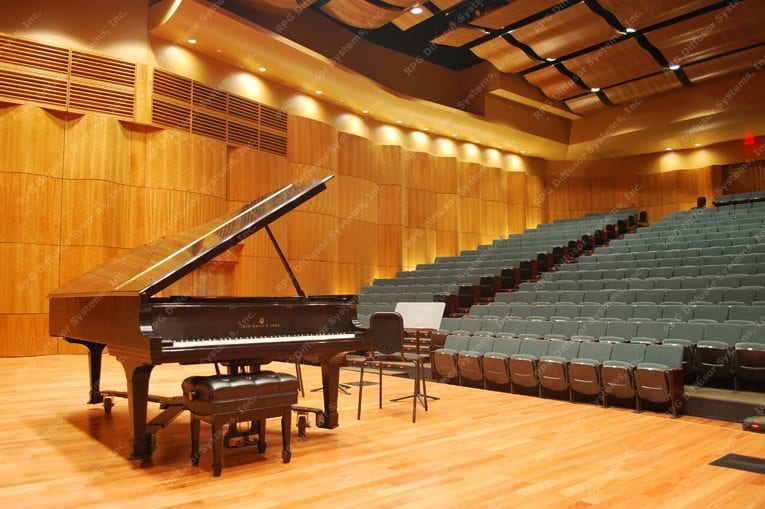 The last piece of the puzzle is finish materials used for acoustics, hard and soft surfaces and how they “reflect” the sound waves around. Movie theaters tend to have softer fabrics as they have a single main sound source and do not want echoing because the sound is mechanic, so the soft fabrics deaden the sound waves rather than bounce them back. Live performance spaces tend to have harder materials so they move the sound around but this must be calculated as the waves will intersect each other. This is where physics gets into the equation, causing waves to cancel each other out, cause delays or even echoes. Have you ever wondered why when watching a major sports event on TV the singer performing the National Anthem doesn’t seem to be moving their lips to the words you are hearing, why they are wearing sound canceling headphones or even lip syncing? This is because sound moves slower than light which is what is transmitting the sports event to your TV and the stadium or arena they are performing in was not designed for live performances like that, so they can be hearing their own words seconds after they say them bouncing back into their ears after traveling through the entire complex.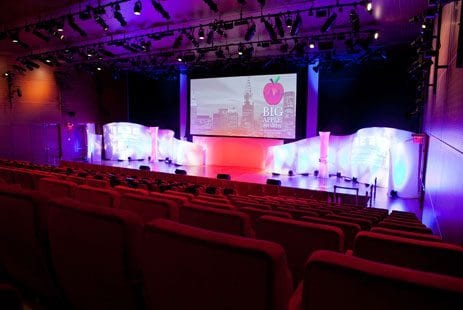


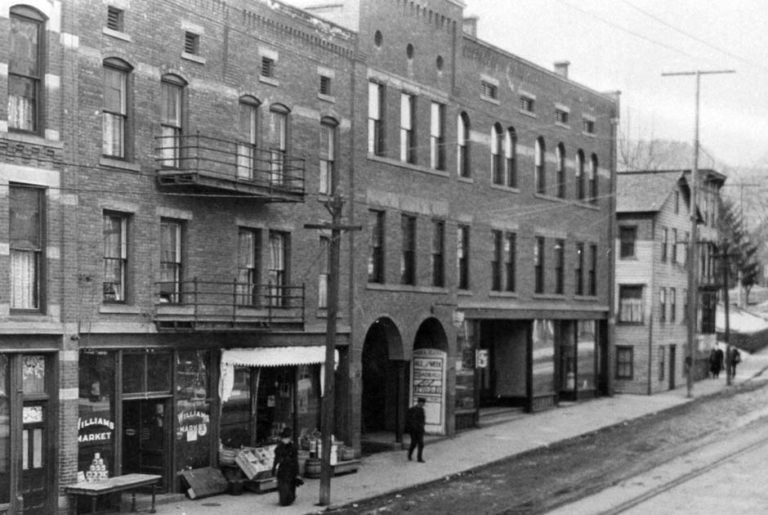 Designated as a historically significant building on the
 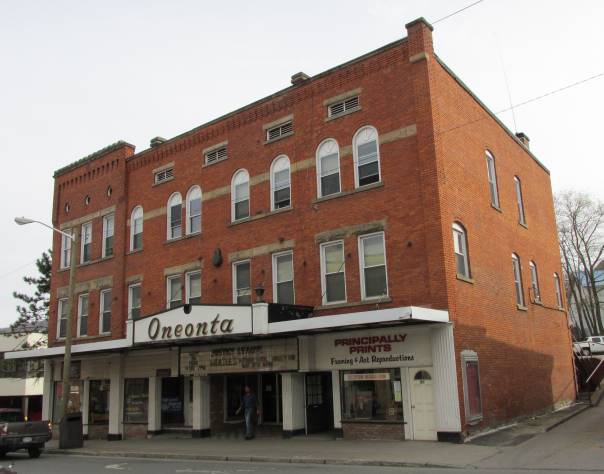 In 2009, the current owner, Tom Cormier, took ownership of the Oneonta Theatre. Interestingly, the theater was actually not what motivated him to buy the building. He became interested in the property for the front part of the building, which consists of three storefronts and six apartments, but when he looked more closely into purchasing the property, he discovered that it actually contained two buildings, one of which was the dilapidated theater. Initially, Cormier said the theater was in such bad shape that it was impossible to stand inside it for more than a half hour without having respiratory issues from all the mold and pigeon poop that had built up over the years, but thankfully, the non-profit group
 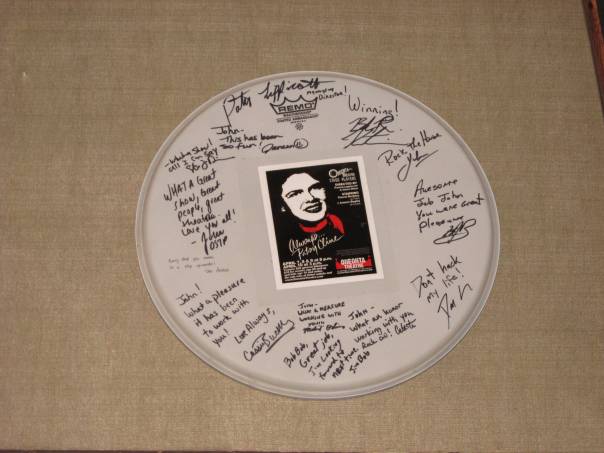 Having gone through extensive repair work, it can now once again be said that the Oneonta Theatre has truly lived up to its motto of “Showing Oneonta A Good Time Since 1897.” Some of the bigger acts who have been booked here since Cormier took ownership include
  When asked about plans to expand or renovate the theatre, Cormier mentioned that he does have some changes in mind for this summer, but it’s too early to reveal those changes. He is in the process of looking for investors for this project, so if anyone is interested, please get in touch with Tom Cormier through the theatre’s website! Upcoming shows that have been confirmed at the Oneonta Theatre this summer include
 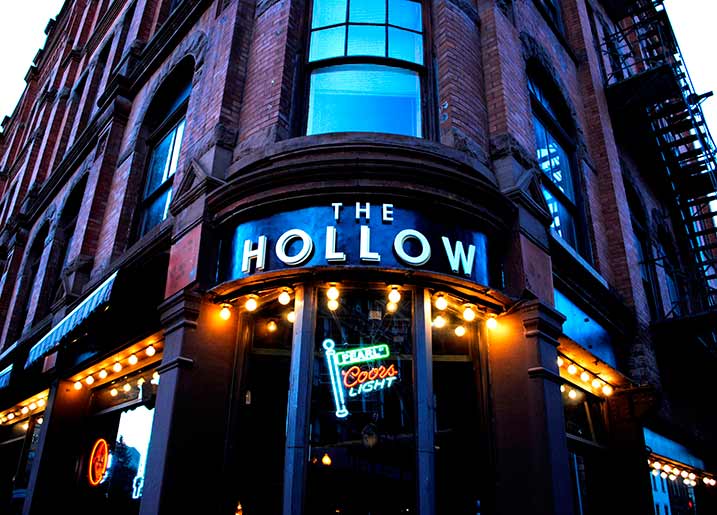 The venue was originally an urban retail store and a shoe repair shop. After renting out the Yorkstone Pub and turning it into the Bayou Cafe, the owners continued to expand further until the stage was built and the bar looked the way the owner’s had planned. Throughout the 2000’s, the venue quickly became known for cover bands that would bring in throngs of people every weekend, with a line out the door. Eventually, cover bands no longer brought the same crowd every weekend and the scene in downtown Albany began to quickly change. The owners saw an opportunity to change the venue for the better of the community and offer live shows that music enthusiasts would want to see. The long time owners sold the venue to close friends of their family and took over the booking for all acts at what would then on be referred to as “The Hollow.” The name is a nod to the area surrounding the venue which has long been referred to as
 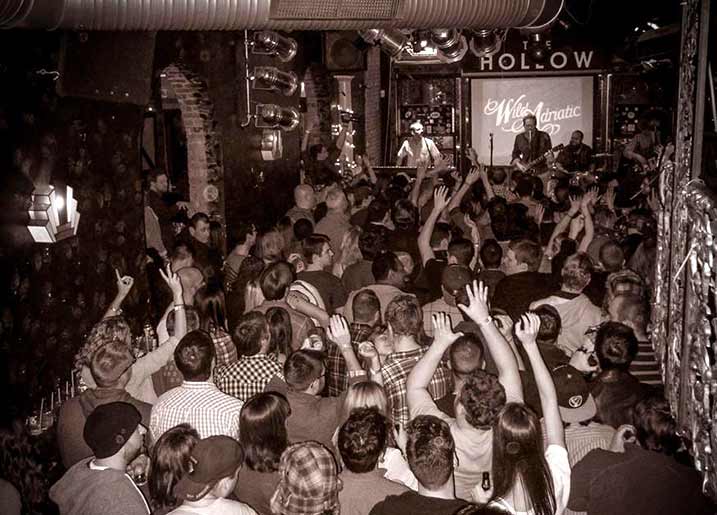 The venue itself is a great spot to catch music locally. The large bar set a few feet from the stage makes it easy not to miss the musical acts while quenching your thirst. All of the Hollow’s bartenders and waitstaff are friendly and personable making it a relaxed environment during happy hour, lunch, dinner or during a live show. The front patio is the perfect place during the warmer months to sit outside with friends even during times where there are no performances. The menu offered at The Hollow gives a wide array of options for whatever your appetite may be, also offering their different pairings of wine and beer for each meal. The bar itself is divided into sections, one section holds the stage and wrap around bar which can get pretty packed during a sold out show, there is a section with some tables and a pool table for those concert goers that want to see the music but not necessarily be within a large crowd of people, as this section can also get pretty packed during a sold out show. The third section is generally only used for dining guests and is rarely full of people during a live show, while a second bar in which you do not have to pay cover for the show to grab a few drinks with friends.