Through Phish side projects, we are introduced to new musicians, some whom we may be familiar with, such as Scott Murawski of Max Creek, while others are new to the Phish family of musicians. Natalie Cressman, who sings and plays trombone in Trey Anastasio Band, sat down with NYS Music for an interview on her musical upbringing, her role in TAB and what the future holds with the release of her debut album.
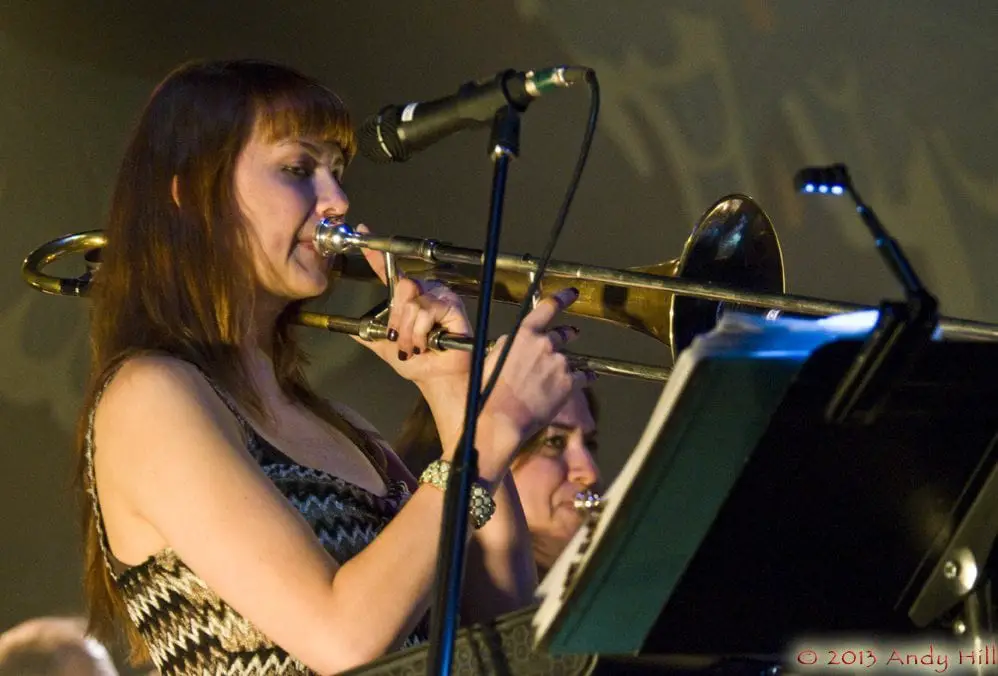 Pete Mason: Your parents, Jeff and Sandy are both musicians. Growing up, what was it like being in a musical household, with music that stretched from Brazilian to Jazz?
Natalie Cressman: It was incredible to be exposed to such a wide array of music on such a subconscious level. I was completely unaware of how unusual my environment was as a kid, but seeing my parents, both American, immersing themselves in these musical cultures (Brazilian and Afro-Cuban) gave me a lot of respect for understanding the music’s roots. Seeing how many different styles of music share similar rhythms and how musical traditions have cross-pollinated over the years helped me think about music on a larger scale. I think being exposed to all of that set me up to be able to play any style of music I set my mind to.
PM: Considering your musical upbringing and coming from a musical family, what made choose the trombone as your instrument? Do you or have you played others as well?
NC: I started out singing and playing Suzuki piano at around 5. I was really into Broadway musicals for awhile, I even sang in Baz Luhrmann’s Broadway version of the Puccini opera La Boheme when I was 10 when it opened first in SF. I started trombone as soon as my arms were long enough to reach (laughs), which was around 9. I think I really liked hearing my dad play it so well and there was an extra trombone in the closet so my parents were stoked about not having to buy me a different instrument. I stopped playing piano or singing as much once I got into the trombone. I still play a bit of piano and bass, but I mostly play just when I’m writing new music.
PM: What was it like when you were asked to join TAB? Was there any hesitancy?
NC: When I was asked to join TAB, I was absolutely thrilled. It was my first tour ever and I thought the music was just so unbelievably great. To be a freshman in college and have a gig like that was just a total shock, in the best possible way. The only hesitancy I might have had at first was trying to figure out how it would all work with my school schedule. It is fortunate in some ways that TAB doesn’t tour that often because it makes it so I always miss just as much school as I possibly can without rubbing the Dean the wrong way. I had a couple really nice teachers who understood the nature of the opportunity and helped me figure it out.
PM: How have you adjusted to life on the road and playing huge rooms?
NC: I have definitely gotten more accustomed to it: I remember the first couple shows physically shaking with stage fright. It’s an intimidating thing to be out in front of a sea of people, but there’s definitely a zone of calm that I’ve figured out how to tap into now that let’s me focus on the music. I’ve always been obsessed with traveling, so being on the road is still pretty exciting. I love wandering around whatever city I’m in. I’m constantly trying to find cute little restaurants and shops that are really unique to the town.
PM: How did you get together with the members of your band Secret Garden?
NC: I met most of my band members through my school (Manhattan School of Music). Most of them are either current students, alums or people I’ve met through friends at school. Some of them I’ve known since before college! There are an astonishing number of talented musicians in New York City, but I think I gravitated towards the guys who now make up my band because we all have eclectic tastes in music that lie outside of the jazz world. I think what is so fun about the project is letting all our other influences seep in through the music to the point where the genre-specific lines are blurred. It gives us a lot of flexibility to make music with a fresh outlook.
PM: You also perform with Peter Apfelbaum and the NY Hieroglyphics as well as Wyllys and the NY Hustler Ensemble. Compared to your other bands, how is that experience different, both in terms of the music and the band dynamic?
NC: Both groups are incredibly creative and inventive. I grew up listening to Peter’s records and I remember hearing the Hieroglyphics as a teenager and feeling so excited about the music that I felt my heart pounding. Peter’s music has such a deep rhythmic groove, yet the music is definitely experimental and forward-thinking. The music is so soulful and yet at the same time so avant-garde. I think of Peter as my musical godfather, and the way he composes music, freely weaving together so many different styles so that the music itself becomes enigmatic, is super inspiring. The band is filled with old friends of my parents, so I definitely feel like I’m among family and it’s really laid back. But make no mistake, they’re super serious about the music. Wyllys’ Nu Disco and Re Edits also are on that line between soulful/groove and the experimental. With Wyllys and the New York Hustler Ensemble, things are definitely a little more unpredictable and spontaneous. But it’s a lot easier to be that unpredictable with only three musicians on stage. It would be miraculous if all 12 of us in Peter’s band could pull off the type of improvised composition that we do in the Hustler’s Ensemble. Jen and Wade are like family to me too, so every gig is always an incredible amount of fun.
PM: Which is more creatively fulfilling for you – writing a song or recording/performing it?
NC: That’s a really hard question. I think they are both fulfilling, but for me the writing process doesn’t feel complete until I hear it fully played, so I’d guess I’d say that performing it is the ultimate fulfillment. However, sometimes a performance doesn’t go as well as I’d like and then it’s hard to be satisfied with an off night. I often lose sleep over it, because you can’t go back and change a live performance. Even once in awhile certain recordings, you have to live with mistakes or things you might have done differently. I really like the relaxed nature of composing, of having the time to go out on a limb and try something different, then being able to erase it if it doesn’t work. It’s easy for me to write freely because there’s no need to be self-conscious or judgmental of your own work when you can tweak and perfect it to your hearts content
PM: In the Stanford Jazz Mentors program you are teaching others. What is your favorite thing about that process?
NC: I really love teaching because I think it is the perfect marriage between my musical skills and my killer babysitting skills (laughs). I started teaching at Stanford when I was barely 19, and a lot of the kids I was instructing weren’t more than a year or two younger than me. But I realized that was pretty insignificant, and I just did my best to get them excited about playing music. So much about teaching is psychological: it’s about giving them that bug that makes them want to know more. I’ve seen so many incredible musicians turn out to be mediocre teachers because they don’t pick up on the vibe of their students and are too caught up in teaching them what they think the kids should learn. It’s a balance for sure, but I think I’m good at figuring out how to get students excited about music, which opens them up for focused, meaningful learning.
PM: You recently had a successful Kickstarter campaign to fund your debut album Unfolding, with fans contributing $7,000 (of a $5,000 goal). As you approached and exceeded the goal and the album’s production became a reality, what was going through your mind at this time?
NC: It was an incredible surprise that the campaign was successful. I was going to fund the entire project on my own, since I’m not on a record label and being a 20 year-old college student it all seemed really overwhelming. A mentor of mine had recommended I work with a publicist and a radio promoter to help build some good press around the release but that was an extra $8,000 on top of paying the musicians, sound engineers, manufacturing, distribution, etc. My mom urged me to check out Kickstarter and so I did it on a whim with a small goal just to get a little help so that I could hire the PR. It did better than I ever could have expected, and the campaign will nearly fund the whole PR campaign! It was also a lot of fun to bring all the pledgers into the project, to share the process with them was really cool.
PM: What are your musical hopes and goals over the next 10 years?
NC: Right now I feel like I’m coming to a cross-road where I can see myself going in several directions. I could get a Master’s Degree, try to establish myself as a jazz musician, start a pop project. But from where I am now, I would love to make a name for my current band in the next 10 years, to be able to play more often, tour with my own group, and reach bigger audiences. I would love to keep writing my own songs and recording albums. With my project, I want to show jazz a relevant art form, I want to motivate other creative musicians to stop playing jazz like its classical repertoire and to tap into all the opportunities found in modern music and technology. I hope to continue playing as a sideman, especially with Trey, as each tour makes me a better musician and a better person too. All I really need to be happy is to have other like-minded musicians to collaborate with and keep me on my toes, and the rest is just the icing on the cake.
 Along with some heavy production work, especially on some of the vocals, the album takes on an almost indie-pop feel at times but also features familiar song structures and lyrical styles associated with any album that has Anastasio and Tom Marshall collaborations on it. As a result, the album bounces in different directions from track to track and never seems to really settle on an overall theme.