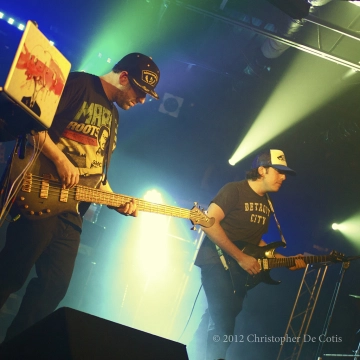
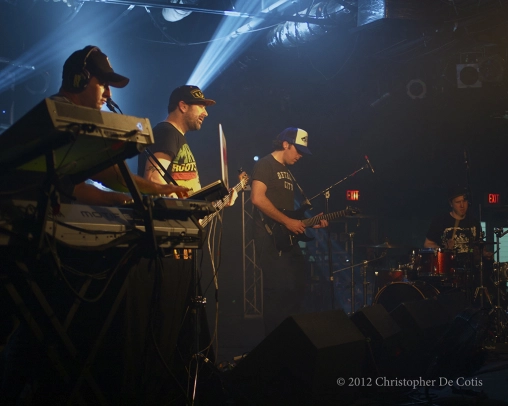
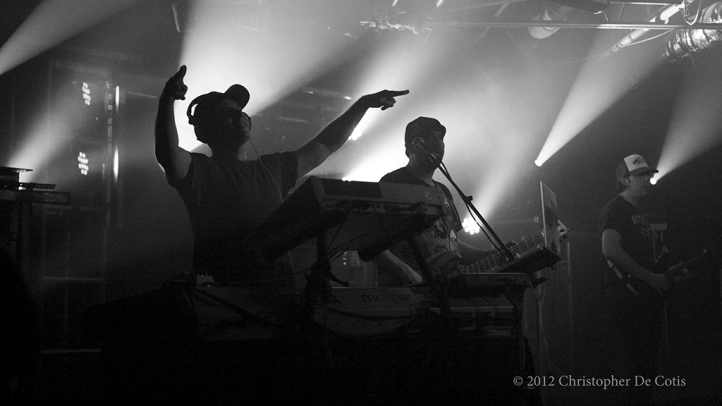
Amid a circus of DJs, 20-somethings with computers and dubstep bands, the art of live electronica has been lost. The creation of electronic dance music by a band and not solely on a computer, is an art form few have mastered. Kraftwerk, Justice, Simon Posford, The Chemical Brothers, Sound Tribe Sector 9 and the Disco Biscuits are in a class of their own. However, from the decreased touring schedule of the latter has grown a 2004 side project that has taken itself and audiences to new heights in the development of live electronic music. Conspirator, fresh off the release of their live album Unlocked: Live from the Georgia Theater, tour 60 or more shows a year from coast to coast, opening the door for the band to make a case as the best live electronic touring act in America today. Numerous festival appearances this summer will likely cement this journey that founding Biscuits’ Aron Magner and Marc Brownstein (who joins us for an interview) has taken with guitarist Chris Michetti and a rotating cast of drummers.
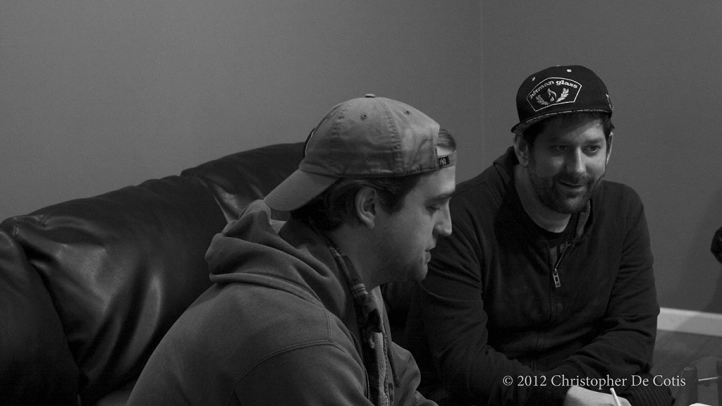
While the show itself was outstanding and a cadre of intensely dancing fans came to check out Dirty Paris and Blockhead open up, the interview with Marc Brownstein shed light on Conspirator, electronic music, and the current state of The Disco Biscuits. Marc said at one point, ‘It’s great to be inAlbany’, even though we were in Clifton Park. This just goes to show how big the Albany music scene is, stretching to Troy and points north, meeting up with the high peaks sounds of Saratoga.
Setlist: So Much More > Step Inside, Hands Up, Countash > Feed the Wolf >Brooklyn Bridge> Hard Acid > Commercial Amen > Caves > Orch Theme > Liquid Sawyer, Gypsy Lane, Neck Romancer E: Fascinate
Interview with Marc Brownstein:
Your new live album, Unlocked: Live from the Georgia Theater was released recently. What is it about the creation of live electronic music that leads to such a kinetic response from the crowd?
Electronic music in general gets a kinetic response from the crowd. Doing it live just brings in that element of surprise, and that’s the thing that we’ve always been used to having in our world, so that’s one thing that I’m not ready to give up and moving into just playing electronic music with an element of surprise in there. You can create it DJing for sure without instruments; really great DJs are great because they construct their sets the way the great bands of all time have constructed their sets and they’ve made the show flow through, they’ll play half of one song then go into another song then maybe they’ll bring in a little piece of one song over another song, and its like they’re doing the same stuff at this point that the great jambands did back in the day, and still do.
What is the origin of the band name Conspirator?
It’s mostly about collaboration. The whole idea was just to collaborate with everyone out there that we know, Joe Russo to the guys from Umphrey’s to the different drummers we’ve used, Lotus, The New Deal, KJ SAWKA and Adam Dietch. It’s about Aron and I having the chance to bring in these different influences and elements over the tracks that we produce and interpret them differently with different musicians.
There are quite a few songs that stretch from Conspirator’s debut album, The Key, have been played by The Disco Biscuits as well. Is there a difference between playing them with two different bands, even though two members are common between them?
It depends on the song. For Portal (to an Empty Head), the difference is that we’re not singing but we’re playing without any tracks, but (Digital) Buddha we’re not singing but we’re playing a whole different version, a computerized version of it and made a track for it. We made a computerized backtrack of Buddha and broke it up, it can be triggered and its totally loose, we’re not stuck on it, we can use it and improvise with it and tweak it, but it makes them completely different from the Buddha that we play in the Biscuits. And then there’s the ones in the Biscuits that we do without any track like Commercial (Amen) or Liquid Handcuffs or Orch Theme but over in Conspirator we play them the way they were written. In the Biscuits we interpret these electronic songs into rock form but in Conspirator we’re playing them as electronic tracks and adding rock instruments to that but staying true to the fact that they’re electronic tracks.
What are the origins of Orch Theme? How did the song develop into such a slow building aria?
The song was named for the sound on the keyboard that it’s based around, so the actual sound of the theme of OrchTheme was called orch theme on the computer so he (Aron Magner) named the song after the sound, which happens sometimes. It’s not the first time its happened where a sound has dictated the name of the track; after all it is music.
So Chris (DJ Omen) and Aron wrote the theme together, then we brought it into the Biscuits, dropped everything except that Orch Theme sound and then we turned it into what we do, which is stretch it the fuck out. Sometimes we even play it without ever playing the theme, we’ve actually put it on the setlist and just played through the whole entire thing and never got to the theme and just left it and went somewhere else. Then at the end of the show we’ll be like ‘we never played that’, and we just got so far out in the jam that we felt like the actual song didn’t even get played.
(After the show, I asked Aron Magner for his take on the origins of Orch Theme and he gave some more details to the creation of the song)
“Orch theme I wrote in 2005 and at that time Lord of the Rings was the best thing ever, as it still is right now. I was working in the studio with DJ Omen and I was wondering if we could make some thematic and cinematic music, I wanted it to sound like electronic, like the orcs are coming in. as I was browsing through patches, I was like ‘oh my god!’, ‘Orch theme’. The motif is trying to say orchestra theme because it has layers and layers, the bottom half of the keyboard has tympanis and the upper half has violas and in between has brass, there are 36 instruments laid out throughout the keyboard that double each other depending on their range so that’s the Orch Theme. So that’s how it came about.”
Recently, electronic music pioneers Kraftwerk performed their albums at MOMA. Did their music hold and influence over your early interest in electronica and if not, who were the first bands that turned you onto electronic music?
Well, Kraftwerk was a thing I found out about later when people used to say that we were the first band to play electronic music, when Kraftwerk was doing this decades before we came along. So they had no influence, it was like a collective unconsciousness of ‘dude, people have been doing this for a long time”, but for us it was mostly for us, Simon Posford, the person who was our earliest influence, via our friends from England who were friends with Posford and were playing us Hallucinogen and Shpongle back in the mid-late 90s. We had heard house music but it didn’t appeal to us as much as psychedelic music. Clearly, that was the bridge, between rock and electronic, that’s why Posford was the bridge, for all of this, for real. A lot of people attribute us as a bridge in America for bringing rock and electronica together, for pushing the styles together at Camp Bisco and by forging a rock and electronica festival, but the bridge came from similarities between the psychedelia of trance and the psychedelia of the jamband world; it sounded very different but the idea was the same, to try to tweak people out.
Your drummers rotate, including Lane Shaw, Mike Greenfield, Darren Shearer, Adam Deitch and KJ SAWKA, currently playing this tour. How hard has it been to interlace through different drummers and keep the music consistent from one night/tour to the next?
It’s been much better since we’ve had KJ for the last six months. Having one drummer is what we want, it’s preferable, and the band is getting better and better. Last night was one of the best shows we’ve ever played, we know each other now, and we can communicate with each other. It’s great.
Is Conspirator, initially conceived as a side project becoming the main touring act? Will we see Disco Biscuit tours again?
Well, when the Biscuits aren’t playing this is certainly going to be the main act. But I’m assuming there’s going to be more Biscuits tours. That’s the assumption I’m running my life on. Of course there’s going to be more Biscuits tours. We wanted 2011 off and we didn’t get it, it just didn’t happen. We wanted to take the whole year off
You mean including Camp Bisco as well?
Yeah we were going to take the whole year off and then we talked Jon into doing Camp and we talked him into doing Inferno and then we talked him into doing Nokia and Identity and before you knew it we played 50 shows and said “Well that wasn’t a year off.” I played another 80 on top of it, I played 130 shows and so at the end of that I think we were just like “OK that didn’t work, the only way to do this is to legitimately try to not to talk anyone into playing any shows. For me, I have to be very disciplined, “OK, I’ll book myself to play with Conspirator and play these shows because I have a lot of energy and I put a lot of effort into trying to get The Disco Biscuits out on tour all the time for years and years and years, I’m always just driving it forward and pushing shows, booking shows, pushing festivals, so for me I just have to be disciplined and say “We’re taking time off, I have to accept that we’re taking time off.” I don’t know if I’ll ever take time off myself, personally. I just don’t see the point in taking time off. I get for other people they have to but for me personally, I just don’t…yeah, there’ll be more Biscuits shows.
Update 4/30, 11pm: This article has been updated to correct the name of a co-writer of Orch Theme. It was Chris Edmonson, AKA DJ Omen. Apologies for the confusion
In April of 1992, Greg Bell promoted his first show in Albany, NY. Over the next few years, Greg Bell has brought to the Capital District the best up-and-coming bands and helped to develop Albany’s live music legacy. Next month, Greg Bell celebrates 20 years with two special shows at Valentine’s, combining the best of the past, present and future of live music in Albany.
NYS Music sat down with Greg Bell at his home and discussed his memories of the past 20 years, how he got started in promoting shows, the evolution of the live music scene in Albany and the musicians and bands that have come up through Albany with the help of Guthrie/Bell Productions.
Pete Mason: Where are you from?
Greg Bell: I grew up on Long Island, in a town on the south shore called Bohemia.
PM: What music did you listen to in high school?
GB: I started listening to Top 40, The Monkees, moved to Jefferson Airplane and Hendrix, Led Zeppelin, Black Sabbath, a lot of different stuff.
PM: What was the first concert you went to?
GB: First concert I was to was Tommy James and the Shondells at the Ohio State Fair. They had several big hits – Mony Mony, Crimson and Clover, I Think We’re Alone Now…
PM : Where did you go to college? What was music like at the time?
GB: Siena; There were a lot of post-Woodstock bands who were touring. The bands we listened to most our senior year were The Grateful Dead, Commander Cody and the Lost Planet Airmen and Jerry Jeff Walker were the three biggest ones my friends and I were into. We listened to everything: Ten Years After, Jefferson Airplane, Loggins and Messina, whatever was hot at the time. There were a lot of singer/songwriters: Neil Young, James Taylor, and Carole King were all big, that were coming out at that time.
PM: Do you have a favorite concert memory from college years?
GB: Nothing offhand, I think of high school more for concerts, when Stony Brook University was having a ton of concerts when I was a junior/senior, so I saw Miles Davis open up for Santana, The Allman Brothers Band on their first tour opening up for Mountain, The Dead with Jerry Garcia playing pedal steel with the New Riders of the Purple Sage in the opening set, playing two shows in one night and I got to see both shows. Those are big memories; at the Summer Festival for Peace (at Shea Stadium) I saw Janis Joplin, one of her last live performances before she died.
PM: How did you first get started promoting shows?
GB: Throughout college my friends and I would throw big parties and we always had music. After college whenever we had big outdoor parties we’d always have a lot of friends who were playing in bands. In terms of doing it professionally to make money, that would be April 3rd, 1992 when a friend of mine rented us the Black Masons Hall in downtown Albany (kitty-corner from Lombardo’s) and let us use the liquor license to serve beer. The lineup included The Sharks, Hard Times, Mother Judge and Bryan Kenny and Friends. The cost was $10 for four bands and all the beer you can drink and went extremely well. It was pretty much sold out and seemed like a pretty easy way to make money. I think that’s one of the downfalls promoters have is that the first couple of shows they do are successful and they think it’s always going to be like that. Then reality kicks in they find out that’s not true.
PM: Who were these bands? All local acts?
GB: The Sharks had been big in the 80s and they were just making a resurgence at the time; Hard Times was made up of Todd Nelson (Fear of Strangers) Kevin McKrell (McKrells), Rick Bedrosian (Hair of the Dog), it was sort of like a supergroup of Albany musicians who had been around for years. Mother Judge still runs the open mic night down at McGeary’s. Friends of ours were musicians at the time so we did it just for fun, see what it was like to put on a show. This is before Guthrie/Bell Productions. That company was called Two Fools Presents; that was me and my friend Dale Metzger, he was my first partner in the music business before Jeff Guthrie and Guthrie/Bell Productions.
Greg Bell and Keller Williams
PM: How did you go from Two Fools to Guthrie/Bell?
GB: With Two Fools we did a few events, we did an outdoor festival in Rensselaerville at one point called ‘Summer Fool Fest’. When The Dead came to town we rented out the Black Masons Hall, put on afternoon shows and some aftershow parties there. Dale and I started getting into different musical things; I started managing a few bands in the area. We parted ways amicably. My friend Jeff Guthrie was also managing a couple bands, including The Sharks trying to get them to do a comeback. One day he called me and said “Hey, I found this room that would be really good for shows that they don’t use for anything. Do you want to start doing shows together?” We managed to find this upstairs room at Valentines that no one was using for anything and we convinced the owner to let us start putting on shows up there. We started renting out the upstairs at Valentines on a weekly basis doing shows. Each week we’d lose a little bit more money, so we kept doing more shows trying to make our money back. After a few months of doing shows together he said we should form a company together. That was the start of Guthrie/Bell Productions, around the spring of 1993. That’s how it started.
PM: How long were you two promoting shows together?
GB: Probably six years or so, maybe longer. He just got tired of doing it and I kind of liked the name, it had a nice ring to it, so instead of changing it I kept it.
PM: When did you start teaching?
GB: 1979
PM: How did teaching and promoting shows conflict?
GB: I just gave up sleep. I went from having one full time job and a family to having two full time jobs and a family. It gave me an excuse to be out, ‘Gotta go to work honey.’ (laughs)
PM: When did promoting shows seem like it going to be a consistent thing?
GB: One of the reasons I started doing this was because there were a ton of local bands who I felt were not getting treated fairly at other clubs, not getting paid what they were worth or not as much time to play. So I started out doing a lot of alternative rock in the area and then, doing shows with Dr. Jah and the Love Prophets and they introduced me to (Peter Prince and) MoonBoot Lover and those two bands were probably the reason I took off promoting the jamband scene. moe. opened up for Dr. Jah, The Disco Biscuits opened up for Dr. Jah, Yolk opened up for Dr. Jah – almost everyone opened up for Dr. Jah their first time because they had the hippie crowd. When I stopped working with Valentines and became more independent and booked more shows in different rooms, I stayed with the jamband scene. That’s kind of how I got pigeonholed with the jamband scene even though over the years I’ve done tons of other shows. I’ve booked Alejandro Escovedo, Dave Alvin, Jeff Buckley, Los Straightjackets and a lot of shows that aren’t jamband related at all but I’ve always sort of been pigeonholed as the jamband promoter, but being a Deadhead I think its been pretty exciting because since I’ve started promoting shows I’ve done a show with every living member of the Grateful Dead at one point or another; I’ve done a show with every member of Phish except for Mike Gordon; I’ve met Jorma Kaukonen, Roger McGuinn, I’ve met many of the people who I listened to in my youth, a lot of my heroes. I’ve become fairly well known in the jamband scene, most bands like working with me, I like working with them. It’s been a fairly successful career, if not financially successful, it’s been fun. I think I’ve helped a lot of bands out. I think I was instrumental in getting that 2nd or 3rd wave of jambands going. At one point, Albany was one of the biggest jamband towns at least in New York and the Northeast. Everyone came through and played at Valentines at one time or another, or Bogie’s.
PM: What was the worst night promoting music?
GB: That’s easy, Bellstock 3 when we had 18 inches of rain in 24 hours and something like 18 bands showed up to play and 18 bands were sent home because there was just no way anyone could play in the amount of rain we were getting. That might be the worst.
PM: How have you seen music evolve over the past 20 years in the Capital District?
GB: I see it pretty much exactly the same: tons and tons of talent in Albany and a limited audience. You can listen to bands that say all the time ‘I remember when it was great and people were coming out’, but it’s been pretty much the same. Albany has always had a lot of talented musicians; there has just never been a central scene. You could never get the San Francisco sound or the Seattle sound because Albany is too eclectic, which is a good thing because you have a wide variety of stuff to see but you can never interest a wider audience that just what you have in Albany. There are bands from Albany who go outside the area and do well and spread the word. There are a select number of music fans in Albany who want to see new stuff. But even then, they don’t show up or pay attention to the opening act because they’re only there for the headliner. I think people need to broaden there horizons; when I put shows on I will put two bands together than seemingly don’t fit together purposefully so people can see bands they might not have ever seen, because a lot of music crosses over genres. Right now electronica and techno are really hot so musicians who play instruments and sing and harmonize are struggling and having a tough time because the young kids want to see the DJs and electronica shows. But I think Albany has always had a great music scene, its just always been separated into groups. You have the indie rock scene, the hard core scene, the jamband scene, something else over here. Albany has always needed one room that was doing everything, so you would have one place where people could go and see all different kinds of music and try and get a scene going better instead of having it spread out all over the city.
PM: Do you think we ever had a place like that? The QE2?
GB: They were pretty eclectic, they were seen as an all punk club; Bogie’s at one point was doing a lot of shows, as was JB Scott’s when it was open years ago, but nothing has stayed open throughout the years; Valentines has had its time when it was one of the top clubs in the area. In Albany right now, on any given night, you can see ten different bands play at different places, which splits the audience. When there are ten shows going on, it’s hard to get one of those shows to go really well. It’s just the nature of the business here.
PM: How could that change?
GB: I’ve been trying to make that change for a number of years; I just haven’t found a way to do it. When Revolution Hall closed, I felt that was a room that could do that and be the centralized spot for music, but it was in Troy and people in Albany didn’t want to go to Troy among other reasons. I think if Albany had a room like Rev Hall it would be successful. There’s a lot of good clubs in Albany, I don’t think there’s a great club in Albany. Red Square is good for some things, Jillian’s is good for some things, Valentines is good for some things, and Savannah’s is good for some things.
Matt Abts, Vinnie Amico, and Greg Bell
PM: What about venues like the Palace, The Armory and The Egg?
GB: They are great places to see shows. At the Palace I’ve had Disco Biscuits, moe., Jimmy Cliff, Medeski, Martin and Wood, Gov’t Mule, Michael Franti, Black Crowes, Dark Star Orchestra, it’s a wonderful room to see shows in. It’s a theater and you need bands that can draw at least a couple thousand people. At The Armory I’ve had moe. a couple of times, Phil Lesh and Friends, Bassnectar, Pretty Lights, Matisyahu, The Roots. But it’s a tough room because you only have a few bands that can do 3-4,000 to fill the room. Bands that do less than 1,000 or more than 5,000 won’t cut it there, so it’s a tough room for that middle area of bands that draw 3-4,000 in a general admission room. For techno shows and DJs it’s a perfect room, like for Deadmau5 and Rusko. I love The Egg, it’s a sit down room, so a lot of the stuff that I do is tough there. I’ve had success there with Dark Star Orchestra and Keller Williams and Medeski, Martin and Wood. You have to have a certain kind of show on in a good room like that. People are easy to work with, the sound is great. All the places in the area that provide music are good for certain things; there’s no one place that’s good for everything.
PM: What do you think of the past five years of music in the Albany area?
GB: It’s hard to say, I’ve seen Rev Hall which was really starting to take off, go under. I’ve seen Jillian’s move from a disco-y place to a viable venue in the area; Red Square is doing a lot of shows and Valentines is starting to pick up again. The music scene in Albany is vibrant and things are picking up thanks to young enthusiastic bands that bring out people. One thing that I’m trying to do, especially since Rev Hall closed, is get back into going out and checking out a lot of younger bands that I’ve been missing for a while. One of my fortes has always been finding young bands and then building them up to the point where they have an audience.
PM: Like Timbre Coup?
GB: Timbre Coup, Formula 5, Eastbound Jesus, Dirty Paris are all great bands, The Sunny Side of the Street Band… there’s tons of bands out there right now that are starting to pick up some steam. I have a couple bands I’m checking out in the next few weeks that I’m interested in seeing how they are, The Greys and Digital Dharma, both seem to be pretty interesting. There are always great up and coming bands but its hard for them to keep it together because bands are making less money now than bands made in the 70s and 80s because there’s no money out there, the drinking age was raised from 18 to 21 over that time. I see opening acts that have to drive 300 miles to make $100 which barely covers gas. You have to really be dedicated and really want to be in a band and be with the right people who have the same dreams and what you want to do. You see too many bands that are really talented that break up because it’s too much of a commitment to be a touring band anymore. You really have to be OK not making any money to get by till you start picking up a fan base. With gas prices now, I can’t really see how bands can open a show for $100. Unfortunately for promoters, expenses go up every year – club expenses, advertising expenses, national and regional touring bands with dwindling fanbases still expect to get paid like when they were drawing bigger numbers. People need to do a lot more cooperation between clubs, bands and promoters and work together so that no one gets hurt and at the least survive. I think that’s one of the things that I don’t see as much among bands; some genres have bands working together to get the scene going but certain genres of music have bands that are more cut-throat and expect more money and more fans to show up. If bands start cooperating and working together, that can make a difference. When I first did shows at Valentines, the audience would include band-members from bands that weren’t even playing and they would get up and jam with the bands on stage. I really don’t see that happening as much anymore, one band getting done at one venue and going to another to see a couple of tunes and maybe sit in, at least as much as I used to. Back when I first started doing Valentines, there were nights when we had to drag people off the stage at four in the morning while there were members of three different bands on the stage playing together. Back then, after midnight was the point where you would worry about breaking even. Now that’s around 11 or so. Part of it is due to DWI laws being enforced; part of it has to do with money. The economy being the toilet doesn’t help either, people aren’t going to be able to spend money on a Wednesday than on a weekend. They have to pick and choose more now.
Soulive and Greg Bell
PM: What is Albany’s role in the past 20 years in terms of live music in the greater Northeast?
GB: When the 3rd wave of jambands were coming up, when moe, The (Disco) Biscuits, Deep Banana Blackout, Strangefolk and that whole group of bands were all starting out when I was starting out promoting shows, at some point I would get them. Albany was a major stop on jamband tours. In any given month I would have at least one night with Ominous Seapods, one night with moe., one night with Conehead Buddha and one night with Yolk; I mean those are four bands right there that are selling good numbers of tickets and anyone who is coming through would come to me. Max Creek when they started touring again, Schleigho and a lot of bands that were coming up at that time. Some of them didn’t go much further although I think some of them should have, such as Peter Prince from MoonBoot Lover should have been famous, I think he’s a talented man, I think Schliegho should have been famous; there’s a lot of talented bands that I’ve seen over the years that got beaten down by the road and record companies and everything else, and once they started getting older, having families and settling down, they couldn’t be on the road making no money. I met tons of great musicians; some of my closest friends are the ones I started promoting shows with in the 90s, I’m still in contact with a lot of them. Bands like moe. who could have stopped doing shows with me years ago and gone to Live Nation and bigger promoters have always stuck with me and remain loyal to me and that means a lot to me. That’s a great honor for a band that’s gone as far as moe. has gone to keep a local promoter involved with them. There’s not a lot of that loyalty going on right now.
PM: What do you think the next five years of music is in the Albany area?
GB: I think we’re on the verge of is, due to economic and social situations, I think Americana is going to get a lot bigger than it is, at some point, when things are typically going like this and things are getting stagnant… I respect what the DJs are doing with techno/electronica, but I think there’s going to be a lot of people who don’t want to see a DJ pushing buttons on a laptop on stage. I think that what’s going to happen at some point is like in the 70s and 80s all of a sudden you had Springsteen and then punk rock coming out to go against disco and arena rock. Then you had Nirvana come out against hair bands and glitter bands… I think we’re at a point now where you’ll see something in the next few years that will be totally different and save rock n roll again. But I think because of the economic situation right now and more people protesting I think you’re going to see more Americana type music where people are singing about what’s going on in the world and in people’s lives. You had Woody Guthrie during the Great Depression, Bob Dylan and Joan Baez and people like that when we were on the verge of/in the middle of the cold war, people coming out during the Vietnam War and protesting. I think you’ll see a lot more of that coming out, I think people tend to go towards that kind of music when things are down. All great music has come from people being down in poor economic situations; you’ve got blues, jazz, folk, all that came out of poor people basically; rap came out of the ghetto where people were economically disadvantaged. I think you’re going to see more of that music coming out and a mix of electronica and rock with The Disco Biscuits and The New Deal and even that’s starting to fade away and it’s getting more and more electronic equipment based more than people based. I think you’re gonna start seeing people start breaking away from that for something new, at least that’s what I’m hoping. I think that the jamband scene has been struggling recently because I don’t see a lot of young hippies coming up now; I see a lot of techno kids coming up. But in the past year or so, I’ve seen a lot more bands, young bands, that are more jamband based, more songs and more jamming, people who can really play their instruments, so I think there’s gonna be a little resurgence of that kind of music too.
Greg Bell celebrates the 20th anniversary of his first show as a promoter celebration of the first weekend of April at Valentines on New Scotland Ave in Albany. On April 6, Conehead Buddha will reunite with The Sunny Side of the Street Band opening, while on April 7, Timbre Coup performs with Formula 5 opening. Come out and celebrate 20 years of great music and toast to 20 more.
All good things must come to an end but all great things deserve an encore. Thursday night, Timbre Coup’s February residency at Jillians of Albany came to an end with their most powerful performance of the month, reeling in dozens of new fans to their rock/techno fusion. The crowd danced and writhed to the jams that developed from songs both new and old, leaving no doubt to the legacy the band is creating through their shows in the Capital District. Guitarist/bassist Dan Gerken said “The residency showed me that not only does acoustic Timbre Coup work, it was one of our strongest sets! You will be seeing more of this completely organic sound of ours very soon. We were happy to be able to experiment with the 4 show run we had.”
For their CD release party ‘Knuckles and Valleys’, the show featured a tracks including March, June, October and a stellar rendition of July to close the show. A sandwich of Arnold Schwarzenegger->Give it to me baby (Rick James)->Arnold Schwarzenegger was unexpected but they nailed it and an appreciative crowd asked for more. Jams out of Watching You and Radio were met with a packed dance floor for both young and old in attendance. This could wind up being a yearly or possibly bi-annual residency and would continue to foster the positive response the band had received in the past two years.
Timbre Coup heads to Syracuse next to play the Westcott Theater on Saturday March 10th with Dirty Paris and Higher Organix, bringing the best of Albany to the Salt City. Dirty Paris and Timbre Coup return the next weekend to co-headline St. Patrick’s Day at Red Square in Albany making for a great Saturday night and continuing their notably worthy presence in their hometown of Albany.
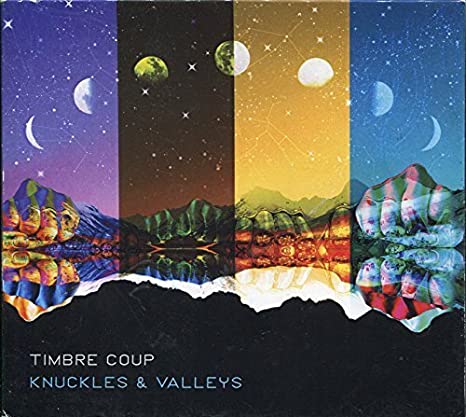
The third album from Timbre Coup, Knuckles and Valleys, following the release of 2010’s Check Out This, will be released on Thursday, February 23rd on the final night of their month-long residency at Jillian’s of Albany.
Twelve tracks for the twelve months of the year, written over the course of 2009, one song each month and gaining the appropriate monthly title as the year progressed. The writing process, as shared by drummer Matt Pickering, “Some songs we tried to capture the mood or feeling of the month in lyrics of music, a couple we just wrote what we were feeling at the time. The mixing on the album reflects how we think the months sound.” The songs have all been played live but for those new to Timbre Coup, they can see how the music portrays the month while existing fans will hear different versions of songs they are already familiar with.
With tracks as easy as these to name in order, a brief description of what to expect from this impressive junior effort:
January – There’s some Tool in here, along with a Middle Eastern jazz infusion and dark vocals, inspired by gritty 90s grunge. Great start to the album/year.
February – A great bass line opens up into a groovy beat, followed by a refrain “This has only just begun” with a mellow sax not unlike “Careless Whisperer.”
March – Instrumental prog-rock goodness; this could be a soundtrack for a boat adrift at sea, encountering storms and finally placid at the end.
April – A musical thunderstorm, great lyrics and wonderful guitar work on a hallmark track.
May – Bass n drums foundation with building guitar licks before a break in the song; the song starts again with more intensity in the second half, growing to great heights. Solid.
June – A homemade electronic feast without missing a beat, strongest track so far, makes for great dancing; lyrics include ‘Keep it pumpin’ till the night is through, it’s a summer rhythm…’
July – Spastic guitar propels the tune forward, the arching solos create the melting rhythms.
August – Another Middle Eastern infusion at the outset, lyrics are celebratory “The day is mine!” as the quartet turn to Mexican influences for an end of summer jam.
September – An airy trance starts off the ninth track, a purely electronic track from four musicians who create a spooky techno song without needing a laptop; pure musical talent in the month of September.
October – Harsh and gritty, machine-gun guitar vs. sweep solo guitar.
November – Indie rock at first, but quickly supplanted by the come-to-expect deep grooves that accent the lyrics and harmony vocals.
December – Industrial beats mark the beginning, rocking and jamming all the way through. A perfect way to cap off a magnificent album.